
Even though I started shooting and editing video some 10 years ago – I can honestly say that I still have a lot to learn. The “learning” part of my craft has been non-stop. I continue to learn as technology constantly pushes us all in that direction. But I love it. I love raising my bar every chance I get. And these days, even though the learning curve may be steep in certain aspects of video production – it’s also a lot easier to access information and help than it was 10 years ago. Again – thanks to the volumes of information online – at the click of a button.
I love the editing process of video production because this is really where I craft the story. I can get totally lost in the story and how I can mold that in whatever direction I choose in the edit room. But I’m not a professional editor and I have the utmost respect for what a pro brings to this part of the process. So I lay down my rough cut – to get the storyline down and then hand it off to a pro to take it to the next level.
I’m editing a recent shoot that was quite challenging on all accounts. A lot of what was shot, was shot on “green screen”. Green screen or “chroma key” is the process of removing a background color, – green for video – blue for film – so that the “subject” or “object” can be placed into another background in post. There is a lot of info out there on green screens so I won’t go into it in depth, but the biggest thing you need to know is how to properly shoot green screen so you won’t have a major melt down in post – or won’t have to spend a fortune for an editor to clean up your mistakes. 
A couple of tips for shooting on green screen:
• Turn off edge enhancements or sharpening in Picture Profiles – in camera menu
• Create a new Green screen Picture Profile w/o sharpening
• Keep subject lighting off background
• Keep background lighting off subject
• Keep green screen as far away from subject as possible
• Minimize seams, wrinkles, folds
• Even out your green screen lighting within 1/2 stop
• Brightness level should be about one stop under key light on your subject.
• Light your subject complimentary to your inserted background
• Don’t use dimmers – changes color temp toward red – not good for keying
• Create an edge or separation light – keep it subtle!!
• Watch out for reflective objects and surfaces (CAR SURFACE) that can pick up green screen
So if you’ve successfully shot a good clean composition as described above – then of course you need to put things together in post. 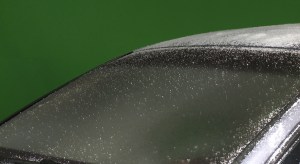 This used to be a tedious process and would involve a lot of work in post production. But thanks to some incredible plug-ins available – you can get a pretty amazing “key” without a lot of hours in the editing room.
I found a product that really helped me out. DVmatte Blast and DVmatte Pro from www.dvgarage.com. These plug-ins will work inside Final Cut Pro as well as Motion. I chose to work within Final Cut. I was amazed by not only how easy it was to use but by the price as well. DVmatte Blast was $99 but I purchased DVmatte Pro for $199 because it gave me more “tweaking” options. And as always whenever I need to learn a new piece of software – I went to http://www.lynda.com. So instead of laboring with greens screens in post for an entire day – I got the job done in a matter of a couple of hours – and I had a lot of compositions to make.
I love to learn but I also like to lead some sort of a personal life – away from the computer. And these days – thanks to a little help from my “friends” I’m achieving a nice balance.
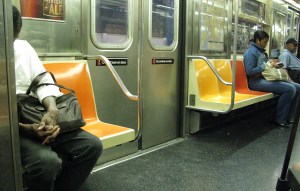 – close enough to commute if I were so inclined or had a “job” to commute to. But since I’m a self employed freelancer and always have been – I look at that short distance to the “city” as the bridge that connects my two worlds. The “city” can pretty much provide me with just about every cosmopolitan need that I may have and my other world – the idyllic little “bubble” where I live – a small rural town in Northwestern New Jersey – gives me space and serenity.
  Both are important in my life and I don’t think I could give up one for the other.
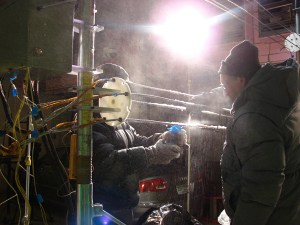 – brilliant electrical engineers – were pushing their own boundaries as they ran tests with ice on power lines and automobiles and as much as I was witnessing this work in sub zero temperatures – it was amazing to watch them work. If I hadn’t been so busy with my own technical challenges – I would have loved to just observe them and try to get into their head.
 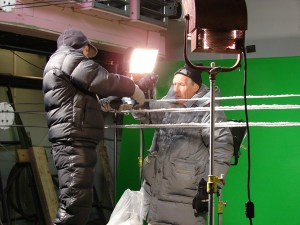 You could almost see their brains working – just by watching their faces. Then to see the triumph in their eyes when their experiments worked – what a thrill. I now need to go to Russia.
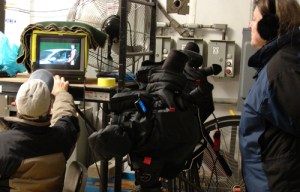 to keep them warm and swapped out the warm packs as we shot late into the night. We had to erect large “green screens” so that in post I can insert winter scenes. Problem was our green screens were large pieces of fabric and the chill blowers were blowing them all over the place. We tried to anchor them but in the end we had to turn the blowers off during the shoot. Thank goodness we didn’t need usable audio. We used hot lights and a lot of them. Used every extension cord we had and every outlet in the room – 10,000 watts. Ironic huh – hot lights in a “cold room”. Because of that we had to leave the lights on the entire time because we knew that when we turned them off – we’d get condensation on the bulbs. When we finally did break the set down at midnight – we turned the lights off, let them cool a bit and put garbage bags over them so that as they warmed we wouldn’t get moisture on them. Didn’t really work too well though.
 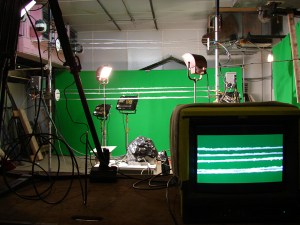 We did the same thing with the cameras and that worked great. Because we had the lights on all day and were using long extension cords – one cord got over heated and actually melted and fused to itself. The Russian electrical engineer noticed it – Thank God – or we would have burned down the building.
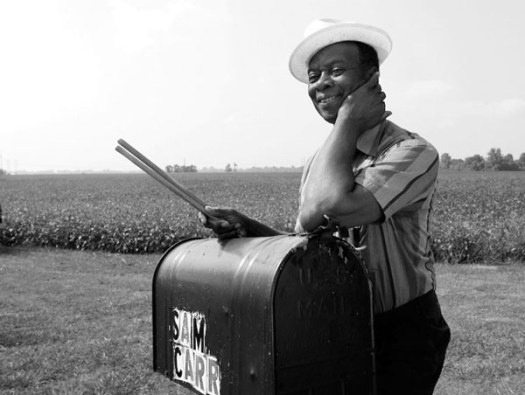 project that had I tried to get funding for but then 9/11 happened and money dried up over night. But for me this was a story that I needed to tell and now because these musicians were in their 70’s and 80’s. I wanted to tell the story of these musicians apart from their music. I was interested in their cultural stories – about the area they grew up in. the Delta and how that gave birth to their music – the blues.
 Journeys of a Hybrid