Business Tips for Photographers in a Multiple Media World

In the blogging sphere of photography and video there is a lot written about gear and how to use it, but precious little written about business.  Chances are, if you are photographer who has been in business for more than 10 years then you know that technology has not only changed our tools, it has changed the way we do business.

For starters we are doing business in a global economy and with that comes pluses and minuses.

Cuba-3858
Havana, Cuba

One huge plus is that we are able to reach a much wider audience than ever before. That is if you have an understanding of how to do that and take advantage of the opportunities that are out there.  One minus or downside is if we don’t adapt our dated business models in a business that has seen monumental changes we won’t be able to compete.

As commercial photographers we are in the visual communications business.  We create imagery that delivers a message or tells a story for a variety of markets including; advertising, corporate, architectural, editorial and others.  Each market has a need for visual content and these days that encompasses both still photography and video.  In the last couple of years the lines dividing these two mediums have faded away at least in terms of how content is consumed in our culture. What’s next – VR (virtual reality)?

Here are a couple of tips to help photographers prosper in our multi-media world:

  • Decide what your company will offer.  Will you only provide still imagery?  Or will you expand your business and offer both still photography and video? Are you quick to answer the question with; “I don’t want anything to do with video” ? The problem with that answer is that most of your clients probably have a dual need for stills and video.  Are you going to send them away to your competition?  Or will you keep your clients in house and take care of their video needs by hiring or outsourcing? That’s a different way of thinking and has the potential to broaden your revenue stream.
  • Decide what role you will play if your company does offer video?  Will you be the director and work with a camera operator?  Or will you assume the role of a DP (Director of Photography) and direct as well as operate the camera?
  • What will you outsource and what will you keep in house?  Maybe you want to expand your business by offering both still photography and motion but you’d prefer to just shoot the still photography and outsource the video.  In that case you could assume the role of the producer and oversee or outsource the video production.
  • Reassess your insurance.  Video productions have a lot more variables. They also usually have larger crews.  More than likely you will need to upgrade your current insurance policy to accommodate and cover that.
  • Change your paperwork.  Make sure that you go through your talent and property releases and modify the language for multi-media.  Change any and all boilerplate contract language to include video (motion).
  • Licensing.  Regardless, if you decide not to expand into video production you will have to contend with the fact that your still images won’t always be used in a stand-alone fashion.  Many still images will be commissioned and/or licensed as part of multi-media projects and that has a dramatic effect on licensing. And if you do decide to expand into video production you too will be licensing other people’s work.
  • Understand new business models.  Let’s face it things have changed in the business of photography.  Photography has become ubiquitous and the competition is fierce.  You are not only competing with professional photographers – you’re competing with semi-pros, amateurs AND video production companies.  One thing is certain, it’s never been more important to have an understanding of multiple mediums and to be unique and stand out amongst the noise. There are no templates you should follow.  Be authentic and true to yourself.
  • Keep an eye out for the next big thing. At this year’s NAB (National Association of Broadcasters) Virtual Reality had a big presence. I’m not quite sure if it’s for me but I will follow the trend and keep my options open.

Check out more tips and information in my ePub The Craft and Commerce of Video and Motion.
 

How Creating a Family Story Movie Turned into Something Else

I’m a photographer/filmmaker hybrid. I got my beginnings in the editorial world telling stories through my images all around the world for magazines like National Geographic, Smithsonian and Travel & Leisure. Mostly I think of myself as a storyteller. When my mother died unexpectedly over a decade ago I realized that I only had a few photos and mementos to keep her memory alive. I’d give anything to hear her voice or her giggle again or to hear her tell a story that she had told a hundred times.

I knew then that I wanted to create films to preserve a family’s story and legacy.A film has the power to preserve those stories through interviews, imagery, sound and music in a cinematic memoir.

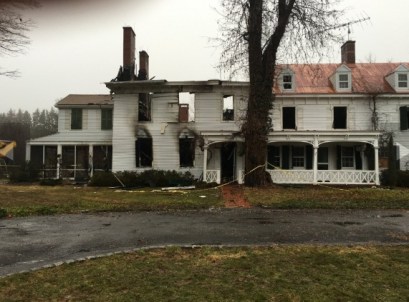
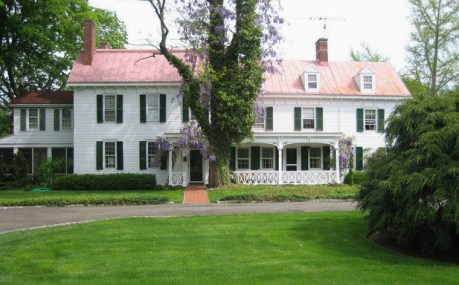
I’ve been working on a film over the last two years about the Pitney family that had inhabited a historic home and farmstead for 11 generations. The farm pitney-farm-before-fire-copyis only about a mile from my house but the family is flung all over the globe. The story seemed almost too big and a bit too distant and I found myself losing focus. Then I met and interviewed one family member, Barbara (Pitney/Lamb) Johnson who had researched and written her family’s biography and was extremely knowledgeable about the family history. She was also incredibly gifted in front of the camera and was able to bring her family’s stories to life through her memories and the warmth and cadence of her voice. It was then I knew that I had the makings of a priceless legacy film.

The farm had not been inhabited since 2013 when the last Pitney to have lived there passed away. The town purchased the farm in 2009 but when the last Pitney inhabitant died in 2013, the future of the historic property became controversial. Some wanted to preserve it for community use and others wanted to sell it. This past winter, one cold February night the Pitney homestead was destroyed by fire. The Morris County, NJ Prosecutor has since been determined the fire to be arson and it remains under investigation.

After the initial shock of the fire pitney-burned-out-shellwore off, I began to realize that I had captured priceless footage of the farm and Pitney family members telling the family’s story. I also realized that I had more than the makings of a just a family story. The Pitney farm had been a binding thread throughout the Pitney family’s history and the property and its demise was another story and a story whose ending has still not been determined.

I finally finished a short preview sample of the Pitney family story . In addition I ended up making a separate preview or trailer of the fire itself. The full feature length film of the family is in production. I’m not quite sure yet where I’ll go with the film about the fire that destroyed the farm but maybe I’ll follow Orson Welles’ advice;  “If you want a happy ending, it depends on where you stop the story”.


Professional Photographers and Value

Let’s face it, these days, professional photographers aren’t only competing with other pros – they are competing with anyone and everyone with an iPhone.

Hanoi, Vietnam
Woman with flowers on bicycle. Hanoi, Vietnam

Before you get upset and kill the messenger – ask yourself “What is my value proposition?” What do you offer that your competition doesn’t’?

I started making a list of things that professional photographers could offer to boost their value to potential clients:

  • Skills – Do you have any unique skills that can set you apart from your competition? If you define yourself by a specialized piece of gear that’s new – keep in mind, you may have just 5 years or less before ‘everyone” has it.
  • Vision – Make sure your “vision” comes from you and isn’t just a copy of what’s “hot” or trendy at the moment.
  • Access – Do you have access that others don’t? I realized when I was shooting for National Geographic that I was given access to a lot of photo opportunities that others didn’t have. Sometimes these opportunities yield photo opps that are off limits to others and make some stand out portfolio samples.
  • Rapport – If you are working in video and part of your job is doing interviews, then having a good rapport with your subjects will give you results that only you will get. Good interviews are dependent on social chemistry.
  • Your audience or following – These days, even getting a commissioned assignment may be dependent on your own social media following. Advertisers want to capitalize on that if it’s the same target audience they are trying to reach.
  • Project management skills – Getting the shot is only one skill set that photographers need to compete. Clients expect you to manage the project from soup to nuts and deliver the goods. That could mean wrangling large crews, getting access or simply making sure that everything that needs to get done to complete a project – is done.
  • Sensitivity – Be sensitive not only to your clients’ needs and problems but to whomever you are working with. I know a very good photographer who began burning most of his bridges with his clients. He was more interested in getting his point across and making demands than he was listening to the needs of his clients.
  • Likeability – Similar to above. There are just too many photographers out there to choose from that if you aren’t likable – well – you may want to look for work that doesn’t require any social skills.

If all this sounds simple –  it is. It’s applying it that’s the tough part. But if you do, you will set yourself apart from your competition.

Thinking of moving into motion?  Check out The Craft and Commerce of Video and Moti

Happy Birthday to John Lennon and Jackson Browne

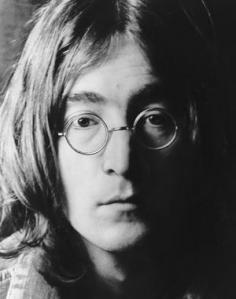
Today marks the birthday of two of my music icons John Lennon and Jackson Browne. John would have been 76 years old johnlennon1if he had not been killed. Their songs have given me happiness and comfort throughout my life. When I first really discovered music during my prepubescent years, it was the music of Beatles that resonated with me. It woke me up and gave me a sense of belonging along with millions of others inflicted with Beatlemania. As time went by their music changed as they became more experimental and the world changed as well.
I recently saw Ron Howard’s film, “Eight Days of the Week” the other night. It was about the Beatle’s touring years. It was beautifully edited and the sound was superb and I looked at it with the eyes and the appreciation of a grown woman who was now a photographer and filmmaker. It gave me a new perspective about their early days than the one I had when I was a smitten preteen. Back then I was just another young girl who was overwhelmed by these lads from Liverpool.

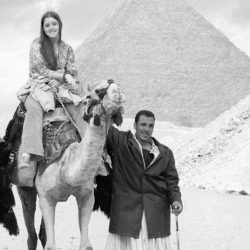
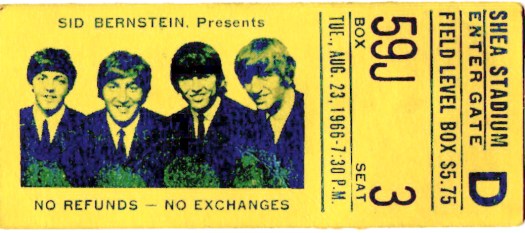
I had attended both of the Beatles concerts when they played Shea StadiumBeatlesTicket4 copy in 1965 & ‘66. Even though I had been there it was the first time that I had actually heard what the Beatles played that night. My family had just moved from Rochester, NY to the NYC area and my dad had somehow obtained 4 tickets to the show in his company’s box seats at Shea. It will go on record as probably the best gift my father had ever given me. It was more of an event than a concert. It quickly became historic and an event I will always remember.
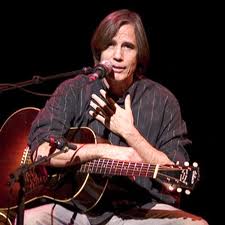
As I got older and had experienced a couple of real relationships with the opposite sex, I moved to California. It was the early ‘70’s, and it was a different time and a different culture.JB I became captivated by the early California sound of Joni Mitchell, Crosby Stills and Nash, the Eagles and of course Jackson Browne. Their music defined an era and my young adult life. Jackson’s songs brought awareness of social issues and motivated the huge demographic of baby boomers to take action. To this day I remain a huge fan of Jackson Browne’s and try to see him in concert at least twice a year. In some ways his lyrics became my religion.
Music makes us happy, provokes us to take action and comforts us when we’re down. It’s universal. I think back to the 1960’s and how the Beatles and their music had gone viral. That was way before we had the Internet and social media platforms and I wonder, how did that happen? I suppose the stars were aligned and it was simply “the right time” to create one of the biggest phenomenons in music of all times. Of course it had a little help pushed by the emerging demographic of baby boomers who were ready to take the world by storm.

I wonder what John Lennon would have gone on to do in his life, if he hadn’t have been stopped by a bullet some 40 years ago. His music will live on and I will keep going to Jackson Browne shows as long as he keeps giving them. Their music is the sound track of my life.

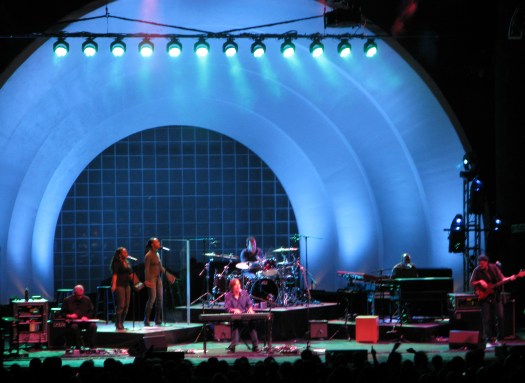
Jackson Browne in concert