Google,Licensing,Copyright – and Free

I got this email the other day. A couple of weeks ago, Tom my partner got a cease and desist from Getty and an invoice for uploading his own images on the ASMP NJ Chapter website because the Picscout robots had picked them up, which is now owned by Getty.

The business of photography has changed because of the Internet in terms of value, licensing, awareness of copyright and all of the above.

I have posted the letter below for discussion and open dialog- please no rants or whining allowed.

Dear Ms Mooney,

I’m not sure if I am contacting the right person, however I am small custom home builder on the Jersey shore in Xxxxx near Atlantic City.  My wife downloaded a picture of a South Jersey beach scene from Google about a year ago and put it on my web site.  She unknowingly downloaded a picture that was copyright protected.  Today, July 15, we received a letter from xxxxxx a company that protects your work and they informed us that we used your picture and wanted 3000.00 to rectify the situation or buy the licence for 1020.00 we settled for the 1020 and took your picture down.

This picture was not a glamorized picture of a beach.  Just a dune and a dune grass fence.  A picture that could have been taken by anyone in South Jersey.  I just wanted to let you know that if this is your picture, it is dispicable that common, decent and hardworking people who have a small struggling business should be subjected to such a ridiculous fine.  The fact that we cannot google and download a beach
scene without worrying that someone OWNS it is outrageous.
Imagine that!  People own pictures of nature!

If this is not you, then my sincere apology, otherwise I think you should be ashamed of yourself and need to contact Google for having your picture available to millions of people.

Regards,

xxxxxxx

Add to FacebookAdd to DiggAdd to Del.icio.usAdd to StumbleuponAdd to RedditAdd to BlinklistAdd to TwitterAdd to TechnoratiAdd to Yahoo BuzzAdd to Newsvine

How to Deal with Criticism

As I get ready to show a sneak preview of my film Opening Our Eyes this week in Traverse City, Michigan, I do so with excitement – but also trepidation.  I have to be prepared for whatever the response and feedback might be.  Most likely, it will be a mixture of praise and criticism – and everything in between.  I also know when taking a chance and entering into new territory – like making a feature film – I open myself up to both positive and not so positive thoughts and comments.

It’s not easy to accept criticism, yet I have found that if I stay true to what it is that I am trying to accomplish and put the criticisms and comments in perspective – I’m far better off.

I try to keep the following things in mind:

Not to take harsh comments personally.  This is tough, because let’s face it when you’ve put your heart and soul into something, it can be very hurtful to hear unkind comments and criticisms. Since, I have made my life’s work – my life’s passion – there’s a fine line between the personal and the work. So I remind myself to think of all criticisms as related to my work.

Consider the source.  I try to remember that this is just one person’s opinions and even if that person is an “expert” or think they are – their perspective can be coming from a whole different place than what I had envisioned.  I’ve also found that many times, the worst criticisms come from people who may have their own issues they are reflecting on.

Step back and think before reacting.  I have learned “to be still” and to take time to digest all comments before reacting positively or negatively to them. Many times harsh words need to be heard – and can be the push I need to make “it” better.  Then it’s up to me to decide if I should respond to those comments and incorporate those suggestions into whatever I am creating – or not. In the past, I have made the mistake of taking everyone’s helpful comments and suggestions to heart, only to end up with a big mess that’s neither “here nor there”.

Trust my instincts. I try to keep in mind that I need to stay true to my own vision. If comments and suggestions are helpful in guiding me there – then I take them to heart. There are times when even though I know the message or story that I want to tell – I need guidance on how to do that.  So, I try to consider all feedback, but to keep it in context with my own vision.

Remind myself that I have done something. This is the most important thing of all – to remind myself that even though what I have created is not perfect – I have done what a lot of others never do and that is bring my idea to reality.  Many times the harshest critics are people frustrated that they have not overcome their own inertia.

Steven Pressfield writes about resistance and criticism in the The War of Art:

“ If you find yourself criticizing other people, you’re probably doing it out of resistance. When we see others beginning to live their authentic selves, it drives us crazy if we have not lived out our own.

Individuals who are realized in their own lives almost never criticize others. If they speak at all, it is to offer encouragement.  Watch yourself.  Of all the manifestations of “resistance” most only harm ourselves. Criticism and cruelty harm others as well.”

Add to FacebookAdd to DiggAdd to Del.icio.usAdd to StumbleuponAdd to RedditAdd to BlinklistAdd to TwitterAdd to TechnoratiAdd to Yahoo BuzzAdd to Newsvine

Ten Things I Learned While Making a Movie With a DSLR

1. It will take twice as long as you think. This is especially true if you have a limited budget. With a limited budget comes a smaller crew and therefore you need to do a lot more of the work yourself – if you can.
2. It will take more money than you think. Everything adds up. There are a lot of costs in post-production – licensing music is a big one and a feature film needs lots of music – and having the sound professionally mixed, makes all the difference and is well worth the money – so anticipate that cost.
3. If you need to transcode files for your editing application – then make that the first thing you do. In fact, I used the Log and Transfer plug-in on Final Cut Pro to do a pre-edit on all my clips as well as add  metadata to the files.
4. Hire a professional editor. Smartest thing I did. I raised funds on Kickstarter so that I could hire a pro. I know how to edit – or at least I thought I did – till I worked with a professional editor. My editor crafted the story and cut it like a musical composition with beautiful timing and rhythm.
5. You will need twice the memory or drives than you thought you would. Even, when working with a professional editor – in fact because I was collaborating with an editor, we had duplicate projects and media on 3 – 2 terabyte drives each!
6. Stay focused on the story. Don’t even go into the editing room without a clear idea of what story you want to tell.
7. Define your target audience. Iit’s important, especially in terms of how you want to craft the story and the rhythm of the piece.
8. Plan ahead as far as screenings or putting content online. Many film festivals have strict guidelines about previous screenings, premiers etc. I wanted to show my film on a big screen, but I couldn’t have it open to the public or charge money, so I opted to have an “invitation only” event and called it a “sneak preview”. Test screenings are done all the time with studios. It gives you a chance to get feedback.
9. Utilize social media. Have a website for the film and a fan page on Facebook.
10. Don’t try to be what you’re not. And don’t try to be all things to all people in your film. Stay true to your vision. Push yourself to try new things. Go with your gut.

Add to FacebookAdd to DiggAdd to Del.icio.usAdd to StumbleuponAdd to RedditAdd to BlinklistAdd to TwitterAdd to TechnoratiAdd to Yahoo BuzzAdd to Newsvine

s

Fear of Failure – Fear of Success

Which is it? Which one of these paradigms rules your own behavior? If you are like me, then it’s a little bit of both.

Lately, I think I’ve been leaning more toward fearing success – than failing. I don’t usually contemplate my fears – most times, rushing into the unknown like a young child. I think that’s my inner voice that is calling and I blindly follow. And when I do follow, good things happen. And that’s when I start to get afraid.

Odd isn’t it – being afraid when things are going as I planned, even as I dreamed. I guess for me, fearing success stems from my own lack of self-confidence and questioning myself “Am I deserving of these good things that are happening in my life?

If I stop and think about it – that it was my hard work that led to those “good things” – then I’m OK. But when hard work comes from a place of passion, deep within me, I lose sight that it is work at all. Sure, there are days when things overwhelm me and days when everything I do seems to “fail”, but mostly my work is my joy.

The only thing I really fear is to wake up one day and not feel joy in what I’m doing. I hope that if that happens, I face my fears and change things.

Add to FacebookAdd to DiggAdd to Del.icio.usAdd to StumbleuponAdd to RedditAdd to BlinklistAdd to TwitterAdd to TechnoratiAdd to Yahoo BuzzAdd to Newsvine

Working With a Professional Editor

I know how to edit. Well, I should say I know Final Cut Pro. Knowing how to use a particular software and knowing how to edit – to tell the story, are two different things. Just like taking a photograph skillfully is more than just knowing how to use a camera.

I have done a relatively decent job editing projects in the past, but nothing has ever been longer than a half hour in length. Nothing has ever been as demanding as what I have been working on over this past year and a half.

After traveling around the world last summer, on a 99-day adventure, shooting a feature length film about people who are making a difference, with just a slim crew (myself and my daughter), and an even slimmer budget, financed with airline miles and hotel rewards, I returned with over 150 hours of footage and 5000 still images.

After a bleak winter of endless days of trying to make sense and order of all my content, I managed to get a very rough storyline down with interview sound bites and do a first cut on the b-roll. But there was a long way to go to get this looking like the film that I imagined in my head. I knew I wanted to work with a professional editor who would not only help me, but also would bring their own vision and craft to the film and most importantly “move the story”.

I’ve been working with Erik Freeland, from Springhouse Films over the past few months and I am simply in awe of what he has brought to the film. I’ve learned so much by collaborating with Erik. Not, little tips and shortcuts in terms of Final Cut but how to tell a story cinematically. I’m beginning to learn about the craft of editing and how the nuances of timing and juxtaposition of clips and interviews can move the story forward – or not.

As a shooter, I’m paying attention to movement in a scene and following the action. An editor looks for just the right part of the action in the clip – and how that clip will juxtapose with another clip. Not only the timing of the action within the clip is important, but also the timing of the duration of the clip itself is critical to the pacing of the film.

Timing is everything in editing – it’s almost like making a musical composition timing and pacing the highs and the lows of the story. In fact a big part of the editing process is integrating the music, adding yet another dimension to weave the viewer in and out of the story. Music is the heart of a film, the emotional backbone. Without music – the film has no heart.

So in a way, a good editor is a mixture between a technician, a storyteller and someone who has rhythm. An interesting combination for sure. It’s been a wonderful experience collaborating with my editor, Erik and I think what has made it work so well is that we have respect for what each other has brought to this project. We have both learned and grown along the way and pushed ourselves creatively. What more can you hope for? That’s the beauty of collaboration.

Add to FacebookAdd to DiggAdd to Del.icio.usAdd to StumbleuponAdd to RedditAdd to BlinklistAdd to TwitterAdd to TechnoratiAdd to Yahoo BuzzAdd to Newsvine

The NON Convergence of Still Photography and Video

Many people, myself included have written about the convergence of stills and video. In fact ever since Vincent LaFloret paved the way, shooting video in a cinematic way with the Canon Eos 5D Mark II, it seems like every still  photographer wants to shoot video with a DSLR . At the same time, high end “video cameras” – not still cameras that also shoot video – but a high end camera like the RED is capable of capturing stunning stills from frame grabs and they aren’t just good enough – they’re great.

I suppose in this sense one could argue that there is not only a convergence of our tools – meaning a camera that is capable of shooting high quality video and still images – but that it also may mean – the end of still photography. I don’t have a crystal ball but if one defines a still image as a “moment in time” then still photography will never go away. If you have a camera that shoots hi res video and can pick and choose the exact frame that fits your still image needs – then we need to realize that this is a convergence of our “tools”  not the the end of creating still imagery.

I love to point out the differences of still photography and video because for me, and many others who shoot both still photographs and video, we think differently when shooting these mediums.

  • A still image is a moment in time.
  • Video is time in motion
  • A still image is one that is meant to linger on – where one can take pause
  • Motion imagery is made up of  a variety of shots and sequences
  • Video provides more information – there’s sound and  movement
  • Still images leave more for viewer interpretation
  • Still images deliver a message visually
  • Video delivers a message utilizing sight and sound

Everyone of these differences requires us to put our minds in a different place. When shooting video, I need to think about what shot will come before and what shot will come after the shot I’m about to shoot. I have to think that way or I won’t have the goods to cut with in the editing room. The message or story gets crafted further in post production with music and interviews and each element plays its part in the feel and arc of the story.

When I’m shooting still images, I must tell the story in that one frame and timing is everything – it’s the “decisive moment”. So, one must ask is it the same – is it even fair – to grab that “moment in time” from a video clip where the camera operator didn’t make a conscious decision when shooting that decisive moment ?

The point is with everyone talking about “convergence” and taking that to mean the demise of still photography – I have to wonder. Is it the end of still photography? Personally, I don’t think so. I think that it merely means a convergence of the tools – not what we create with those tools.

Add to FacebookAdd to DiggAdd to Del.icio.usAdd to StumbleuponAdd to RedditAdd to BlinklistAdd to TwitterAdd to TechnoratiAdd to Yahoo BuzzAdd to Newsvine

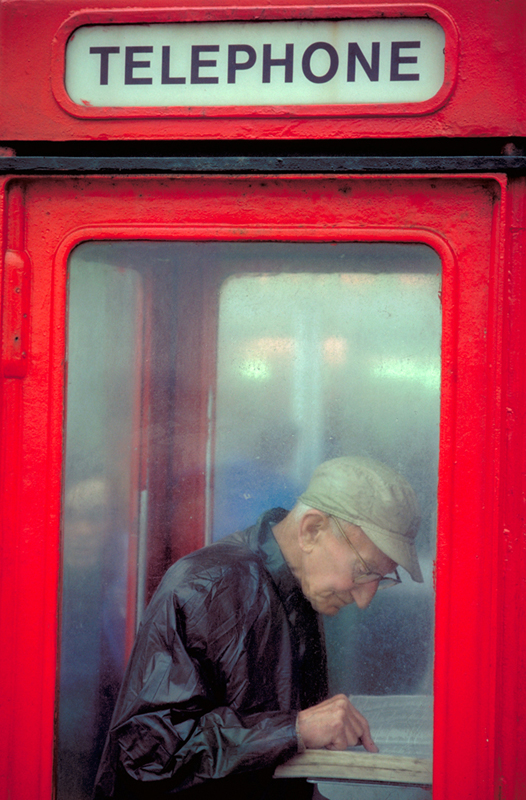
Pick Up the Phone

Maybe because today is Father’s Day, I’m thinking about ties and connections and how much has been lost over the years in the way we have chosen to communicate with one another.

Pick up the phone and call

It’s an odd mix as far as behavior goes, in terms of how we communicate (or don’t), but regardless of whether we are communicating for business or personal – we seem to have lost the “personal” touch.

The memories I have of my Dad and others who are no longer here, are our conversations and just enjoying the dialog between the two of us.  These days, it seems as if people avoid one another – even when they are in the same room together.  There have been a few occasions over the last couple of months where I have been with a small group of friends and there has always been someone in the bunch – who is there in body – but not really –  because they are glued to their “device” and communicating with whomever isn’t there.

Call me “old” but I just don’t get that. I’ll always opt to have a conversation with someone face to face and my second choice is always  to have a conversation with him or her over the phone.  Why?  Because a phone conversation has interaction – in real time.  Emails can be exhausting with the back and forth banter and texting is even worse because of those little keys.  And of course when emails are ignored – there is no interaction – so what’s the point?

With all the options of how to communicate with everyone these days,  including all the social media forums, a personal connection is still the best way as far as I’m concerned.  Sure, you can’t take the time to talk to everyone on any given day, and I don’t.  But there are times, that I do want to connect with someone on an individual level – without blasting it out to the world on Facebook or Twitter and without it being a one sided conversation. And when it comes to business, nothing replaces the one on one face to face or a phone call.  That’s really the only way to emote your message and relay it in the manner it is meant to come across.

Today is Father’s Day.  If you have a Dad who is still in your life – pick up the phone and call him because I know it will make his day.  If my Dad were still alive, I would be making that call.  My only regrets are the times that I put those calls off.  But what I don’t remember is why I did it – the reasons couldn’t have been that important – but stupidly I rationalized they were at the time.

Add to FacebookAdd to DiggAdd to Del.icio.usAdd to StumbleuponAdd to RedditAdd to BlinklistAdd to TwitterAdd to TechnoratiAdd to Yahoo BuzzAdd to Newsvine

The Making of a Movie with a DSLR

It’s been a wild ride since I first began this journey of making a feature film with a DSLR camera – in my case, the Canon Eos 5D Mark II. I had already completed three short documentaries to date – all made with traditional video cameras from my first Canon XL-1 to my current HD Sony EX-1. But this time I was heading out on a 99-day journey around the globe, with my 23 year old daughter in search of ordinary people on six continents, who were making a difference in the world, and we had to pack light.
We were “the crew” – the two of us. We had to work efficiently and with gear that would fit into two backpacks and would endure the adventure as we traveled to 17 different countries on 30 flights. I also wanted to shoot both still images and motion, so I opted for the DSLR solution. Of course, I was enchanted by the “big chip” and the cinematic look of these cameras, but I was also thinking of my gear in practical terms – how I was traveling – how I would be shooting – and of course the desired outcome.

You can read more about the gear I took here.

So with my daughter “running sound”, doing the interviews with our subjects, shooting still images, and navigating us through the subway systems in Moscow and Buenos Aires, and me taking care of all the logistics and  shooting both video and stills, we came back 99 days later with almost 3000 gigabytes of content – that’s approx. 150 hours of footage and 5000 still image captures!

I wasn’t mentally prepared for what came next and that was 2 intensive months on my part ingesting all the content into my editing system, transcoding and adding metadata to the files and culling through hours of interview soundbites until I had cut it down to three . It was grueling and my winter months were spent putting in 14 hour days – 7 days a week. I was overwhelmed, yet somehow driven by some force.  It was a lot of work, it was tedious and it was daunting – but yet it was my passion and somehow this inexplicable “force” got me through it.

I raised money along the way through crowd funding on Kickstarter and with that, I hired an editor. After I handed the project off to my editor, Erik Freeland of Springhouse Films, there was a huge sigh of relief on my part. I knew the post production had a long way to go but, I also knew that I had to let it go for a while and step back. Working with Erik has been amazing in itself and he has brought enormous value to this project and film. I have learned a lot from his insights and his talents in knowing how to” tell a story”, and we are finally coming to the completion of this film. Or at least in getting the “first cut” done for a sneak preview on July 17th, at the State Theater in Traverse City, Michigan. The screening is by invitation only and if you would like to attend, just drop me an email at gail@openingoureyes.net and tell me how many people would like to attend.

Since I first dreamed up this project in the final days of 2009, to the departure of our trip in the Spring of 2010, to where we are now, it has been a continual journey on every level imaginable. And I have had many angels working on my behalf – my husband Tom Kelly who has been the “wind beneath my wings” and without his support none of this would have been possible, my extended family who have been amused over the years with my schemes and dreams, my dear friends Angel Burns and Ally Raye who have believed in me and this project and have made incredibly exciting things happen for this film. (I’m not quite ready to divulge some of those exciting things publicly, just yet), Maria Grillo and Jason Harvey at The Grillo Group who have been so giving with their time and talents and created all the graphic design for the film’s release, and so many other “angels” who have helped me with foreign translations, been financial backers, helped me spread the word globally, and every person who was there for me when I needed support and encouragement. I am deeply grateful to have all these people in my life.

We live in an empowering time. When I began my career as a still photographer, over 30 years ago, I never would have imagined doing any of this. In fact just two years ago, none of this would have been possible. Our dreams are as big as we want them to be. I have seen this dream clearly from the start and each day I get closer and closer to seeing it become a reality.

Watch the Trailer

Add to FacebookAdd to DiggAdd to Del.icio.usAdd to StumbleuponAdd to RedditAdd to BlinklistAdd to TwitterAdd to TechnoratiAdd to Yahoo BuzzAdd to Newsvine

Misplacing My Muse

It’s been a couple of weeks since I’ve written in my blog. That’s not like me. To be honest, I just haven’t felt like writing. I thought that I had lost my muse – like it was some real person in my life who had “cut me off”. Whether the reason that I was giving myself for not wanting to write was real or fictionalized – I just didn’t have the desire – so I didn’t. I started writing a couple of years ago, when I would wake up at 4AM with my mind spinning and couldn’t get back to sleep. So, I got out of bed and wrote about whatever was going through my head at the time.

My daughter Erin (and others) will tell you that I’m an extrovert. That’s accurate for the most part, but I also have another side that surfaces every so often that makes me want to withdraw. And that’s when I have the urge to “feed my head”. I read a lot and have conversations with friends who plants seeds in my head that may turn up later in another project. I’m refueling. I’m tuning into myself.

But getting back to the whole “muse” notion. I think I may have been confusing a “muse” as being someone who was real in my life. Someone who would stimulate my mind with fresh ideas and encourage me to pursue them. Sure, I have had people in my life that did just that for me. But what I really think was happening was more subtle – or at least was subtle to my conscious mind. My perceived “muses” were really just causing me to look into my inner voice and myself. In other words the “muse” was inside me.

I’m not sure what is a more frightening thought – to think that a muse is someone tangible who may come into and out of my life leaving me vulnerable to these outside forces – or that a muse is my own inner voice who just doesn’t seem to shut up some days. Maybe a muse is a bit of both – my inner voice but also how I choose to react to outside forces.

Regardless, I have learned to go with the flow of energy that is there in the present. It’s far better than to fight it. That’s not to say that I don’t fight “resistance” and I do not define resistance solely as outside forces. In fact, most resistance comes from my own mind and ego – always trying to rationalize and give me good reasons why I should not pursue something – why I should not confront my fears.

So if there are weeks that go by and I seem to have disappeared – if in fact the disappearances are even noticed amongst the other distractions of life – know that I am taking some time off to feed my own head.

I’m just trying to sing the song I was meant to sing.

Add to FacebookAdd to DiggAdd to Del.icio.usAdd to StumbleuponAdd to RedditAdd to BlinklistAdd to TwitterAdd to TechnoratiAdd to Yahoo BuzzAdd to Newsvine

A Year Ago Today – The Beginning of Our Documentary and the DSLR

It was exactly a year ago today that I left with my daughter on a 99-day journey around the world to create a documentary about people on six continents who were making a difference in the world. I was not new to video or documentaries, having shot motion for over twelve years and completing three short films.  But this was big – not in the sense of “big production” or “big crew” or certainly not “big budget” – it wasn’t any of those things but it was indeed BIG.

I had no idea how big it turned out to be.  The trip in itself was almost the easy part, although don’t get me wrong – it was arduous on every level.  What was overwhelming was taking the project from idea to completion.  Had I known how overwhelming it has been at times, I may have reconsidered – or at the very least had a bigger crew.

The crew was my daughter and myself.  I shot video. She shot stills.  She interviewed the subjects and ran sound.  I operated the camera and shot B-Roll.  She research, scheduled and pre-interviewed the subjects and I worked on all the logistics – travel, travel needs and gear.  I thought about gear long and hard and decided to go with the hybrid cameras, in my case the Canon 5D Mark II and the Canon 7D.  I wanted to capture both stills and video, but I didn’t want to bring two separate camera systems, so I chose the hybrids. I have written a lot about the gear but the all time most popular post I wrote was about my gear for this 99-day journey.

We returned in September with over 150 hours of footage and over 5000 still images.  Wow!  Talk about overwhelming. I spent 2 solid months of my winter getting the footage into a manageable rough timeline – or at least the sound bites. I handed it off to my editor Erik Freeland of Springhouse Films and he hopes to get me his rough cut this weekend.  I’ve had many conversations with Erik over the past month or so about the story(s) and the arc of the film and he truly understands how to tell a story.  I am extremely grateful that I was able to hire a professional editor and it never would have been possible, without my successful run with Kickstarter.

I have been working a lot in the back scenes with distribution options and I am thrilled with what I am finding.  This is the time for “the documentary”.  It’s possible with small budgets and crews to make a powerful film that can be seen in hundreds of various venues well past the big screen movie houses and film festivals.  It’s an amazing time for “the individual” and what can be accomplished because of technology. That’s another blog for another time though.

I’m headed to California this afternoon to speak at Cal Poly tomorrow evening. Join me if you’re in the area.  For old time’s sake, I took my Eagle Creek bag  – which I had circumvented the globe with.  It seemed like the right thing to do.

Add to FacebookAdd to DiggAdd to Del.icio.usAdd to StumbleuponAdd to RedditAdd to BlinklistAdd to TwitterAdd to TechnoratiAdd to Yahoo BuzzAdd to Newsvine