Just Say Yes

This past weekend at ASMP’s SB3 conference in LA, a young woman came up to me and said that I had given her an “ah ha” moment.  I asked her why and she reminded me of what I had said at a panel discussion the evening before.  A photographer had just told a story of how he saw himself in very specific terms as to what type of photography he did – he saw himself as wearing one hat.  But a client came to him with a job that didn’t fit into his norm and so he turned it down.  Then the client came back a few days later in desperation and asked him to please reconsider and he did.  The job ultimately turned into a lucrative and regular gig and he learned a powerful lesson and that was to open his head up more to possibilities.

I was in the audience and the moderator asked if anyone had a response to this story.  I said that I was really into saying yes more at this point in my life and career and that when I did, the universe was opening up and really great things were happening.  I could go on to list a number of examples of some good things that have happened but the point here is that negative energy breeds negativity and positive energy breeds hope and change and positive results.

It’s pretty tough these days to stay positive, with the photographic industry in a state of flux and the lackluster economy but it’s not impossible.  Some things I have found that help me stay positive are simple to implement in your life and others take a bit more practice.

  • For starters, stay away from the groaners and moaners who spend their time complaining.  That negativity is contagious – so get as far away from those people as you can.
  • Find something you do like and cultivate that passion.  It will show.  You’ll start to talk about it and people will be attracted to you because of it.  That attitude is contagious as well but is an attitude that you want to “catch”.
  • Embrace learning.  Growth always has hope and hope will renew your spirit.
  • Learn to let go of the things that don’t work out.  God knows I have had to abandon many expectations but I try to move on and replace them with new ones.
  • You can’t control what others do to you but you can control how you react. Empower yourself with that thought.
  • Think good thoughts in those moments right before you drift off to sleep.  When you are sleeping your subconscious takes over and if you have positive thoughts running through your head just before you go into that subconscious state – that is what will be reinforced.
  • When you are feeling low and nothing seems to be working – find something that is working and be grateful for that.  And know there are certainly others in the world that are far less fortunate than you.
  • Always remember that life is the greatest gift of all.  Embrace it, cherish it and make every day count.

When you say yes, you at least have a chance at a positive outcome.  When you say no – you’ve closed the door.  My reward that weekend was knowing that I gave someone an “ah ha” moment. Who knows what may come out of that?  What a powerful thought.  What a powerful word.

There were all kinds of “ah ha” moments this past weekend in Los Angeles at the SB3 conference.  There’s another SB3 conference in Philadelphia coming up – February 25-27.  Come and join others who embrace the positive notion of growth, hope and change.

Add to FacebookAdd to DiggAdd to Del.icio.usAdd to StumbleuponAdd to RedditAdd to BlinklistAdd to TwitterAdd to TechnoratiAdd to Yahoo BuzzAdd to Newsvine

Collaboration in Video and….

During one portion of my career, I spent a lot of time shooting still photography assignments for magazines like the National Geographic Traveler, Smithsonian and Travel & Leisure, to name a few. I was hired to shoot the images. A writer was hired to write the story.

Every magazine and every story worked differently as far as how I would collaborate with the writer. Sometimes the writer and I would just have a conversation about focus and approach and then we’d be off on our own, each bringing our own perspective to the piece.

Sometimes, I’d be given a manuscript that had already been written and I was expected to illustrate it. This worked well when I, the writer and the magazine would agree on the focus of the “story” and match our talents to that end. But there were times when a magazine would want very literal illustrations of the words, which not only stifled the images but weakened the words. One time I was asked to photograph “the lurkage of limousines.”

And then there were times when I went to a destination with a writer to do a story on that destination and even though we were there at the same time, we came back with different stories. I got my story done on site and the writer did most of his/her work after returning from the destination.

With video collaboration is essential because there are so many facets, each calling for different skill sets. Some collaborations occur simultaneously on set and some later in post-production but all have to work well in order to get to the same end in harmony. Harmony meaning, not just being able to get along but to communicate and work well together as one, but also where each respects each other’s role in the process.

It’s very tricky to assemble the right mix of people, but here are some important things to look for when building a team or even a partnership:

  • Trust – You have to be able to count on someone to do their job. And likewise, you have to also commit to uphold your end of the deal. The team is only as good as the weakest link. That becomes even more critical, the smaller the team is. If you’re only working with one person and you can’t count on them – you’ll be doing the work yourself. It’s important to know that someone has your back.
  • Working Style – While it’s not important for all to be morning people or night people or have similar working styles in that sense, it can be extremely frustrating for all concerned if there are procrastinators on the team. That’s because timing in video production is important for workflow. If someone doesn’t deliver when they promised – it holds up the whole production. We had one situation where a motion graphics artist held the entire post-production up for months.
  • Expertise – Surround yourself with experts. They will make you look good. But remember, just because someone is expensive doesn’t mean they are the best for your job. There could be someone who is more right for the project who is less expensive. Keep style and vision in mind. Talk to potential crew members and get references.
  • Right for the job – The “best” editor in terms of the commercial world might not be the right person for your project. For me, I want to work with an editor that is also interested in the project besides the money it pays. I look for an editor who will also bring a different perspective as to how the story gets told.
  • Bottom line – Work with people you can count on – otherwise the job might not get done.

Add to FacebookAdd to DiggAdd to Del.icio.usAdd to StumbleuponAdd to RedditAdd to BlinklistAdd to TwitterAdd to TechnoratiAdd to Yahoo BuzzAdd to Newsvine

SB3 – Get Inspired

If you haven’t registered for the ASMP Strictly Business 3 conference yet, I would highly suggest that you do so.  They will be held in three locations starting next week: January 21-23 in Los Angeles; February 25-27 in Philadelphia; and April 1-3 in Chicago.

There’s an incredible line up of speakers presenting workshops on pricing, estimating, copyright, workflow, strategic career planning, successful portfolios and branding and video production. I’ll be presenting two workshops: “Thinking in Motion” and “Shooting Video with the DSLR”.

Branding expert Colleen Wainwright will deliver her keynote “Making People Love You Madly: Selling Yourself in a Postmodern Marketplace”.  Tom Kennedy, whom I’ve know since his days at the National Geographic Magazine will give a keynote “Learning New Skills for the Changing Media Landscape”.

This conference series is meant for everyone, not just photographers who are beginning their careers.  In fact, I think that photographers who have been in business for many years will benefit equally, if not more than a shooter who is new to the business.

I have been in business for over 30 years and I have found that one of the most dangerous things that can happen to a creative person,  is for them to become complacent, especially in a business like photography.  It’s even more deadly to become complacent these days in our fast changing world of technology.  We not only need to stay current with our skills, we need to keep our vision fresh.

When I got into video and motion more than a decade ago, I was looking for something to excite me.  I felt that even though my business was successful and that I had accomplished many of my creative goals, the spark was getting dim inside me and at times I felt like I was reinventing the wheel.  So, I set out on a learning curve and have been soaking up information ever since.

I love to learn and I have found that the more I wonder and grow, the better off I am creatively and the more successful I am in business.  I’ve also found that networking and collaborating with my peers has opened my eyes to all sorts of possibilities that I never knew existed.  I think that’s what makes the SB3 conference so powerful – the sharing of information with our peers.  You don’t get that from online learning.

We live in a time where anything is possible.  Come to SB3 in LA, Philadelphia and Chicago and be prepared to be inspired.

Add to FacebookAdd to DiggAdd to Del.icio.usAdd to StumbleuponAdd to RedditAdd to BlinklistAdd to TwitterAdd to TechnoratiAdd to Yahoo BuzzAdd to Newsvine

Crowd Funding and What I’ve Learned

There’s a scene at the end of my favorite holiday movie “It’s a Wonderful Life”

It's a Wonderful Life

where George Bailey, a character played by Jimmy Stewart is surrounded by his friends as they come to his aid and bail him out of his financial shortcomings, caused by his crazy Uncle Billy. I’ve seen this film at least a dozen times and ok – I admit it – I cry every time George Bailey’s little girl opens a book that mysteriously appears under the Christmas tree with the inscription “No man is a failure who has friends”.

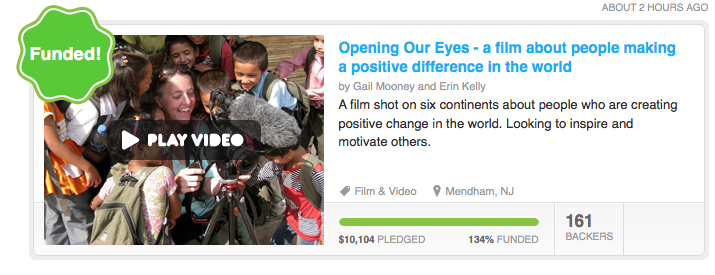
I felt like George Bailey today when I saw the email from Kickstarter telling me that my daughter’s and my film project, Opening Our Eyes had been officially funded.  We actually exceeded our goal of $7500 and raised just over $10,000! What a feeling – what a triumph and all possible because of our “friends”. Through crowd funding – our friends had helped us reach our goal and made our film a reality.

This would not have been possible just two years ago.  But, Kickstarter and other crowd funding sites like it, provide other options for artists and entrepreneurs who are seeking funds to make their creative ideas come to life. Many times these ideas might not fit within the confines of what a traditional bank would finance, but there are some great ideas that have a chance now of becoming a reality –  and we all benefit by that.

Here are some things that I have learned through the process of getting our film funded on Kickstarter.

•    You have to do the work.  Once you launch your project page on Kickstarter, you need to let potential backers know about it, using social media or email blasts or word of mouth.  Just like getting traffic to your website, you can’t expect people to stumble upon your project and fund it.
•    You have to make it fun.  Have fun with the “rewards” that you offer your backers, and on Kickstarter every project must have rewards.  People love to give, but they also love to feel like they are part of something or that they have helped to make something happen.  If a backer contributed to my project at the $500 reward level, they will receive an Associate Producer credit in the film and on the project’s website, along with DVD’s of the film when it’s completed, as well as a signed print and an e-book from the project’s journey.
•    Keep your financial goal realistic.  Look at other projects that are similar to yours and see what the “market will bear”.  See what has been successful and ask yourself why. Remember that if you ask for too much money and don’t meet 100% of your goal by the time the funding period is over for your project, then you won’t receive anything.  Only projects that are successfully funded at 100%, will receive funds.
•    Use social media and email blasts with common sense – don’t be obnoxious.  If you do send emails – don’t send  an email again to someone who has already backed your project.  Ask people to share your project link on social media but don’t overdo it.
•    Post updates on your project to keep your backers and potential backers informed.  Use visuals if you have them,  both on your page site as well as in your updates. Photographs and videos really give a project presence and are a must have. You want to stand out from the crowd.
•    There is no such thing as a pledge too small.  They say the average pledge on Kickstarter is around $25 and I can attest to that.  Out of our 161 backers – 69 had made pledges of $25.  It all adds up.  And every time someone backs your project there is also the opportunity that they may share it with someone they know who may in turn make a contribution.
•    Be grateful and appreciative.  I made it a point to send each and every one of my backers a personal thank you note.
•    Have faith – because anything is truly possible these days.

Add to FacebookAdd to DiggAdd to Del.icio.usAdd to StumbleuponAdd to RedditAdd to BlinklistAdd to TwitterAdd to TechnoratiAdd to Yahoo BuzzAdd to Newsvine

Will Your New Year be New?

“For last year’s words belong to last year’s language and next year’s words await another voice.”
– T.S. Eliot

Happy New Year

This is the day that many of us make New Year resolutions. I prefer to look back over the past year and ask myself if I’m on track or on purpose in my life. As I look back, I congratulate myself for my accomplishments and forgive myself for my screw ups. I think about what made me happy and what didn’t. I think about the people in my life – family, friends and work colleagues and how different my life would be without them. I look back at the creative work that I’ve been doing and question – what jobs were satisfying to me and why? Were my creative efforts an expression of who I am and how I see things?

As I look back over 2010, I feel pretty good as far as feeling like I was “on purpose”. The economy was lousy, but I was able to stay afloat and fortunate to be in a position to pursue a “passion project”, that kept me alive creatively and also helped me grow as a human being. But I think the most important part this personal project played in my life was that it pushed me in every way possible and in doing so opened my eyes as to how I want to live my life – the rest of my life, however much time that may be.

None of us know how long we’ll be on this planet Earth. There may not be a next year, when you’ll get around to doing those things that you’re always telling yourself and others that you want to do. All we have is the “now”. So, as I look forward to the New Year and all the promise that it holds, I remind myself that my future is dictated by all those little choices that I make in the “now”.

It’s the little things we do along the way that control the life we live. The choices we make – the way we treat and react to people and circumstances – what we allow in our life that will ultimately determine our year ahead. So, in looking back at the old year, I’m reminded of what did and didn’t work well in my life.

In looking ahead, I won’t be making a list of resolutions, but will try to remember that there will be times, when I need to make those little choices in the “now” along the way. There will be moments when I need ask myself if I should take a job or walk away from it, or times when I need to remind myself that I can’t control how people treat me, I can only control how I react to it. I can only control what I allow in my life. Every day, I’ll be faced with hundreds of little decisions, directions in which to turn that may or may not be good for me. I will try to make the choices that will keep me on purpose.

Like Kenny Rogers sang “You’ve got to know when to hold them – and know when to fold them”. A great metaphor for how to look at life.

Add to FacebookAdd to DiggAdd to Del.icio.usAdd to StumbleuponAdd to RedditAdd to BlinklistAdd to TwitterAdd to TechnoratiAdd to Yahoo BuzzAdd to Newsvine

Don’t Become a Photo”saur”

A lot of people tell me that I’m way ahead of things since I got into video/motion over ten years ago. Most still photographers weren’t even thinking about video ten years ago. Neither was I. Nor did I have a crystal ball. But I am a visual communicator and that means that I am always looking for the best way to communicate the message or tell the story. And twelve years ago, it became possible and affordable for me to deliver the message with another medium. Not instead of still photography but in addition to it.

My desire to explore video and motion at the time, wasn’t coming from a “tool” point of view. It was coming from a cultural one. When I think about it, I wasn’t fascinated by the technology – I was fascinated by what people were doing with the technology. Fast forward a decade later and I’m just wowed by where all this has gone. Our culture has changed dramatically in the last ten years because of technology. And while that is still “fascinating” and like creative adrenalin, it’s also a game changer in how it has affected the business of photography.

Don’t get me wrong and think that my message is to tell you to get into video or multimedia so as not to become a photo”saur” and become extinct. That’s not what I’m saying. What I am saying is that the cultural psyche has changed. Take notice and adapt. That doesn’t just mean, change the subject matter you shoot or how you shoot it to stay “fresh”. And it doesn’t mean to buy a video camera or a hybrid and start shooting motion. Those are probably good ideas but probably not going to be what keeps you in business.

The old days aren’t coming back. The ways of doing business have changed. Technology is democratizing when it’s placed in everyone’s hands. Understand that. Know that your clients understand that. So, think past the tool and technique and focus more on who you are and what you can bring to your customers to stay relevant. Some thoughts to ponder:

• Who are you? (why do your customers come to you and not your competition?)
• What services do you offer your client? If you don’t offer video and your client needs to look elsewhere – you’ve lost an opportunity.
• Are you still a one-man band? I don’t mean you need a large staff but have you considered setting up a virtual company when you need it with editors, sound people etc.?
• Do you continue to learn?
• Are you still using a dated business model ? Consider different licensing strategies for new media.
• Do you utilize social media?
• Are you noticing who’s “coming up” – the new talent? Do you try to see them through your customer’s eyes.
• Are you interested in other things besides photography?
• Are you willing to take risks? Creatively and otherwise.
• Ask yourself the question – how would I have approached this if I was just starting out?
• Think of solutions – then look at those decisions at a total 180.

Learn. Grow. Adapt.

Don’t become a photo”saur” and become extinct.

Add to FacebookAdd to DiggAdd to Del.icio.usAdd to StumbleuponAdd to RedditAdd to BlinklistAdd to TwitterAdd to TechnoratiAdd to Yahoo BuzzAdd to Newsvine

Listen Up – Audio is Everything

Audio is everything in video. I can’t stress this enough. Most times “capturing audio” is a skill that still photographers don’t have. If your job is on the line – my suggestion is hire a good sound guy. If you’re doing a personal project and want to learn more about getting good sound, here are some tips.

• Don’t use the camera’s internal microphones, except for reference.
• Never use “auto” when recording audio. Turn off the AGC (automatic gain control) on the DSLR cameras.
• Get your microphones in close. For b-roll situations, you can get away with a shotgun mic mounted on the camera. But microphones mounted on cameras can pick up camera noises.
• Use a good wind screen or dead cat when outside. Even if you’re inside, on a windy day, with windows open, you can pick up wind noise.
• Use a good set of headphones. Over the ear is best but earbuds can be used in a pinch. Your audio meters tell you that you’re getting sound, but not if the sound is any good.
• Use shotgun microphones for your interviews. Get them in close to your subject – no more than 1-3 feet away.
• Lav microphones, attached to lapels can be used wired or wirelessly. Be careful with your positioning to avoid unnecessary noise from hair or jewelry.
• Go wired whenever you can. Resort to wireless solution if wired isn’t possible.
• Use an omni-directional or cardiod microphone when you are in more acontrolled situation and you want your sound coming from more directions.
• Don’t cross your audio cords with your electrical cords. This causes a hum that you will detect if you are wearing headphones.

Pay attention to audio. Start letting your ears do more of the work. Every room and situation has its own sound. Listen up.

Add to FacebookAdd to DiggAdd to Del.icio.usAdd to StumbleuponAdd to RedditAdd to BlinklistAdd to TwitterAdd to TechnoratiAdd to Yahoo BuzzAdd to Newsvine

Getting Your Train Back on Track

I was going to write about audio today, but my mind wasn’t there – it was elsewhere. That’s the fun part about it for me, I write if there’s something I’m thinking about.

This morning my mind was drifting to other things, like the highs and lows of the last couple of weeks. But when I have weeks that are like life on a roller coaster, I remind myself that I have to focus on the peaks and the thrills to survive the plunges. I also know that if I really want to live life then I have to be prepared for both ends of the spectrum.

I’ll share some thoughts that have helped me keep my train on the track.

  • I love myself for who I am.
    If timing is everything, then sooner or later I’ll get it right.
    Work is not a negative word.
    Do what I love to do, regardless of what others say.
    Understand my adversaries – I may learn something.
    Some of the things that have upset me the most, have helped me grow.
    Value friendships.
    True friendship continues to grow over the longest distance.
    Understand, no matter how much I care, others won’t. That’s OK.
    Be fearless to love.
    Forgive those who have hurt me.
    Forgive myself.
    There’s a time for everything.
    Be fearless to keep trying even though I’ve lost before.
    If I create from the heart, nearly everything works.
    Be fearless to think that anything is possible.

And one more from Yoda –“ Train yourself to let go of what you fear to lose.”

Maybe I’ll talk about audio next week.

Add to FacebookAdd to DiggAdd to Del.icio.usAdd to StumbleuponAdd to RedditAdd to BlinklistAdd to TwitterAdd to TechnoratiAdd to Yahoo BuzzAdd to Newsvine

Editing Tips for Multimedia and Video

A few days ago, I wrote a blog about “having a point” – or telling a story when you create multimedia pieces. Of course you have to have an overall idea and focus to start with, but below are some editing tips on how to make it come together in the editing room.

  • Edit with a purpose. Why are you making the “cut” where you are? Are you cutting on the action? Are you cutting on the beat of the music? What’s the reason behind your cut?
  • Set a pace or rhythm. Just like writing, where you have pauses in sentences with commas, edit your visuals to your narrative or interview soundbites, cutting after words and phrases.
  • Use image sequences to transition between different ideas and themes.
  • Let your images linger on the screen, giving time to breathe between them.
  • Cut on the beat or against the beat of music. Edit the music and let it become part of your piece, rather than just a background soundtrack.
  • Adjust the volume of your music – lowering it during interviews and raising it when there is no narrative or dialog.
  • Use audio fades between music cuts to soften the cut.
  • Insert room tone between cuts in interview soundbites, making the cuts less apparent.
  • Use interview footage sparingly – when introducing someone or when someone is expressing emotion on the screen.
  • Identify interview subject with name and title text in lower third.
  • Use text that’s easy to read and break it up over many slates. Leave the slate on the screen long enough to read twice.
  • Always start with your strongest images.
  • Don’t “move” all your still images – leave some static on the screen.
  • Don’t use dissolves.
  • When working with media from DSLR cameras, keep the media in the DCIM folders for logging and transferring into Final Cut Pro with the plug-in. If you have taken your media out of the DCIM folders – then create a new DCIM folder for the purposes of importing the media into FCP.

Remember to keep the story in mind at all times. When you think you have the story laid down in a rough cut – have friends over to watch it. Ask them what the story was. If they don’t know or can’t tell you, then you have more work to do.

Add to FacebookAdd to DiggAdd to Del.icio.usAdd to StumbleuponAdd to RedditAdd to BlinklistAdd to TwitterAdd to TechnoratiAdd to Yahoo BuzzAdd to Newsvine

“Here’s an Idea – Have a Point”

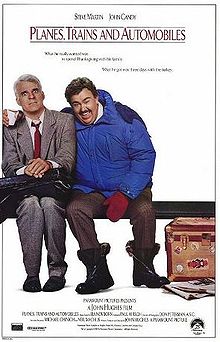
One of my favorite holiday movies is “Planes, Trains and Automobiles” with Steve Martin and John Candy. There’s a great scene in the movie where Steve Martin loses it and starts a rant directed toward Candy’s character, Del Griffith. Del, is a “nice guy” who talks incessantly. Martin’s character, Neal Page, an uptight ad man, frustrated by the day’s travel mishaps, finally explodes at his travel companion Del after one too many stories and says – “here’s an idea – when you tell a story, have a point!”

Am I the only one who has been oversaturated with multimedia and video pieces that are little more than pretty visuals to music? Don’t get me wrong, there are plenty of pieces that I do like, but there are far too many where I get bored and bail mid-way through because there is no point – there is no story.

Worse yet, the audio or music track many times feels like it has no connection to the visuals. It may be a great piece of music and provide pacing for the video, but it doesn’t complement the story. And there are times that the music is the most interesting part about the piece – if you take it away, what do you have? Most likely a pagination of moving and/or still images – like pages in a magazine or prints on a gallery wall. Independent and isolated vignettes with a music track – but no story- just eye candy.

What holds my interest is a story, where all the elements of audio, music, video clips, stills, text and narrative are parts of the whole and each one is integral in telling the story. I don’t think I’m alone in being interested in the story. Humans have enjoyed “the story” since the beginning of time. It doesn’t matter if it’s told verbally in a one on one conversation, in a multimedia piece, or in a major motion picture – a good story is a key ingredient for human interest. We all love a good story.

Personally, there is so much out there to watch these days on any given site that hosts videos, if I’m going to invest time in viewing something – I want it to have a point. If it doesn’t when I get to the end – I feel somehow let down.

I’m sure some of you will disagree with me on these thoughts and many of you may get loads of satisfaction from watching pretty visuals laid down to music and that’s OK. I’ve just had my fill of pretty content splashed before me, becoming a blurred palette in my head.

So, here’s an idea – have a point.

Add to FacebookAdd to DiggAdd to Del.icio.usAdd to StumbleuponAdd to RedditAdd to BlinklistAdd to TwitterAdd to TechnoratiAdd to Yahoo BuzzAdd to Newsvine