The Smell of Fixer in the Morning

This is a bit off topic but was prompted by my trip yesterday to Randolph Community College in Asheboro, NC.  I was giving a seminar for ASMP  “Converging Media – Adding Video to Your Skill Set”.  After setting up for my presentation I was given a tour of the school – a wonderful facility.  After going through their impressive computer labs and studios – I asked my guide and Program Head, Chuck Egerton,  if the school still had dark rooms.  He smiled and said “I’ll show you”

The second I entered the darkroom – and got that familiar taste of fixer in my mouth – I was immediately transplanted back to Brooks Institute in Santa Barbara where I had studied 34 years ago.  It’s hard to believe it’s been 34 years but when I walked into that darkroom and saw the students making their prints – it seemed like I was back at school.

A lot of memories flashed through my mind that hadn’t surfaced in years.  Being the only woman in my class – and one of six in the entire school.  Always being in a rush because I was working full time at night and going to classes and executing my assignments during the day.  Racing from the Riviera campus to the Montecito campus at break neck speeds around the curves in my big old orange Dodge van.  And most of all living in beautiful sunny Southern California, yet spending a lot of my time – in the dark.

The changes in photography have been profound since then and I’d probably have to say that as much as I learned at Brooks – I’ve learned a lot more since – out of necessity because of technology.  I love learning more now than I ever did in my younger days.  History gives interesting perspectives and when something jogs my memory and I remember my own history – I’m amazed by how much things have changed.  Seems like only yesterday.

Convergence – Defining Yourself By Your Vision – Not Your Tool

It’s 4AM as I write this entry.  I can’t sleep.  That often happens when my mind is in overdrive as it has been all week – over stimulated by the process of editing video. I’ve also spent a lot of time this past week speaking with quite a few photographers who are working in both the still photography and video mediums.  Some shooters I spoke with got into video because the entry level became cheaper when hybrid cameras that shoot both stills and video came on the market.  Other people I talked to weren’t “camera operators” at all – they were DP’s or Directors of Photography on high-end commercial broadcast productions.

One question I asked these shooters was “What do you call yourself these days?” Personally I’m struggling with that question myself.  Am I a  photographer?, a videographer? (I hate that term), a DP?, a media producer?  Who am I ?  What do I call myself? I have yet to answer that question for myself, but the answers that I got from everyone I spoke with, ran the gamut, encompassing all the titles above.  As I replayed these conversations in my head, I realized that for me the problem was I was trying to define myself by my tool.  And that just doesn’t work.

The problem is if we define ours by our tools – then we are diminishing the value of our creativity or our visionboy_viewer in the process.  We aren’t placing the value on what is unique in all of us – our vision. At the same time we’re placing too much value on the tool – in this case the camera.  As technology accelerates the production of more sophisticated cameras that are cheaper and easier to use – and we’ve placed our value on being the technician – we’re in big trouble.  Because ultimately anyone with a vision who has the “ability” to realize that vision, can put together a crew of technicians to facilitate their vision or idea – and do it cheaper these days because of technology.  And there’s nothing wrong with that.

Professional photographers get defensive when a potential client places no value on what is unique about them (their vision) and approaches them with the attitude that if you won’t work for the prices they dictate – they will just find another photographer.  But what they are really saying is that they feel that they can “just” find another camera operator. The problem is that these photographers haven’t presented their vision and because of that they are perceived as being interchangeable. That’s not a good place to be and never will be.  And for that reason when a professional still photographer comes to me and says that they are interested in getting into video and asks the question “What video camera should I buy?” I gently tell them – well sometimes not so gently tell them – it’s not about the camera.

How does one define what they are?  Great question that has a lot of answers, as it should.  Technology is amazing – but it’s the human part of the process that excites me because we’re all so different in how we see.

Video, Editing and Chroma Key (green screen)

Even though I started shooting and editing video some 10 years ago – I can honestly say that I still have a lot to learn.  The “learning” part of my craft has been non-stop.  I continue to learn as technology constantly pushes us all in that direction.  But I love it.  I love raising my bar every chance I get.  And these days, even though the learning curve may be steep in certain aspects of video production – it’s also a lot easier to access information and help than it was 10 years ago.  Again – thanks to the volumes of information online – at the click of a button.

I love the editing process of video production because this is really where I craft the story.  I can get totally lost in the story and how I can mold that in whatever direction I choose in the edit room.  But I’m not a professional editor and I have the utmost respect for what a pro brings to this part of the process.  So I lay down my rough cut – to get the storyline down and then hand it off to a pro to take it to the next level.

I’m editing a recent shoot that was quite challenging on all accounts.  A lot of what was shot, was shot on “green screen”. Green screen or “chroma key” is the process of removing a background color, – green for video – blue for film – so that the “subject” or “object” can be placed into another background in post. There is a lot of info out there on green screens so I won’t go into it in depth, but the biggest thing you need to know is how to properly shoot green screen so you won’t have a major melt down in post – or won’t have to spend a fortune for an editor to clean up your mistakes.  ResidentialExterior_NewTech

A couple of tips for shooting on green screen:

•    Turn off edge enhancements or sharpening in Picture Profiles – in camera menu
•    Create a new Green screen Picture Profile w/o sharpening
•    Keep subject lighting off background
•    Keep background lighting off subject
•    Keep green screen as far away from subject as possible
•    Minimize seams, wrinkles, folds
•    Even out your green screen lighting within 1/2 stop
•    Brightness level should be about one stop under key light on your subject.
•    Light your subject complimentary to your inserted background
•    Don’t use dimmers – changes color temp toward red – not good for keying
•    Create an edge or separation light – keep it subtle!!
•    Watch out for reflective objects and surfaces (CAR SURFACE) that can pick up green screen

So if you’ve successfully shot a good clean composition as described above – then of course you need to put things together in post. Windshield OutsideThis used to be a tedious process and would involve a lot of work in post production.  But thanks to some incredible plug-ins available – you can get a pretty amazing “key” without a lot of hours in the editing room.

I found a product that really helped me out.  DVmatte Blast and DVmatte Pro from www.dvgarage.com. These plug-ins will work inside Final Cut Pro as well as Motion.  I chose to work within Final Cut.  I was amazed by not only how easy it was to use but by the price as well.  DVmatte Blast was $99 but I purchased DVmatte Pro for $199 because it gave me more “tweaking” options.  And as always whenever I need to learn a new piece of software – I went to http://www.lynda.com.  So instead of laboring with greens screens in post for an entire day – I got the job done in a matter of a couple of hours – and I had a lot of compositions to make.

I love to learn but I also like to lead some sort of a personal life – away from the computer.  And these days – thanks to a little help from my “friends” I’m achieving a nice balance.

My Hybrid World

This is kind of off topic in the sense that it speaks a bit to my personal lifestyle as opposed to my professional one – yet in a way it’s the perfect analogy to my hybrid existence of working in both the still and the video worlds.

I live 38 miles west of Manhattan Island subway– close enough to commute if I were so inclined or had a “job” to commute to. But since I’m a self employed freelancer and always have been – I look at that short distance to the “city” as the bridge that connects my two worlds. The “city” can pretty much provide me with just about every cosmopolitan need that I may have and my other world – the idyllic little “bubble” where I live – a small rural town in Northwestern New Jersey – gives me space and serenity. bicycleBoth are important in my life and I don’t think I could give up one for the other.

I feel this way in terms of working with both still photography and video. They each in their own way are creatively fulfilling. Because I’m a storyteller – I look to each medium in terms of being the right tool to tell the story. I think differently in each medium and for this reason it’s very difficult for me to shoot both stills and video on the same job – although I have done that on many occasions. But my head is in a totally different place – depending on which medium I am working in.

I’ve said many times that it’s not about the tool – I can’t just swap out the tool because it’s really not that simple. With still imagery it’s all about the moment in time. With video it’s time in motion. With still imagery I’m selecting that precise moment where the story gets told. With video I’m telling the story through a sequence of imagery – always thinking in terms of the beginning, middle and end and ultimately with the “whole” piece in mind.

I could never make a choice between the two mediums at this point in my life because they are each needed in their own unique ways. Each serving their own purpose in how I choose to communicate – visually and creatively. Just like the hybrid personal world that I live in.

Video Production in the Deep Freeze

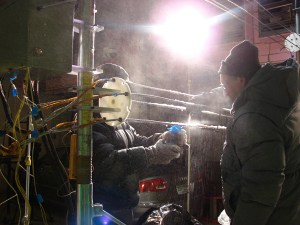
I just spent the last week in New Hampshire working on an “industrial” video for a new business venture that will be licensing an amazing new “ice” technology. It was perhaps the most challenging job that I’ve had in many years – especially from a technical level.  One day we worked from 8AM – midnight in a “cold room” at the US Army Cold Regions Research and Engineering Laboratory (CRREL) shooting “ice” experiments.  We were dealing with extremes on all levels.  The Russian scientists scientists– brilliant electrical engineers – were pushing their own boundaries as they ran tests with ice on power lines and automobiles and as much as I was witnessing this work in sub zero temperatures – it was amazing to watch them work. If I hadn’t been so busy with my own technical challenges – I would have loved to just observe them and try to get into their head.  scientists2You could almost see their brains working – just by watching their faces.  Then to see the triumph in their eyes when their experiments worked – what a thrill.  I now need to go to Russia.
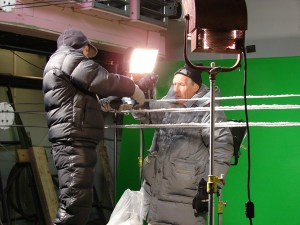
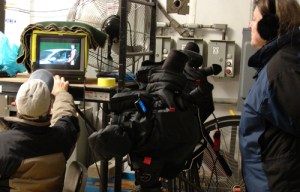
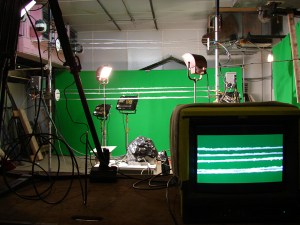
My partner Tom had done a great job with pre-production, making sure we would be fully prepared to work and have our equipment work in these extreme cold temperatures.  We put the cameras into “polar mittens” mittens to keep them warm and swapped out the warm packs as we shot late into the night.  We had to erect large “green screens” so that in post I can insert winter scenes.  Problem was our green screens were large pieces of fabric and the chill blowers were blowing them all over the place.  We tried to anchor them but in the end we had to turn the blowers off during the shoot. Thank goodness we didn’t need usable audio. We used hot lights and a lot of them.  Used every extension cord we had and every outlet in the room – 10,000 watts.  Ironic huh – hot lights in a “cold room”.  Because of that we had to leave the lights on the entire time because we knew that when we turned them off – we’d get condensation on the bulbs.  When we finally did break the set down at midnight – we turned the lights off, let them cool a bit and put garbage bags over them so that as they warmed we wouldn’t get moisture on them.  Didn’t really work too well though.  setWe did the same thing with the cameras and that worked great.  Because we had the lights on all day and were using long extension cords – one cord got over heated and actually melted and fused to itself.  The Russian electrical engineer noticed it – Thank God – or we would have burned down the building.
We shot an interview with another brilliant Russian scientist who was passionate about ice and also shot b-roll of all kinds of things, the campus (we were at Dartmouth), labs, refrigerators, icemakers and the computers in the cad labs. All in all things went quite well considering the adverse conditions we were working in and pushing our equipment and ourselves to the limit. One HUGE bummer was that the assistant that Tom had hired  – who came recommended from another photographer – quit after the first day.  We got through the shoot though – but had to muster up everything we had within us.  The client wrote today to say he was extremely pleased with the roughs he had seen and impressed with our fortitude on the shoot given the situation.

Now on to phase two – to record the narrative, research a ton of stock footage and photos, pick the music, work with the motion graphics team and put it all together.  As much as the postproduction inevitably involves a lot of work and long hours – I love this part.  This is where the story comes together and is really crafted.  And that’s always the best part for me.

Photos ©Sheldon Tefft

Sam Carr (1926-2009) Legendary Blues Drummer

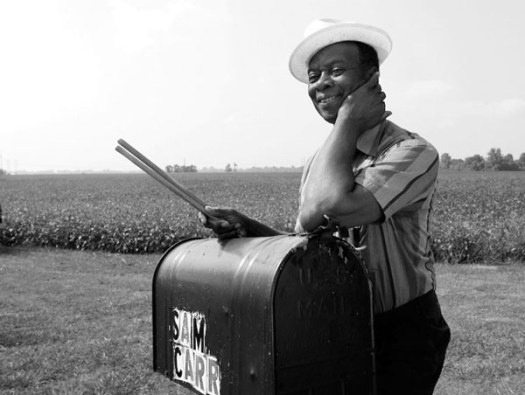
I received some bad news today that Sam Carr died.  Sam was a legendary blues drummer – he was also one of the sweetest people that I came to know.  I interviewed and photographed Sam in 2001 at his home in Lula, Mississippi – the heart of the Mississippi Delta.

I was working on my first really ambitious documentary after getting into video the year before.  It was a personal Sam Carr, Lula, MSproject that had I tried to get funding for but then 9/11 happened and money dried up over night.  But for me this was a story that I needed to tell and now because these musicians were in their 70’s and 80’s.  I wanted to tell the story of these musicians apart from their music.  I was interested in their cultural stories – about the area they grew up in. the Delta and how that gave birth to their music – the blues.

My first trip to Mississippi was on a shoestring budget with my heart in the right place and open to whatever I may find.  My husband, my 14 year old daughter and I hit to road for the Mississippi Delta the summer of 2001. To be honest I didn’t have much in the way of a planned itinerary.  I had tried to line up interviews with some of the musicians but the cultural divide between us made it difficult to pin down a schedule.  So I was open to letting serendipity happen and it did.

I had spoken with Sam Carr and his wife Doris who had been with Sam since she was 13 years old until she passed away last year.  Sam was very cordial and kind and was quite willing to be interviewed.  I had pinned him down with a date in a vague sort of way and we all – my husband, my daughter and I – showed up at the proper time.  It was a typical August day in the South – hot and humid.  So we sat on a bunch of mismatched chairs underneath a big old shade tree.  Sam literally talked for hours and I was drawn into his stories about his childhood, his father, Robert Nighthawk a legendary guitarist who didn’t raise Sam, his music, his regrets and his life now during his older years. At times it was difficult to understand him because of his dialect but I listened carefully and his words made permanent marks on my soul.  We talked until evening and it will be an afternoon that I will never forget.

Sam’s words became a big part of my film.  That first interview also convinced me that these stories needed to be told – and by the musicians themselves.  I went on to photograph and interview – Little Milton and Robert Lockwood Jr. – who have also left this earth since my interviews.  We still have Pinetop Perkins – 96 years old, Big Jack Johnson, who played with Sam in the band Jelly Roll Kings, Willie “Big Eyes” Smith and Magic Slim. The outcome of my efforts was  a 26 minute film and a still photographic essay about The Delta Blues Musicians that has become a traveling multimedia exhibition.  View the trailor.

I heard this sad news from Pinetop’s manager who I’ve become friends with over the years.  She told me that Sam died quietly with his family and friends around.  She also told me that his family was grateful that I had captured Sam and his stories that day.  And she told me that his epitaph may be “I lived a rich man’s life in a poor man’s shoes” – the last thing that Sam told me that glorious August day.

Letting Go of What We Know

There’s so much angst these days in the “photography” community and not just the photo community but everywhere.  People are almost paralyzed from fear – fear of the future.

I don’t think we ever get anywhere if we let “fear” take over our lives.  Certainly not if we live and work in a creative field.  The fear seems to creep up when what we are “used to” is no longer there.  Anyone who works for newspapers can relate to that statement.  But we can’t change “what is”. I don’t look “back” often but when I do – I do it to get perspective.  And when “fear” of the future manifests itself so strongly – to quote Jackson Browne “it seems it’s easier sometimes to change the past”.

We all know we can’t change the past – so why do we dwell on it?  Because it’s really scary to face a future where all the rules have changed.  Technology has forever changed the game.  We can moan that our clients don’t respect us and that they just want work that is “good enough” and worse yet – coming to terms with the fact that maybe, just maybe “good enough” is good enough for their needs. As we communicate visually over electronic platforms like the “web”, do we need an image file that is 8000 pixels in its longest dimension with 300 res – like we did for those glossy brochures?

On the other side of the table is that nagging notion that we all must learn to shoot “motion” and “video” and we’re intimidated by it because it’s not what we know.  I guess I’m an oddball because I’ve never really been too intimidated by what I don’t know – I’m actually drawn to it and excited by it.  Sometimes I rush to the unknown almost carelessly without even considering the consequences. And there’s always consequences – many times negative ones – or ones that may seem negative at the time.  But every now and then – if you just “let go” of holding on to what may not be working anymore in your life – you’ll find that you’ve opened yourself up to wonderful possibilities.  I keep my eye on those possibilities and it’s so much better than holding onto the past.

Are You a DP or a Hybrid? – What’s the Difference?

I’m searching for “the word” the “title” of what I am these days.  I’m a photographer.  I also shoot video but I hate the word “videographer” because it sounds a bit cheap to me or at least dated. I generally think to myself that I’m a “visionographer” but I tend to “title” myself as a “media producer”. With all the talk recently about getting into video, I feel the need to make a distinction between being a shooter or a DP as opposed to a producer.

There is nothing new about still photographers moving forward in their careers and segwaying into commercial motion work.  Traditionally they take on the role of the DP (Director of Photography).  Many times they don’t man the camera but direct the shooter instead.  Generally speaking they work in large crews and with agencies.  The biggest distinction is that most times it’s a “work for hire” situation because the production company owns the finished product.

With the explosion of video and in particular web video, come new buyers for this medium.  Buyers from the corporate world as well as institutions and even ad agencies that may have been historically just “print”.  With the advancement of technology and being able to deliver a high end product because of it – leaner and meaner small production companies have come along.  When you have a shooter using the RED and able to deliver not only the motion part of the job but able to pull stills from the shoot, once again still photographers feel threatened.

When I got started in video, I made a conscious decision to take on the producer’s role.  I could choose to shoot or edit or I could delegate these roles to outside contractors.  I could also form partnerships that were fluid as the needs may be.  But more importantly, I maintained ownership of the final product – which was what I was used to coming from my still photographer background.

Still photographers are essentially producers anyway so it’s not such a mental leap.  So when your client comes to you and asks you if you shoot video (and you don’t) think before you answer that with a NO answer.  It may be better to form some partnerships with people who do and not only keep the money in house – but not send your client off to someone who does.

Codecs and Confusion

It seems like every month manufacturers roll out new video cameras along with more new “proprietary” codecs.  With over 18 standard formats and hundreds of variations it has made “workflow” for digital video very complicated. We’ve got everything from DV, HDV, DVCPRO HD, XDCAM EX , Cinealta to The RED.  It makes multi camera shoots – a potential nightmare with different cameras shooting different codecs. And on top of that each camera offers a variety of frame sizes and rates to shoot in.  Ultimately, there are no guaranteed workflows anymore.

Here’s an interesting round table discussion of various experts in the field  – Ken Stone, Michael Horton, Philip Hodgetts and Andrew Balis – discussing codecs and standards.  http://tiny.cc/nRGOV

So how can we take some of the confusion out of all this and determine the proper camera and workflow for ourselves?  To answer this question it’s best to determine “where you want to go” and “then you’ll know where to start”.  What do you need to deliver?  Is it a video for the web,broadcast or the big screen?

Many times choice of camera and workflow is driven by budget.  A lower end camera producing a codec with less resolution will be “good enough” for a web video. Will the “good enough” attitude being driven by budgets lower our expectations for quality?  Some feel that it’s changing our aesthetic judgment. I don’t think the high end will go away.  In fact advances in technology has enabled more people to make a living doing what they love because there are more choices within their budget.

One thing’s for sure – technology is a double-edged sword and it will continue to change our lives.  I just wish that soon there would be a coordinated effort amongst the camera manufacturers to standardize for the sake of workflow.

Field of Dreams (and Video)

I love baseball – not sure why.  Maybe it’s just the idea of baseball that I love.  It’s traditional, American and a nostalgic reminder of summers past – at least for me.  I’m also a Cubs fan and I know what it’s like to be the eternal underdog, yet forever hopeful.  And that’s me – forever hopeful and optimistic. cubs_fans

I watched the movie “Field of Dreams” recently and I realized that it’s not really about baseball at all.  But about a belief in your dreams and following through with what you believe in.  And to do that you must be hopeful.

What does that have to do with video?  Nothing really, but it’s why I started exploring this medium 10 years ago, when technology was transforming video because it was going from an analog to a digital world.  And because of that, it was dramatically changing not only that “industry” but our culture as well.  It became “possible” to further your dreams – because of technology.  Whether that be shooting a full length “film” from a creator’s stand point or presenting and distributing your “brand” in a new way via a new platform (the web) and one where you can interact with your “target audience”.

Ten years have gone by since I started shooting digital video.  It’s been a challenging, yet rewarding time in my life and my career.  I have a tremendous sense of hope and see opportunities in this medium because I think it’s just the beginning of how we’ll see, hear and experience  video in our lives.

The video world is full of crazy formats and codecs as well as other unknowns and it can be scary for a photographer to jump into an entirely different mind set – let alone skill set. But taking risks can yield great rewards.  You just never know unless you take the chance.