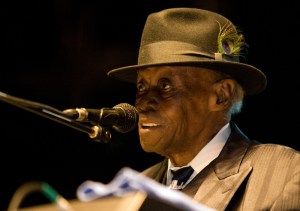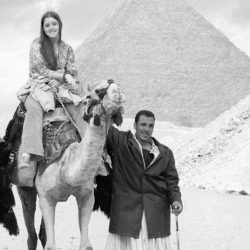
Life on the Road and My Favorite Place

When I was a little girl my mom used to take my sister and I to Walgreens to get an ice cream sundae.  Back then, like other drug stores and five and dimes, you could get a bite to eat at the counter.  I had a game that I’d play every time we’d go.  I’d sit on the stool and spin myself around. I would assign exotic destinations to various landing spots that the stool would stop spinning – and determine that those were the places that I would travel to in my life.  I somehow knew back then that “the road” would become a huge part of my life.

Over the years people have asked me “Where is your favorite place that you’ve ever been?”. To be honest, I hated that question because I never had an answer.  There were too many places, all different in their own way that attracted me to them.Iom peel boat And then about 10 years ago I had an assignment for Islands Magazine to cover the Isle of Man.
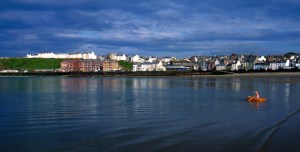
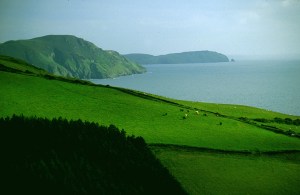
The island pulled me in from the start. I felt a strange sense of belonging, a connection that I couldn’t explain.  The air was cool and pure with a constant wind that blew across the island from one sea to the other.  It’s a small island located in the Irish Sea somewhere between Ireland and Scotland.  An island that’s reminiscent of Ireland 50 years ago –port erin an island where time seems to have stopped.
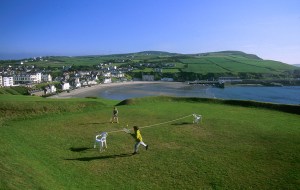
Because the island is small, I didn’t feel the usual rapid pace that I have felt on previous assignments where I was given too much to cover and too little time.  I could linger and catch the moods of the island and the vibe of the people.  It was a magical place with open, cinematic vistas of aiom scenic patchwork of every shade of green you can imagine, stretching from the barren upland’s to the blue of the sea.  The sea was always present.
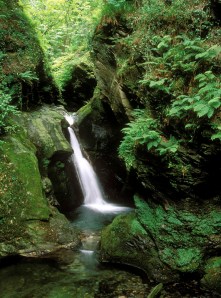
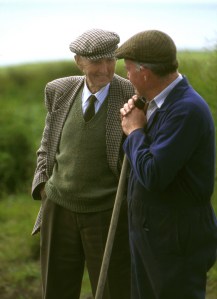
There were secret glens with waterfallwaterfalls and I thought that fairies must surely live there, somewhere beneath the ferns.  The island was enchanting on every level.  One day I came upon a crowd of people in a field.  I asked someone what was going on and they replied that it was a turnip weeding contest.  How wonderful I thought, a contest to weed a field.  I spent the morning caught up in the event, taking a few images, but mostly just talking with peoplemen iom and storing those conversations in my head.
And then like every other time I’ve taken to the road – my journey came to an end and it was time for me to leave.  There’s a legend on the island that every time the Queen of England comes to the Isle of Man (the island is an independent nation), the great god Mananan covers the island in a mist, so that she won’t find her way there and take the isle back.  The night before I left, a dense fog enveloped the isle and I thought the gods didn’t want me to leave – and I didn’t want to leave.  But the fog lifted and it was my time to go, but I knew that I finally had an answer to the question “Where is your favorite place you’ve been?”
Robert Frank, “The Americans” and The Road

I went to see Robert Frank’s “The Americans” this past week at the Met in New York City. I have always been a fan of Frank, not so much for his fashion photography but his photographic observations of “us”robertfrank_10.T – us Americans, our culture at that time in our history.  He was an observer of “all” people not just the beautiful ones captured on the pages of Harper’s Bazaar, and he captured those observations for generations to come.
As I took my time looking at the prints and contact sheets displayed, I was able to get a glimpse of how he shot – what his camera lingered on and where he went from there.  I could see his thought process in how he made his selections, looking at the frames circled with his red grease pencil. I read his letters to his colleague Walker Evans, another favorite of mine and I got a much better sense of him as a person and photographer.  I watched an early video that he filmed and was amazed by how he pushed his own photographic boundaries into another medium.  The exhibition provided a wealth of insight and information on Frank, his project “The Americans” and a time in our country’s history – and I was captivated.

His images linger in my head and remind me of my beginnings in photography and “why” I became a photographer.  Like Frank, I’m an observer of all people, of cultures and use my camera as a means to capture my observations and share them with others.  My passion is rooted in my own personal road trips; I have taken over the years with my camera. It has triggered in me the desire to explore, to embark on another journey with my camera and see where it takes me.

I’ve spent a career and a lifetime “on the road”, always the traveler, observing and capturing the daily lives of others – not the famous, but the common man.  Not the horrific, the outrageous, the exotic for those reasons  – but because they’re part of the world I live in.  My hope is that I the images I leave behind, will provide others a glimpse of that time, that space, those lives that I stumbled upon during a lifetime spent on the road.

Why I (Still) Shoot Still Images

Even though I’ve been shooting motion for over 10 years, I still spend half my time shooting still images. When my story can be or should be told with images that are “moments in time” then a still camera is always my tool of choice.

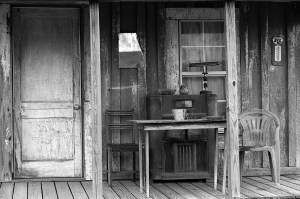
For me there is a certain timeless quality of a still image. Still images are meant to be explored by the eye while lingering on the “moment” captured. Perhaps a better way to explain the power that I find within still photographs is to show you some recent images I shot. Hopsons_shack

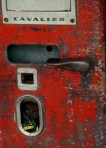
This past weekend I visited a favorite spot of mine. It’s an old plantation in Mississippi and every time I visit, I see it in a different way. But I always see it in a timeless way – it’s like time just stopped there.Hopsons_vending_J2X8487 Even though this plantation is worlds away from my cultural norm – I get a feeling of comfort mixed with a bit of melancholy for my own past when I’m there.
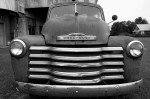
I could put these images in a multimedia format and add a narrative or a music track. But the question I ask myself is why? Hopsons_car_grillJ2X8622Will it add or will it distract? What piece of music should I use and what will that add to the story? Will the music overpower the piece – because many times it can. And too many times people try to add music to mediocre images to make them more exciting.Hopsons_car_J2X8561
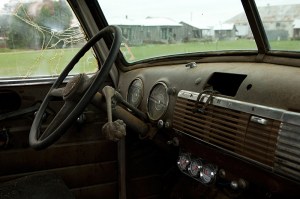
A still image has the power to capture the eye of the viewer and make them want to know more. If an image I make draws the viewer in – to see that moment in time – just as I saw it – when I shot it – then I’ve done my job as a storyteller.

Add to FacebookAdd to DiggAdd to Del.icio.usAdd to StumbleuponAdd to RedditAdd to BlinklistAdd to TwitterAdd to TechnoratiAdd to Yahoo BuzzAdd to Newsvine

Finding Your Passion

How does one find their passion?  How does one even define the word – passion?  The dictionary gives a few definitions. I’ll cite two:
– “intense or overpowering emotion such as love, joy, hatred, or anger.”
– “the object of somebody’s intense interest or enthusiasm”

Passion isn’t something you can teach someone – you just have to have it inside of yourself.  If you’re passionate about something – you just know.  I’m a photographer and a filmmaker .  But my passion is “telling the story” and I use my craft as a means to that end.  I’m interested in the human story and the cultural context that gives birth to those stories.

My insatiable desire to seek out and explore the human story has led me down many wonderful paths in my life. One of those paths led me to shoot a personal multimedia project on The Delta Blues Musicians.  My goal was to shoot environmental still portraits– as well as shoot video interviews of them .  I met my goal – at least in terms of creating an exhibition of still images and a short documentary – but I’ve never thought of this project as really being finished.  And that’s because I’m so passionate about the subject – “the blues”.

This past Friday, I headed down to Mississippi for Pinetop Perkins homecoming.  PinetopPinetop Perkins is a legendary boogie woogie piano player in the blues world.  He’s 96 years old and still going strong.  He is living proof of a man who is “living his passion.  I’ve become friends with Pinetop’s manager over the years and yesterday we got together over lunch to catch up on what was going on in our lives. I hadn’t been to the Delta for a few years and she was giving me the latest news on some of the musicians that I had interviewed for my film.  Four have since died – Little Milton, Robert Lockwood Jr., Ike Turner and most recently Sam Carr.
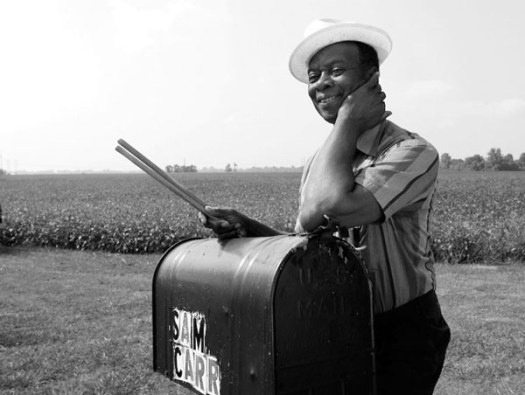
Pinetop’s manager is a very interesting woman who used to be an Anthropology professor at University of California at Berkeley.  She taught interview techniques as part of her ethnology classes.  When I had originally called her up to request an interview with Pinetop – she turned me down.  But not being one to take my first no – I asked her to check out my website and I also sent her a portrait I had taken of Sam Carr.  When she saw the photo I had taken of Sam – she changed her mind – she gave me my time with Pinetop.  She said that after she saw the portrait I took of Sam – she knew that  I understood “cultural context”

Yesterday at lunch she paid me another high compliment.  She told me that while she couldn’t quite dissect my “interview technique” (and she kind of rolled her eyes as she said it – because at times my techniques are quite comical) – she said that people just seem to be comfortable with me and  because of that they wanted to talk.  She also told me that I’ve been the only one to get a smile out of Robert Lockwood Jr. in an interview – but that’s another story.  Those comments were rewards in themselves for the efforts I’ve made on this project over the years – but there have been so many more.  Many rewards – all because of my passion for “the blues”.

Later that evening I got a chance to see Pinetop perform again.  I was backstage at the main festival stage – it was unusually chilly and I had a blanket with me.  Pinetop was sitting in the wings and I gave him my blanket as he waited for his cue.  He seemed so small and fragile.  When he got up to walk on stage and take his place at his keyboard before the crowd – he came alive.  And when he played his first note – I caught “it” in his eyes – a passion for his music and more than that – a passion to play for “his people”.  He didn’t want to leave last night – he played another song for “his people” and raised his arms in joy as the crowd embraced him.  It was a moment I’ll never forget.

Convergence – Defining Yourself By Your Vision – Not Your Tool

It’s 4AM as I write this entry.  I can’t sleep.  That often happens when my mind is in overdrive as it has been all week – over stimulated by the process of editing video. I’ve also spent a lot of time this past week speaking with quite a few photographers who are working in both the still photography and video mediums.  Some shooters I spoke with got into video because the entry level became cheaper when hybrid cameras that shoot both stills and video came on the market.  Other people I talked to weren’t “camera operators” at all – they were DP’s or Directors of Photography on high-end commercial broadcast productions.

One question I asked these shooters was “What do you call yourself these days?” Personally I’m struggling with that question myself.  Am I a  photographer?, a videographer? (I hate that term), a DP?, a media producer?  Who am I ?  What do I call myself? I have yet to answer that question for myself, but the answers that I got from everyone I spoke with, ran the gamut, encompassing all the titles above.  As I replayed these conversations in my head, I realized that for me the problem was I was trying to define myself by my tool.  And that just doesn’t work.

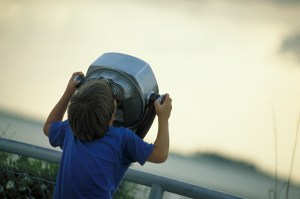
The problem is if we define ours by our tools – then we are diminishing the value of our creativity or our visionboy_viewer in the process.  We aren’t placing the value on what is unique in all of us – our vision. At the same time we’re placing too much value on the tool – in this case the camera.  As technology accelerates the production of more sophisticated cameras that are cheaper and easier to use – and we’ve placed our value on being the technician – we’re in big trouble.  Because ultimately anyone with a vision who has the “ability” to realize that vision, can put together a crew of technicians to facilitate their vision or idea – and do it cheaper these days because of technology.  And there’s nothing wrong with that.
Professional photographers get defensive when a potential client places no value on what is unique about them (their vision) and approaches them with the attitude that if you won’t work for the prices they dictate – they will just find another photographer.  But what they are really saying is that they feel that they can “just” find another camera operator. The problem is that these photographers haven’t presented their vision and because of that they are perceived as being interchangeable. That’s not a good place to be and never will be.  And for that reason when a professional still photographer comes to me and says that they are interested in getting into video and asks the question “What video camera should I buy?” I gently tell them – well sometimes not so gently tell them – it’s not about the camera.

How does one define what they are?  Great question that has a lot of answers, as it should.  Technology is amazing – but it’s the human part of the process that excites me because we’re all so different in how we see.

My Hybrid World

This is kind of off topic in the sense that it speaks a bit to my personal lifestyle as opposed to my professional one – yet in a way it’s the perfect analogy to my hybrid existence of working in both the still and the video worlds.

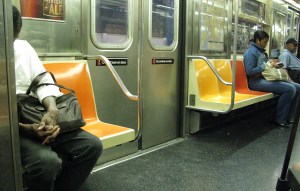
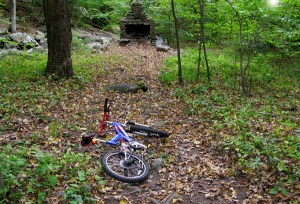
I live 38 miles west of Manhattan Island subway– close enough to commute if I were so inclined or had a “job” to commute to. But since I’m a self employed freelancer and always have been – I look at that short distance to the “city” as the bridge that connects my two worlds. The “city” can pretty much provide me with just about every cosmopolitan need that I may have and my other world – the idyllic little “bubble” where I live – a small rural town in Northwestern New Jersey – gives me space and serenity. bicycleBoth are important in my life and I don’t think I could give up one for the other.
I feel this way in terms of working with both still photography and video. They each in their own way are creatively fulfilling. Because I’m a storyteller – I look to each medium in terms of being the right tool to tell the story. I think differently in each medium and for this reason it’s very difficult for me to shoot both stills and video on the same job – although I have done that on many occasions. But my head is in a totally different place – depending on which medium I am working in.

I’ve said many times that it’s not about the tool – I can’t just swap out the tool because it’s really not that simple. With still imagery it’s all about the moment in time. With video it’s time in motion. With still imagery I’m selecting that precise moment where the story gets told. With video I’m telling the story through a sequence of imagery – always thinking in terms of the beginning, middle and end and ultimately with the “whole” piece in mind.

I could never make a choice between the two mediums at this point in my life because they are each needed in their own unique ways. Each serving their own purpose in how I choose to communicate – visually and creatively. Just like the hybrid personal world that I live in.

Sam Carr (1926-2009) Legendary Blues Drummer

I received some bad news today that Sam Carr died.  Sam was a legendary blues drummer – he was also one of the sweetest people that I came to know.  I interviewed and photographed Sam in 2001 at his home in Lula, Mississippi – the heart of the Mississippi Delta.

I was working on my first really ambitious documentary after getting into video the year before.  It was a personal Sam Carr, Lula, MSproject that had I tried to get funding for but then 9/11 happened and money dried up over night.  But for me this was a story that I needed to tell and now because these musicians were in their 70’s and 80’s.  I wanted to tell the story of these musicians apart from their music.  I was interested in their cultural stories – about the area they grew up in. the Delta and how that gave birth to their music – the blues.

My first trip to Mississippi was on a shoestring budget with my heart in the right place and open to whatever I may find.  My husband, my 14 year old daughter and I hit to road for the Mississippi Delta the summer of 2001. To be honest I didn’t have much in the way of a planned itinerary.  I had tried to line up interviews with some of the musicians but the cultural divide between us made it difficult to pin down a schedule.  So I was open to letting serendipity happen and it did.

I had spoken with Sam Carr and his wife Doris who had been with Sam since she was 13 years old until she passed away last year.  Sam was very cordial and kind and was quite willing to be interviewed.  I had pinned him down with a date in a vague sort of way and we all – my husband, my daughter and I – showed up at the proper time.  It was a typical August day in the South – hot and humid.  So we sat on a bunch of mismatched chairs underneath a big old shade tree.  Sam literally talked for hours and I was drawn into his stories about his childhood, his father, Robert Nighthawk a legendary guitarist who didn’t raise Sam, his music, his regrets and his life now during his older years. At times it was difficult to understand him because of his dialect but I listened carefully and his words made permanent marks on my soul.  We talked until evening and it will be an afternoon that I will never forget.

Sam’s words became a big part of my film.  That first interview also convinced me that these stories needed to be told – and by the musicians themselves.  I went on to photograph and interview – Little Milton and Robert Lockwood Jr. – who have also left this earth since my interviews.  We still have Pinetop Perkins – 96 years old, Big Jack Johnson, who played with Sam in the band Jelly Roll Kings, Willie “Big Eyes” Smith and Magic Slim. The outcome of my efforts was  a 26 minute film and a still photographic essay about The Delta Blues Musicians that has become a traveling multimedia exhibition.  View the trailor.

I heard this sad news from Pinetop’s manager who I’ve become friends with over the years.  She told me that Sam died quietly with his family and friends around.  She also told me that his family was grateful that I had captured Sam and his stories that day.  And she told me that his epitaph may be “I lived a rich man’s life in a poor man’s shoes” – the last thing that Sam told me that glorious August day.

Letting Go of What We Know

There’s so much angst these days in the “photography” community and not just the photo community but everywhere.  People are almost paralyzed from fear – fear of the future.

I don’t think we ever get anywhere if we let “fear” take over our lives.  Certainly not if we live and work in a creative field.  The fear seems to creep up when what we are “used to” is no longer there.  Anyone who works for newspapers can relate to that statement.  But we can’t change “what is”. I don’t look “back” often but when I do – I do it to get perspective.  And when “fear” of the future manifests itself so strongly – to quote Jackson Browne “it seems it’s easier sometimes to change the past”.

We all know we can’t change the past – so why do we dwell on it?  Because it’s really scary to face a future where all the rules have changed.  Technology has forever changed the game.  We can moan that our clients don’t respect us and that they just want work that is “good enough” and worse yet – coming to terms with the fact that maybe, just maybe “good enough” is good enough for their needs. As we communicate visually over electronic platforms like the “web”, do we need an image file that is 8000 pixels in its longest dimension with 300 res – like we did for those glossy brochures?

On the other side of the table is that nagging notion that we all must learn to shoot “motion” and “video” and we’re intimidated by it because it’s not what we know.  I guess I’m an oddball because I’ve never really been too intimidated by what I don’t know – I’m actually drawn to it and excited by it.  Sometimes I rush to the unknown almost carelessly without even considering the consequences. And there’s always consequences – many times negative ones – or ones that may seem negative at the time.  But every now and then – if you just “let go” of holding on to what may not be working anymore in your life – you’ll find that you’ve opened yourself up to wonderful possibilities.  I keep my eye on those possibilities and it’s so much better than holding onto the past.

Field of Dreams (and Video)

I love baseball – not sure why.  Maybe it’s just the idea of baseball that I love.  It’s traditional, American and a nostalgic reminder of summers past – at least for me.  I’m also a Cubs fan and I know what it’s like to be the eternal underdog, yet forever hopeful.  And that’s me – forever hopeful and optimistic. cubs_fans

I watched the movie “Field of Dreams” recently and I realized that it’s not really about baseball at all.  But about a belief in your dreams and following through with what you believe in.  And to do that you must be hopeful.

What does that have to do with video?  Nothing really, but it’s why I started exploring this medium 10 years ago, when technology was transforming video because it was going from an analog to a digital world.  And because of that, it was dramatically changing not only that “industry” but our culture as well.  It became “possible” to further your dreams – because of technology.  Whether that be shooting a full length “film” from a creator’s stand point or presenting and distributing your “brand” in a new way via a new platform (the web) and one where you can interact with your “target audience”.

Ten years have gone by since I started shooting digital video.  It’s been a challenging, yet rewarding time in my life and my career.  I have a tremendous sense of hope and see opportunities in this medium because I think it’s just the beginning of how we’ll see, hear and experience  video in our lives.

The video world is full of crazy formats and codecs as well as other unknowns and it can be scary for a photographer to jump into an entirely different mind set – let alone skill set. But taking risks can yield great rewards.  You just never know unless you take the chance.

Living The Dream

There’s that feeling again – a surge of energy and excitement running through my body as I stepped off the plane in Costa Rica.  Feeling the wonderment of being in a “foreign” land and the unknown possibilities that awaited me. I love that feeling – I live for that feeling, even after more than 30 years of traveling the globe –I get that same “surge” that I felt the first time I left the comfort of my “norm”, all those years ago.

My journey to Costa Rica was a short one – too short because of life’s other commitments but nevertheless worth all the hassles that one must endure when flying these days.  I actually don’t mind the hassles and the hours of waiting in airports or train stations, because it’s my time to just let my imagination run wild and I choose instead to focus on the rewards that come with traveling.

The insatiable desire to “explore” is what led me to become a photographer.  My camera has been my “eyes” on the world and all it has to offer whenever I’ve needed to get outside of myself. But oddly enough this time, I didn’t feel compelled to let photography or video drive the experience.  In fact there were several times during the trip that I made a conscious choice not to shoot something but rather to see things through my own eyes and immerse myself in the experience instead of just through the viewfinder.  Those moments weren’t recorded for others to see in print or on the web, but nonetheless were indelibly carved in my memory – listening to an off key singer in a surfer bar performing a Bob Marley tune, watching hot lava rocks tumbling down an active volcano from my hotel room, laughing at the monkeys in the rain forest and feeling the freshness of the rain in an afternoon’s downpour – all etched in the recesses of my mind.

When I was a young girl, I remember walking home from a friend’s house on a cold winter’s evening.  It was that magical time of day when there was still a bit of light left in the sky, yet dark enough that you could start to see inside people’s houses.  The big picture windows were like movie screens to me and I remember wondering to myself about what went on inside those walls.  As much as I felt a certain warmth while peering through those windows, I also felt a bit of loneliness in being “on the outside and looking in”.

Years later while hitching a ride in Romania, I was picked up by a man who was headed up the road to attend a wedding.  When we arrived at his destination, he asked if I would like to go with him to the wedding.  I was in no particular hurry and didn’t really have a place that I needed to get to so I took a chance and said yes.  That “wedding” turned into a three-day event and one of those magical times where I became part of the “inside”.  At the end of the long weekend and when I knew that it was time for me to go, my new “friends” and I exchanged addresses and made promises to see each other again.  We all knew that a reunion would most likely never happen and that the “magic” could never be repeated but I’m certain that I am not alone with the memories  from that weekend etched in my head.

My camera has always been my “tool” that has enabled me to live my dream.  But at the same time, a lot of the magic and wonderment has happened when I’ve taken my eye away from the viewfinder and found my way “inside”.