Personal Projects

When I first started out in photography – professionally speaking – it wasn’t customary to show “personal work” to a potential “commercial” customer.  At that time, in the late 70’s, art directors and designers wanted to see that you could “shoot” the things that they needed shot.  So, if you aspired to shoot the

English: Double Stuf Oreos, by Nabisco.
English: Double Stuf Oreos, by Nabisco. (Photo credit: Wikipedia)

Oreo cookie ads – you needed to have an image of Oreo cookies in your portfolio.

This was always a dilemma for me because my photography was “personal”. I became a photographer as a means to an end – the end being that it would enable me to live a lifestyle that I wanted to live.  I knew early on that I wanted to live a life, full of people, places and adventures along the way.  I wanted to live the kind of life that stories are written about.  And, I wanted to get paid for it. I wanted to make that lifestyle the foundation of my career. How bold and naïve of me to think that I could make my business – my pleasure.  Yet, somehow I managed to do just that and I have had the most extraordinary life because I was foolish enough to think I could.
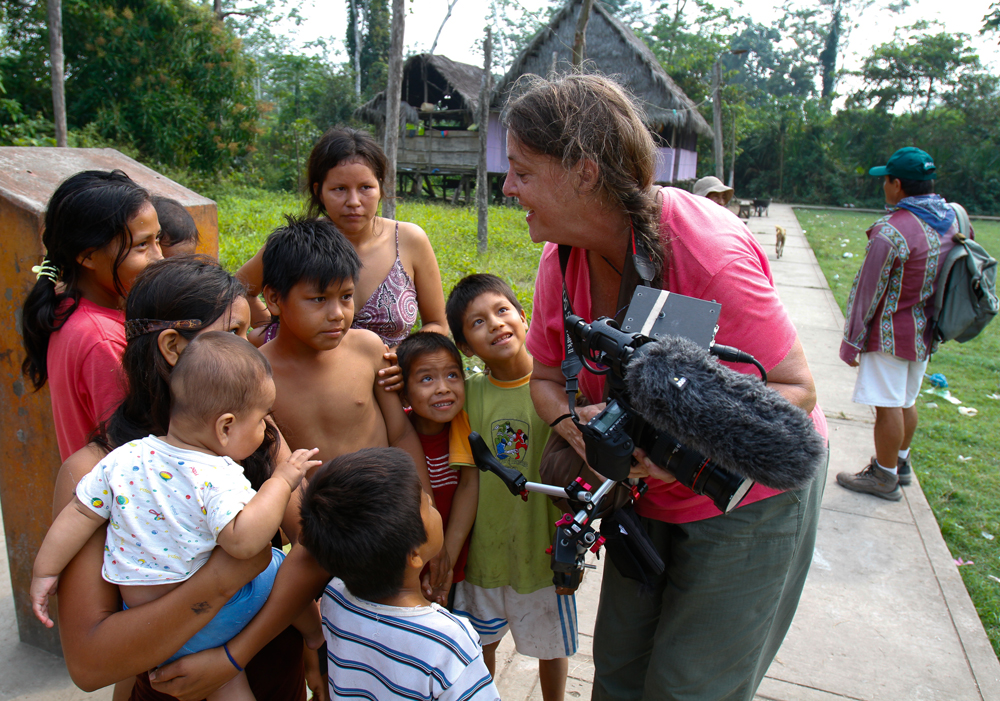
Times have changed –they always do – and now art directors want to look at a photographer’s personal work.  They want to see what a photographer “has to” shoot to fulfill their vision.  It’s not only acceptable now to show personal work to a commercial client – it’s a must.  And it’s never been easier for a photographer to show many facets of their work and career via social media platforms and blogs. It’s also a lot of  hard work.

For me, it’s never been difficult to find something that I’m passionate enough about to be able to spend the kind of time and resources that’s necessary to complete it.  I think that’s the key to starting and completing anything – it has to be something that you really want to do. If you don’t really want to do something, even though you know it will be a good thing to do, you’ll just end up giving yourself reasons and excuses whenever a task needs doing.

For the most part, my personal projects have picked me, not the other way around.  They’ve all started with an idea that just wouldn’t leave my mind. Then I’d start to see my idea in vivid imagery as it played out cinematically in my head.  That’s how my film project, Opening Our Eyes, got started – with an idea that planted itself in my brain, until it was time for me to act on it.  Thankfully, the idea didn’t go away and that I did act on it.  It’s hard to believe that I’m still acting on this idea, more than two years later.  But, I have learned that making a film is a process.  A young filmmaker told me that “a film is never finished – but there comes a time when you are ready to let go”.

I supposed you could say that this film has been my ultimate personal project.  The fact that it was collaboration with my daughter Erin makes it even more personal.  But the lines between work and personal and family have always been blurred in my life.  That’s exactly the life that I set out to live.

Teaching and Learning – Four Weeks in China

It’s the start to a beautiful day in Brookside, NJ and I’m home at last after a long and arduous 4-week trip to China.  I had been teaching Chinese journalists, video journalism or new media as they refer to it in China.

I hadn’t fully realized how hard “teaching” really is until after these past four weeks.  To begin with, I was teaching a difficult subject – “how to produce and shoot short video stories”, to journalists at the “state’s” largest news and photo agency.  I had 4 days to teach 4 weeks worth of material –how to think and shoot in motion, edit video stories and upload them online. To make things even more difficult, everything I said had to be translated by my interpreter to my students, making the instruction take three times longer.

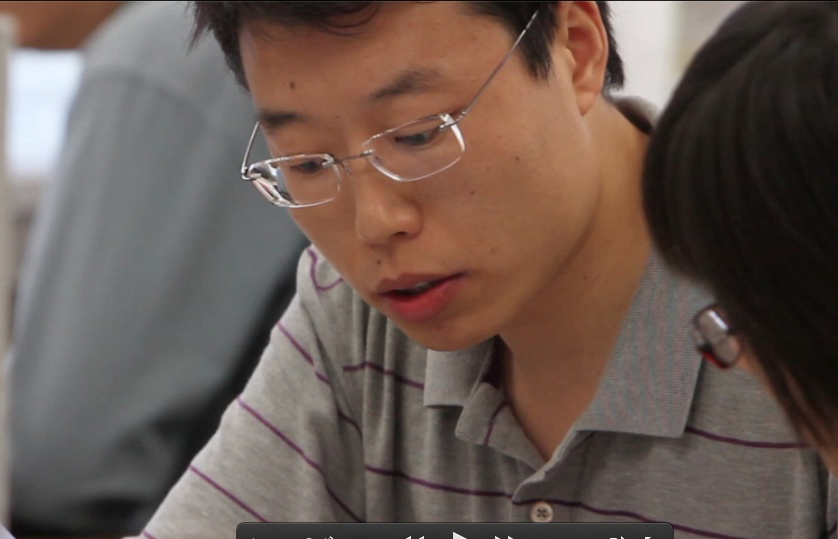
Each week my students amazed me by their eagerness to learn, despite coming to the class with the bare minimum in the way of  “tools”.  Some students didn’t even have cameras that could shoot video. Some had dated low res video cameras and no one had any audio gear at all.  When it came to the editing part of the program, their computers were under equipped to handle Adobe Premiere CS 5.5, which they had recently downloaded and installed on their PC’s. And yet, each class managed to produce a short story after less than four days!

This entire adventure was a lesson in collaboration. My students learned to collaborate.  Like most photojournalists they were used to working solo, so collaborating was a foreign concept to them.  But, collaboration is a common way of working when it comes to video and it was a necessity in China, because the students were lacking in gear.

I was part of a team of four teachers on this trip, so I too was working in a collaborative way.  That was equally tough, as I am used to working as an independent producer and accustomed to making my own decisions.  The other three photographers/teachers were also independent photographers, used to doing things their own way.  Egos collided from time to time within the group, yet we ultimately knew we needed to maintain the “group” in order to deal with the angst that came with doing this job. On top of that, our Chinese hosts wanted to control us.

I think we all learned a lot about each other in the process as this adventure played out.  I know I did.  But, I also learned a lot about myself. Perhaps, this was the purpose of this trip – to learn more about myself and grow from the experience.  Time will tell.

I can also say that I learned from my students.  There is always one student who feels that they already know everything, and usually tries to “stump the teacher”.  When this happens, I handle it with humility and thank the student for teaching me something that I did not know. I do not hide the fact that I don’t know everything.  And then I take the opportunity to relay to the rest of the class, that I never want to stop learning, no matter how old I get.  I tell them that in living this way, it has brought many rewards in my life and I encourage them to do the same.

I’m home now.  It’s a beautiful Sunday morning in Brookside, NJ and I’m reflecting on my last weeks, which remained an adventure until the end.  Chinese activist, Chen Guangcheng was on my flight from Beijing to Newark, NJ, seeking asylum in the US and making a new life for himself and his family.  As Chen adjusts to a totally new life in America, I’m happy to be home again with my freedom and liberties in tact.

What Really is the Future of Photography?

Luis Javier Rodriguez Lopez, done for wikipedi...
Luis Javier Rodriguez Lopez, done for wikipedia, might be found at my webpage in a future; http://www.coroflot.com/yupi666 (Photo credit: Wikipedia)

No one has a crystal ball so it’s really anybody’s guess as far as what the future of anything is.  Anyone who tells you otherwise is simply a bull shitter and they probably have a bridge to sell you as well.

Does anything ever stay the same?  One quick glimpse into history will verify that nothing stays the same.  But sometimes, it difficult to “see” changes because for the most part, they happen slowly.

I’m of the mind that still photography is and always has been just one way to communicate.  Images have the power to grab our attention and linger in our minds.  If I were to ask you to think of 5 still images and to tell me what they are in just 1 minute – which images come into your mind – and why? Do they give you a reference of what what happening in your life, like a song does?  Or are they disconnected bits of pixels?

Quite honestly, I’m bored with this subject of predicting the future and I’m beyond bored with talking about gear.  Gear has nothing to do with communication.  If it did, we could take the human being out of the equation.  Is that going to be the future?  Cameras everywhere, clicking away, recording  what’s transpiring?

I used to say that video and motion was where things were heading.  But I’m questioning that answer now.  I see so many videos that don’t communicate anything, some just visual eye candy moving across the screen or the device du jour.  But then there are a few long and short videos that suck me in and take me to another place – in body and mind. I see still images that affect me the same way, as well as good films. I think all of us can recite memorable lines and scenes of movies we’ve seen.  They stay with us because they’ve hit a nerve or touched our hearts. They’ve told a story – they’ve moved us in some way.  As a visual communicator that’s what a filmmaker is supposed to do.

I am a visual person.  I like to write but I don’t think like a novelist, I think like a screenplay writer.  Don’t misunderstand me, I would never even come close to calling myself a screenplay writer, but I do recognize that is how my mind works. I think cinematically – I think I always have.

For me, the only thing I would predict as far as the future is concerned is that we all seem to be moving to a more visual world in terms of how we communicate.  Will the written word lose importance in the future?.  I don’t think so, anymore than I think that talking with one another will disappear, although there I some days I wonder when I see groups of people in a bar and everyone is looking at their phones instead of talking to one another.  Songwriters will still give verse to music.  That is as old as man has been around.  Technology has changed the way a musician “makes” his music and has certainly how it is distributed.  What hasn’t changed is the emotion and thought behind a good song.

My future will surely be visual and I will use whatever tool best communicates the stories that are within me to tell.  Other than that, I have no idea what is in our future and that is one of the greatest joys in life – to wonder and dream about what’s to come.

The Difference Between TV and New Media

It’s been a tough 3 weeks teaching video to journalists in China – perhaps the toughest thing I’ve ever had to do.  It’s not the teaching part that’s hard – it’s knowing if what I am saying is being correctly translated to my students, it’s being away from friends and family and just being away for so long that makes it tough. I have one more week to go and will take a good long rest when I return to the US.

Last week was especially difficult but yet my amazing students got me through it.  They simply amazed me in how quickly they learned.  They learned in 4 days what it takes most photographers to learn in 4 weeks or months.

Every week I have a new group of students and each week there are always one or two students that I know really “get it”.  There was one student who I coined a nickname for “Mr. Question” because he asked more questions than most.  His questions weren’t just about what settings to use on his camera or how to do something in Adobe Premiere, but more about the “big picture”.  His questions always showed me he was thinking.

One question, this particular student asked me this week, really caught my attention.  He asked me “How are we (new media producers) different than TV?

Stephen-Lee-TV-News-Presenter SMALL
Stephen-Lee-TV-News-Presenter SMALL (Photo credit: Wikipedia)

I had just read an article online that addressed this very question and it talked about how newspaper video journalists are now winning more Emmys than TV news journalists.

I responded to my student by telling him:

  • TV news makes the reporter part of the story – sometimes even the “star”
  • New media tells the story through the voice of the subjects – making them the “stars”
  • TV news is delivered to us on the network channels – 3 times a day.
  • Online news is 24/7 and on demand.  We get the news online when we want it and wherever we want it – on our desktop computers, on our iPhones or on our iPads. We also can share the news and interact with others.  We become part of the delivery chain.
  • TV news journalists rush back to the studio to get the story on air by 5 o’clock. The stories are generally very short – limited to their broadcast slot.
  • As new media producers we have the luxury of working longer on feature stories and delivering them online to a global audience.  While print newspapers and magazines are folding – there has been a rebirth of the long documentary story that can now be delivered online.  We are communicating to a wider audience around the world, no longer being restricted by time and space.

In the 1960’s newspaper executives were lamenting about the good old days and predicting that TV would kill them.  I find it ironic that the shoe seems to be on the other foot now.  I teach “motion” and “video journalism” to a lot of still photographers.  There are some who buy their DSLR’s and aspire to make broadcast spots for TV.  There are some who aspire to make feature length films for Hollywood.  And then there are some who tell me that there is nothing new about video and that field is already glutted with videographers and cinematographers. Those are the old business models for video and motion.

The ones who “get it” are the hybrid creatures that recognize that there is a shift in the way we communicate.  They understand that video is really just another medium in which to tell their stories – not a business model, nor a niche market.

My student in China who asked me this question- he “gets it”.  He understands that he is part of the future of how Chinese journalists and others around the world, will deliver the news. That’s why they call it – new media.

Pioneering in Video

I’ve been in China for the past two weeks, teaching video journalism to some of the best photojournalists in China.  Last night at dinner, the top director of the program told me (via my interpreter) that Xinhua, China’s biggest news agency, was setting up their multimedia department to stay current with how news is communicated in this day and age.  She thanked me for teaching and inspiring her journalists in this medium and said that I was an honorable “pioneer”.

I never set out to be a pioneer when I first started shooting video and motion in the mid ‘90’s – I merely recognized that when the “tools” of this medium became affordable, it was now possible for me to tell my stories in another dynamic way.  But I never turned my back on still photography and I would say that it still makes up about 50% of my business – at least in the time that I devote to it.  I would also say that while I spend 50% of my time split between both mediums – I make more than 75% of my income from shooting motion – capitalizing on not just making income from shooting video but also on the other elements like editing.

I started thinking about the aspect of being a pioneer and the more I thought about it, the more I realized that I wasn’t trying to set new ground at all – I was really just challenging myself and more importantly staying true to why I became a photographer and that was to communicate.

I’ve given a lot of workshops to still photographers who want to move into video.  Generally there are two types of photographers – the ones who think that because they have been “shooting” for many years, they “just” need to understand a new mode on their cameras and the ones who embrace the fact that this is an entirely different medium and they understand that they are novices, and are eager to learn how to communicate in a different way.  It’s usually the cocky photographers that fail miserably and end up with a string of unconnected “moments in time” to a music track.

Ever since the first DSLR that incorporated a video mode hit the scene, I’ve seen more and more still shooters, move into motion.  After only a couple of months, I even see some of them teaching workshops.  It amazes me, because many times some of these same shooters have been hypercritical of “amateurs” coming into their profession with their auto everything “point and shoot” cameras.  I’ve had some shooters tell me that they aren’t going into motion, because they think that when these tools  become easier to use and more automated – the same thing that has happened to the profession of still photography will happen in video.  I disagree with this notion but more importantly I think that this attitude is usually a mechanism people use to talk themselves out of challenging themselves and are reluctant to “change. ” Just like when still photography moved from film to digital – the ones who got left behind were usually the ones who tried to convince themselves that digital would never be as good as film.

I cannot take credit for being a pioneer in video.  There are many who came before me that were true pioneers and I feel that would discredit them and their efforts.  I’m simply a storyteller and I’m happy that I’m still passionate enough about telling the story that I continue to find the best way to tell the stories that I am meant to tell.

Thanks to the gracious people in China and the Xinhua News Agency for recognizing and embracing the future and being keen to learn.  Perhaps many of these students will not shoot multimedia – but learning how to shoot in motion has made me a better still photographer and will make them better shooters as well.

Teaching Video Journalism in China

Chinese flag, Beijing, China.
Chinese flag, Beijing, China. (Photo credit: Wikipedia)

I’m sitting in the Continental (United) airport lounge at EWR, waiting to board a flight for Beijing.  I’m headed to China for 4 weeks to teach Chinese journalists, video journalism.  My mind is spinning with ideas, questions and the usual array of “what ifs” as I take on another adventure.

About two years ago, I started saying “yes” to opportunities that presented themselves to me – or at the very least, I began to consider opportunities, rather than to talk myself out of things, right off the bat.  Because, of that mind set, I’ve been going where life seems to take me and it has presented quite a few interesting adventures.  It’s not that I’m foolhardy and doing things on a whim – it’s that I have been listening to myself – my inner voice – and it has been my guiding force.

I’m told that the Chinese are hungry for “western” knowledge.  But what I have to teach them is something universal, and that is – how to tell a story – using the medium of video.  Seems so basic and simple – how to tell a story – and I suppose it is, but like anything else, it’s simple if you understand it.  The key to understanding something is to have the desire to learn.  Some people say they want to learn – but that’s different than really having the desire to learn.

Some folks feel threatened by this seemingly insatiable desire of the Chinese to learn all things western.  I’m also finding that when people feel threatened by something – they try to “stop” whatever it is they are feeling threatened by.  It’s one of those stupid human tricks that folks have played since the beginning of mankind.  I process this behavior pattern as unproductive and unsustainable. It rarely works as far as eliminating a perceived threat.  You simply can’t totally eliminate desire.

Rather than stop others from growth – a better way is to better yourself.  I’d rather put my energies into where I want to go in my life – than in trying to squash other people’s hopes and dreams.  I’ve also found that what goes around – comes around.  When you “give” and “help” others – you ultimately create a better world – or “space” for everyone.

So, as my mind races this morning with my hopes, my expectations and enthusiasm – I try to keep the nagging doubts and fear at bay.  I tell myself that it’s natural to have concerns.  But I also tell myself that I can either let my concerns consume me and turn into fear or I can welcome the “unknown” and embrace the opportunity at hand.  I’ll let my inner voice guide me because it seems to be doing a good job.

Add to FacebookAdd to DiggAdd to Del.icio.usAdd to StumbleuponAdd to RedditAdd to BlinklistAdd to TwitterAdd to TechnoratiAdd to Yahoo BuzzAdd to Newsvine

The Love and Angst of Learning

I don’t think there has ever been a point in my life when there wasn’t something that I didn’t want to learn about.  I’m just a very curious person who has an insatiable desire to learn. I’ve been learning about filmmaking over the last two years and I am addicted to learn more.  I am realizing that I have always thought in a cinematic way.  As a photographer, I saw my stories as films – a pagination of images – combining to form the story in my mind’s eye. I am so intrigued right now with the craft and structure of screen writing, and want to learn more.  I have a story in my head that I want to “get out” and I see the visual elements playing out in my head.  Now, I’m starting to “hear” the story and the words and I want to learn how to craft those elements into the beginning of a screenplay.

Last Christmas, I got the Rosetta Stone course for Spanish.  When I was traveling with Erin in South America, she became my translator and I was really frustrated that I couldn’t understand the language, so I vowed to learn Spanish.  I’ve been trying to squeeze in the time to learn electronically, but it’s so hard for me.  Languages have always been difficult for me – even English.  Really the only way to learn a language is to immerse your self into it.  I try to tune into conversations when I hear Spanish being spoken and make feeble attempts to participate.  Slowly, I’m getting better but I doubt I will ever be able to roll my r’s.  I have found though that when I “relax” and imagine myself as someone who is fluent in the language, I do much better.  The same thing happened when I was in New Zealand last fall and I got on an ATV vehicle for the first time.  I just pictured myself as being one with the machine and I did just fine.

Lately, I’ve been teaching myself editing with Adobe Premiere.  With Final Cut Pro going to a completely different program, I wanted to expand and learn Premiere.  But, what really prompted me to learn is that I will be going to China for a month, to teach Chinese journalists how to “tell stories in motion”.  I knew I needed to learn an editing application that was cross-platformed and Adobe Premiere was the obvious choice.  Learning Premiere has been easy, especially with Lynda.com. I am such a big fan of Lynda.com. Of course, knowing how to edit helps.  Essentially it’s not much different than Final Cut.  Things are named differently, but the basics are the same.  There are also a lot of things that I love, especially the easier integration with other Adobe products like After Effects, Photoshop and Bridge.  Now the Adobe Suite has a screenwriting application, Story. Could that be the nudge needed to follow through on the screenplay that’s beginning to play out in my head?

So, my learning path continues. But I’m also playing my part by passing along what I know.  Things have a way of coming full circle.

Add to FacebookAdd to DiggAdd to Del.icio.usAdd to StumbleuponAdd to RedditAdd to BlinklistAdd to TwitterAdd to TechnoratiAdd to Yahoo BuzzAdd to Newsvine

Technology – Connecting our Past and our Future

These days with social media it is so easy to connect with people all over the globe.  We can make new friends and reconnect with old friends with ease. We can use social media to share knowledge and ideas or simply stay in touch with friends.

One thing I have learned in reconnecting with friends from the past is that even though time has passed and changes have transformed our lives – the underlying character traits of most people, remain the same.  If someone I knew had been an adventurous soul in college or high school – they were still adventurous souls.  At least this has been my experience when I have reconnected with people from my past.

Quite honestly at this point in my life, I am so involved with my “now”, I don’t really have the urge to dig into my past. I’ve never been to any of my high school reunions and there have been many.  But when I do reconnect with people from my past, they are always people I have a natural and lasting connection with.  What attracted me to those people then, are usually the same things that attract me to them now and vice versa.

With any type of relationship, I take the attitude that the people who are in my life are those that are meant to be there at this time. There’ll be good relationships and not so good relationships, but each is meant to play its purpose in my life.  The same holds true in business relationships – there’s always an ebb and tide in most relationships, and we learn by it…. Or we should.  There’s the sweet and the bitter side to anything in life and it’s almost like those two ingredients need to be there for a “life well lived.”

I’ve learned a lot about filmmaking and the art of storytelling over the last couple of years, and the one thing that stands out, is that every story needs a “conflict” or an “opposition”. Every story needs contrast.  If it doesn’t – it’s not a good story – at least in terms of the entertainment business of films, TV shows, books, magazines etc.  I’ve been thinking about that a lot lately and I try to identify those themes when I watch a movie or read a book.  There is always an element of conflict or opposition to almost all stories and stories are taken from real life.

So when I look at my ultimate story –my life’s story –I tell myself to accept both the pain and the joys of life, because they are meant to be there. They are part of the process. I tell myself to expect the unexpected and leave any and all possibilities open. I tell myself to bridge the past with the now and allow the future to be what it’s meant to be for a life well lived.

Add to FacebookAdd to DiggAdd to Del.icio.usAdd to StumbleuponAdd to RedditAdd to BlinklistAdd to TwitterAdd to TechnoratiAdd to Yahoo BuzzAdd to Newsvine

A Time For Everything

Have you ever had days when you’ve had dozens of pressing items that need attention, yet somehow you just can’t seem to concentrate, no matter how hard you try?  Your mind just seems to drift.  Today is one of those days for me. My mind is scattered and my thoughts are thrown in a million different directions.  Is it a bad case of spring fever or is it the beginning of something less temporary?

Spring is upon us, along with that annual feeling of “new” and “fresh” that comes with it.  It’s a time of year when everything feels hopeful, especially after coming out of the dark days of winter.  This winter was harsh – not in terms of the weather but in what my spirit endured.  Things seem to come in cycles – the ups and downs of life – careers, finances, relationships – the wins – the losses.  All the stuff that goes into a life well lived.

Today my mind is drifting back to memories of those magical, lazy days that seem to be burned indelibly into memory – a rainy day conversation at a plantation in Mississippi, a long walk through Central Park with a friend on an unhurried autumn day, an afternoon on the beach, lingering long after the crowds had gone, to watch the last glint of light on the water – and so many other memories of life’s “quiet moments”.

These are the days that make up a life well lived.  It’s days like today, when I take time to remember that,  there is indeed a time for everything.  Maybe today is a day I just needed to enjoy the day itself , and welcome the spring – and the hope that comes with it.

Add to FacebookAdd to DiggAdd to Del.icio.usAdd to StumbleuponAdd to RedditAdd to BlinklistAdd to TwitterAdd to TechnoratiAdd to Yahoo BuzzAdd to Newsvine

For the Pleasure of It

Many years ago, I had one of those memorable dream assignments. I was doing a story for the National Geographic Traveler on Manor Homes in Ireland – places where tourists could stay.  They ranged from small, historic homes to grand estates. My husband and daughter came along, because this was one of those opportunities I wanted to share with them.

One of the homes we stayed in was actually a large farm owned by the Allen family.  It was a delightful family and everyone was involved with the operation of the farm, the restaurant and inn, and the food – the glorious food.  When I arranged the dates to photograph this property, the inn was full, so they graciously put us up in their private quarters.  That ended up being a blessing in many ways.

One morning, Mr. Allen, the patriarch of the family told his son Rory that he was going to the village to get a flat tire fixed.  When he returned, Rory asked his father how much they had charged him.  His father replied “they did it for the pleasure of it.”  There’s not a day that I don’t think about that remark.

I have never thought of my work as “work” at all.  The line between work and pleasure has never been present in my life – at times it has been a blurred line at most. Sometimes because I didn’t make this distinction, I found it difficult to stop “working” at the end of the day.  My husband, who is also my partner, would occasionally tell me “enough” – but for me there were days it was never enough.  I was doing exactly what I wanted to be doing.

I attended the San Luis Obispo International Film Festival last week as one of the filmmakers who had a film in the festival.  It was incredible in so many ways.

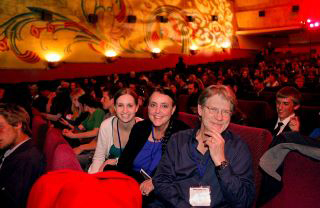
Erin, Gail and Tom at the San Luis Obispo International Film Festival

For starters, I got to share it with my family and friends.  I watched films, went to symposiums and workshops and networked with all sorts of people at parties and events.  It was my reward for all the blood, sweat, tears, hours, days and months that I have invested in this project.

As I met and talked with other filmmakers last week, I was reminded of why I was here, with a film at a film festival. I’ve been doing my work “for the pleasure of it.”  It’s what I love to do.

Add to FacebookAdd to DiggAdd to Del.icio.usAdd to StumbleuponAdd to RedditAdd to BlinklistAdd to TwitterAdd to TechnoratiAdd to Yahoo BuzzAdd to Newsvine