The Difference Between Photographers & Filmmakers

Red carpet of the Palais des Festivals et des ...
Red carpet of the Palais des Festivals et des Congrès during the 2001 Cannes Film Festival. (Photo credit: Wikipedia)

I am winding down after a couple of intense months, traveling the film festival circuit with my documentary Opening Our Eyes.  I have enjoyed every bit of it, but it wore me out – in a good way.

I find that when I am “out there”, I get richly rewarded in many ways.  I think what I enjoyed the most about the film festivals, and what was the most beneficial to me, was the opportunity to dialog with other filmmakers.  I learned a lot in the process. But what stood out to me was how different these conversations were from conversations that I have with my still photographer colleagues.

Many times the conversations I was having with other filmmakers were centered on a story.  That should come as no surprise because that’s what filmmakers do – they tell stories.  But filmmakers tell stories “cinematically”, so when they are talking about the story that they are currently working, or a story idea they want to pursue, they speak in great visual detail so I see a very clear picture in my head.

My conversations with my still photographer peers, in terms of craft, are more apt to be about how they created an image.  Photographers generally talk more about the role they played in making the photo, like how they lit it or the gear they used.  Sometimes, photographers will tell me a story about what they went through to make a photograph and those stories can be very interesting and entertaining, but again the conversation is more about the execution of the image – than the story of the image.

Lately I’ve been trying to figure out how and where I fit into the mix. The truth is, I remain in the middle – a true hybrid.  I realize that ever since I can remember, I have always seen stories playing out cinematically in my head, so I guess I have always had a filmmaker’s mind even though it lay dormant for most of my professional career.  On the other hand, as a still photographer and one who has been an observer of life through my camera I see things like light and composition.

So, I am a true hybrid and I can see my still photographic “eye” in the motion work I create. Others who have seen my film have remarked about the composition and lighting, because it does look different and stands out from other documentaries.  Sometimes that has been a good thing and sometimes not.  Regardless, it is what it is – a creation from a still photographer’s eye applied to motion.

Embrace the differences – see what happens.

Five Things Photographers Should Do if They Want a Future in Photogaphy

An RKO publicity still of Astaire and Rogers d...
An RKO publicity still of Astaire and Rogers dancing to “Smoke Gets in Your Eyes” in Roberta (1935) (Photo credit: Wikipedia)

Understand there’s no such thing as “just do it”.  Nobody “just” does anything; even the folks that make it look that way. I used to watch old Fred Astaire movies and he always made dancing look effortless and easy. But he worked every day of his life on perfecting his skills. It takes a lot of hard work to make a life “your own”, rather than follow a more conventional path.  If you want to sustain yourself financially with a profession like photography, you have to be prepared and willing to do what it takes to make that happen.

Don’t just say no – come up with alternatives. About a decade ago, photographers started rallying together to stand up and say no to bad contracts.  It didn’t work and still doesn’t because there’s always going to be somebody that will say yes.  The problem with “just” saying no is that photographers are only focusing on the problem and not coming up with better options or solutions.  These days photographers have the benefit of technology that has made possible a variety of new options photographers can use to promote and market their work. If we all start focusing on what we can do, instead of just saying no to bad deals, we’d all be better off.

Collaborate/Partner with other creatives.  Photographers have always been fiercely independent creatures.  That has its benefits creatively but can be a real detriment in business.  These days it is a lot easier to connect and collaborate with others, even virtually, and in the process we become stronger as a team of creatives.  Think about teaming up with people who are good at skills you don’t possess, whether it is video or CGI or graphic design.

Walk the Walk – Don’t Just Talk the Talk.  If you have something to say, then by all means say it.  Don’t be a whiner or hang around other whiners and say, “somebody should do something”.  If you don’t like what is happening around you – then do something about it. I am on the board of directors of my trade association, ASMP (American Society of Media Photographers).  I feel that my role on the board is to share my knowledge and skills at this “table” so our members may benefit and the industry stays healthy.  I can only do that if I have something to share and that means I need to be walking the walk – not just talking the talk.  If you are an ASMP member and feel you have something to share with your colleagues, I encourage you to run for the board and become part of the solution. You can declare your candidacy up until December 31st.

Don’t aspire to be part of the status quo.  That just doesn’t work in photography.  You need to be better than the rest to stand out.  What does that mean and how does one do that?  There’s only one way – listen to the voice inside you – and shut out the “noise”.  If you can remember to be true to who you are, you’ll knock the socks off the status quo.


Building an Audience and Why It’s More Important Than SEO

If my sole goal in writing my blog were to attract as many hits as I could, I’d focus my concentration on using all the “right” SEO keywords throughout the context of my writings.  I don’t want to write like that though, with my thoughts focused on using certain key words, in order to get the most eyeballs.  I would rather write with my focus on what I have to share with my audience and what they want and value from me. That may yield a smaller audience, but it will be the right audience.

It’s nice when something I write goes viral, but I’m more interested in building an audience that is also a community of people who are interested in what I have to say, share or sell. I’m also interested in building a community who understand that by interacting with one another, they make each other stronger.  Ultimately, by finding that niche of people who are interested in, and value what I and other members of this “community” have to offer, I am building a sustainable audience. It takes a lot longer to build this type of audience, but in the long run, the returns are longer lasting.

Chris Guillebeau, is a guy who understands how to build an audience.  He writes a blog called The Art of Non-Conformity,

Yesterday he wrote:

“I used to run several little businesses that produced a good income, but they were completely dependent on external factors such as Google rankings or the lack of competition in my space. It was fun while it lasted, but when efficiency entered the marketplace, I had to move on. Looking back, I can now see that I didn’t really have a business; I was merely taking advantage of an opportunity. And most critically of all, I didn’t have an audience. “

He goes on to say:

“When you devote your attention to cultivating and enriching an audience over time, you have much more security. You aren’t dependent on the whims of Apple, the fluctuations of Google rankings, or whether a publisher will return your calls. Listen closely and the audience will tell you what they want. Even if you don’t always get it right, well, keep caring and you’ll get another chance. “

I’m a big fan of Guillebeau because he does listen to his audience. I know that I will always get something of value from his writings.  He gives me a reason to come back, whether it is to read his blog or buy another book or attend one of his World Domination Summits.

I try to apply this type of thinking in how I promote my photography and video business as well in promoting my film.  With my film, I have been able to get a very clear sense of who my audience is, through my FB fan page interactions, the film’s blog and recently by physically meeting people at various film festivals over the last couple of months.  I was able to interact with my audiences and to find out, what they liked about the film through their comments and questions.  I could see how I made them feel through the film how that prompted them to action.  Sometimes the action was to buy a DVD or ten DVD’s for friends and family. And sometimes, I find out later that I had motivated somebody who had watched the film to take some positive action.

I know that if I want to build a sustainable audience I need to do more than to just someone into a theater or to buy a DVD, I need to continue to create and share what I do best, and I will be giving the audience what they want at the same time.

It really all comes down to knowing what your audience wants or needs and being the one who has the desire and the skills to fulfill that need. To really build an audience you need to identify two things that will work together in making that happen:

What you are good at?

And

What your audience (client)  is looking for?

When those two things are in sync with one another, you’ll be building the right audience, which is far better than attracting lots of eyeballs but not giving them what they’re looking for.

Copyright, Contracts and the Independent Photographer

Most photographers hold copyright sacred.  By law, (in the United States) a photographer holds the copyright to his or her work, unless they transfer it to another person, company, institution or organization.  Generally, this happens in a “work for hire” situation.  But it appears that this is becoming more and more the standard in contracts between photographers and the clients who are commissioning them.

This is happening more frequently in editorial markets, where magazines see the added value of the photographs that they commission, beyond their original usage and want to keep that additional revenue, rather than relinquish it to the photographer.  Many publications have partnered with stock agencies for the purpose of “reselling” the images.  Historically, photographers would benefit from relicensing their photographs when shooting for publications. Editorial assignments paid much lower rates than commercial commissions so in return a photographer would receive a credit and in most cases could make additional money by relicensing their images for other uses.  That is quickly changing.

Photographers have been so narrowly focused on just holding on to their copyright, they haven’t been paying much attention to the details in the contracts. Some contracts being offered, transfer the photographer’s copyright to the magazine and in turn offer the photographer a small percentage of any future commissions made from the “resale” of their images, but this of course is a percentage of the magazine’s commission after the stock agency takes their cut.  A lot of photographers think that’s better than not getting anything at all.  But is it?

What’s most alarming in some of the recent contracts that I have seen, is a clause that states that the photographer will hold the magazine harmless if there should be any legal consequences resulting from their images.  So, contractually, even though a photographer no longer holds the copyright to the images they were commissioned to create, nor maintains any control over how those images are used (by the magazine or the stock agency) they are liable if there are legal consequences.

The devil is in the details.  Read the contracts. Do the math and ask yourself if you’ll still be in business in 5 years.  As for me, I see new opportunities beyond commissioned work and one of the many rewards is that I will hold the copyright to the images (still or motion) that I create.

How to Become a Still and Motion Hybrid

I’ve been living the life of a still and motion hybrid for the last 13 years.  Sometimes my work is weighted toward still imagery and sometimes more toward motion.  These days, it seems more like the two mediums have merged and my time is evenly balanced between both.

This past month I’ve talked to a lot of filmmakers as I’ve traveled around the film festival circuit with my film, but I’ve also talked to lots of photographers at Photo Plus Expo and other photographer gatherings.  I started to notice a difference in the conversations I was having with still photographers and filmmakers.  Filmmakers were usually talking about “the story” and the conversations were more like listening to the unveiling of a movie.  Still photographers, tended to talk more about how they executed “the story”.

When I talk to “hybrids”, the conversations are a blend of telling the story, with a bit of “execution” thrown in. I’m starting to notice something new in visual communications with a new aesthetic developing.  This recently became very apparent to me when I was asked to be a juror on the 1st AP-AI Motion Arts Awards.   I looked at over 50 entries and what I saw was a very unique look emerging.  What I saw was motion through a still photographer’s eye and it was incredibly exciting.

As technology continues to change how society communities, I truly believe that we as photographers need to think of ourselves as more than just someone who shoots still imagery.  As print gives way to electronic delivery, photography will take on a broader meaning as to how it’s executed.

Some things to keep in mind going forward:

  • Hang around with people who are embracing change.

From Seth Godin:

“Who you hang out with determines what you dream about and what you

collide with.

And the collisions and the dreams lead to your changes.

And the changes are what you become.

Change the outcome by changing your circle.“

  • Stop thinking of video or motion as a separate market
  • Stop giving yourself reasons NOT to do something.
  • Say YES more often
  • Remember the “tools” and the “medium” are just a means to an end. We have a whole array of new tools to create with and platforms that allow us to communicate globally.  Get excited about that.

Why Photographers Need to Stop Thinking of Video as a Market

I find that many still photographers I talk to either want to “get into video” – or they don’t.  In either case, most photographers think of video as an entirely separate market. The truth is, video is not a market at all.  It’s simply another visual medium a “photographer” can use to express themselves with, convey a story, or hopefully do both.

I have been a still photographer for over 30 years and a motion shooter for over 15, but I have been a storyteller since I started talking.  I have not abandoned my still photography, by any means, In fact if anything, adding motion to my skill set has made me a better photographer.

These days, I work with whatever medium that best conveys the message or story that I need to deliver.  I not only think about that in creative terms but also in how the story will be delivered and to whom. Last week

English: Cover of the February 17, 1933 (vol. ...
English: Cover of the February 17, 1933 (vol. 1 issue 1), first issue of News-Week magazine (now Newsweek). The issue features seven photographs from the week’s news on the cover. Featured are: Adolf Hitler, Franklin Roosevelt, Joseph Stalin, Franz von Papen. The issue has 32 pages and cost 10 cents. (Photo credit: Wikipedia)

Newsweek announced they were no longer going to publish a print edition. Clearly that will have a trickle down effect on paper sales, printers, advertising agencies, on down to photographers. It won’t just affect photographers shooting for Newsweek, but will also have an impact on commercial photographers as well. It will affect many markets.

We, as a society are communicating differently and everything is in flux because of it. People are getting their news immediately and on demand, on their phones and other mobile devices.  How can a print edition of a news magazine compete with that?  It can’t. How will advertisers react to that?  That’s the million-dollar question, isn’t it?  How can an advertiser monetize the “mobile platform”?  Do they make a viewer watch a short ad at the front end of a story?  As we communicate more and more using smaller devices, advertisers and marketers will need to come up with new ways of reaching their target audience.

Technology is a double-edged sword. It forces change on all of us but it also opens up opportunities.  The advertisers will be able to know exactly the audience they ARE attracting, based on information gathered from analytics.  Independent photographers can use technology the same way, if they open their minds up to new ideas and start to see opportunities.  But that will only happen if they start to see video as just another medium to work with, instead looking at it as a separate market, and telling themselves that’s not what they do.

I had the privilege recently of being a juror on a “motion” competition.  I was very encouraged by what I saw and I looked at over 50 videos.  I saw something new and different.  I saw the “photographic eye“ applied to motion. I saw a different visual aesthetic emerging.  Makes sense doesn’t it?  Photographers creating in a new way using new tools for a society that communicates differently.

Your Inspirational Heroes Are Just Like You

Today, October 9th is the birthday of two people who have been very inspirational to me over the years – Jackson Browne and John Lennon. Lennon would have turned 73 years old today if he had not been gunned down in NYC when he was only 40 years old.  I admire both of these men, not only for their incredible skills in writing but also for their activism and courage to stand behind their beliefs.

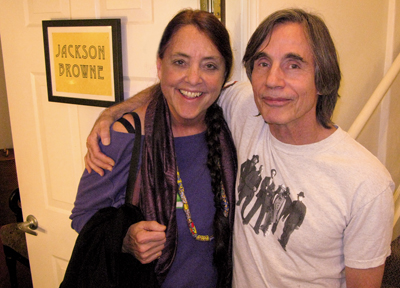
I had the honor of meeting Jackson after one of his concerts last October.  It was a memorable moment. Jackson had allowed me to use his song, “Alive in the World” in my film, Opening Our Eyes and it had been arranged for me to personally thank him after the show. He was warm and generous with his time and we talked a bit about the blues – a topic that continues to surface in my life.

The blues (music) seems to be the foundation of many of the musicians that inspire me. The blues is authentic and that authenticity comes through in the lyrics of both Jackson and John.  Throughout their songs, we get a very clear idea of how they feel and think. They share their frailties and inner thoughts as we see them as real people just like us.

I suppose a lot of us think it’s too risky to be so open with our thoughts and our hearts and choose instead to bury our  dreams, desires and fears inside the deepest recesses of our minds. A lot of angst can come sometimes from remembering things that have happened in our past – things we did or wished we had done – things we said and wished we hadn’t said – you know all those fleeting thoughts that seem to haunt us at times.  None of us can change the past – it has already happened. But we all can choose how we let our past affect our present and our future.

Some of us try to “block out” the painful things that have happened in our lives. I have found that I can’t really succeed in doing that because there will always be something that will trigger a memory. In fact when I try to “close myself” off like that, it actually just continues the pain, because I’m expending negative energy, trying to “block” it out . Instead, I try to channel those thoughts when they come, into more positive energy by reminding myself who I am, not how someone or something made me feel.

Everyone has ups and downs in their lives – it comes with being human.  That’s why the music and lyrics of Lennon and Browne resonate with their fans – they can relate- as humans. I think as creative people we can learn from these two musicians – how to take chances and how to be true to ourselves and follow our own path – regardless of how unconventional it may seem to others .  When we are true to ourselves, we will find that our future direction will unfold as it should – we just need to get out of our own way.

“You don’t need anybody to tell you who you are or what you are. You are what you are!” John Lennon

Stressing the Story

Years ago, a colleague wrote an article about me for a trade magazine and entitled it “Gail Mooney – Past and Future Storyteller”.  Before that was written, I had never really thought of calling myself a storyteller, even though I had lived my entire life pursuing “the story”. In fact, it was because of my infatuation with people’s stories that I became a photographer and filmmaker. The pursuit of the story is what has driven me in making my own choices in life

But having a love for the story is far different than being able to tell a story. Regardless, if the story is told through still images, movies, songs, poems or books, the story must come through in order to resonate with an audience. I’ve been reading a lot about screenwriting lately, and how a story is written and structured for the movies.  Certain things must take place within the structure to make a story work.

  • Characters should be well defined and developed in the first third of the film.  The audience will need to get enough information about the characters in order to care, one way or another.
  • Stories should have conflict and contrast – just like life.  In every good film there is usually a low point right before a character prevails or a situation turns itself around.
  • Cinema has a language all of its own in how it tells and drives the story. The choice of lens or the way the camera is moved and from what angle, conveys to the audience a feeling. Make conscious choices and decisions as to what cinematic tools you use and why.
  • They say editing is the last line of defense for the story.  Every cut an editor makes has a profound effect on how the audience will feel.  An editor is able to tell a story in a hundred different ways, based on what clips they choose, how they cut them together and their selection of music.

I was very fortunate when I first started learning video.  I took the Platypus Workshop with PF Bentley and Dirck Halstead and they always stressed  “the story”.  I remember that I couldn’t even begin to shoot my project until I got my “commitment” (story) ok’d by Dirck or PF.  In order for them to commit to my story, I needed to commit to it first and they knew I wouldn’t be able to do that until I knew the story well enough to tell it.

Knowing and communicating your story in any medium simply means always being present in what your doing.  When the choices and decisions become obvious and effortless, then you know that you are telling the story you meant to tel

Forcing Accountability

Yesterday was one of those days that I had a hundred things to do and only a few hours to do them.  I had to give final approval of an ePub I was wrapping up, package and send out exhibition Blurays and posters to film festivals that I have been invited to and finish a video job I was editing, all before heading into NYC to moderate a panel discussion on video for the NYC chapter of ASMP.  My mom used to say, “If you want something done – ask a busy person”.  I never did understand that when I was younger but I know now, that the busier I am – the better I am with utilizing my time.

I was also fine-tuning the presentation that I was going to be giving to the students at Brooks Institute next week. As an alumna of Brooks,

Gail Mooney as a student at Brooks Institute
© Chad Weckler

I was honored when I was asked to speak. I was also taking this responsibility seriously and I was getting a bit stressed over it, which is uncharacteristic for me.  I’m usually very comfortable with public speaking.  I knew I wanted to talk about the value of “community” and how being part of the ASMP has played into that, but I didn’t want to sound “canned”.  I knew that I needed to personalize that message and really boil it down to what that has meant to me.  But I also knew I needed to come off as someone who is still relevant and not be perceived by the students as just someone whose their mother’s age. I needed to show my spirit inside that hasn’t aged at all since graduating from Brooks all those years ago.  I knew I needed to put myself in their shoes and see through their eyes in order to really connect with them. I started thinking in terms of what I know now and what I wished I had known back when I was a student at Brooks.

So, as I headed into NYC, I had a lot going through my mind.  The ASMP event was great.  It was a packed room with an engaged audience and terrific panelists.  But the best part of the evening was the networking after the event.  That’s where the real sharing of information happens and a sense of community is felt.  It’s easy to get disconnected these days from the human connection because we all spend so much (too much) time online.  That human connection will never be replaced by technology. That was one thing I wanted to point out to the students when I talked to them next week – to physically get “out there”.

I got home late and woke up early and needed a good jolt of coffee while I checked my emails.  One email jumped out at me. It was a newsletter from Jonathan Fields who I started subscribing to after hearing Jonathan speak at the World Domination Summit this summer.   The newsletter had a link to a video of Jonathan interviewing, Chris Guillebeau the founder of the World Domination Summit.  Chris writes a blog that I follow, called the Art of Non-Conformity.  As I listened to the interview, it became clearer as far as what I wanted to say to the students in my presentation next week. Chris said one thing that was right on target.  He was talking about pursuing an idea and he said that by putting your idea out to the world – by telling someone about it – you were in fact “forcing accountability”.

I thought back to when I first had the crazy notion of traveling around the world with the purpose of creating a feature documentary about individuals on six continents who were making a positive difference in our world.  The idea had been tossing around in my head for months before I told anyone.  Then one evening as I was walking back from dinner with fellow ASMP board member, Blake Discher, I decided to put the idea “out there”.  It was something I did on impulse, but as I look back on it now, Blake was probably the right one to “test run” this crazy idea on.  He responded with an affirming, “thumbs up”, but not overly exuberant, which was exactly what I needed. Blake is a very grounded person, so for someone like him to not look at me and tell me that I was out of my mind, was the nudge I needed.  So, it was that short, impulsive, casual conversation that forced me to be accountable with my idea.

I went on to make the movie that I set out to make and even better, I got to share the experience with my daughter Erin.  It has changed both of our lives for the better.  That’s not to say that everything has worked out in ways that I may have wanted or thought I wanted.  But it has been a journey that I was meant to take. I have met people that I never would have met in the process and that in turn has led to so many more incredible experiences and adventures that I couldn’t have possibly imagined.

I started thinking about my life’s journey and all the things I have learned since my days as a student at Brooks.  And then I thought,  “what if I knew then what I know now? “  The thing is, if I had already known all those things back when I was a student, I never would have had the journey that I’ve had.  Everything happens in its own time and when it is meant to happen.  And that’s what life’s all about – the journey along the way and that only happens when we leave room for the unexpected.

Saying Goodbye to a Friend and Colleague

Today the photo world is mourning the loss of Susan Carr.  Susan died yesterday after her long battle with cancer.

Susan was perhaps the strongest woman I have ever known.  She was also the most giving.  She gave above and beyond, everything and anything she put her mind to. She tirelessly gave to ASMP (American Society of Media Photographers) and many of her colleagues will attest to that.  But I will remember Susan beyond her work for ASMP  I will remember Susan for her positive spirit.

One fond memory I have of Susan is the day my daughter, Erin graduated from Northwestern University.  My husband, Tom and I were the only “family” members to attend Erin’s graduation because most of our family lives on the East Coast and Chicago isn’t exactly around the corner.  We were going to have a nice, but simple celebration lunch and I called Susan and asked if she would like to join us.  She happily accepted our invitation and was humbled to be included in our celebration. Her presence that day was so joyful and she made the day even more special.  She was part of our family that day and she helped us celebrate one of life’s wonderful moments.

Susan and I didn’t always agree, but we always had the utmost respect for one another.  We were both women in a business that was dominated by men – at least that’s how it was when we first started out in our careers.  That’s changed over the years as more women have entered into the business of photography, but back then – you had to be a strong woman to compete in what was then, a “man’s world.”

But as strong as Susan was, she also had a heart of gold and a deeply intuitive nature. You could see that in her work. Her ongoing project, photographing people’s environments, really showed her spirit to be true.  She gave her still images of these environments  a “voice”,  even though there was no sound. Even when no people were present in her photographs, you could hear and feel the inhabitants of the environments that she selected to shoot.  She leaves behind a wonderful legacy with her work and a testament to the time she lived in.

I will miss Susan in many ways, but mostly in how she encouraged me.  When I first started giving seminars and had a few bumps with some negative feedback, Susan had faith in me. She supported me  and gave me helpful advice that was right on target and just what I needed.  She was also a big supporter of my film, in many ways.  On September 20th, Opening Our Eyes will screen at Valencia College in Orlando, FL as part of a celebration for International Peace Day and The Global Peace Film Festival.  After the screening, the students will congregate outside and make a human peace sign – each one bearing a lit candle.  Those candles will be for you Susan – your life on Earth was far too short but you burned so brightly while you were with us and you will always be remembered.

“To find your calling is a gift.  A purpose provides the drive to pursue
excellence along with an unwavering belief that your work is of value.
When you can take this resolve and turn it into a vocation you achieve
a rare and extraordinary feat.”

~ Susan Carr, “The Art and Business of Photography”