Licensing Video?

There are probably people who would argue with me as far as the practice of licensing video being the norm in the world of video production, other than the licensing of stock motion footage. Perhaps that may be true in some business models and certainly true in older business models, but I can tell you that has not been my experience.

I should clarify that I do not position myself as a “hired gun”– meaning a camera operator who turns over their footage at the end of the day. I choose to assume the role of producer and maintain control over my intellectual property or the finished video product. I cannot do this in the traditional motion picture industry but that business model is changing due to technology and the influx of indie filmmakers who are making their own rules and bringing their films to market themselves. And for the most part – I can’t do this in high-end broadcast spots when working with a middleman – or ad agency where ultimately their end customer maintains all rights.

However, the demand for video has skyrocketed in recent years and with that has created a new client base who are using video in new ways and on new platforms. I am establishing my own set of rules accordingly. One of them is licensing the finished product just as I did my still images. I can only do that with video productions that I have produced and hold the copyright to.

Typically, I will separate the licensing of my still images from the video product as well as the creative fees. I may be shooting both mediums on the same job but I handle the licensing differently. I have found that video has a shorter shelf life so I am not as concerned about the duration of the license (length of time) as I am with still imagery. But I am concerned about it’s “reach” which these days is global – thanks to YouTube.

Another thing I do is I make sure that it is stated in my contract and/or estimate that the license for the entire video production does NOT include permissions and/or licenses to any still images that are made from frame grabs pulled out of the video footage. Putting this up front in the estimate has actually proved beneficial because if a client does anticipate the need for still images – they will hire me to create stills – rather than take them from frame grabs.

We are living at a time where just about everyone’s business models are changing. So, if someone tells you that licensing video isn’t the norm – outside of the stock motion footage business – think again. What is the norm these days? It may be the precedent we are setting now.

Add to FacebookAdd to DiggAdd to Del.icio.usAdd to StumbleuponAdd to RedditAdd to BlinklistAdd to TwitterAdd to TechnoratiAdd to Yahoo BuzzAdd to Newsvine

How to be a More Interesting Person

I came across one of the best blog posts I’ve ever read this past week on Forbes.com.  But before you jump off to that link, I’d like to share some of my thoughts-about what makes some people interesting – and some not.
  • Talk to people outside your inner circles – I found when I was a student at Brooks Institute, I was frequently bored at the student/photographer parties because all the conversations centered around just photography.  It was a natural topic for discussion but the talk was always about gear and rarely about creative ideas. I found more stimulating conversations outside my peer group which actually helped me creatively with my photography.
  • Be a better listener.  Have you ever had dinner with someone who commanded most of the conversation but followed up later with a note telling you what a great evening they had in your company?  People love to hear themselves talk and for many – great listeners become “interesting people” in the process.
  • Do things and go places where interesting people hang out.  Get out of the house and away from your TV set and interact with people from all walks of life.  I’ve spent a lifetime street shooting for magazines.  My most memorable conversations have been with people I’ve encountered along the way.  These are people who I never would have interacted with normally but those are the conversations that have stayed with me over the years.
  • Be yourself. So many people do things to “fit in”.  They become clones of their environment rather than staying true to themselves. There is nothing interesting about people like that for me.  That’s why I travel and embrace other cultures.
  • Minimize the swagger.  This one is right off the Forbes list but it’s a good one.  No one likes being around folks who are full of themselves and have big egos.  Some groups of people are more prone to this than others – generally people who come from professions where they feel what they do for a living has life or death consequences. Doctors are really the only ones dealing with life or death situations – and quite honestly a lot of doctors I’ve met aren’t very interesting to talk to because many are so self important, they let their egos get in the way.

I hate to make broad strokes but I find artists, filmmakers, musicians, taxi drivers, doormen (and women) and circus people some of the more interesting people to be around.
Get out more – live life fully – try new things – talk to more people and people who aren’t like you at all – be open – be giving – be caring – share – and embrace life every day with joy.

But check out the Forbes.com post – it’s an easy read and will bring a smile to your face.

Add to FacebookAdd to DiggAdd to Del.icio.usAdd to StumbleuponAdd to RedditAdd to BlinklistAdd to TwitterAdd to TechnoratiAdd to Yahoo BuzzAdd to Newsvine

A Solo Act

Video is very much a collaborative effort, and that’s exactly what I love about it. I’ve made some wonderful connections and partnerships while creating my documentary, Opening Our Eyes.

But every now and then, I find that I need to go “solo”.  I am a storyteller and a bit of a wanderer by heart and it had led to an interesting life – a life full of people, cultures and far flung destinations around the world. I have found that when I travel solo, I become more absorbed into the culture of where I am. I have no one with me to distract me or draw my attention away.

I’ve spent many years, traveling, observing and shooting stories for magazines all over the globe. In looking at my old work or even when editing new work, I’ve noticed a similarity in “feeling” among many of my images. There’s a quiet contemplative mood that shows through. In my people photos this “mood” is apparent in the connection that I make with my subjects – whether in a posed or candid photo. With my landscapes there’s more of a serene, yet melancholy moment.

I’ve come to realize that this “feeling” in many of my still images come my perspective as an”individual” who is solo when shooting. I can always tell which images I’ve shot when I’ve been by myself as opposed to those shot when traveling with a group. It’s hard to put into words, but when I’m alone and I’m exploring, I shoot differently. I see differently. I interact differently and people react differently to me.

So, I will always make room for both ways of working in my life – collaboratively and as a solo act. Each one brings its own rewards into my life and to my craft.

Add to FacebookAdd to DiggAdd to Del.icio.usAdd to StumbleuponAdd to RedditAdd to BlinklistAdd to TwitterAdd to TechnoratiAdd to Yahoo BuzzAdd to Newsvine

The Problem With (Most) Video/Motion Workshops

This has been something that has been weighing on my mind for months now – ever since the seemingly “overnight sensation” of people giving video workshops as well as the growing number of still photographers that are feeling the need to take these workshops.

The biggest problem that I see with all the video/motion workshops that are out there is that they oversimplify video production and take the approach that the single independent still photographer can learn and do it all – produce, operate the camera, capture good audio and manage the post-production and edit.  I suppose to be fair – while it may be true that the independent still shooter can learn all facets of video production, that is not the best approach as far as setting up a viable business model for a video production company.

Video is a collaborative medium.  While I may be able take just about any video production from soup to nuts single handedly – I know that the production would suffer if I did.  I learned a long time ago to build a team of good sound people, editors and even camera operators that I can draw on to hire on a need be basis.  They make the production and me look good and that’s what keeps my clients coming back.  It also allows my business to grow because I can take on more projects. If I’m not entrenched in all aspects of the production. It frees me up to start production on another project while still in post-production of a previous project.  If you are a one-man band, you not only don’t have this option but you actually make yourself look small in the process.

Video and motion have many facets to them.  I advocate that the best business models are when one positions themselves at the top of the content creation ladder by overseeing the production of the whole and hiring the appropriate crew that will facilitate the process.  By recognizing the differences between this business model and the “solo” model that most independent photographers work under, you’ll have a much better shot of maintaining ownership of your work and creative vision as well as having the potential to grow your business beyond your own singular capabilities.

The other problem with workshops that over simplify the process of video production by promising that you will be up and running after a one day workshop is that they are centered around learning the gear and the software which changes by the month.  If you learn just the gear du jour and not focus on the business of video production you will be in competition with other independent dabblers and that’s a quick way to the poor house in terms of sustainability.

A week doesn’t go by when I don’t get at least a dozen calls or emails from still photographers who feel they need to get into video and are overwhelmed by the learning curve.  I tell them that the best thing they can do is NOT to try and learn all these skills themselves and that in fact that will only delay their entry into the video production, business if that is what they are after.  A better way is to keep your focus on your vision, apply that to a sustainable business model that will incorporate video and collaborate with others who will make you look good and help you grow your business.

Add to FacebookAdd to DiggAdd to Del.icio.usAdd to StumbleuponAdd to RedditAdd to BlinklistAdd to TwitterAdd to TechnoratiAdd to Yahoo BuzzAdd to Newsvine

Five Top Tips for Emerging Photographers

I talk to a lot of young aspiring photographers these days and invariably I am asked, “What advice would you give someone who is just starting their career in photography? – Is there a future? – Can I make a living?”

I don’t have a crystal ball but I do have 35 years of experience behind me but yet the enthusiasm and outlook of a 25 year old.  I remind myself of what I learned from my mentors when I was just starting out. One mentor, who shaped my career, was art director Adrian Taylor of Travel & Leisure Magazine. Adrian taught me a lot – about magazines, about the story, about style and taste and most importantly he gave me the confidence to believe in myself.  Adrian gave two young, naïve photographers, my partner and myself a chance and in return – we always gave it our all every time we set out to shoot a story.

Add to FacebookAdd to DiggAdd to Del.icio.usAdd to StumbleuponAdd to RedditAdd to BlinklistAdd to TwitterAdd to TechnoratiAdd to Yahoo BuzzAdd to Newsvine

With that said, I would not be where I am today if it had not been for mentors like Adrian Taylor and my greatest joy at this point in my life is to pay that forward to photographers just starting their careers.

  • Learn video – Video is no longer a “specialty niche” or in fact a separate genre at all.  In the very near future – which is already upon us – a photographer will need to know how to shoot both stills and motion – or partner with someone who does.
  • Stay true to what your inner voice is telling you.  For example, if your passion is to be a photojournalist, don’t listen to people who are telling you that photojournalism is dead and that newspapers are a thing of the past.  While “printed” newspapers may be dying out – journalism and photojournalism is not.  Don’t let others’ dogma determine what your path should be.
  • Collaborate with your peers.  When I was first starting out, photographers kept their clients, their techniques and their ideas to themselves.  But I have found that whenever I have collaborated with others – we all push the bar to the next level – each bringing their own strong suits to the project.  As a subject of my film Opening Our Eyes told me “We’ve got to shine each other up.”
  • You don’t need the validation of others to proceed with your idea and make it into a tangible plan and product.  As far as publishing and/or distribution is concerned – the gates to the kingdom are open and the kingdom is the entire world.  We are living in a time of empowerment for the individual and for a content creator that is profound.  If you are willing to do the work – the rewards are bountiful.
  • Act on the ideas that don’t go away.  It’s easy to let resistance sabotage you.  Resistance comes from many places – your loved ones, friends, your peers – but mostly yourself.  Stop talking yourself out of ideas and start acting on the ones that just won’t quit you.

I have made my work my pleasure in my life.  I have always found it difficult to separate the two.  When you feel that – you’ll know you are on the right path.

Competing With Yourself

I started writing this blog a couple of days after I got to New Zealand. Now I am in the airport lounge waiting for my departure after an incredible 16 days in this country.

When I began this post, I had just won the Bronze award for Travel Photographer of the Year at the SATW (Society of American Travel Writers) convention in Wellington, New Zealand. I was up against some pretty stiff competition from some of the best travel photographers in the world, so it was an honor that I greatly appreciated.

On the last evening of the convention, they announced the winners of the Photographer Shootout that had taken place the first 3 days of the trip. The starting point was the Auckland airport where all the photographers involved were given their own vehicle – each identical in every way so as not to give anyone an unfair advantage. You could make your own itinerary and go anywhere you wanted to on the North Island – as long as you returned the car in Wellington – 3 days later by 5PM.

The weather was mixed as it usually is during springtime in most countries. We had some clouds, some sun and one morning of hard rain. One of the challenges of course was driving on the left side but that wasn’t as frustrating as the lack of a “shoulder” along the road to pull off to when I saw a magnificent sight – which was just about every 5 minutes. The distances were deceiving and invariably I had twice as much on my itinerary that I ended up getting to.

When I finally returned the car, I was happy to be rid of it – weary of the winding roads that were quite challenging at times. I felt good about the photos I had captured – but not overwhelmed by them because there were so many that I knew I had missed. When they announced that I had won second place silver portfolio – I was surprised and delighted because it had been so challenging for me on many levels. I’m mostly a people and city photographer, so in a country that’s known more for their scenery than large population centers – I was constantly pushing myself out of my norm.

I think that is why the shoot out reward is particularly meaningful to me. I wasn’t trying to beat out my competition and in fact I didn’t feel like someone else needed to lose in order for me to win. I felt good that I had pushed myself out of my comfort zone and every time I have done that, I have been richly rewarded. It was nice to be recognized by my peers and it was nice to win a prize but the best part of all was the feeling that I gave myself. I succeeded in what I had set out to do and that was to try something new and face some trepidations.

The older I get I realize that it’s all about the journey – not the destination.

Add to FacebookAdd to DiggAdd to Del.icio.usAdd to StumbleuponAdd to RedditAdd to BlinklistAdd to TwitterAdd to TechnoratiAdd to Yahoo BuzzAdd to Newsvine

Burning Bridges

I used to have a friend who would tell me that my life was made up of circles, each one completing the ring like segments of my life.  The truth is that’s not unique to me – that’s life in general.

It’s Photo Plus Expo week in New York City, when photographers from around the world gather at Javits to look at new gear, take part in seminars and network.  I don’t think I have missed an Expo since they began over 30 years ago. A lot has changed in the photography business over the past 30 years, but one thing is for certain and that is – it’s a very small world as far as the people who are part of this business.

Last night, I went to a couple of parties where I ran into quite a few people that I’ve met over the span of my career.  Some I had done commissioned assignments for, some I had met through seminars that I had given and some were just old friends that I hadn’t seen in a very long time.  But a couple of folks who approached me last night, and struck up a conversation, were people who had totally blown me off in years past – people who had simply ignored me.  In every instance, these had been people who had recently experienced a shift in their own lives and now had a sudden interest in me and in what I was doing – to further their own gain.

I know that I have burned a few bridges in my lifetime and I’m sure there are some I’m not even aware of. (Anyone who tells you that they haven’t burned bridge is just simply not aware.)  Some of those bridges, I have tried to rebuild and have succeeded. and some were beyond repair.  What I have learned – and wish I had learned 20 years ago – is that everything comes around in your life, no matter how much you have grown or changed – the past is always present. And it seems easier sometimes to change the past – but of course that’s not possible.

What I’m finding now is that due to profound changes in the photography business as well as the lingering lousy economy, that the same people, who had ignored me or dismissed me a few years ago, were now acting like my “best friend”.  I’m sure they didn’t remember how dismissive they had been to me – in fact I doubt that I was even on their radar at the time.  But circumstances had changed in their lives and now they were taking notice of me and even asking for my help. I suppose I could say that they had burned a bridge with me but then again in most of these situations there had never been a bridge to burn to begin with.

The point is, you never know how your past will affect your future.  You may think that you are in a position where you have no need for certain people in your life and be dismissive.  But nothing lasts forever and if there is anything that I’ve learned by getting older – it’s just that.  Our lives are made up of circles, each one connecting our past with our future.  Consider that when dealing with people who come in and out of your life – because nothing ever stays the same.  Many times you’ll find out that those people that you thought  you had no use for in your past – may be key in your future.   Hindsight is the best sight and you always get the best light from a burning bridge.

Add to FacebookAdd to DiggAdd to Del.icio.usAdd to StumbleuponAdd to RedditAdd to BlinklistAdd to TwitterAdd to TechnoratiAdd to Yahoo BuzzAdd to Newsvine

What to do When in a Slump

There are all types of slumps – creative, financial, relationship and personal. I’m sure there are others, but those are what come to mind – I’ve experienced all of them. I think that comes with living the kind of life I lead. There are times when it seems like I’m on a never ending roller coaster ride with lots of ups and lots of downs. The one thing I try to do when I’m in whatever kind of slump I’m experiencing,  is to focus on the areas that seem to be working in my life.  I’ve learned to take the bitter with the sweet.

Here’s some other remedies I have found that help get me out of a slump:

  • GET OUT – I mean that literally as well as figuratively. I break the pattern of what I am doing that doesn’t seem to be working and “get out” of that place. I also literally – get out – I change my environs – I get together with friends.
  • TRY SOMETHING NEW – I do something that I may have been thinking about, but I usually talk myself out of with every rational reason I shouldn’t do it. So, I follow my irrational instincts.
  • WALK AWAY – This is especially true when you are dealing with something technical and you just don’t “get it”. There have been days when I have struggled with something that wasn’t working – like when editing in Final Cut Pro – and I need to give myself some time away from the problem. But this only works if you aren’t up against a tight deadline. I try not to force a learning curve into situations with tight deadlines.
  •  FOCUS ON WHAT IS GOING RIGHT – There is always something to be grateful for – focus on that.
  • BE STILL – I think this is perhaps the most important remedy that I have learned to embrace and that is – to give something time and not  force it. If something is meant to happen then it will – and in its own time.

Every one of these “remedies” is pretty much centered around the same thing,  and that is to recognize that there will always be slumps in one way or another – but they will make those sweet times that much sweeter.

Add to FacebookAdd to DiggAdd to Del.icio.usAdd to StumbleuponAdd to RedditAdd to BlinklistAdd to TwitterAdd to TechnoratiAdd to Yahoo BuzzAdd to Newsvine

Being Yourself

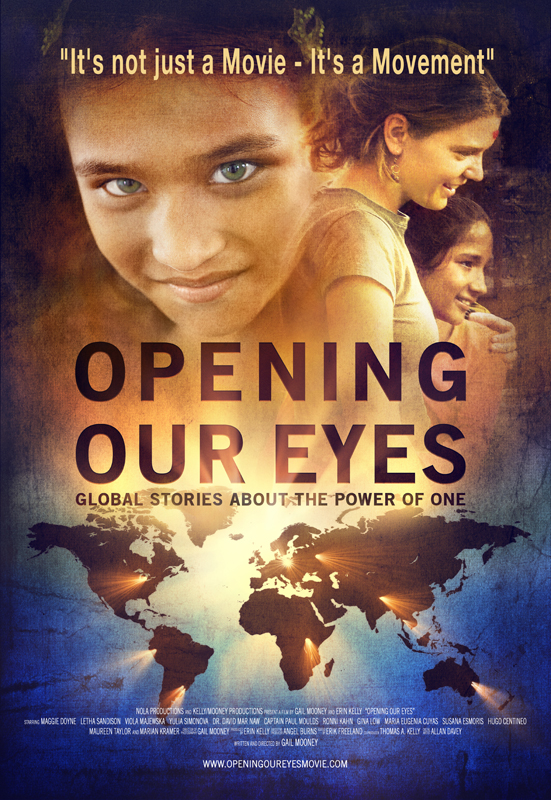
Yesterday, I gave a talk and showed a bit of my film, Opening Our Eyes,

Movie poster for Opening Our Eyes

at the PACA conference in New York City.  I had been asked by ASPP to speak about the making of the film and my plans for distribution.  To tell you the truth, even though I’m always thrilled to show and/or talk about the film, I was a bit nervous with this crowd.  PACA stands for the Picture Archive Council of America and its member include some of the biggest stock photo agencies in the world, including Getty, Corbis, Masterfile and Alamy. I was nervous because part of my message was that I no longer needed the validation or others to get my stories to market.

I thought my message would be somewhat threatening, because I was telling the audience that content creators no longer needed the traditional gatekeepers of the past, to get their stories “out there.”  That because of technology, it was possible for the individual to have a global reach and if one is willing to do the work – the prize is all theirs – meaning the monetary rewards.

I had a tough time slot to speak – right after lunch  –  I knew that I would be dimming the lights for the film and that is never a good thing to do in that time slot.  But, Tom Kennedy had given his very inspirational talk about new media and new opportunities in the  marketplace.  I had heard Tom’s talk  as part of ASMP’s SB 3 series this past year – and I knew that my presentation was a great follow up to his – and in fact it was almost like a case study example of what Tom was talking about.

My presentation went amazingly well and as I looked out into the dimly lit audience as the film was playing – I couldn’t see any closed eyes.  I felt that I made a connection, and that perhaps in some small way, I had made a difference.  Maybe, I just got people thinking about what they could do to make a difference in their own lives.  And maybe I had influence beyond that.  But, I know that I stayed true to myself.  My intent was not to come off as threatening  – but I did want to make people feel a tiny bit uncomfortable.  It’s when we get uncomfortable that we push ourselves to a better place.

My message was simple.  Someone doesn’t need to lose – in order for someone else to win.

Add to FacebookAdd to DiggAdd to Del.icio.usAdd to StumbleuponAdd to RedditAdd to BlinklistAdd to TwitterAdd to TechnoratiAdd to Yahoo BuzzAdd to Newsvine

Women and Photography

I have to get something “off my chest”, so forgive this mild rant.

Yesterday, I attended a conference in NYC.  It was a trade show geared to video production with an educational track.  I was sitting in on one session and there were only a handful of people in the room – I’d say less than 10.  I was the only woman in the room. The instructor went to each person in the classroom and asked them what they wanted to learn from his workshop.  He went to everyone in the room – but me!

I was sitting next to my partner, who is also my husband.  I suppose the instructor decided that he didn’t need to ask ME that question. I didn’t count.  Maybe because we were together and he felt that he only needed to ask one of us.  But if so, why not ask me? I felt invisible. It was an all too familiar feeling that I have had in my 35-year career as a photographer and now a filmmaker. But I couldn’t believe that I was still feeling invisible after all that I’ve accomplished in those 35 years.

When I started my career in photography, it was definitely a man’s world.  I was one of six women at Brooks Institute and the only woman in my graduating class.  I fell in love with a “Brookie” and we headed back East to make our fame and fortune in photography.
We’ve done a lot of jobs together over our 35-year partnership and we’ve done a lot on our own.  I needed to do my solo gigs because I felt I had to prove to myself that I could deliver the “story” or the task on my own.  When I worked with my partner, it was always assumed by the client or our peers that I was the rep for my partner – never the photographer.  People have always asked us why we refer to each other as partners rather than husband and wife – that’s why.

Perhaps that’s why I try so hard – but then again maybe that’s just my nature.  And maybe because I always give it my all, I can’t help but be surprised when I’m treated like I’m invisible.  At this point in my life, I can either let it bother me or I can think about who I am and what I’ve done and contributed to my profession.  I focus on that and I take every opportunity to share and talk to young people – women and men.

The irony is, in photo schools these days the women far outnumber the men, yet there are still instructors out there like the one that I encountered yesterday.  I have to ask myself why? I do know that in giving seminars over the last two years for ASMP, I would consistently get comments from women telling me how refreshing it was to have a woman teaching tech.  But they also told me that I wasn’t intimidating like some male teachers they’ve had.

So what’s the point?

I only have one point and that is don’t hire me because you need to fill the slot with a “female” – hire me based on what I’ve accomplished.  Hire me for who I am.  Think past the gender and teach your children well.

Add to FacebookAdd to DiggAdd to Del.icio.usAdd to StumbleuponAdd to RedditAdd to BlinklistAdd to TwitterAdd to TechnoratiAdd to Yahoo BuzzAdd to Newsvine