SB3 – Get Inspired

If you haven’t registered for the ASMP Strictly Business 3 conference yet, I would highly suggest that you do so.  They will be held in three locations starting next week: January 21-23 in Los Angeles; February 25-27 in Philadelphia; and April 1-3 in Chicago.

There’s an incredible line up of speakers presenting workshops on pricing, estimating, copyright, workflow, strategic career planning, successful portfolios and branding and video production. I’ll be presenting two workshops: “Thinking in Motion” and “Shooting Video with the DSLR”.

Branding expert Colleen Wainwright will deliver her keynote “Making People Love You Madly: Selling Yourself in a Postmodern Marketplace”.  Tom Kennedy, whom I’ve know since his days at the National Geographic Magazine will give a keynote “Learning New Skills for the Changing Media Landscape”.

This conference series is meant for everyone, not just photographers who are beginning their careers.  In fact, I think that photographers who have been in business for many years will benefit equally, if not more than a shooter who is new to the business.

I have been in business for over 30 years and I have found that one of the most dangerous things that can happen to a creative person,  is for them to become complacent, especially in a business like photography.  It’s even more deadly to become complacent these days in our fast changing world of technology.  We not only need to stay current with our skills, we need to keep our vision fresh.

When I got into video and motion more than a decade ago, I was looking for something to excite me.  I felt that even though my business was successful and that I had accomplished many of my creative goals, the spark was getting dim inside me and at times I felt like I was reinventing the wheel.  So, I set out on a learning curve and have been soaking up information ever since.

I love to learn and I have found that the more I wonder and grow, the better off I am creatively and the more successful I am in business.  I’ve also found that networking and collaborating with my peers has opened my eyes to all sorts of possibilities that I never knew existed.  I think that’s what makes the SB3 conference so powerful – the sharing of information with our peers.  You don’t get that from online learning.

We live in a time where anything is possible.  Come to SB3 in LA, Philadelphia and Chicago and be prepared to be inspired.

Add to FacebookAdd to DiggAdd to Del.icio.usAdd to StumbleuponAdd to RedditAdd to BlinklistAdd to TwitterAdd to TechnoratiAdd to Yahoo BuzzAdd to Newsvine

Don’t Become a Photo”saur”

A lot of people tell me that I’m way ahead of things since I got into video/motion over ten years ago. Most still photographers weren’t even thinking about video ten years ago. Neither was I. Nor did I have a crystal ball. But I am a visual communicator and that means that I am always looking for the best way to communicate the message or tell the story. And twelve years ago, it became possible and affordable for me to deliver the message with another medium. Not instead of still photography but in addition to it.

My desire to explore video and motion at the time, wasn’t coming from a “tool” point of view. It was coming from a cultural one. When I think about it, I wasn’t fascinated by the technology – I was fascinated by what people were doing with the technology. Fast forward a decade later and I’m just wowed by where all this has gone. Our culture has changed dramatically in the last ten years because of technology. And while that is still “fascinating” and like creative adrenalin, it’s also a game changer in how it has affected the business of photography.

Don’t get me wrong and think that my message is to tell you to get into video or multimedia so as not to become a photo”saur” and become extinct. That’s not what I’m saying. What I am saying is that the cultural psyche has changed. Take notice and adapt. That doesn’t just mean, change the subject matter you shoot or how you shoot it to stay “fresh”. And it doesn’t mean to buy a video camera or a hybrid and start shooting motion. Those are probably good ideas but probably not going to be what keeps you in business.

The old days aren’t coming back. The ways of doing business have changed. Technology is democratizing when it’s placed in everyone’s hands. Understand that. Know that your clients understand that. So, think past the tool and technique and focus more on who you are and what you can bring to your customers to stay relevant. Some thoughts to ponder:

• Who are you? (why do your customers come to you and not your competition?)
• What services do you offer your client? If you don’t offer video and your client needs to look elsewhere – you’ve lost an opportunity.
• Are you still a one-man band? I don’t mean you need a large staff but have you considered setting up a virtual company when you need it with editors, sound people etc.?
• Do you continue to learn?
• Are you still using a dated business model ? Consider different licensing strategies for new media.
• Do you utilize social media?
• Are you noticing who’s “coming up” – the new talent? Do you try to see them through your customer’s eyes.
• Are you interested in other things besides photography?
• Are you willing to take risks? Creatively and otherwise.
• Ask yourself the question – how would I have approached this if I was just starting out?
• Think of solutions – then look at those decisions at a total 180.

Learn. Grow. Adapt.

Don’t become a photo”saur” and become extinct.

Add to FacebookAdd to DiggAdd to Del.icio.usAdd to StumbleuponAdd to RedditAdd to BlinklistAdd to TwitterAdd to TechnoratiAdd to Yahoo BuzzAdd to Newsvine

Editing Tips for Multimedia and Video

A few days ago, I wrote a blog about “having a point” – or telling a story when you create multimedia pieces. Of course you have to have an overall idea and focus to start with, but below are some editing tips on how to make it come together in the editing room.

  • Edit with a purpose. Why are you making the “cut” where you are? Are you cutting on the action? Are you cutting on the beat of the music? What’s the reason behind your cut?
  • Set a pace or rhythm. Just like writing, where you have pauses in sentences with commas, edit your visuals to your narrative or interview soundbites, cutting after words and phrases.
  • Use image sequences to transition between different ideas and themes.
  • Let your images linger on the screen, giving time to breathe between them.
  • Cut on the beat or against the beat of music. Edit the music and let it become part of your piece, rather than just a background soundtrack.
  • Adjust the volume of your music – lowering it during interviews and raising it when there is no narrative or dialog.
  • Use audio fades between music cuts to soften the cut.
  • Insert room tone between cuts in interview soundbites, making the cuts less apparent.
  • Use interview footage sparingly – when introducing someone or when someone is expressing emotion on the screen.
  • Identify interview subject with name and title text in lower third.
  • Use text that’s easy to read and break it up over many slates. Leave the slate on the screen long enough to read twice.
  • Always start with your strongest images.
  • Don’t “move” all your still images – leave some static on the screen.
  • Don’t use dissolves.
  • When working with media from DSLR cameras, keep the media in the DCIM folders for logging and transferring into Final Cut Pro with the plug-in. If you have taken your media out of the DCIM folders – then create a new DCIM folder for the purposes of importing the media into FCP.

Remember to keep the story in mind at all times. When you think you have the story laid down in a rough cut – have friends over to watch it. Ask them what the story was. If they don’t know or can’t tell you, then you have more work to do.

Add to FacebookAdd to DiggAdd to Del.icio.usAdd to StumbleuponAdd to RedditAdd to BlinklistAdd to TwitterAdd to TechnoratiAdd to Yahoo BuzzAdd to Newsvine

The Power We Have as Visual Creators

The last two weeks have been enlightening and humbling for me, and I’ll try to share some of the thoughts that have been racing through my mind.

I was honored to be asked to speak about video, at ASMP’s Ohio Valley Chapter’s Photo Tech conference last week.  It’s a great event and an enthusiastic and engaged group of people.  I also had the pleasure of seeing Walt Jones presentation:  “CGI – Friend or Foe”.  Walt is a talented photographer and CGI artist.  He is in my opinion a new breed of visual communicators.  He started out by showing examples of “images” and asking the audience if they were photos or CGI.  I was 100% wrong with every one of my guesses.  The point is – I couldn’t tell the difference.  I was in awe of the power of these relatively new tools that we as “image creators” have at our fingertips.

It really got me thinking that “seeing is NOT believing” anymore and the ramifications of that.  I started thinking of the ethical consequences and how in the wrong hands this power can be misused. But as I tossed those thoughts around in my head, I realized that this is really nothing new as far as the power we, as visual creators have, to manipulate an image or skew the story or the message.  Even before Photoshop and similar applications hit the scene, we as image creators could sway opinion or belief, just by what we chose to show, or not show.  If you look back in history, photographs, film and TV, have swayed public opinion long before the tools of Photoshop and CGI.

Yesterday, I got an email from a photographer, Aaron Huey, with a link to his Ted talk.  He told the story of the Lakota Sioux Indians through his words and his images.  He presented a timeline of this tribe’s history through his words, as he showed his images of modern day Lakota on their reservation or as he refers to it – their prisoner of war camp.  It was one of the most powerful Ted talks, I have ever seen.  It also reinforced the notion of the “power” that we all have as visual creators.

I’ve been thinking about that power a lot, and the responsibility that comes with it and that I believe that we all have the obligation, to use it wisely.  A few years ago, I created a documentary entitled Freedom’s Ride, a story about two diverse groups of high school students who rode the bus together to Alabama, tracing back the Civil Rights Movement of the 1960’s. The words of one teacher that I interviewed have stayed with me.  He said, “we can pass all the laws we want – but we can’t legislate morality”.   I’ve been thinking about that statement a lot this week.  It’s never been more important than it is now, because of the tools of technology, that we make sure our moral compasses are in check and headed in the right direction.

Add to FacebookAdd to DiggAdd to Del.icio.usAdd to StumbleuponAdd to RedditAdd to BlinklistAdd to TwitterAdd to TechnoratiAdd to Yahoo BuzzAdd to Newsvine

Should You Be Thinking About Video?

For the past two years I’ve been traveling around the country presenting a seminar called “Should I Be Thinking of Video” for ASMP (American Society of Media Photographers.  This seminar had become quite popular with still photographers as interest in video escalated, partly due to the hybrid cameras and partly due to the increased demand for video content for the web and mobile devices.  The iPad in particular is a game changer and everyone seems to be keen on either creating video content or buying it.

With this rush to find or produce video, I’ve seen quite of few people attend these seminars because they feel they have to get onboard.  A few weeks ago, someone in the audience, who appeared quite annoyed, raised their hand and said, “but you didn’t answer the question – should I be thinking of video”.  He went on to say that there was nothing new about video and weren’t there plenty of videographers already out there. I replied that he needed to answer that question himself.  I could only provide him with background information about video production but that decision as far as if he should embrace video was for him to make.  I also said that yes there were plenty of videographers out there working in traditional markets that have been around for decades.  What is new is the increased demand for video because we as a society are moving more toward an electronic means of communication and away from print.

I think the most important point here is that no matter what creative path you may wish to pursue, you need to have a reason for doing it.  For me, I started shooting video more than a decade ago because as a storyteller, I felt the need for motion and sound to adequately tell the stories that I wanted to tell.  I certainly wasn’t chasing a trend – not that video is a trend.  Just like in still photography, it’s not about the tool or the camera, it’s about your vision and if you don’t know why or if you should be shooting video then how can you possibly have a clear vision.

I can probably better answer the question “should you be thinking of video?” this way.  If it’s because you have a camera that is also capable of shooting in video mode then then the answer is no – you shouldn’t be thinking of video, because you will be a technician or a button pusher and will compete with every other person who has that same tool. But if you are thinking, seeing and feeling projects and stories that are all about motion and sound, then you’ve answered that question for yourself.

Add to FacebookAdd to DiggAdd to Del.icio.usAdd to StumbleuponAdd to RedditAdd to BlinklistAdd to TwitterAdd to TechnoratiAdd to Yahoo BuzzAdd to Newsvine

Photo Plus Expo 2010 Etc.

What a difference a year makes.  I’ve been going to Photo Expo since it started, whenever that was some 20 or 30 years ago. It used to be held at the Coliseum, New York’s old convention center, when it was much smaller.  Over the years Photo Expo got bigger and bigger, with huge sections of the floor devoted to lab equipment and hundreds of other booths displaying everything from cameras to computer software.

The last few years the Expo has gotten smaller.  Gone is all the lab equipment of course, but also not present are some of the big vendors like Adobe and Apple.  This year was the first year there was another photographic event happening simultaneously, called “Shoot NYC….an advanced photography forum”.  This event was hosted by Hasselblad and Broncolor, and just few blocks away from Javits. I didn’t get a chance to get down there but I heard rave reviews from those who went saying it felt like it was geared more for the “professional”.

One difference I have noticed over the years of attending Photo Expo is the shift in the attendees, more toward retail photographers and prosumers. That was reflected both on the floor and in the seminar selections. There was an entire seminar track this year devoted to weddings and portraits. Another sign of the times was seeing an entire seminar track devoted to video and multimedia, as opposed to one or two seminar choices in previous years. I could only find one seminar this year about stock photography; actually it was about microstock in particular. That’s a big change from when there were a dozen seminars relating to stock photography to choose from.

I presented a seminar with Paula Lerner called “Multimedia and Video” and was part of a panel for a seminar called “Ethics and Photography” which was streamed live globally, but I did find time to sit in on a couple of very interesting sessions.  One of my favorites was “Affordably Simple Marketing”, given by Juliette Wolf Robin.  She provided a lot of terrific tangible information.   I also enjoyed seeing and hearing Lauren Greenfield talking about her documentary work.  And even though I’m not a teacher, I found “Teaching in the 21st Century” quite interesting.  As always Blake Discher’s seminar on “Sales and Negotiating for Photographers” was fantastic and fresh. I also attended ASMP‘s annual member meeting where Tom Kennedy spoke about the new media landscape which was right on target.

The floor was smaller and as mentioned before, Adobe and Apple not present.  Canon and Nikon had a lot of action and interest with their hybrid DSLR cameras as expected and I saw a lot more third party gear for the hybrids displayed – Zacuto rigs, Redrock Micro rigs, and Glidecams, along with fluid head video tripods.  This trend is not going away and in fact isn’t a trend at all, as we move more and more toward electronic publishing with magazines scrambling to produce versions for the iPad and get their app designed.

The annual “bash” was more of a bust, leaving people hungry and thirsty due to no food being offered (except bags of potato chips) and a cash bar.  It was held at the Intrepid, which sounded like it was going to be interesting, but not a great venue for a party.  But it was nice to see my friends and colleagues and catch up with them.

It will be interesting to see what this event will look like next year – I can only guess that there will be plenty more changes.

Add to FacebookAdd to DiggAdd to Del.icio.usAdd to StumbleuponAdd to RedditAdd to BlinklistAdd to TwitterAdd to TechnoratiAdd to Yahoo BuzzAdd to Newsvine

“Kickstarting” a Passion Project

For anyone who has been reading my blog, you know a few things about me – I love to dialog and share with others, my work and my pleasure are one in the same and I always have a passion project that I’m working on.

I can’t say that I’ve always been like this.  In the beginning of my career it was a lot harder to dialog and share with people – pre-social media and email.  And as my career took hold and I became busier with work, I didn’t have time for sharing or personal projects.  But for someone like me who is a dreamer, I was starting to burn out.

When I started exploring the video medium in the late 90’s, it triggered a spark in me.  I started thinking and dreaming about all the stories that I wanted to tell – that would be possible for me to tell – through this medium.  One of my first attempts at telling a story with video was a short documentary I did on my daughter’s youth symphony.  I couldn’t have picked a harder subject if I tried because it was all about sound, which I knew nothing about.  And anyone who has ever shot a musical concert knows that it’s almost impossible to do with only one camera.  But I naively pursued with this project and learned a lot in the process.

My next passion project was The Delta Blues Musicians that I envisioned as a multimedia project combining still environmental portraits of these musicians along with video interviews, capturing their life’s stories.  It was a lot of work and for the most part, I went it alone – doing everything myself.  For anyone who has ever tried to shoot both stills and video on the same job, you know it’s not an easy thing to do.  That project will always be near and dear to my heart and continues to reward me in ways that I never knew were possible.

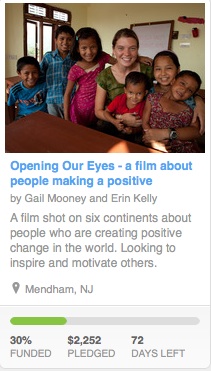
There have been other passion projects since these first two and my head is usually full of ideas that are rumbling around, just waiting for the right time to surface. I am in the midst of a project now, Opening Our Eyes that is perhaps the most ambitious one I’ve ever dreamed up. This past weekend I launched the project on Kickstarter.  Kickstarter is a website that posts creative projects for the purposes of finding funds. It’s a perfect example of crowd funding where one can donate anywhere from $1 to $10,000 to the project of their choice, and in the process make someone’s idea come to life.

I launched Opening Our Eyes on Thursday and within 3 days we reached 30 % of our goal. We still have a long way to go and have another 71 days to get fully funded.  The way Kickstarter works is that if you don’t get funded 100%, then all bets are off and you don’t receive anything.  So, I’m doing my best to do what I like the least and that is make a pitch for pledges.  My intent is to secure enough funds so that I can collaborate with a professional editor and raise the bar on the film that my daughter and I shot this past summer on our 99-day adventure around the world, about people who are making a positive difference in the world.

It’s really a win/win for anyone who chooses to give – even a pledge of $25 will get us closer to our goal and you’ll receive a DVD of our film when it’s finished.  So please check out our project on Kickstarter and pass this link along to others.  Ultimately our goal is to inspire and motivate other change-makers through the power of our film. We know we can do it with everyone’s help and it will make you feel good to give – it always does.

Add to FacebookAdd to DiggAdd to Del.icio.usAdd to StumbleuponAdd to RedditAdd to BlinklistAdd to TwitterAdd to TechnoratiAdd to Yahoo BuzzAdd to Newsvine

Fear and Isolation

I see it everywhere – people reacting – frozen by their fears. And it seems to be catching.  That’s because fearful people like company.  Somehow they feel that if they can get others to bind with them in spreading their doom, that their own fears and trepidations will be validated.

People are so angry these days because their world is changing and they feel threatened.  I see it in government where the tone these days is angry – full of hatred and fear and more time is spent pointing the finger of blame at others than in coming up with solutions to problems.

I see groups and organizations taking on a “we versus them” insular attitude, thinking that somehow by keeping people out of their exclusive group – they will have more for themselves.

I see relationships where one person may feel threatened or insecure and tries to exclude other people and relationships from their insular lives. They foolishly believe this will make their relationship stronger – the two of them against the world so to speak.

I understand why the fearful act this way.  Somehow they think that if they can convince others to go along with them in their pursuit of eliminating competition or outside influences– they will receive more.  But it doesn’t work that way.  It never has and it never will.  The simple reason is that people who spend their time telling themselves and others what won’t work or focus just on themselves, instead of embracing others and being open to possibilities, become insular and ultimately create their own demise. They are bringing nothing positive into the world – no motivation for growth – only reasons why they should stop themselves.  They predict the future in negative ways and in the process create that reality and then say, “see I told you”.

The group that tries so hard to keep things the same and feels threatened by newcomers ultimately becomes a group of old thinkers who die out.  The person who attempts to gain more attention from their mate by keeping them from their friends and outside interests, soon finds out that doesn’t bring them more attention, but rather resentment because it’s unsustainable.

There have been times in my life that I’ve been sucked into these negative mindsets and I can tell you that not only it didn’t bring anything good into my life – it kept good out.  These days, I have been giving more of myself.  I have been getting out there and meeting people, sharing with people and I’m finding out that in the process, I’ve gotten a lot more in return. But I don’t give with the expectation to receive in return – I give because in the long run, everyone benefits.

We become stronger when we allow others in our lives to give to and to learn from. We should strive to allow people in our lives who want us to succeed, because those people understand that in helping and supporting us in turning our dreams into reality – they are also creating a better environment for themselves.  And when a couple understands that when they love their mate enough to let them and their spirit soar by not manipulating or placing restrictions, their relationship will ultimately get stronger and will stand the test of time.

Think about this today.  What kind of life do you want to live?  Do you want a life of possibilities or one of predictable doom by keeping your “community” narrow and insular? You never know – that person that you decided to exclude, may have been the one who could have changed your life – in a positive way.

Add to FacebookAdd to DiggAdd to Del.icio.usAdd to StumbleuponAdd to RedditAdd to BlinklistAdd to TwitterAdd to TechnoratiAdd to Yahoo BuzzAdd to Newsvine

The Power of Yes

I’ve just experienced one of the most extraordinary weekends of my life – all because I said yes.  Barely more than a week ago, I sent an email with a link to the trailer of my documentary to Rebecca Self,

Rebecca Self at the European Summit for Global Transformation

who I was introduced to by two of the subjects in my film, Letha Sandison and Maggie Doyne.

Letha Sandison and Maggie Doyne

Rebecca is an amazing woman – she’s a connector of change makers.  The day after Rebecca got my email, she replied “Would you consider coming to Amsterdam this weekend and showing your trailer at The European Summit for Global Transformation.  My first thought was “wow” – and with a title like that, it was bound to be a gathering of very interesting people.  My next thought was, “it’s not possible – there’s not enough time – the airfare will be high” etc. etc.  All very practical thoughts – right?

And then I flipped it and told myself all the reasons I should say yes. I ‘d have the opportunity to show a culturally diverse audience a sample of my film and talk about the idea behind it. I would get to see Letha and Maggie again because they were going to be speaking.  And most importantly, I would be spending the weekend with people that not only believed that anything is possible – but are making the impossible happen, together. So I replied to Rebecca and said YES.

For two days I listened, as all kinds of people told their stories – people who are actively doing things that are making our world a better place. They awed me with their courage, their commitment and their passion.  But the most empowering part of the conference was connecting with these people, who were not only there to talk about what they were doing, but also to network with others to help them make their commitments a reality.

As I write this, on my last night in Amsterdam. I’m ready to head out to have one final dinner with some of the most fascinating  people I have ever met.  It has been a powerful weekend, being part of this group of people, from all over the world that are making extraordinary things happen.  This is what my film is all about – the power of the individual, working together to make things happen – across the globe.

To be able to show my ten-minute trailer to these amazing change makers was an honor and reward in itself.  But to spend the weekend with such a unique group of people who believe that anything is possible, was extraordinary and fortified me as I go forward in editing over 150 hours of footage.

I have a friend who is always telling me that I need to say “no” more often – because I tend to spread myself too thin.  But this time, I was glad I said “yes”.

Add to FacebookAdd to DiggAdd to Del.icio.usAdd to StumbleuponAdd to RedditAdd to BlinklistAdd to TwitterAdd to TechnoratiAdd to Yahoo BuzzAdd to Newsvine

The Thin Line Between Work and Pleasure

I’ve always been lucky because there’s a very thin line between my work and my personal life. That’s because I’ve never looked at what I do for a living as work, or at least if one defines work in negative terms.

I became a photographer and later a filmmaker because I’m a born storyteller and the camera is a means to that end for me. I come from a long line of storytellers, as evidenced by boxes of old letters telling the tales of family long gone. While they may have told their tales by pen, through their words, I have chosen the camera as my tool to tell the stories that I have to tell. So how could I possibly equate the word work with the professional life that I’ve built – telling the stories of people and companies around the world? It’s in my blood.

Sure, there have been jobs through the years that seem a lot more like work than others, especially when a client hasn’t trusted their instincts in why they hired me by allowing me to trust mine. But there have been so many other jobs where I’ve had to pinch myself to believe that they’re real.

I’m also a firm believer in following my instincts and that has led to many rewarding opportunities in my life. I’ve been doing that a lot lately and the universe is opening up for me. I’ve stopped waiting for someone else to validate me in order for me to pursue a project that I’m passionate about. I’ve stopped telling myself all the reasons that I shouldn’t do something and I’ve replaced them with all the reasons that I should. I think about the pros and don’t dwell on the cons. And that’s because I’ve blurred the lines between work and pleasure.

I’ve just completed a 99-day journey shooting a documentary on change makers – people who were making a positive difference in the world. Over the weekend I got an email, inviting me to show my ten-minute tease at the opening of the European Summit For Global Transformation in Amsterdam, this weekend. I immediately started to discount it, telling myself that I didn’t have enough notice etc. etc. Then I saw it differently – I saw it as an incredible opportunity to not only show the tease of my film but to network with like minded people. So, this evening I’m headed to Amsterdam.

Years ago when I was traveling a lot, shooting for magazines like Travel & Leisure and National Geographic Traveler, as I departed for my trips, my mother always used to say – “have a nice vacation”. I used to get annoyed because I thought that she didn’t recognize the fact that I was working and not going on vacation. But, as I reflect back on the “work dynamic” that I’ve set up for myself, I think – maybe she was the one that had it right. It’s been one long pleasure trip.

Add to FacebookAdd to DiggAdd to Del.icio.usAdd to StumbleuponAdd to RedditAdd to BlinklistAdd to TwitterAdd to TechnoratiAdd to Yahoo BuzzAdd to Newsvine