ASMP and Motion

I’m on the National Board of Directors of the ASMP, The American Society of Media Photographers.  About four years ago, I was asked if I had ever thought about running for the board.  The person who had asked me this question, knew that I had been shooting video in addition to still photography and thought that it might be a good idea to have someone on the board who had an understanding of this medium.  That was four years ago, and even though I had been shooting video for over 10 years – the “explosion” of this medium (in terms of the demand) had really just started.

I did run, served three years, ran again and got elected. I’ve shared my knowledge of this medium through meetings, seminars, blogs, emails and during Q&A’s when I screen my film.
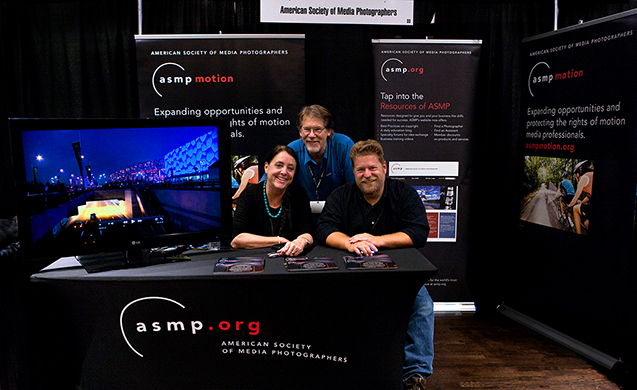
Gail Mooney, Tom Kelly and Chris Hollo at ASMP booth, DV East

This past Wednesday, I spent my day manning the ASMP booth at DV East Expo. Former national board member (and now President of the ASMP Tennessee Chapter) Chris Hollo and my partner Tom Kelly joined me.  We were well prepared with a large flat screen monitor displaying a loop of our members work. I was intimate with the reel as I had just finished editing it and I was very impressed with the quality of the work.  It certainly was an attention grabber.

So, what was ASMP, a trade organization of still photographers, doing at a video expo? Essentially, we were there to provide a community and reach out to other professionals who are shooting both mediums and provide information about sound business practices.  If this demographic does not understand the value of copyright or value the concept of licensing, then it will ultimately affect the way business is done in the still photography industry.

Some people may think that ASMP is becoming too inclusive or is creating more of a problem by suggesting that video may be the answer for its members, only for them to find out, that industry is glutted as well.  The old business models of bloated production companies with fat budgets are hanging on for dear life, along with the old business models of the film industry.  But if you think outside the box, especially in terms of how you structure your photography business – the opportunities are out there.

ASMP doesn’t cease to be an advocate for its still photographers who have no interest in motion – it’s actually making the entire industry healthier by educating the hybrid competition.  A lot of the people I talked to yesterday, shot both still photography and video, but even the ones who just shot video – called themselves “photographers” and they all had questions about “the business”.

I’m so closely associated with  “video” by members of this society; they tend to forget that I am a photographer.  I don’t call myself a photographer simply because I spend 50% of my time shooting still images, or call myself a videographer because I spend the other 50% of my time producing video. I don’t want to define myself by my tools, at all. I “see” as a photographer, with the vision of a filmmaker and the heart of a storyteller.  I also have a strong desire to stay in business doing what I love to do.  By being an advocate for sound business practices across these mediums, I get a lot more back than I give.  All photographers’ benefit, regardless of what type of cameras they shoot with.

Friend and fellow board member Ed McDonald, tells his own story about how he had become too rigid at one point in his career, as far as how he perceived himself and what kind of photographer he was. He found that when he became more flexible in how he “defined” himself, his business got better. As I think about Ed’s story, I know we have a lot in common.  For me, when I stopped restricting myself to just shooting still images – not only my business got better – so did my still photography. Shooting motion has made me a better still photographer because it has made me a better storyteller.

I got an email late last night from someone I ran into at the expo.  They wrote:

“Thanks for your vision and inspiration and all you’ve done for ASMP.”  So simple and so poignant and I thought – “isn’t that what I was supposed to do?”
Making a Movie With a DSLR and (crowd) Funding It

The first thing I will say is – I did it!  I successfully created a movie

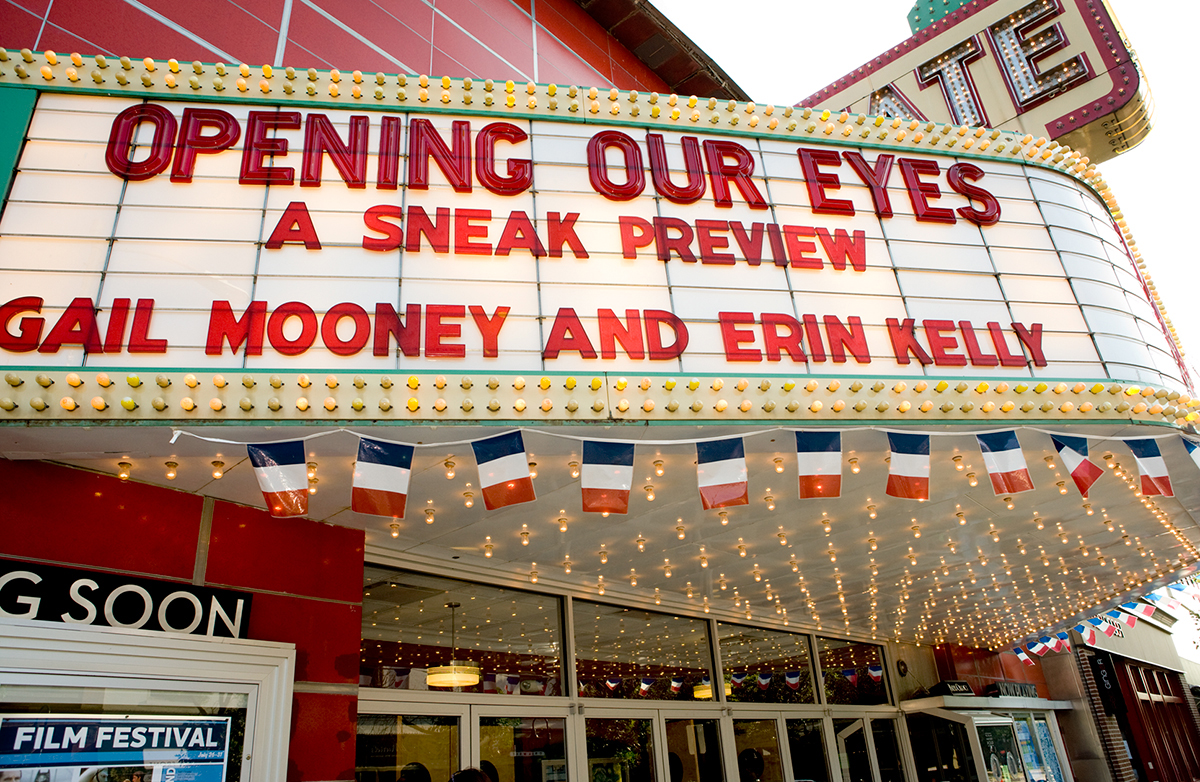
State Theater, Traverse City, MI

– from soup to nuts – with the smallest of micro-budgets, a tiny crew and a lot of hard work.  We’ve had some nice awards at film festivals along with a slew of rejections, and it has been one of the richest experiences of my life.

I’ve written about the journey and the technical aspects of the making of this film, on this blog and the Opening Our Eyes blog.  One of the most popular posts on this blog (it continues to get dozens of hits each day) is the post I wrote about gearing up for this movie. I’ve written so much about this project that I decided to collate a lot of my material and produce a couple of ePubs.  One is available now and hopefully, the 2nd one will be online soon.

A good idea, hard work and a lot of determination are essential in pulling off something like this – and to be crazy enough and confident in yourself to think you can do it.  I can tell you one thing – the confidence factor had its ebbs and tides.  I found that many times my level of confidence changed with my “hits” and my “misses”.  That certainly came into play during both my crowd funding campaigns on Kickstarter and IndieGoGo.  I’ve been thinking a lot about crowd funding lately because it seems like just about everybody is doing it these days. It certainly has exploded since I reached my Kickstarter goal, a year and a half ago. Seth Godin announced today that he is launching a Kickstarter campaign to publish his ePubs – sounds like his traditional publisher doesn’t want to take the risk and finance it until he sees if “the people” are interested.

I have to tell you that I was somewhat bothered when I read Godin’s blog. Kickstarter doesn’t accept every project that gets pitched to them.  When I did it the acceptance rate was about 40-45%.  I don’t know what it is now, but it’s got to have dropped significantly.  And that’s the thing – when “publishers” won’t take the risk, and high profile writers turn to their readers to back them, it’s going to be harder for the true “indie” to get noticed.  The same thing has happened with a lot of film festivals.  Film festivals started out, as a place for indie’s to screen their movies.  Now, at many of the festivals, the “indies” are competing with the big indie studios.

Things are constantly changing.  It becomes harder for the “indie” to get funded and noticed but it’s also easier because of social media. If  you are thinking of embarking on a project – a film or a book – and you aren’t sure if you should do it or can afford it – you can either talk yourself into it – or out of it.  It’s kind of like looking at the glass, half full or half empty.  I can choose to muse on my losses and put myself in a funk, or I can reflect on my wins and the rewards that have come into my life with the making of this film, and feel good about myself.  Each day, I ask myself which way do I want to tip? it’s up to me to determine my value – not anyone else. And today, I think I will feel pretty good about what I was able to achieve.

The Difference Between TV and New Media

It’s been a tough 3 weeks teaching video to journalists in China – perhaps the toughest thing I’ve ever had to do.  It’s not the teaching part that’s hard – it’s knowing if what I am saying is being correctly translated to my students, it’s being away from friends and family and just being away for so long that makes it tough. I have one more week to go and will take a good long rest when I return to the US.

Last week was especially difficult but yet my amazing students got me through it.  They simply amazed me in how quickly they learned.  They learned in 4 days what it takes most photographers to learn in 4 weeks or months.

Every week I have a new group of students and each week there are always one or two students that I know really “get it”.  There was one student who I coined a nickname for “Mr. Question” because he asked more questions than most.  His questions weren’t just about what settings to use on his camera or how to do something in Adobe Premiere, but more about the “big picture”.  His questions always showed me he was thinking.

One question, this particular student asked me this week, really caught my attention.  He asked me “How are we (new media producers) different than TV?

Stephen-Lee-TV-News-Presenter SMALL
Stephen-Lee-TV-News-Presenter SMALL (Photo credit: Wikipedia)

I had just read an article online that addressed this very question and it talked about how newspaper video journalists are now winning more Emmys than TV news journalists.

I responded to my student by telling him:

  • TV news makes the reporter part of the story – sometimes even the “star”
  • New media tells the story through the voice of the subjects – making them the “stars”
  • TV news is delivered to us on the network channels – 3 times a day.
  • Online news is 24/7 and on demand.  We get the news online when we want it and wherever we want it – on our desktop computers, on our iPhones or on our iPads. We also can share the news and interact with others.  We become part of the delivery chain.
  • TV news journalists rush back to the studio to get the story on air by 5 o’clock. The stories are generally very short – limited to their broadcast slot.
  • As new media producers we have the luxury of working longer on feature stories and delivering them online to a global audience.  While print newspapers and magazines are folding – there has been a rebirth of the long documentary story that can now be delivered online.  We are communicating to a wider audience around the world, no longer being restricted by time and space.

In the 1960’s newspaper executives were lamenting about the good old days and predicting that TV would kill them.  I find it ironic that the shoe seems to be on the other foot now.  I teach “motion” and “video journalism” to a lot of still photographers.  There are some who buy their DSLR’s and aspire to make broadcast spots for TV.  There are some who aspire to make feature length films for Hollywood.  And then there are some who tell me that there is nothing new about video and that field is already glutted with videographers and cinematographers. Those are the old business models for video and motion.

The ones who “get it” are the hybrid creatures that recognize that there is a shift in the way we communicate.  They understand that video is really just another medium in which to tell their stories – not a business model, nor a niche market.

My student in China who asked me this question- he “gets it”.  He understands that he is part of the future of how Chinese journalists and others around the world, will deliver the news. That’s why they call it – new media.

Pioneering in Video

I’ve been in China for the past two weeks, teaching video journalism to some of the best photojournalists in China.  Last night at dinner, the top director of the program told me (via my interpreter) that Xinhua, China’s biggest news agency, was setting up their multimedia department to stay current with how news is communicated in this day and age.  She thanked me for teaching and inspiring her journalists in this medium and said that I was an honorable “pioneer”.

I never set out to be a pioneer when I first started shooting video and motion in the mid ‘90’s – I merely recognized that when the “tools” of this medium became affordable, it was now possible for me to tell my stories in another dynamic way.  But I never turned my back on still photography and I would say that it still makes up about 50% of my business – at least in the time that I devote to it.  I would also say that while I spend 50% of my time split between both mediums – I make more than 75% of my income from shooting motion – capitalizing on not just making income from shooting video but also on the other elements like editing.

I started thinking about the aspect of being a pioneer and the more I thought about it, the more I realized that I wasn’t trying to set new ground at all – I was really just challenging myself and more importantly staying true to why I became a photographer and that was to communicate.

I’ve given a lot of workshops to still photographers who want to move into video.  Generally there are two types of photographers – the ones who think that because they have been “shooting” for many years, they “just” need to understand a new mode on their cameras and the ones who embrace the fact that this is an entirely different medium and they understand that they are novices, and are eager to learn how to communicate in a different way.  It’s usually the cocky photographers that fail miserably and end up with a string of unconnected “moments in time” to a music track.

Ever since the first DSLR that incorporated a video mode hit the scene, I’ve seen more and more still shooters, move into motion.  After only a couple of months, I even see some of them teaching workshops.  It amazes me, because many times some of these same shooters have been hypercritical of “amateurs” coming into their profession with their auto everything “point and shoot” cameras.  I’ve had some shooters tell me that they aren’t going into motion, because they think that when these tools  become easier to use and more automated – the same thing that has happened to the profession of still photography will happen in video.  I disagree with this notion but more importantly I think that this attitude is usually a mechanism people use to talk themselves out of challenging themselves and are reluctant to “change. ” Just like when still photography moved from film to digital – the ones who got left behind were usually the ones who tried to convince themselves that digital would never be as good as film.

I cannot take credit for being a pioneer in video.  There are many who came before me that were true pioneers and I feel that would discredit them and their efforts.  I’m simply a storyteller and I’m happy that I’m still passionate enough about telling the story that I continue to find the best way to tell the stories that I am meant to tell.

Thanks to the gracious people in China and the Xinhua News Agency for recognizing and embracing the future and being keen to learn.  Perhaps many of these students will not shoot multimedia – but learning how to shoot in motion has made me a better still photographer and will make them better shooters as well.

Technology – Connecting our Past and our Future

These days with social media it is so easy to connect with people all over the globe.  We can make new friends and reconnect with old friends with ease. We can use social media to share knowledge and ideas or simply stay in touch with friends.

One thing I have learned in reconnecting with friends from the past is that even though time has passed and changes have transformed our lives – the underlying character traits of most people, remain the same.  If someone I knew had been an adventurous soul in college or high school – they were still adventurous souls.  At least this has been my experience when I have reconnected with people from my past.

Quite honestly at this point in my life, I am so involved with my “now”, I don’t really have the urge to dig into my past. I’ve never been to any of my high school reunions and there have been many.  But when I do reconnect with people from my past, they are always people I have a natural and lasting connection with.  What attracted me to those people then, are usually the same things that attract me to them now and vice versa.

With any type of relationship, I take the attitude that the people who are in my life are those that are meant to be there at this time. There’ll be good relationships and not so good relationships, but each is meant to play its purpose in my life.  The same holds true in business relationships – there’s always an ebb and tide in most relationships, and we learn by it…. Or we should.  There’s the sweet and the bitter side to anything in life and it’s almost like those two ingredients need to be there for a “life well lived.”

I’ve learned a lot about filmmaking and the art of storytelling over the last couple of years, and the one thing that stands out, is that every story needs a “conflict” or an “opposition”. Every story needs contrast.  If it doesn’t – it’s not a good story – at least in terms of the entertainment business of films, TV shows, books, magazines etc.  I’ve been thinking about that a lot lately and I try to identify those themes when I watch a movie or read a book.  There is always an element of conflict or opposition to almost all stories and stories are taken from real life.

So when I look at my ultimate story –my life’s story –I tell myself to accept both the pain and the joys of life, because they are meant to be there. They are part of the process. I tell myself to expect the unexpected and leave any and all possibilities open. I tell myself to bridge the past with the now and allow the future to be what it’s meant to be for a life well lived.

Add to FacebookAdd to DiggAdd to Del.icio.usAdd to StumbleuponAdd to RedditAdd to BlinklistAdd to TwitterAdd to TechnoratiAdd to Yahoo BuzzAdd to Newsvine

Looking Back

Today, I’ve been looking back through two year’s worth of blog posts that I have written. Wow – I’ve written a lot!  I really surprised myself at just how much when I started gathering the content that I had written in regards to the making of my documentary, Opening Our Eyes. I’m putting together my 2nd ePub that will be a companion to my first ePub, recently published on Amazon and Barnes and Noble.

My focus is centered on the “craft” and the making of the film, and I talk about everything from “the gear” I put together for our 99-day journey around the world to the distribution process for the final film. A bulk of the content has already been written with photographs ready to upload and links.  It’s just a matter of consolidating the information and presenting it in a more concise way.

Earlier in the year, I paid my dues in the learning department when I put together the first ePub.  After my experience working with a professional formatter, I quickly realized what not to do.  One big thing I learned was not to get too heavy with the images because the first generations of Kindles have only b&w displays.  I also learned not to create intricate designs in Pages because later I had to undo all the work I had done for a PDF version of the printed book.

I am amazed at how much I have written over the last few years.  It was interesting to look back through some of my blog entries, and see how I was “processing things”  at the time I was writing those posts.  I’ve never really kept a journal before, accept for a one year period in my life, between the ages of 19 and 20, when I was making my first journey around the world.

I’m really happy that I have archived these stories and records of my life, but that’s not what motivated me to first start writing. I used to wake up super early in the morning – my mind spinning with ideas and random thoughts, not allowing me to get back to sleep.  So, I would get up and I started writing down my random thoughts and I found it therapeutic.  It was like having a conversation with someone and sorting things out.

There are chunks of time in my life that I simply don’t feel like writing or that I have nothing to really say.  My mind seems to go into a dormant phase where I convalesce with other distractions – usually mindless ones. But then there are days when I just have the need to get my thoughts down on paper.  I’m grateful for those days – on days like this when I take the time to look back from where I’ve been.

Add to FacebookAdd to DiggAdd to Del.icio.usAdd to StumbleuponAdd to RedditAdd to BlinklistAdd to TwitterAdd to TechnoratiAdd to Yahoo BuzzAdd to Newsvine

Monetization of Photography in Spite of a Lousy Economy

I talk to a lot of photographers. I don’t define the word “photographer” by the type of camera he or she shoots with. Whether someone is shooting with a still camera, a traditional video camera, a motion picture film camera or a hybrid camera that shoots both stills and motion – a “photographer” these days is apt to embrace more than one of these tools.

Regardless of the tools you may use, I’ve come up with a few tips on how photographers can stay afloat and make money in this continued stagnant economy.

  • Think outside the box – don’t think of yourself as one who just shoots still images. Even your “still” clients will have a need for motion imagery these days.  It may not warrant the need for them to hire a big video production crew to make a broadcast spot.  But it could be one of your corporate clients needs a “talking head” for their website. Even if you don’t shoot motion or don’t want to – collaborate with someone who has these skills to fill your client’s needs instead of sending your clients  elsewhere.
  • You don’t need someone else to commission your services in order for you to make a living. When photographers take on personal projects, not only are they creating a buzz and getting noticed by potential clients, they are also creating their own “content” to monetize. It is possible now to get our content to market without the need of a middleman. Portals are open and plentiful to all.
  • Take advantage of what is “free”, rather than be put out of business by it. There are so many ways to build your brand and get noticed without spending a fortune. The costs of building and maintaining a website have dropped significantly because of advances in technology. And utilizing social media to create a buzz and get the word out about your company is virtually free with Facebook, Twitter,LinkedIn and YouTube. But be prepared to do the work and discipline yourself because this territory is ripe with distractions.
  • Re-purpose your content. If you’ve been blogging or have something useful to share – consider packaging your “knowledge” into ePubs, podcasts or “how to” webinars. One thing I’ve learned about making an ePub is that you can either do it yourself or hire a formatter so that it gets to market quickly – via Amazon, Barnes and Noble or the iTunes platform. Price it right – and offer more than one ePub at a time. (I’m working on my 2nd ePub now) In this market, if someone has just spent $3 or $4 to buy your ePub and they see you have another one for sale – it’s not a big stretch for them to buy that other book you offer at the same time.
  • Collaborate with others. Partner with others to put on webinars, podcasts, call in phone seminars etc. Use this opportunity to build your own brand. Don’t always feel that you have to be the only “act” offered. In fact many times, if you join forces with other creatives, it will get you further than if you are the only speaker in a half filled room. Get out there and get noticed and learn from your colleagues at the same time.
  • Be authentic. I cringe when I write that word because it has become a bit trite. I guess in a way I have always been authentic. In fact I just can’t help myself. If you are true to yourself, you will be ready, eager and able to work hard on your dreams. And hard work is exactly what is necessary to make it in this profession.  You’ve got to want it bad enough in order to do the work. If you are a clone of other photographers, you’re career will be short lived. I guarantee the photographers that you are emulating will be “moving on” because their passion is driving them to new things. So, what happens to the cloned versions then?
  • Don’t focus solely on the money. Easy to say and really hard to embrace when you can’t pay your mortgage. But look at any successful person – I don’t care which business you choose to look toward in terms of finding successful people – but you’ll see that most people who have “made it big” were not driven by the money. I’m not saying that money is not important, but if you are solely focused on the money and not on the act of creating – it will show.   Being too focused on the  money part of the equation, can sometimes push it away. People sense it. It’s human nature to want to be around a “winner” – not someone who is begging for a job to keep them afloat financially.
  • Be patient. Everything turns around. While the old days and ways of doing things won’t come back, better opportunities will replace them. Don’t be paralyzed by your own fears. Do what you can that won’t cost you a lot of money and there is plenty you can do. Work social media, learn new skills – audio, editing, writing etc., network with people, create new content for ePubs, webinars, and podcasts. Use your imagination, pursue what you are passionate about and when the economy turns around – you’ll be ready.

Add to FacebookAdd to DiggAdd to Del.icio.usAdd to StumbleuponAdd to RedditAdd to BlinklistAdd to TwitterAdd to TechnoratiAdd to Yahoo BuzzAdd to Newsvine

When “We” Became “Me”

It started happening after JFK was assassinated, followed by Martin Luther King’s death and finally the brutal slaying of JFK’s brother, Robert in the kitchen of a hotel in Los Angeles.  We were beginning to shift from a culture of “we” that began after the troops came back from the “big war – WWII” and everyone wanted to get back to normal life – having families, friends, and earn enough money to take a vacation every year, pay your bills and be able to educate your kids so that they would have a chance at a better life.

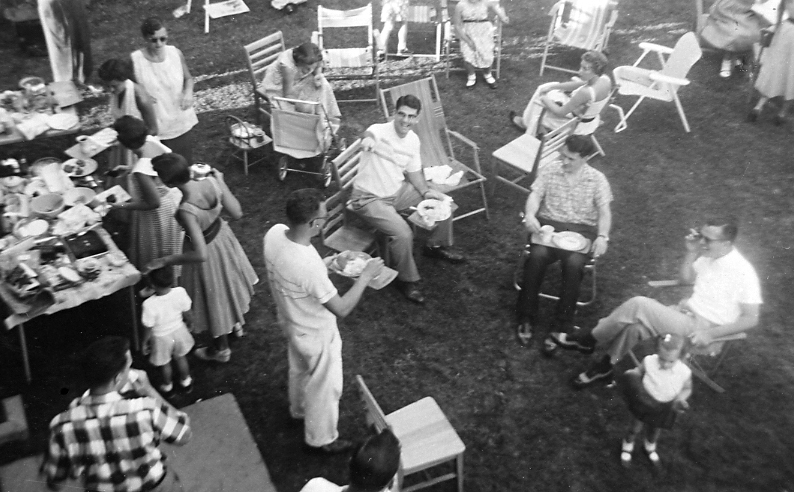
I was a kid in the fifties and it was a time when there was a real sense of community – definitely a “we” feeling in many ways.  Our backyards all connected into one big play field for all the kids in the neighborhood with the “woods” being the un-chartered territory beyond. We ran free, till dark, feeling like our own tribe of “we” with our own set of rules. Everyone pretty much looked out for one another –parents looked out for their neighbors’ kids, kids watched out for other kids, moms helped out other moms and dads the same.  We had a sense of community.

In the late sixties things began to change.  The Vietnam War was in full swing, along with the Civil Rights Movement and student unrest was building to the “Arab Spring” of its times. Our dreams were beginning to fade – our friends were coming home in body bags, our cities and neighborhoods were being destroyed during the riots of the late sixties, and our leaders were assassinated, one after another.  A shift was starting to happen.  We were becoming divided.  Fences and hedges started to divide our backyards, breaking up that once endless playing field.  We were starting to become more about “me.”

As a culture we roared through the 80’s and 90’s following a path as a society that believed that in order to win, others had to lose.  We became greedy, thinking only of our personal gain and caring little how that affected others. The divide among us has exceeded beyond what most of us would have ever thought possible.  We have made an art of  “ how to get nothing done” with our political system and no one is getting anywhere.  We are expending so much negative energy and if we don’t turn that around, we are all doomed.

I’m not a pessimist – just the opposite. I think if we can all just stop and flip our mindset into what we “can do”, instead of slamming the “other guy”, we just might be able to turn things around.  I see a younger generation, the 25-30 year olds who are thinking more in terms of the “we”, and getting away from the “me” mentality.  I have great hopes for this generation. We are at a turning point.  I’d like to look back at this time 10 years from now and say to myself  “I’m glad I did something.”

Add to FacebookAdd to DiggAdd to Del.icio.usAdd to StumbleuponAdd to RedditAdd to BlinklistAdd to TwitterAdd to TechnoratiAdd to Yahoo BuzzAdd to Newsvine

New Business Models in Photography and Video

This topic comes up a lot these days.  But you could apply “new business models” to just about any business – not just photography and video. Photography and video, in and of themselves are not business models at all, but rather they are mediums that are used commercially, non-commercially and personally. The business end of photography and video comes when you determine how you want to apply them in terms of today’s markets.

Today’s markets are global.  That’s good news and bad news, depending on the type of work you do.  If you are a stock photographer or even if you have expanded that into also shooting stock motion footage – your inventory or your content if you will, must be unique in some way in order to sustain that type of business model in our global economy. You will need to stand out if you pursue this type of market.

If you are a commissioned commercial or editorial photographer, cinematographer, or director, the competition is fierce and once again, if you don’t have a unique style or vision, most likely you will end up playing by others’ rules or signing “their” contracts.  It comes down to supply and demand of talent and work, and you either need to compete by price or offer something that you do better than your competition.

The good news is, if you are willing to do the work, the world is your stage.  The portals for distribution of your “content” are open to all and as “creatives” we are no longer dependent on middlemen.  When I get asked to talk about “new business models”, I always look at it as “where are the new opportunities?” – where I will be carving out my own “new business model”, rather than having to adapt to others ideas of what that is.  There is a big difference in those two approaches.

I am carving out a business model for who I am creatively, and where I see the most opportunities for what I do well.  When I am authentic to who I am and apply this to my work, I am able to get the type of work to market and reach the right audience while maintaining ownership and control over the licensing of my work.  I am able to do that not only because technology has enabled me to do that, but more importantly it has created a demand for the type of content that I create.

Think about it.  What are your strengths? What are your passions?  Now imagine a business model based on your answers. The world is our stage.

Add to FacebookAdd to DiggAdd to Del.icio.usAdd to StumbleuponAdd to RedditAdd to BlinklistAdd to TwitterAdd to TechnoratiAdd to Yahoo BuzzAdd to Newsvine

Licensing Video?

There are probably people who would argue with me as far as the practice of licensing video being the norm in the world of video production, other than the licensing of stock motion footage. Perhaps that may be true in some business models and certainly true in older business models, but I can tell you that has not been my experience.

I should clarify that I do not position myself as a “hired gun”– meaning a camera operator who turns over their footage at the end of the day. I choose to assume the role of producer and maintain control over my intellectual property or the finished video product. I cannot do this in the traditional motion picture industry but that business model is changing due to technology and the influx of indie filmmakers who are making their own rules and bringing their films to market themselves. And for the most part – I can’t do this in high-end broadcast spots when working with a middleman – or ad agency where ultimately their end customer maintains all rights.

However, the demand for video has skyrocketed in recent years and with that has created a new client base who are using video in new ways and on new platforms. I am establishing my own set of rules accordingly. One of them is licensing the finished product just as I did my still images. I can only do that with video productions that I have produced and hold the copyright to.

Typically, I will separate the licensing of my still images from the video product as well as the creative fees. I may be shooting both mediums on the same job but I handle the licensing differently. I have found that video has a shorter shelf life so I am not as concerned about the duration of the license (length of time) as I am with still imagery. But I am concerned about it’s “reach” which these days is global – thanks to YouTube.

Another thing I do is I make sure that it is stated in my contract and/or estimate that the license for the entire video production does NOT include permissions and/or licenses to any still images that are made from frame grabs pulled out of the video footage. Putting this up front in the estimate has actually proved beneficial because if a client does anticipate the need for still images – they will hire me to create stills – rather than take them from frame grabs.

We are living at a time where just about everyone’s business models are changing. So, if someone tells you that licensing video isn’t the norm – outside of the stock motion footage business – think again. What is the norm these days? It may be the precedent we are setting now.

Add to FacebookAdd to DiggAdd to Del.icio.usAdd to StumbleuponAdd to RedditAdd to BlinklistAdd to TwitterAdd to TechnoratiAdd to Yahoo BuzzAdd to Newsvine