Change

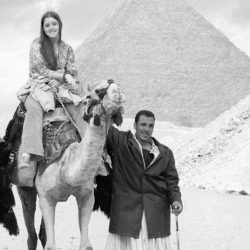
Change Who likes change? Other than needing a change of scenery every now and then, change is usually tough to take. I grew up with change. My family moved 10 times before I got out of high school.

Kindergarten, Chicago, IL

I was always the “new kid”. (Hint: I’m in the second to last row. I was also the “tall kid” even in Kindergarten)

No, my dad wasn’t in the military and we weren’t on the lam – he was just climbing the corporate ladder. He’d get promoted or there would be a new sibling and we’d move to a bigger house or he’d get promoted and transferred and we’d move to a totally different place leaving our friends and familiarities behind.

I’m not complaining, nor saying that I feel slighted by having that constant change in my life. It was the life I knew and I suppose I always looked at it with open eyes and curiosity about what was next to come. Of course, if I thought about the friends and sometimes family that I was leaving behind, it made it much harder.

Perhaps growing up in a constant state of change made me more flexible in dealing with all the changes affecting my business these days. Both still photography and video production have been profoundly changed by a bad economy and technology. Kind of like a double whammy. At least with technology the sword cuts both ways and also provides opportunities. It’s usually during the tough times when the economy is bad when innovation happens. Sometimes people just have to be forced to make changes in their lives, even if what they have been doing hasn’t been working. I was asked to speak at Cal Poly on the theme The Role of Mass Communication and Media Technology in Today’s Global Economy: A Multidiscipline Approach. Specifically, they wanted me to talk about how I was using technology to communicate in a global market. I started thinking about how this past year I had vigorously embraced new tools and a new business model, integrated with the Internet and social media to create a mixed media project that will ultimately result in a feature film, a book, an e-book and maybe even an exhibition. I didn’t have a big team behind me, nor did I have a lot of money. We had a two-person crew- myself and my daughter, an editor and my husband working the PR, the social media and the back support. We raised some money on Kickstarter with the help of our backers and we’ve had musicians offer us their music and talents to our film. We are extremely grateful for all of the support worldwide and it could never have happened without advances in technology.
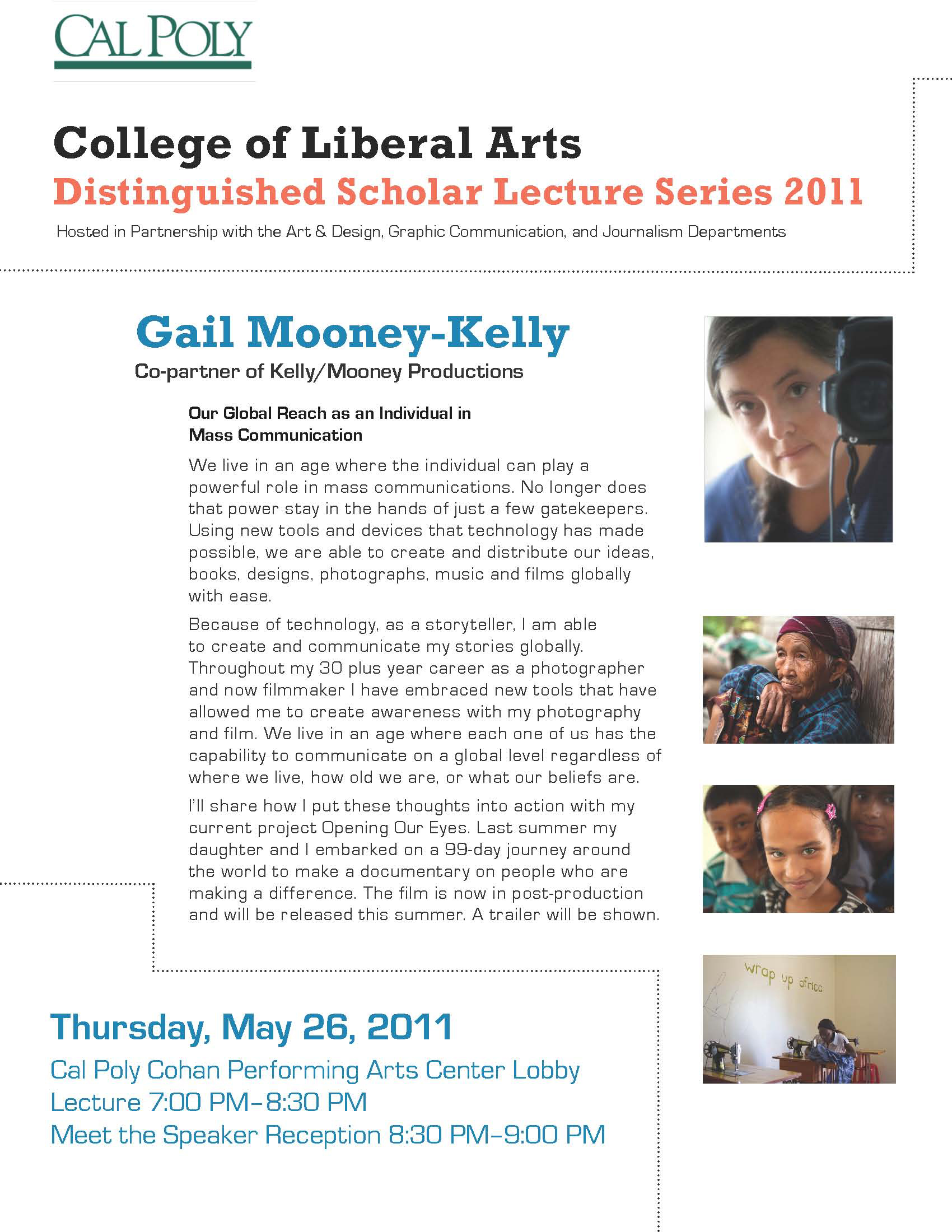
The fact is that we live in such an amazing time where something like this is even possible. It is a time of empowerment for the individual. Technology is democratizing and is leveling the playing field especially in terms of distribution. The locks are gone and the gates to distribution are open and affordable. Within a month of uploading the trailer to my film on Vimeo, it has been played in 95 countries – that’s almost ½ the countries in the world. What a staggering thought in terms of mass communication!

Going forward my ultimate plan at this point in time is to distribute the film through iTunes or Netflix and DVD’s through Amazon. More importantly, I would like to set up 100’s of screenings in communities all over America – maybe even all over the world – and use the film to move people to action. Kind of like a grass roots effort to motivate people to make a difference in their communities. Imagine what kind of an effect that would have if it spread virally through the world. Just Imagine.

Add to FacebookAdd to DiggAdd to Del.icio.usAdd to StumbleuponAdd to RedditAdd to BlinklistAdd to TwitterAdd to TechnoratiAdd to Yahoo BuzzAdd to Newsvine

Validation No Longer Necessary

There seems to be a prevailing attitude of doom and gloom. We have an economy that can’t seem to turn itself around and we’re bombarded by change that technology continues to thrust upon us.  We’re scared to death of the unknown and nobody seems to know what to do next and how to make any money doing it.

Yet, I’ve never been more hopeful in my life. Why?  Because I no longer need someone else to validate my ideas – and that is a powerful notion.  Those of us in the communication business seem to be particularly fearful. Some believe that the “news” business is dying because print publications – newspapers and magazines are folding every week.  But the “news” business is not dying – it’s just being delivered  in another way – electronically and globally.  There are no longer just a few gatekeepers with a lock on the playing field.

Human beings are social animals and we will always have the need to communicate with each other.  These days we can communicate with one another globally.  An idea or creation can be shared around the world in a matter of minutes.  Think of the power in that and think of how we can use that power and the opportunities it presents.  I could digress into a discussion on the ethics of this thought but I’d like to focus more on the reach and influence that each one of us has in creating awareness.

Many of us get enamored with the latest devices that enable us to deliver and receive information with speed and ease. As technology’s exponential growth continues to change our lives in every way imaginable, we will constantly be incorporating and upgrading new gadgets and devices as part of our lives.  We need to be mindful that these “toys” are merely enablers and that each one of us can use these tools to create and distribute our words, images, designs and ideas across the planet.

I think that we as creative’s or journalists underestimate ourselves sometimes.  Perhaps because we chose professions that aren’t lucrative – at least in terms of money.  However, what one is paid doesn’t necessarily correlate with one’s worth. We live in a time now where we can use our creative skills to really make a difference and to tell the stories that we feel need to be told. Mass communication has been democratized. We no longer need the traditional gatekeepers to validate our ideas.

I never would have dreamed that I would be able to circumvent the globe, create a documentary with only one other person in my crew  – my daughter and then distribute it internationally. I never imagined that I would have the power to create awareness on a global level like I did when I uploaded my trailer to Vimeo.  In a little more than a week’s time people in over 72 countries had played that video. Now in less than a month’s time, that trailer has been played in almost half the countries on the planet.  Staggering thought.

This was not a commissioned project by a network or a motion picture studio. If I had waited for that – it never would have happened. I assigned myself.  I was able to fund it by using my airline points, hotel rewards and doing trades with manufacturers for equipment.  I also successfully raised money via Kickstarter a crowd funding site  that made it possible for me to hire a professional editor. My daughter and I have been building an audience for our film since we started blogging about our journey. Our readers got more and more engaged as they followed us on our 99-day adventure around the world. They spread the word through Facebook and Twitter and via their own blogs and pretty soon word of our project spread virally. That was precisely our goal.  To use our tools and skills to create a film about the change makers of our world so that others would be inspired and motivated as to what they can do.

I often think about how things in my life and in history would have been different if we had the Internet when I was growing up.  For starters it would have had a huge effect on the Civil Rights Movement of the 60’s and the Vietnam War.  But everything happens in its own time and when it is meant to happen.  Change can be scary or it can be embraced and sometimes both at the same time.

Never stop dreaming. Never stop learning. Always listen to that inner voice.  Then use the means and the tools of the day to do the dance you are meant to do.

Add to FacebookAdd to DiggAdd to Del.icio.usAdd to StumbleuponAdd to RedditAdd to BlinklistAdd to TwitterAdd to TechnoratiAdd to Yahoo BuzzAdd to Newsvine

NAB Show 2011 Afterthoughts

Whew!  I’m fatigued in every way imaginable – in a good way though as I always am after attending the National Association of Broadcaster’s annual show in Las Vegas.  It’s overwhelming and over stimulating and after I get home and decompress for a day I’ll make some sense out of what I learned and how to apply it in my hybrid world.

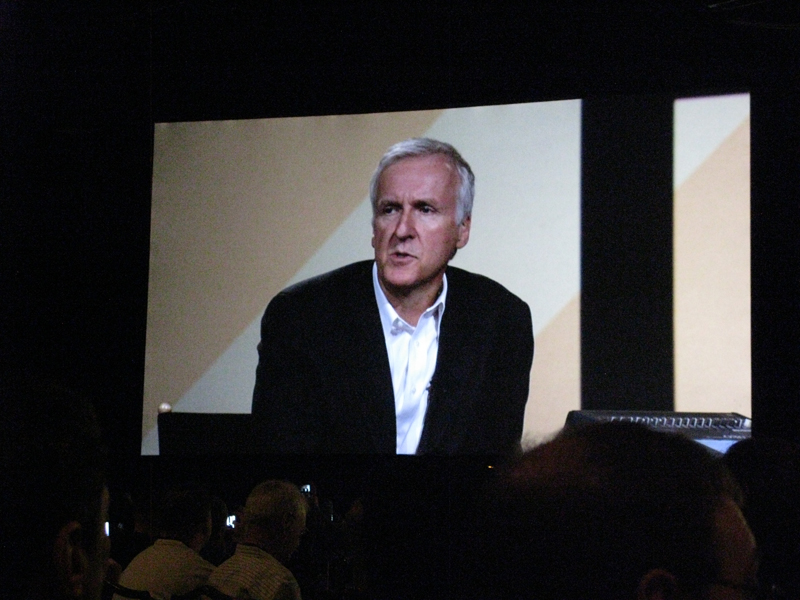
What springs to the forefront of my mind as I wait for my flight, which is delayed, is that convergence and/or “integration” continues at a rapid pace.  3D, which seemed to be the big topic last year is still present but not commanding all of the attention.  This year the conversation seemed to be centered on the integration of TV and Broadband.  But I couldn’t help but wonder as I went from James Cameron’s keynote where he talked about his continued thrust into 3D, to a session on TV and Broadband convergence – where does 3D fit into the Broadband world?

Many attendees infatuated with the HDSLR solution wondered why Canon didn’t roll out the next “hybrid”.  I’d like to think that Canon is working on a video camera that will utilize a “big chip” than working on  a still camera that has less work arounds in an attempt to make them more video friendly.

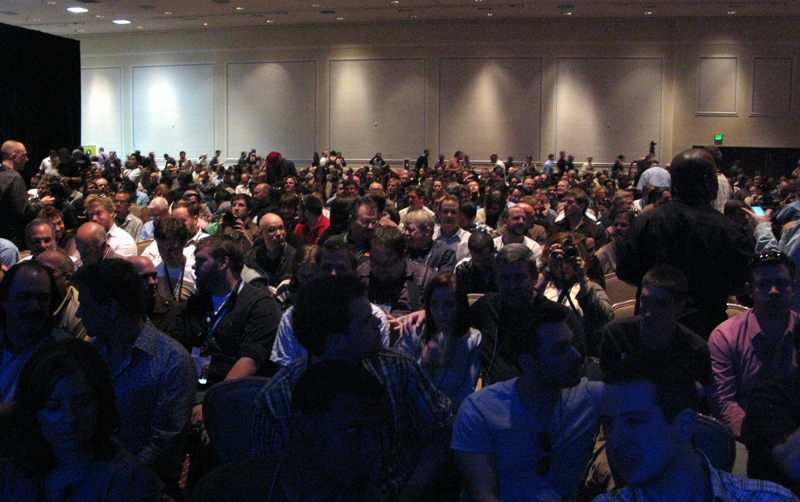
Adobe announced CS5.5 and the next day Apple made their worldwide premier of Final Cut Pro X at the Final Cut Pro Users Group Supermeet.  The crowd went wild as each new feature was demo’d – no transcoding, auto rendering in the background while still working, no more clip collisions and so forth.  At the end of the demo everyone’s jaw dropped when they announced the price at $299.  What Apple didn’t tell us – is if and how it will integrate with the other apps in Final Cut Studio like Soundtrack Pro, Motion, Compressor and Color.

Another very cool product was the Ninja by Atomos an Australian outfit.  The Ninja is a monitor  – but not just a monitor because it takes your media out as 8/10 bit uncompressed HDMI and stores it on insertable 500 G hard drives.  Unbelievable and at a price of less than $1000.  That means that compressed media gets output at a quality 8 – 10 times better than recording it to cards.  Sorry, DSLR users but it doesn’t work with Canon’s DSLR’s  because for some reason there is no way to record the data without the display.  That’s a question for Canon as to why it can’t over ride that and output and record without the display recorded on the data.

As always my favorite part of NAB is sitting in on the Super Sessions with big time directors, editors, CEO’s of broadcast networks and manufacturers.  That’s where you truly get to engage the movers and shakers in the industry and learn and ask questions.  One of my favorite sessions was with filmmaker Kevin Smith.  He is the kind of guy that constantly pushes the envelope and he made a comment that stuck with me.  He said “Hang with the people who ask why not – not the people who ask why”.  It’s a lot easier to question why and in the process never get anywhere but to have to courage to say “why not” – well that’s when things get created and invented.

So, as I head home thoroughly exhausted in a good way; I’ll hang onto that thought and seek out others who say “why not?”

Add to FacebookAdd to DiggAdd to Del.icio.usAdd to StumbleuponAdd to RedditAdd to BlinklistAdd to TwitterAdd to TechnoratiAdd to Yahoo BuzzAdd to Newsvine

Embrace Disruption

Every now and then disruption needs to take place and does.  Technology is causing disruption in all our lives but it need not be looked at as a negative thing.  We can embrace it and find opportunities or we can shut ourselves off and become obsolete.

It’s Day 3 of the NAB Show Every April the National Association of Broadcasters have one of the largest conferences in the world but these days this show is not just attended by broadcasters.  As TV converges with the Internet the attendees have become more and more diverse.

On a very small scale there is the DSLR contingent along with all the vendors that cater to this group with their third party add ons – a big business these days for sure. At Canon’s display, Hollywood DP’s and cinematographers like Gale Tattersall of House and Russell Carptenter of Titantic (to name just one of his films) tout the merits of the Canon 5d MarkII and make the point how these hybrid cameras have created a new aesthetic.  They are also quick to point out that these “affordable” cameras are not chosen because of budget but rather because they are small and discreet and create a beautiful image in low light.  One digital “rebel” filmmaker remarked how he shot a scene for his film on an airplane with an actor and no one even took notice because its such a low profile camera.

But back to the word disruption.  Convergence works both ways. As much as the DSLR has rocked the still photographic world and created a huge hunger amongst still photographers who want to learn how to shoot motion and capture good sound, it has also rocked the world of motion shooters who are providing stills for their clients and learning the language of photography.

TV and Internet are converging.  There is a whole generation that has no need for a cable hook up.  They watch what they want – when they want – online.  Just like they never get a landline – many never get hooked up to cable.  The small affiliate broadcast stations are feeling just as threatened these days as magazine photographers are because of the demise of print publications.  Their worlds have changed because the patterns of the end user have changed.

Director James Cameron (Titanic, Avatar) just formed a partnership with a 3D company.  As TV’s are manufactured with 3D capability and the tech hurdles are overcome, he feels that 3D will become mainstream. But he goes on to say that the big problem is content because the only content created now is coming from the motion picture industry.

And Apple made their worldwide announcement last night with Final Cut Pro X.  I was in the room and all I can tell you is that it is REVOLUTIONARY.  Watch out Adobe.

But at the end of the day – of every NAB day – as I sort through all the information and announcements – I ground myself and think about what I will choose to embrace.  How can I use technology and apply it to what I do and why.  If disruption means that I can tell my stories in a better way or reach more people – that I welcome it with open arms.

Add to FacebookAdd to DiggAdd to Del.icio.usAdd to StumbleuponAdd to RedditAdd to BlinklistAdd to TwitterAdd to TechnoratiAdd to Yahoo BuzzAdd to Newsvine

Believing in the Impossible

It’s such a big leap isn’t it?  To really believe that anything is possible. For me it’s far easier to believe that anything I put my mind to is possible than to think that everything is hopeless. It’s a simple mindset and a way of life.

Think about it for a minute.  When you are convinced that you have the ability to make the impossible – possible – then you will put your dreams into action.  You will take that chance and by doing so you are creating your own reality instead of reacting to what others have created for you which may not be in your best interests.

I’ve never been a big fan of hearing “you can’t do that” or “it won’t work”.  Those are fighting words to me because no one can predict the future – so I find comments like that offensive to my very being. I’ve come up with my own theories about why there are so many naysayers in the world.  One theory is that misery loves company and because there are some people who stop themselves – they seem to take comfort in deterring others from their dreams.

Stay away from the naysayers and remind yourself that they don’t know the future – nobody does.  Hang around people who are crazy enough to brazenly go forward and pursue those thoughts and dreams that live deep inside themselves because they are listening to their inner spirit.

They say the spirit inside never ages.  I believe that and I know when I feel aligned with my spirit because I feel child like – filled with wonder, curiosity and belief in myself and my dreams. When I tell people about my wild notions, they get caught up in my passions and spur me on.  These days with social media we have the power to turn one person’s simple idea into a collective thought – into a possibility.  Imagine the power in that thought. That’s the power of the individual to create change and change starts with that one crazy thought that someone had who listened to their spirit inside.

Let’s hear some of your own crazy notions.  Who knows it just may spark something in someone and change their life.

Add to FacebookAdd to DiggAdd to Del.icio.usAdd to StumbleuponAdd to RedditAdd to BlinklistAdd to TwitterAdd to TechnoratiAdd to Yahoo BuzzAdd to Newsvine

Editing a Trailer – Part II

First let me thank everyone for his or her comments and suggestions.  It’s very difficult to cut a short trailer because I’m so close to the story(s) that it’s hard not to make assumptions or see the obvious.  I’ve always found that getting feedback from people is important at a certain point in the process.  I want to be far enough along in the edit that it’s “almost” there but not so far that I’m reluctant to change things.

My first impulse after reading everyone’s comments was to take all the suggestions to heart and I started implementing the changes. I quickly realized it was starting to feel like a corporate job that had been designed by committee and it was somehow missing the mark.  I was trying to cover all bases, trying to please everyone and I was losing sight of my own insights.

I took the weekend to revisit the trailer every now and then, in between socializing with my brothers and sister and their families.  It was the first time we had all been together since my mother died, over 7 years ago.  My brother was up from Florida and it was his kids first time seeing snow.  It brought out the kid in all of us – throwing snowballs and sledding down our front yard, which is pretty steep, and not for the timid.

As usual, taking a break from the technology brought everything back into perspective.  This morning I knew what I needed to do.  I shuffled some things around, cut 20% out, adjusted the sound and the text and came up with something I think that I can live with.  It’s not perfect but like Maggie says in the trailer “If I waited for things to be perfect, I never would have done it”. So I’m throwing this out to the universe and see what transpires.

http://www.vimeo.com/21598761

Thanks again to all who took the time to watch and comment on my previous renditions.  I appreciate your comments more than you know.  Occasionally, when I’m at a conference or another professional event, someone will come up to me and thank me for what I share in my blog or tell me that something I said inspired them.  The truth is it works both ways because I get so much in return.

Add to FacebookAdd to DiggAdd to Del.icio.usAdd to StumbleuponAdd to RedditAdd to BlinklistAdd to TwitterAdd to TechnoratiAdd to Yahoo BuzzAdd to Newsvine<!–


Editing a Trailer

Like anything else the best way to learn how to do something is to “see” how it’s done.  I wanted to create a trailer for my documentaryI’m working with a professional editor on this project but while he is getting acquainted with over 160 hours of footage, I wanted to challenge myself to see if I could create a trailer.

For me, it’s always much harder to edit a very short piece. Everything becomes more critical – every cut – every shot – every sound bite and sound effect – every slate and every high and low in the music. And trailers are the ultimate shorts. You need to peak someone’s interest and make them wanting more.
I started paying attention to the trailers on DVD’s and online. I watched them to see how they were constructed. I analyzed them and paid close attention to things like sound effects, music and slates and if it made me want to see the movie.  There were a couple of trailers in particular that I really liked, each for different reasons.  One trailer was for the film I Am.  This trailer gave me some ideas on how to use music and text to deliver the story idea in a concise way and get people’s attention. I also liked it because it was just vague enough to intrigue me but not to confuse me.  Another trailer I like is Dennis Connor’s Breaking Boundaries; the Art of Alex Masket.  There are a lot of things I love about this trailer.  Dennis’s subject Alex Masket couldn’t communicate verbally so Dennis blended visuals of Alex using other people’s sound bites as the narrative.  He also had a beautiful jazzy musical score composed for the trailer.

My challenge was that I had to make a trailer for a film that was about 11 stories. The first thing that I needed to remind myself was that it really wasn’t about  11 stories.  It was about 11 people but ultimately one story.  With that thought I started pulling together  my strongest sound bites.  One benefit of spending all that time editing the past few months was that I was very intimate with the interview footage and I knew where to look for the gems.  I was looking for provocative remarks that left one wondering and they needed to be short and to the point.

Once I got the stand out sound bites on a timeline I started looking for some live action footage and other b-roll.  Then I began to interweave the appropriate visuals with the sound bites – pacing them – giving the piece a bit of time to breathe.  I also added slates with text to help tell the story.

Once I got it down to a reasonable length – in my case 3:45 – which is still a minute too long – I started looking for the perfect music.  I came across Neosounds.com a royalty free music site with some of the best RF music out there.  Picking music for me is like picking wallpaper, going back and forth until everything starts to sound the same.  After making a few painful decisions, I integrated my musical choices into the timeline.  There was still something missing and that was sound effects.  There are hundreds of great free sound effects that come with Soundtrack Pro.  I picked a couple of them to boost and emphasize certain spots in the trailer but I wanted to keep them subtle.  For example I used a sound effect of a motorcycle in one spot and a jet engine taking off in another.

What has resulted from this exercise are two variations of a trailer.  I am sharing these both with everyone because I would like feedback. I don’t want to influence opinion here, other than to say one trailer has a bit of more information than the other. One is also 15 sec. longer. Any and all comments are welcome.

Which one should I use?

Watch the links in this order.

http://www.vimeo.com/21241911

http://www.vimeo.com/21376387

Add to FacebookAdd to DiggAdd to Del.icio.usAdd to StumbleuponAdd to RedditAdd to BlinklistAdd to TwitterAdd to TechnoratiAdd to Yahoo BuzzAdd to Newsvine

Editing 150 Hours of Footage From a DSLR

As I roll away the miles, driving the ten hour trip to Michigan to rendezvous with my daughter Erin to film the last of our subjects for our documentary Opening Our Eyes, I realize how desperately I needed a long road trip – just cruising down the highway.  I have been in utter isolation for the past month, editing over 150 hours of footage that we had shot over our ultimate road trip around the world this past summer.  Little did I know that the 99-day journey would be the easy part of this project.

This past month there have been many times that I became so overwhelmed with the process of editing that I wanted to throw my hands up in surrender and just give up.  But somehow I plowed through it, many days putting in 14 plus hours.  I was on a mission and listening to the words of my subjects got me through it.  After all these were some of the most inspirational people I had every met, so revisiting them through their interviews was a constant reminder of the goal of this film which is to create awareness and inspire and motivate others to make a difference and create change.

Ultimately, my challenge is to take ten (soon to be eleven) different stories of people across the globe who are making a positive difference in the world.  After finally getting the tedious tasks finished, of transcoding files and sorting through the good from the bad clips, I arrived at a point where I needed to start telling “THE” story.  Meaning I needed to determine how I could best structure the film to convey the common themes between my subjects.

In order to see the story clearly – I needed to get away from the technology. So as the miles roll by, the story becomes  more vivid in my head.  I see the hero(s), the themes, the commonality and the arc of the story as the stories intertwine.  I won’t give away too much information other than to say that the solution is simple.  They aren’t eleven different stories after all. It’s really a global story about the power of one.  How one individual can create positive change and not only effect generations to come but change themselves as well. It’s a basic human story that resonates with all of us.

When I started writing this blog I was going to talk about editing tech tips. Somehow as the miles rolled by and my head became clear of the intense electronic input from the past month, I not only saw the story, but I felt it.  I had gotten back on track and gotten to the heart of the story.

Add to FacebookAdd to DiggAdd to Del.icio.usAdd to StumbleuponAdd to RedditAdd to BlinklistAdd to TwitterAdd to TechnoratiAdd to Yahoo BuzzAdd to Newsvine

SB3 – Get Inspired

If you haven’t registered for the ASMP Strictly Business 3 conference yet, I would highly suggest that you do so.  They will be held in three locations starting next week: January 21-23 in Los Angeles; February 25-27 in Philadelphia; and April 1-3 in Chicago.

There’s an incredible line up of speakers presenting workshops on pricing, estimating, copyright, workflow, strategic career planning, successful portfolios and branding and video production. I’ll be presenting two workshops: “Thinking in Motion” and “Shooting Video with the DSLR”.

Branding expert Colleen Wainwright will deliver her keynote “Making People Love You Madly: Selling Yourself in a Postmodern Marketplace”.  Tom Kennedy, whom I’ve know since his days at the National Geographic Magazine will give a keynote “Learning New Skills for the Changing Media Landscape”.

This conference series is meant for everyone, not just photographers who are beginning their careers.  In fact, I think that photographers who have been in business for many years will benefit equally, if not more than a shooter who is new to the business.

I have been in business for over 30 years and I have found that one of the most dangerous things that can happen to a creative person,  is for them to become complacent, especially in a business like photography.  It’s even more deadly to become complacent these days in our fast changing world of technology.  We not only need to stay current with our skills, we need to keep our vision fresh.

When I got into video and motion more than a decade ago, I was looking for something to excite me.  I felt that even though my business was successful and that I had accomplished many of my creative goals, the spark was getting dim inside me and at times I felt like I was reinventing the wheel.  So, I set out on a learning curve and have been soaking up information ever since.

I love to learn and I have found that the more I wonder and grow, the better off I am creatively and the more successful I am in business.  I’ve also found that networking and collaborating with my peers has opened my eyes to all sorts of possibilities that I never knew existed.  I think that’s what makes the SB3 conference so powerful – the sharing of information with our peers.  You don’t get that from online learning.

We live in a time where anything is possible.  Come to SB3 in LA, Philadelphia and Chicago and be prepared to be inspired.

Add to FacebookAdd to DiggAdd to Del.icio.usAdd to StumbleuponAdd to RedditAdd to BlinklistAdd to TwitterAdd to TechnoratiAdd to Yahoo BuzzAdd to Newsvine

Crowd Funding and What I’ve Learned

There’s a scene at the end of my favorite holiday movie “It’s a Wonderful Life”

It's a Wonderful Life

where George Bailey, a character played by Jimmy Stewart is surrounded by his friends as they come to his aid and bail him out of his financial shortcomings, caused by his crazy Uncle Billy. I’ve seen this film at least a dozen times and ok – I admit it – I cry every time George Bailey’s little girl opens a book that mysteriously appears under the Christmas tree with the inscription “No man is a failure who has friends”.

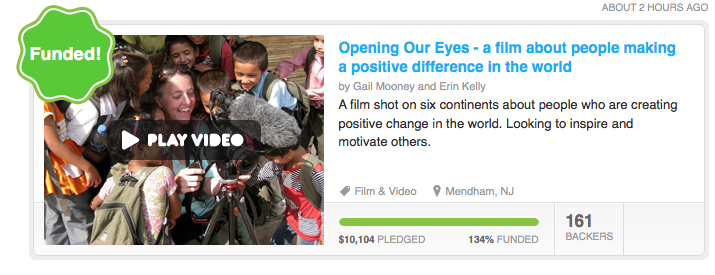
I felt like George Bailey today when I saw the email from Kickstarter telling me that my daughter’s and my film project, Opening Our Eyes had been officially funded.  We actually exceeded our goal of $7500 and raised just over $10,000! What a feeling – what a triumph and all possible because of our “friends”. Through crowd funding – our friends had helped us reach our goal and made our film a reality.

This would not have been possible just two years ago.  But, Kickstarter and other crowd funding sites like it, provide other options for artists and entrepreneurs who are seeking funds to make their creative ideas come to life. Many times these ideas might not fit within the confines of what a traditional bank would finance, but there are some great ideas that have a chance now of becoming a reality –  and we all benefit by that.

Here are some things that I have learned through the process of getting our film funded on Kickstarter.

•    You have to do the work.  Once you launch your project page on Kickstarter, you need to let potential backers know about it, using social media or email blasts or word of mouth.  Just like getting traffic to your website, you can’t expect people to stumble upon your project and fund it.
•    You have to make it fun.  Have fun with the “rewards” that you offer your backers, and on Kickstarter every project must have rewards.  People love to give, but they also love to feel like they are part of something or that they have helped to make something happen.  If a backer contributed to my project at the $500 reward level, they will receive an Associate Producer credit in the film and on the project’s website, along with DVD’s of the film when it’s completed, as well as a signed print and an e-book from the project’s journey.
•    Keep your financial goal realistic.  Look at other projects that are similar to yours and see what the “market will bear”.  See what has been successful and ask yourself why. Remember that if you ask for too much money and don’t meet 100% of your goal by the time the funding period is over for your project, then you won’t receive anything.  Only projects that are successfully funded at 100%, will receive funds.
•    Use social media and email blasts with common sense – don’t be obnoxious.  If you do send emails – don’t send  an email again to someone who has already backed your project.  Ask people to share your project link on social media but don’t overdo it.
•    Post updates on your project to keep your backers and potential backers informed.  Use visuals if you have them,  both on your page site as well as in your updates. Photographs and videos really give a project presence and are a must have. You want to stand out from the crowd.
•    There is no such thing as a pledge too small.  They say the average pledge on Kickstarter is around $25 and I can attest to that.  Out of our 161 backers – 69 had made pledges of $25.  It all adds up.  And every time someone backs your project there is also the opportunity that they may share it with someone they know who may in turn make a contribution.
•    Be grateful and appreciative.  I made it a point to send each and every one of my backers a personal thank you note.
•    Have faith – because anything is truly possible these days.

Add to FacebookAdd to DiggAdd to Del.icio.usAdd to StumbleuponAdd to RedditAdd to BlinklistAdd to TwitterAdd to TechnoratiAdd to Yahoo BuzzAdd to Newsvine