How to Become a Still and Motion Hybrid

I’ve been living the life of a still and motion hybrid for the last 13 years.  Sometimes my work is weighted toward still imagery and sometimes more toward motion.  These days, it seems more like the two mediums have merged and my time is evenly balanced between both.
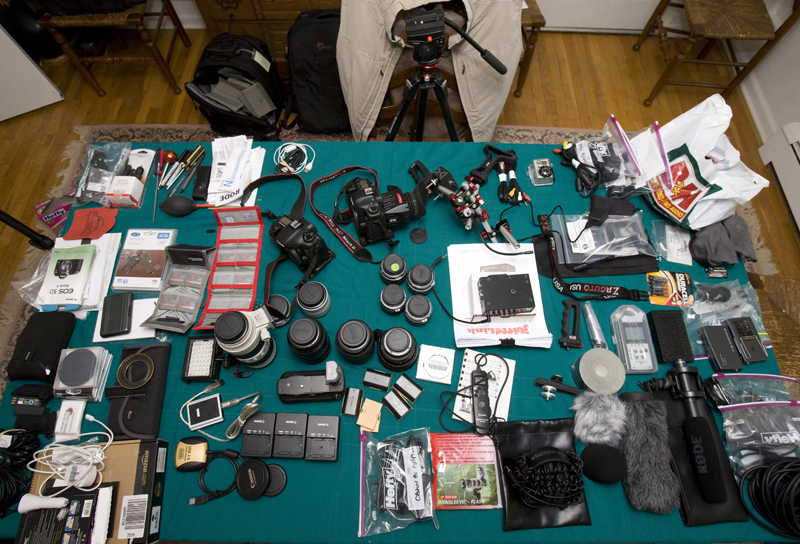
This past month I’ve talked to a lot of filmmakers as I’ve traveled around the film festival circuit with my film, but I’ve also talked to lots of photographers at Photo Plus Expo and other photographer gatherings.  I started to notice a difference in the conversations I was having with still photographers and filmmakers.  Filmmakers were usually talking about “the story” and the conversations were more like listening to the unveiling of a movie.  Still photographers, tended to talk more about how they executed “the story”.

When I talk to “hybrids”, the conversations are a blend of telling the story, with a bit of “execution” thrown in. I’m starting to notice something new in visual communications with a new aesthetic developing.  This recently became very apparent to me when I was asked to be a juror on the 1st AP-AI Motion Arts Awards.   I looked at over 50 entries and what I saw was a very unique look emerging.  What I saw was motion through a still photographer’s eye and it was incredibly exciting.

As technology continues to change how society communities, I truly believe that we as photographers need to think of ourselves as more than just someone who shoots still imagery.  As print gives way to electronic delivery, photography will take on a broader meaning as to how it’s executed.

Some things to keep in mind going forward:

  • Hang around with people who are embracing change.

From Seth Godin:

“Who you hang out with determines what you dream about and what you

collide with.

And the collisions and the dreams lead to your changes.

And the changes are what you become.

Change the outcome by changing your circle.“

  • Stop thinking of video or motion as a separate market
  • Stop giving yourself reasons NOT to do something.
  • Say YES more often
  • Remember the “tools” and the “medium” are just a means to an end. We have a whole array of new tools to create with and platforms that allow us to communicate globally.  Get excited about that.

Why Photographers Need to Stop Thinking of Video as a Market

I find that many still photographers I talk to either want to “get into video” – or they don’t.  In either case, most photographers think of video as an entirely separate market. The truth is, video is not a market at all.  It’s simply another visual medium a “photographer” can use to express themselves with, convey a story, or hopefully do both.

I have been a still photographer for over 30 years and a motion shooter for over 15, but I have been a storyteller since I started talking.  I have not abandoned my still photography, by any means, In fact if anything, adding motion to my skill set has made me a better photographer.

These days, I work with whatever medium that best conveys the message or story that I need to deliver.  I not only think about that in creative terms but also in how the story will be delivered and to whom. Last week

English: Cover of the February 17, 1933 (vol. ...
English: Cover of the February 17, 1933 (vol. 1 issue 1), first issue of News-Week magazine (now Newsweek). The issue features seven photographs from the week’s news on the cover. Featured are: Adolf Hitler, Franklin Roosevelt, Joseph Stalin, Franz von Papen. The issue has 32 pages and cost 10 cents. (Photo credit: Wikipedia)

Newsweek announced they were no longer going to publish a print edition. Clearly that will have a trickle down effect on paper sales, printers, advertising agencies, on down to photographers. It won’t just affect photographers shooting for Newsweek, but will also have an impact on commercial photographers as well. It will affect many markets.

We, as a society are communicating differently and everything is in flux because of it. People are getting their news immediately and on demand, on their phones and other mobile devices.  How can a print edition of a news magazine compete with that?  It can’t. How will advertisers react to that?  That’s the million-dollar question, isn’t it?  How can an advertiser monetize the “mobile platform”?  Do they make a viewer watch a short ad at the front end of a story?  As we communicate more and more using smaller devices, advertisers and marketers will need to come up with new ways of reaching their target audience.

Technology is a double-edged sword. It forces change on all of us but it also opens up opportunities.  The advertisers will be able to know exactly the audience they ARE attracting, based on information gathered from analytics.  Independent photographers can use technology the same way, if they open their minds up to new ideas and start to see opportunities.  But that will only happen if they start to see video as just another medium to work with, instead looking at it as a separate market, and telling themselves that’s not what they do.

I had the privilege recently of being a juror on a “motion” competition.  I was very encouraged by what I saw and I looked at over 50 videos.  I saw something new and different.  I saw the “photographic eye“ applied to motion. I saw a different visual aesthetic emerging.  Makes sense doesn’t it?  Photographers creating in a new way using new tools for a society that communicates differently.

Stressing the Story

Years ago, a colleague wrote an article about me for a trade magazine and entitled it “Gail Mooney – Past and Future Storyteller”.  Before that was written, I had never really thought of calling myself a storyteller, even though I had lived my entire life pursuing “the story”. In fact, it was because of my infatuation with people’s stories that I became a photographer and filmmaker. The pursuit of the story is what has driven me in making my own choices in life

But having a love for the story is far different than being able to tell a story. Regardless, if the story is told through still images, movies, songs, poems or books, the story must come through in order to resonate with an audience. I’ve been reading a lot about screenwriting lately, and how a story is written and structured for the movies.  Certain things must take place within the structure to make a story work.

  • Characters should be well defined and developed in the first third of the film.  The audience will need to get enough information about the characters in order to care, one way or another.
  • Stories should have conflict and contrast – just like life.  In every good film there is usually a low point right before a character prevails or a situation turns itself around.
  • Cinema has a language all of its own in how it tells and drives the story. The choice of lens or the way the camera is moved and from what angle, conveys to the audience a feeling. Make conscious choices and decisions as to what cinematic tools you use and why.
  • They say editing is the last line of defense for the story.  Every cut an editor makes has a profound effect on how the audience will feel.  An editor is able to tell a story in a hundred different ways, based on what clips they choose, how they cut them together and their selection of music.

I was very fortunate when I first started learning video.  I took the Platypus Workshop with PF Bentley and Dirck Halstead and they always stressed  “the story”.  I remember that I couldn’t even begin to shoot my project until I got my “commitment” (story) ok’d by Dirck or PF.  In order for them to commit to my story, I needed to commit to it first and they knew I wouldn’t be able to do that until I knew the story well enough to tell it.

Knowing and communicating your story in any medium simply means always being present in what your doing.  When the choices and decisions become obvious and effortless, then you know that you are telling the story you meant to tel

ePubs and Seminars – Why Some Inspire and Some Don’t

I’ve been working on an ePub about the “Business of Video”. I have one ePub selling now and

ePub #2

another one at the formatter, and I finally had  time over the weekend to fill in, the middle chapters of the “business” pub.  I had already made the decision to approach this ePub, the same way I would, if I was editing a video, by starting with the beginning and the ending and then filling in the middle.

As I was working on this book, it occurred to me that I should add a prologue – something that would explain the “why” I was writing the book in the first place. I had decided to write this ePub after receiving countless phone calls and emails from still photographers who had questions about incorporating motion into their own businesses.  The emails and calls started slowly at first, when I began writing this blog, which is geared toward still photographers who were moving into motion. It was after I started giving seminars and speaking at various venues, that I quickly became overwhelmed with the correspondence that I was getting. I realized something had to give, when I was spending more time talking to photographers and associates about their projects, than I was on things that I wanted to do.  I was also keenly aware there was a hunger for this type of information, so I began the process of writing an ePub about the business of motion.

It wasn’t until I received this email from someone who had taken my seminar, that it became clear to me of how I should approach the direction and content of this book.

They wrote:

“ I just wanted to tell you that your seminar was extremely inspirational, even though I can’t really say I learned anything new. Thank you.”

Ten or fifteen years ago, I may have taken that remark in a negative way, but I actually took it as a huge compliment.  It was also a very telling statement.  These days, we are overloaded with information. There is a wealth of content online (much of it is free), and there are days I simply get lost in this sea of information, spending way too many hours sifting through it all. On top of that, there are books, ePubs, podcasts, webinars, seminars, and workshops galore.  It’s become so easy to disseminate knowledge; that we end up receiving a lot of the same information, just regurgitated and repackaged.

I started thinking about the “why” in terms of what people hoped to take away from a book or a seminar.  I believe that most people are hoping to get information that they can use and apply it in their own businesses. Statistically, only 2% of workshop participants will actually act on what they have learned.  Many times people end up feeling so overwhelmed, that instead of applying the information learned, they end up giving themselves excuses why they can’t.  So, when I read this comment from someone telling me that I had inspired them, I realized that should always be the end goal for both the giver and for the receiver  – to inspire and get inspired.  I knew that if I wanted to inspire people to take action as my end goal, that I needed to do more than simply deliver the same basic knowledge that already existed in other books and seminars.  I knew that I needed to deliver the information in a way that was unique to me, through my own voice and my own experiences.

If I can do that, and inspire people through my own passion, I will succeed in moving them to take action.  Stay tuned.

Moving Into Motion – What is Your Why?

Over the last couple of years, in addition to maintaining my video production company and making a feature film, I have been teaching seminars and consulting still photographers who are thinking of getting into “motion”.  Many times I start out by asking participants why they want to get into motion.  The most common answer I get is “because it seems like that is where everyone is headed”.  That is perhaps the worst answer and reason a photographer – or anyone else, can give.

I suppose I could just do a show and tell and demonstrate the cool gear I have and how to use it, and I do talk about gear, but I would be remiss if I didn’t stress the “why” question.  Video is a medium that is all about story telling.  While a still photograph can also tell a story, video, by it’s very nature of incorporating visuals and sound, has the power to deliver a message or story in a very emotional way.  This is why many non-profits use video in their fund raising efforts – they have found that when they deliver their message with video – people give more money.

I got a call recently from someone who had just lost a close relative and they wanted their personal affects photographed.  My first question of course was why.  The obvious answer would be that they wanted these “things” archived.  But what they really wanted or the why in this case was that, these items evoked memories and memories are attached to feelings and it is those feelings that people want to archive when someone close to them dies. So, I felt my job was to capture and preserve those feelings for the ones who are left behind.  I knew if I didn’t approach the job like that, I would end up with images of just “things” and that would be more like a catalog of objects.

I was trying to unravel the “why” because that is what I’m best at.  My cameras and other tools of my trade – don’t do that for me – my heart and mind play a major role in that process and I believe that many times, this is what sets me apart from my competition. Photographers who don’t question the why, end up with images or video that may be beautifully executed but don’t emote or tell the story in a meaningful way.

I thought that perhaps the best way to approach this “job” would be to add a voice to it.  Even though the deceased can’t tell their story – their family and friends – can.  I also knew that I didn’t want to confuse the issue with video interviews because it could be a distraction, rather than add to the overall piece.  The decision was made to approach the job as a multimedia piece, using still images and sound recordings from relatives.

Interviewing is an art and it’s also something that can either make a piece strong – or end up as a disaster.  Like a bad script, an interview can either strengthen a piece or just as easily, weaken it.  It really is dependent on the person who is doing the interview. When done well, interviews will bring a unique voice and point of view to a project and that cannot be copied.  For example, I could do an interview with someone and hit all the right marks that I’m going for, as far as tone, emotion and connection.  I could give someone else the same list of questions and ask them to interview the same subject and they would get entirely different results.  It all comes down to rapport and that is not a one size fits all type of thing. Interviewing skills are difficult to teach, because invariably people want more of a black and white list of do’s and don’ts of the process. A great interview is really about having a good conversation with someone – but you leave your part out of the piece, when you edit it.  It’s comes down to good listening skills and rapport.  Sounds easy, but people either have these skills or they don’t.

I’ve thought about this a lot over the years that I’ve been shooting video and I always start with the “why”.  Why is it that I am really good at interviewing my subjects?  I can’t really pinpoint the reason(s), other than to say that I’m really interested in what people are telling me – and they sense that.  That’s just me and it always has been.

I became a photographer because of my insatiable curiosity in peoples’ stories – not because I was interested in photography.  My camera is a means to that end, whether it is a video camera, a still camera or a camera that is capable of shooting both.  I always start with the “why” and pick the camera and medium that best answers that question.

I am currently working on my 3rd ePub.  It is about the business of motion/video with lots of great tips and advice that will help you stay in business as you cross over into other mediums.  Stay tuned and in the meantime – start defining your “why”. Check out Simon Sinek’s TED talk – it will inspire.

Meeting Michael Moore

It seems like I’m meeting a lot of celebrities these days, but the truth is I’m meeting a lot of just regular folks too because I’m putting myself “out there”.  It’s just that celebrities stand out because – they’re celebrities.  Ever since Tom posted this photo

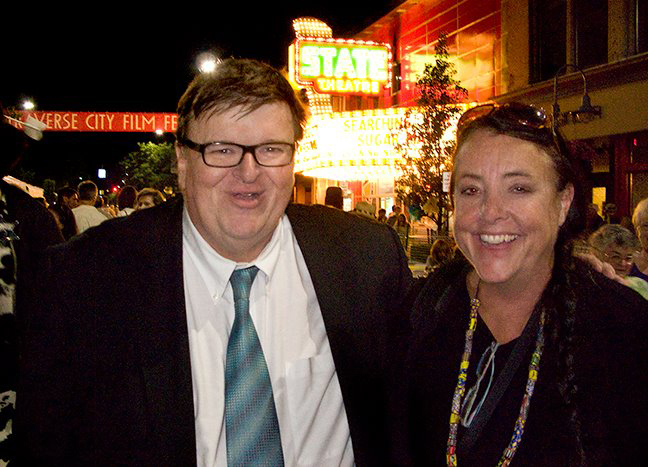
Michael Moore and Gail Mooney at the Traverse City Film Festival

on Facebook, of me with Michael Moore at the Traverse City Film Festival, I’ve gotten a lot of emails from people asking me about it.

To be honest, I was one of many that Michael had a 5-minute chat with that night at the opening party of the festival.  I won’t tell you exactly what we will talked about, other than to say that I asked him how I could get 15 minutes of his time.  That probably wasn’t the best question to ask him at a large party that he was escorting Susan Sarandon to, but I figured I would do what Michael Moore would have done.

Moore is a polarizing kind of guy – strong in his convictions and people either love him or hate him.  I’m somewhere in the middle, but after reading his book “Here Comes Trouble”; I’ve probably swung more to the “love” end of the spectrum.  His book is about his life – with each chapter telling a story about a particular time and experience. I didn’t really know a lot about Moore and all that he has done, but he is like the Forest Gump of his time. In his book he tells the most amazing stories about himself and the serendipitous situations he has encountered in his lifetime.  It’s extraordinarily funny and I would highly recommend it, regardless of what you think about Moore.

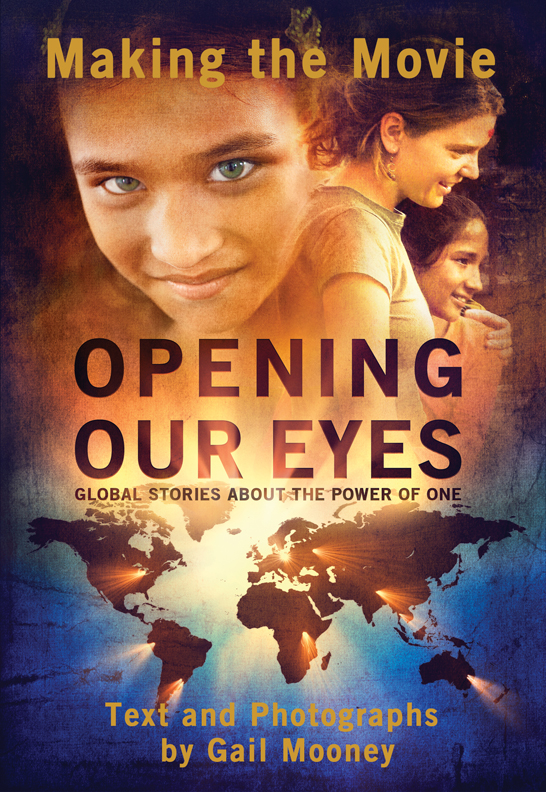
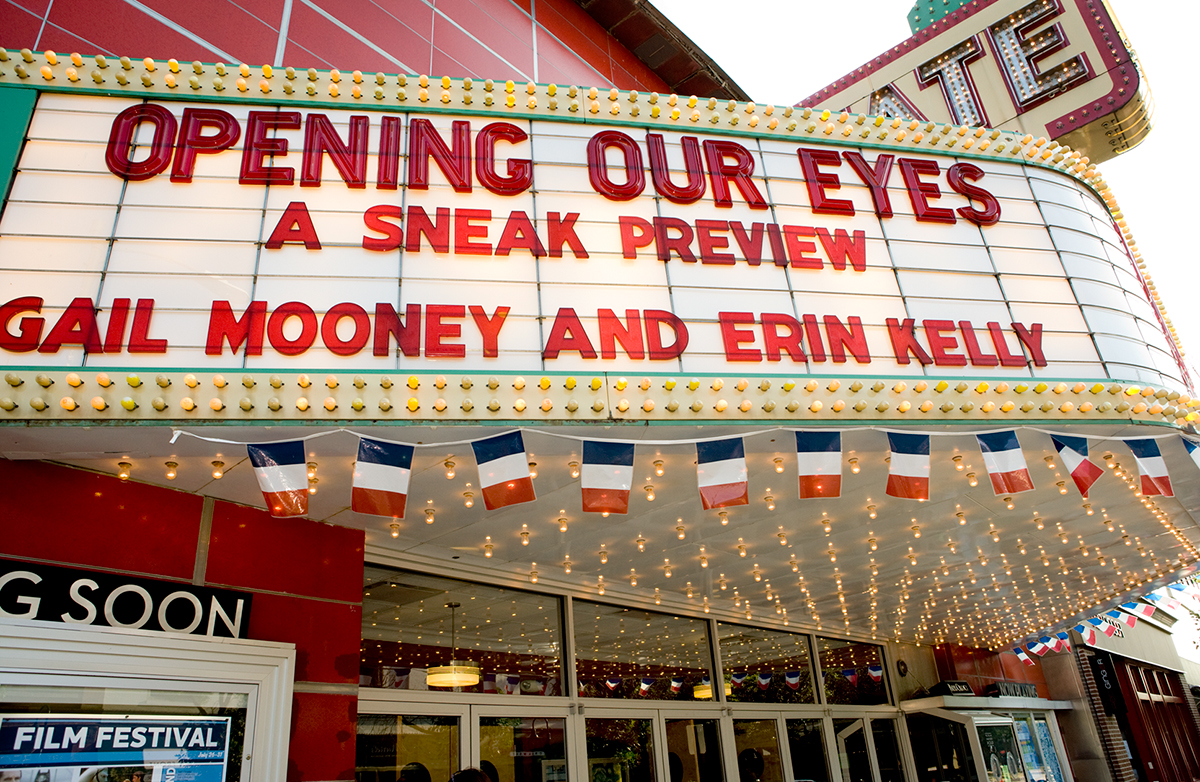
Michael has done a lot for the people of Traverse City, Michigan.  He was co-founder of the Traverse City Film Festival and if you’ve never been – GO.  It’s a festival like no other and it’s in one of the most beautiful spots in the country, in northern Michigan.  Michael was instrumental in restoring the State Theatre that had been vacant for over 40 years.  We were able to rent that state of the art theater last year to show a sneak preview of our film, Opening Our Eyes for only $250.00!  Michael loves films and filmmakers.  He also started a funding campaign to raise money for new seats for a local elementary school’s auditorium.  He had only one condition – that the school would honor Martin Luther King by recognizing his birthday as a national holiday and closing on that day. That was only last year, a time when most schools in our nation had recognized this holiday long ago.

I was a bit surprised to see Michael at the “open” outdoor party that night.  He’s literally a “target” and has had many threats on his life.  At one point in his life, he was guarded by a team of ex Navy Seals because of these threats and the copious amounts of “hate mail” he was getting.   I’m sure that has taken a toll on him personally, yet he stays true to his convictions and continues to speak out.

It’s not easy to stay true to your convictions, especially when it’s counter to the status quo.  I admire people, who are consistent in this way, regardless if I agree with their point of view or not.  After all, we live in a democratic country, and democracy is built on the voice of the people – and that means ALL people.  My biggest fear is losing that right to speak out. Ironically, when the “status quo” feels threatened,  “fear” is used to control the voice of the people and only a few are brave enough to speak out, facing the wrath and conjecture of popular opinion.  Moore is one of these people and whether you agree with him or not – take a moment if you live in America to think about this. It’s because of people like Moore that we are still “free” to speak out.

Sadly we couldn’t stay for the entire festival, but we did get to see the film, “Don’t Stop Believin’: Everyman’s Journey” – an incredible story of the band Journey and how they found their new lead singer in a most unusual place – The Philippines.  I just found out that this film got the “best audience award”.  Seems fitting for this movie to receive that award – it’s got everything that someone like Michael would love – a great story with a message that anything is possible and to never stop believing.

How Shooting Video Can Make You a Better Still Photographer

So, many people identify me with video, they tend to forget, that I still create still photos and have had a l-o-n-g career in making them.  I’ve been shooting still images for over 30 years for magazines, corporate clients and advertising, as well as just shooting for the pure joy of doing it – without the need for an assignment or validation from anyone else.

Because so many people seem to assume that I abandoned my still photography when I started to shoot motion, I was surprised and delighted to get a note from a colleague when they spotted a still photograph that I had recently shot in New Zealand.

“Gail, I often hear your voice when I see your still images.  I can’t quite articulate what I mean by that, other than to say that when I look at many of your images, I hear your laugh and feel your smile and warmth come through”. 

He then wrote: “You photo reminded me of the following quote”:

“This is a hard world to be ludicrous in, with so many human beings so reluctant to laugh, so incapable of thought, so eager to believe and snarl and hate.

Kurt Vonnegut

“Thank you Gail for giving us a glimpse of joy and laughter”

I was quite touched by his note and it got me thinking about how my exploration into shooting motion may have played a big part in how I now approach shooting my still images.

 Here are a couple of things that I’ve identified:

  • Video has made me a better visual storyteller – That’s because the medium of video is all about storytelling and no other medium does it so well.  It’s made me think about how I will “tell the story” in one still image that is captured as a moment in time.  A good still image should not have to rely on a caption – to tell the story.
  • Video has made me think in sequences, with a beginning, middle and end –, This has been a huge boost when I’m creating a pagination of stills.  I think beyond the one image, and what will come before as well as after it, on the printed page. I plan and shoot images with that in mind, thinking not just about the parts of the story, but the whole as well.
  • My still images now have a voice – For me one of the most frustrating, yet fulfilling dimensions of video is sound.  Still images on their own, obviously don’t have audio, but they can have a voice.  When I’m shooting stills, I want the viewer to “hear” them as well as to “see” them.
  • When I’m shooting video I’m using all manual settings – I’m not on auto-pilot. This makes me think more about the desired look I want to achieve in the final image.
  • My still images have become more personal – more authentic. – Now, maybe video didn’t play a direct role in this, but it has pushed me into new territory. When that happens, habits get broken and make way for new possibilities.  In a way, it’s like a new start – a new beginning and that is always an exciting place to be, creatively. It has opened up my eyes to see things differently.

Perhaps most importantly, shooting video has reinforced the notion that my creativity, whether it be motion or stills, has nothing to do with the particular camera that’s in my hands.  The camera is just the facilitator for the stories and images that play out in my head.

At the end of the day – I am a photographer.

Vision vs Trends

I find that many creative (and not so creative) people confuse the meaning of the two words – vision and trends.  When someone has a vision, they see past the status quo, whereas by the time something becomes a trend – it is status quo.  Seems clear to me, and yet for the most part, the common perception of what a trend is – hot, successful, youthful, revolutionary – really isn’t visionary at all, because by the time it becomes a trend – everyone is doing it.

Case in point.  Four years ago, when I joined the board of ASMP, some may have seen me as a visionary because of my early foray into video.  Four years later, it seems like everybody is doing video.  Does that make me a visionary?  Perhaps.  But I need to make a very important point here, and that is when I started shooting video almost 15 years ago, it was not because I had a vision, that the future of photography would be video.  It was because I saw myself then – and still do – as a storyteller and one who delivers the visual message, with whatever creative tools do it best.

I get super frustrated with people who define me by the type of camera (tool) I choose to use.  Anyone who has heard me speak, knows my mantra is “it’s not about the tool”. So for anyone to narrowly define me by this one particular medium – video – instead of  understanding that I foresee the  “future of photography” in the broadest sense of the word “photography”,  – are only seeing me through their own “narrow” lens.

I’ve spent a lifetime, trying not to pigeonhole myself into one genre or medium and to stay true to myself and what my instincts are telling me, rather than to jump on the latest trend. I can tell you this – by the time something is trendy – there’s nothing gutsy or visionary about jumping on that bandwagon.

Being visionary is:

  • Taking a risk based on instincts instead of emulating the latest trend.
  • Being concerned about the substance of something – not just the packaging and the veneer. Thinking that way will make you outlive any trend.
  • Being afraid, yet still being brave enough to act on what your inner voice is telling you.
  • Managing to be bold enough to come forward with an idea that is not the popular opinion du jour.
  • Not getting in your own way by seeing yourself through only one narrow lens – In the early 1900’s, when the automobile hit the scene, the folks in the horse and buggy business who saw themselves in the transportation business survived – the ones who saw themselves as in the horse and buggy business………well we know what happened to them.

I won’t get into politics here, except to say that sadly these days, so many of our world “leaders” are not visionaries and we desperately need leaders who are. But that takes courage and going against the status quo.  It’s far easier to follow others, after they have paved the way.  That’s not only a lack of vision – that’s bad leadership.

Mistakes Professional Still Photographers Make When “Moving” to Video

1.  They forget about the story – it’s not your camera that tells the story – it’s the person using the camera. Pretty visuals, slapped into a motion timeline with music, doesn’t necessarily tell a story.  Video is a story telling medium – don’t forget that.

2.  They think they already know how to shoot – if you think because you are a professional photographer and all you need to do is get a camera with a “video mode” on it, you are mistaken. Shooting in motion is far different than shooting still images. An experienced motion shooter can spot a video shot by a still photographer with little know how, right away.

3.  Thinking audio isn’t important – audio is more important than the visual when producing video.  Hire a sound person to do it right, but don’t discount it.

4.  Thinking the DSLR camera is all you need for video productions – this is a biggie.  How are you going to go after professional video jobs if this is the only tool in your kit?  Sure you can rent a RED – but make sure you are as proficient with this tool as your competition is before hanging out your “motion” shingle.

5.  Positioning themselves just as DP’s or Directors and thinking you’ll maintain ownership of your work. If you assume the role of a camera operator, DP or even a director – you will be in a work for hire position in most markets.  Position yourself as a producer – shoot if you want to – and direct – but realize that you’ll be just one rung on the “content ladder”.

6.  They don’t learn interview skills – this is what separates the pros from the still shooters who have DSLR cameras and think that’s all they need.  I’d say about  70% of my work includes on camera interviews.  Even though I ask the questions- I’m not on camera, my subject is.   I not only need to know how to ask the right questions and get great audio, but I need to produce a usable interview clip for an editor. That means knowing how to get great soundbites. This is one area I excel in – it’s all about rapport with your subject.

7.  They try to compete in “old business model” markets – Everyone wants to shoot broadcast spots and feature films (or short films) so they think that after shooting motion for only a few months – or even a year – they will be able to compete in the high end business of video production.  First, this market, like the still photography market,  has changed drastically, mostly marginalized by still photographers who are just starting to shoot motion,  shooting jobs for next to nothing because they have no understanding of this “business”.

8.  Learning the “how to’s” in terms of gear – but nothing about the business – this is also a biggie.  There are so many “how to shoot motion” workshops and roadshows out there but no one seems to be teaching the business end of things.  Still photographers think they already know “the business” but quickly realize that they don’t, and they put themselves out of business in this medium – before they’ve barely started.

9.  Teaching “how to” workshops in video with little or no experience – I can’t tell you how many photographers have called me for technical advice about some pretty basic stuff in terms of video,  and four months later they are teaching workshops. Please don’t become part of the problem and send more shooters out into this field without teaching them something about business. And if you are considering taking a workshop – do your homework and take the workshop from someone who is accomplished in this field and has done something.

10. They forget about the story – I know that’s #1 but it needs reinforcing.

ASMP and Motion

I’m on the National Board of Directors of the ASMP, The American Society of Media Photographers.  About four years ago, I was asked if I had ever thought about running for the board.  The person who had asked me this question, knew that I had been shooting video in addition to still photography and thought that it might be a good idea to have someone on the board who had an understanding of this medium.  That was four years ago, and even though I had been shooting video for over 10 years – the “explosion” of this medium (in terms of the demand) had really just started.

I did run, served three years, ran again and got elected. I’ve shared my knowledge of this medium through meetings, seminars, blogs, emails and during Q&A’s when I screen my film.

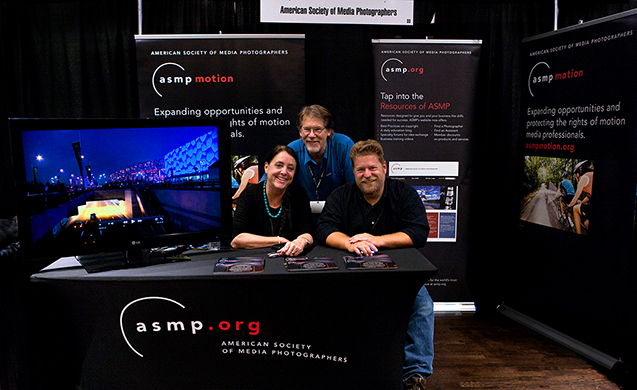
Gail Mooney, Tom Kelly and Chris Hollo at ASMP booth, DV East

This past Wednesday, I spent my day manning the ASMP booth at DV East Expo. Former national board member (and now President of the ASMP Tennessee Chapter) Chris Hollo and my partner Tom Kelly joined me.  We were well prepared with a large flat screen monitor displaying a loop of our members work. I was intimate with the reel as I had just finished editing it and I was very impressed with the quality of the work.  It certainly was an attention grabber.

So, what was ASMP, a trade organization of still photographers, doing at a video expo? Essentially, we were there to provide a community and reach out to other professionals who are shooting both mediums and provide information about sound business practices.  If this demographic does not understand the value of copyright or value the concept of licensing, then it will ultimately affect the way business is done in the still photography industry.

Some people may think that ASMP is becoming too inclusive or is creating more of a problem by suggesting that video may be the answer for its members, only for them to find out, that industry is glutted as well.  The old business models of bloated production companies with fat budgets are hanging on for dear life, along with the old business models of the film industry.  But if you think outside the box, especially in terms of how you structure your photography business – the opportunities are out there.

ASMP doesn’t cease to be an advocate for its still photographers who have no interest in motion – it’s actually making the entire industry healthier by educating the hybrid competition.  A lot of the people I talked to yesterday, shot both still photography and video, but even the ones who just shot video – called themselves “photographers” and they all had questions about “the business”.

I’m so closely associated with  “video” by members of this society; they tend to forget that I am a photographer.  I don’t call myself a photographer simply because I spend 50% of my time shooting still images, or call myself a videographer because I spend the other 50% of my time producing video. I don’t want to define myself by my tools, at all. I “see” as a photographer, with the vision of a filmmaker and the heart of a storyteller.  I also have a strong desire to stay in business doing what I love to do.  By being an advocate for sound business practices across these mediums, I get a lot more back than I give.  All photographers’ benefit, regardless of what type of cameras they shoot with.

Friend and fellow board member Ed McDonald, tells his own story about how he had become too rigid at one point in his career, as far as how he perceived himself and what kind of photographer he was. He found that when he became more flexible in how he “defined” himself, his business got better. As I think about Ed’s story, I know we have a lot in common.  For me, when I stopped restricting myself to just shooting still images – not only my business got better – so did my still photography. Shooting motion has made me a better still photographer because it has made me a better storyteller.

I got an email late last night from someone I ran into at the expo.  They wrote:

“Thanks for your vision and inspiration and all you’ve done for ASMP.”  So simple and so poignant and I thought – “isn’t that what I was supposed to do?”