The Hard Part About Working With DSLR’s

After two solid months of intensive shooting a documentary – shooting both stills and video with two DSLR cameras, the Canon 5D Mark II and 7D, I can honestly say working with these hybrids is not easy. And it certainly isn’t fast, especially if you are working in a small crew as we are.

Yes, the visual is stunning but I can’t help but think how many moments I may have missed that I probably would have gotten if I had been shooting with a video camera. When shooting motion, I have a constant mantra running through my head and that is “shoot and move”. That’s because you need a lot of footage at the end of the day and you need to edit your film. I’m not talking about working with a neatly storyboarded script and a Hollywood crew. I’m talking about working lean and mean and in a somewhat discreet way that is in order when shooting a documentary.

That really hit me last night while shooting on the streets of Sydney, Australia. My subject that I’m focusing on here is Paul Moulds from Oasis, which is a youth support network dealing with homeless street kids. I needed to hit the streets at night and knew that I not only had to be sensitive to the situations that I’d be shooting but also alert to the dangers. I’m positioning myself with a lot of expensive gear in tough neighborhoods where drugs and violence rule.

If ever before I needed to shoot and move and act quickly and keep a third eye out for any lurking danger. No time to stress on the importance of the perfection of the visual. I needed to get in close to the action – make sure my audio was being captured sufficiently and get the story. So even though I can tell you that my visual will be beautiful and lacking “noise” in the blacks – I probably would have gotten better and more meaningful coverage with a video camera.

I’m sure there will be plenty of you who will argue that there are journalists embedded in war zones with these cameras. And of course there’s Vincent LaFloret’s brilliant cinematic night films. But for me, I think there are times when I could have reacted faster with a video camera. And so I think – what’s more important – the resolution or the story?

Add to FacebookAdd to DiggAdd to Del.icio.usAdd to StumbleuponAdd to RedditAdd to BlinklistAdd to TwitterAdd to TechnoratiAdd to Yahoo BuzzAdd to Newsvine

True Convergence With the DSLR Cameras

I read today that mega publishing company Conde Nast “names a new president as company seeks new business model”. http://adage.com/mediaworks/article?article_id=145071

“The historical priorities that have served our company so well — great content, best-in-class magazines, key client relationships – remain the cornerstone of what we do, but we need to move beyond the magazine,” said Mr. Townsend, who remains CEO, in the statement.”

Wow – so one of the biggest publishing companies is realizing that electronic delivery and the internet isn’t an afterthought or an add on to their print pubs.  That would have been unheard of just 2 years ago, but with the proliferation of mobile devices, including the iphone, ipad and other “i” devices, we really are seeing a shift in the way we communicate.

Photographers should definitely take notice of this and understand that they need to think differently themselves. Imagery and workflow that worked in the print world just isn’t going to fly in the world of “i” devices. You need to think and see differently when creating for electronic devices that are capable of showcasing still images, video and sound.  And it’s no longer sufficient to just regurgitate still imagery for the web or pick up a hybrid camera and switch into live mode and shoot video that will adequately convey a message in motion.  It goes beyond the tool – it’s thinking, seeing and anticipating in motion.  After 11 years of shooting motion and over 30 years of shooting still images, my mind seamlessly makes the switch a hundred times a day between thinking and seeing in “moments in time” or “time in motion”. It’s a bit analogous to being fluent in a foreign language when you find yourself thinking in the language rather than needing to do the translations anymore in your head.

Many still shooters who are just beginning to shoot video are so consumed with the technical aspects of the tool, they forget that they need to think and shoot differently when shooting video.  I see a lot of people moving the camera, rather than letting movement take place in front of the camera.  And I see a lot of independent clips shot and then put together in a video timeline, but with no connection to one another or unity in a sequence.  Basically, a slide show of video clips – but not a story sequence.

It takes time to get to the point where you think in motion, especially if you’ve been a still shooter for many years.  My instincts are now that I know when to pick up the right tool – a video camera or a still camera, rather than choose the tool without meaning to the subject that I will be shooting.  I choose the tool that will best communicate the message.

The best advice I can give to still shooters who want to move into video is for them to stop compartmentalizing the two mediums.  Don’t define yourself as a videographer or a still shooter that does sports or weddings or commercial work.  As print gives way to electronic delivery, our clients need to communicate in a different way and we need to be creative in delivering their message and choose the best tool that will do that.  If we can think like that then there is true convergence – not only with our tools but the way we think.

It’s no wonder that publishing houses are hiring shooters with skills entrenched in both mediums.  They need creative’s who think differently – not just in moments in time or time in motion, but a true blend that only a hybrid shooter can deliver.  That’s my best advice that I can offer to people just starting out as photographers or videographers – don’t separate the two – become a hybrid and learn to communicate creatively with the right tool at the right time.

Add to FacebookAdd to DiggAdd to Del.icio.usAdd to StumbleuponAdd to RedditAdd to BlinklistAdd to TwitterAdd to TechnoratiAdd to Yahoo BuzzAdd to Newsvine

Living in the Now

The last couple days have been eye opening as well as reminders as to why I have embarked on this project www.openingoureyes.net. Maybe I needed a reminder at this point in my life that you only go around once and to make the most of it. And after spending a couple days with Ronni Kahn, CEO of Oz Harvest, I got that reminder and it affirmed in my mind why I took a risk, took on a personal project and took off for 3 months on a journey with my daughter around the world.

But Ronni reminded me how important it is that you really only have the “now” in your life because you don’t know what tomorrow may bring. I remember when I first embraced the notion of living in the “now”. I was 19 years old and hitchhiking around the world. I remember a consistent remark from people who stopped to pick me up and bring me a bit further along on my journey. Many of them said, “I wish I had done what you’re doing when I was your age”. I never lost sight of that and have always lived my life with the thought that if I don’t do “it“ now, I may never get the chance again.

No one really knows what tomorrow will bring – that’s the mystery of life. The best-laid plans are never givens and the surprises and unexpected moments are many times the most rewarding.

Tonight, I had a simple yet memorable dinner with my 23-year-old daughter Erin. As we ate our pizza and had a lovely, inexpensive bottle of wine – we took notice that here we were in Sydney, Australia, overlooking the Sydney Opera House and it all seemed so surreal. But it was real, it a moment in time that we made happen, that we didn’t postpone until the “perfect” time in the future and a time that we will always have and always remember. We were living in the “now” moment.

Add to FacebookAdd to DiggAdd to Del.icio.usAdd to StumbleuponAdd to RedditAdd to BlinklistAdd to TwitterAdd to TechnoratiAdd to Yahoo BuzzAdd to Newsvine

HDSLR Video – The Camera is Just the Beginning

Many still shooters make the same mistake when jumping over to video – they only think about the camera and the shoot. When this happens, what quickly follows is mild to severe panic when they realize that audio is even more important than the visual and post-production is video is far different than in stills. On top of that, if you shoot video like a still photographer – you’ll want to kick yourself when you get in the editing room.

The good news is there are plenty of resources when embracing these various skills and learning curves than when I started shooting video over ten years ago.

Here’s a few great sites, listservs and blogs that you should bookmark:

http://asmp.org/tutorials/video-tutorial.html

http://photocinenews.com

http://www.cinema5d.com/index.php

http://phillipbloom.net

newspaperVideo@yahoogroups.com

http://worldwide-studios.com/Worldwide_Studios/Resources.html

So have fun and remember, the more your learn, the more you realize you need to know.

Add to FacebookAdd to DiggAdd to Del.icio.usAdd to StumbleuponAdd to RedditAdd to BlinklistAdd to TwitterAdd to TechnoratiAdd to Yahoo BuzzAdd to Newsvine

A Birthday Gift

Today was one of those days that are memorable and just make you feel good to be alive and affirm your life’s convictions. Even though I “worked” today – on my birthday – I realized once again that my “work” has never really felt like work at all, but rather a gift.

Once again, because I am a storyteller and a visual communicator by profession and have the great fortune to have been able to make a living doing so, I had the privilege of spending the afternoon with a remarkable woman. Her name is Ronni Kahn, CEO (Chief Energy Officer as she would say) and founder of Oz Harvest, a food rescue program in Sydney, Australia. What Ronni does is quite simple – yet far reaching. She has set up an organization that picks up food from events, parties, affairs etc. that would have normally been thrown away, and sends it over to various charities that feed the needy.

But one of the many remarkable things that Ronni has done was to use her connections and passion to change the law so that people and organizations who were willing to give away their perishable and left over food, could do so without fear of being sued or liable in the process of doing a good deed. Ronni made it happen because she saw the big picture and overcame the obstacles in the way.

We spent the afternoon with Ronni, first touring around the lovely coastal areas of Sydney, then filming her inspirational interview and ended the afternoon at the beach. One thing stuck with me that Ronni said during the interview. She told me that many people tell her that they would love to get involved and do something along the lines that she has done but that it just wasn’t the right time in their lives and then proceed to give her a variety of reasons of why they can’t. And then she said “if you want to do something – you just need to do it”. You need to stop making excuses and live in the “now”.

As I write this blog entry, her words are kicking around in my head and I realize how grateful I am that I am living in the “now” and doing what I feel I need to do. And that is the best birthday gift of all – nothing can ever top that.

Thanks Ronni for a wonderful and memorable day.

Add to FacebookAdd to DiggAdd to Del.icio.usAdd to StumbleuponAdd to RedditAdd to BlinklistAdd to TwitterAdd to TechnoratiAdd to Yahoo BuzzAdd to Newsvine

Professional Still Photographers as Amateur Videographers

These days many still photographers are frustrated when their clients decide to take their own pictures or get photos from amateurs who take photos that are good enough. And sometimes “good enough” is not only good enough – it’s pretty good because technology has enabled just about anyone to take a reasonably good photograph.

Indeed technology has lowered the bar to the entry into the realm of professional photography. But any pro knows there is more to “making” a good photo than the actual execution of an image. There are many problems to solve, and there’s the matter of being able to consistently make good photos.

But I must tell you, over the past year I have seen still photographers exhibit the same attitude that they abhor in their clients when it comes to the medium of video. As more and more still photographers embrace video because of hybrid cameras like the Canon 5D Mark II, many fall victim to the same line of thinking and that is if they buy a “good” camera that shoots “HD” video – that’s all they need to throw out the “video shingle” and they’re in business.

The problem is they lose sight of some very important things:
1. Shooting motion requires a different thought process
2. Audio is everything
3. Post production is very different for video than for still images
4. Video is a collaborative process

So when I get a question from a still photographer as to “what is a good video camera?” – I bounce the question right back at them and say – when an amateur photographer asks you what still camera takes good pictures – what do you say? Most quickly get the analogy and realize that while they are pros in the still photography world – buying a video camera or an HDSLR doesn’t make them professional a videographer. Motion is a wonderful medium, but get to learn the craft because it’s more than just the camera.

Add to FacebookAdd to DiggAdd to Del.icio.usAdd to StumbleuponAdd to RedditAdd to BlinklistAdd to TwitterAdd to TechnoratiAdd to Yahoo BuzzAdd to Newsvine

I Don’t Believe in Re-Inventing Myself

I hear an awful lot of people these days saying they are re-inventing themselves. I always take pause when I hear that because I think to myself that I don’t want to re-invent myself.

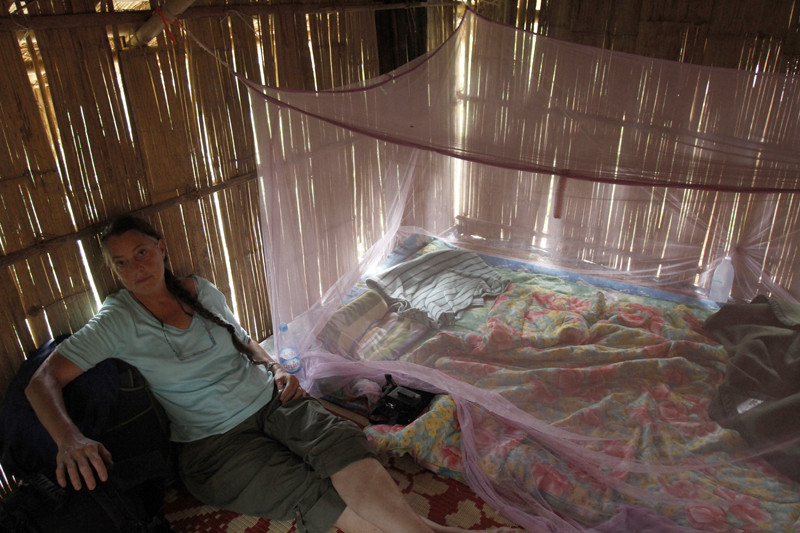
Gail in bamboo hut in hill tribe village, northern Thailand

I like who I am and what I do – so why change it? It doesn’t really matter to me if I’m in vogue or doing what everyone else is. What matters is that I’m true to myself.

Don’t get me wrong – I’m not stuck in the 1970’s and wishing for the good old days. It’s just that I’ve always kind of done what moves me – what I just have to do. So in that sense I suppose one would say that I re-invent myself on a daily basis. But in fact I’ve always lived my life and pursued my career based on what that little voice or “inner self” is telling me to do.

Has that inner voice always been right? Many times when things don’t have the kind of outcome that I expected, I’d probably say that my inner voice led me astray. But in fact, the outcome was what it was meant to be – even though it wasn’t what I wanted. Things happen for a reason and things happen when they are meant to happen.

There have been times when I’m in such a hurry – in pursuit of my dream – that I don’t stop and realize that my dream is happening right then and there. On those days when I feel that I’m just a day away from where I want to be – I try to remind myself that maybe I’m already there.

In my 99-day journey around the world, I try to remind myself on a daily basis – not to look ahead to my next destination but to relish the one I’m in. A powerful thought and an even more powerful action.

So as I continue on following what that inner voice is telling me, I realize this is what I’m meant to do and this is the time that I’m meant to do it. I believe that and know that this is all happening for a reason. This is my path and where it will lead, I’m not certain. But I’ll follow along with faith and good judgment and never feel forced to re-invent myself.

Add to FacebookAdd to DiggAdd to Del.icio.usAdd to StumbleuponAdd to RedditAdd to BlinklistAdd to TwitterAdd to TechnoratiAdd to Yahoo BuzzAdd to Newsvine

Capturing Good Audio When Shooting With DSLR’s

I see a lot of confusion and misconceptions amongst still photographers as they embrace video using the DSLR camera. For many audio is an after thought which is a big mistake because audio is much more important than the visual. Unless you’re just laying down still images or video clips to music then you have to be able to capture good sound. Some things to consider and remember.

1. You’ll never get good sound with the camera microphone – only use the camera mic for reference audio.

2. Don’t buy a camera that won’t let you use external microphones – unless you will be capturing your audio separately and syncing it later in post.

3. If “running and gunning” – you can probably get away with using a mic mounted on the camera as long as you are close to your audio source. You can either use a mic with a mini plug and connect it to the camera OR you can run the mic via an xlr cord to a mixer like a JuicedLink or a Beachtek, which is much better, rendering a cleaner audio capture.

4. For interviews, most likely you won’t want your camera to be extremely close to your subject. So you won’t want to use a mic mounted on the camera – it’s too far away. I rig a shotgun mic on a boom stand and I also use a lav on the subject and run both into my camera if I’m using a traditional video camera or into my JuicedLink mixer if I want to capture the sound on the same card as the audio.

5. When using a DSLR camera, capturing your audio separately with a digital recorder is ideal. I use a Samson H4N Zoom that not only has a built in dual stereo mic but two XLR inputs. I run my shotgun mic and lav mic into the Zoom and then sync the sound later in post with software called Plural Eyes. Make sure you keep the audio on in the camera as well to use as a reference for syncing later on.

6. When using a device like the zoom that has a built in mic – remember that even though this is a quality mic – you MUST get the mic in close to your sound – no more than a foot away. I prefer not to use this mic but rather a shotgun because a shotgun is more focused and won’t pick up a lot of the ambient noise.

7. Use headphones. Don’t just look at your meters – wear headphones and make sure that you are getting quality sound. You could be picking up interference or static.

8. Always consider your audio even for your b-roll – you need some audio – even if you only intend it as ambient background sound.

9. I only use a wireless system when I need to. In cities like New York you can get a lot of interference on the frequencies. Always go wired if you can. And if you find yourself needing a wireless system, spend the money to get a system that has a good range.

10. Be quiet and tell your crew to be quiet as well. You never know when you’ll want to use the audio – even if you think you won’t need it.

Add to FacebookAdd to DiggAdd to Del.icio.usAdd to StumbleuponAdd to RedditAdd to BlinklistAdd to TwitterAdd to TechnoratiAdd to Yahoo BuzzAdd to Newsvine

Revisiting “Standing on a 10 Foot Frozen Wave”

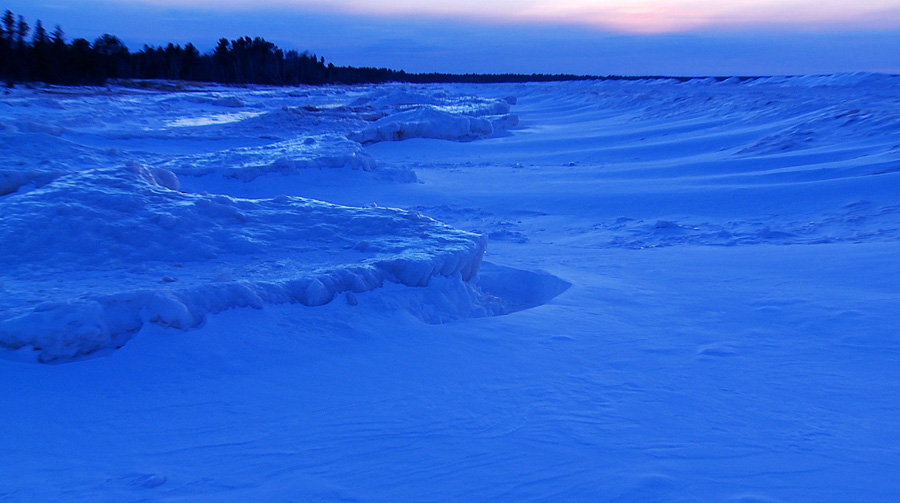
It’s been only 5 months since I stood on top of a 10 foot frozen wave of Lake Superior in the Upper Peninsula of Michigan. Seems like a lifetime ago. I couldn’t be further from that wave, both literally and figuratively speaking.

Lake Superior, Upper Peninsula, Michigan

As I stood on the crest of that frozen wave, in utter silence with no one in sight for miles, I reflected on the human spirit in this remote part of the world. The sun was setting and I was fearful of slipping into a crevice but yet drawn to the glow of the setting sun – feeling hopeful for the future.

I am in Jaipur, India right now with the temperatures nearing the 100 mark and the humidity level the same. But it seems hotter because everything here in India seems intensified on every level. I’ve been on the road for close to 2 months now and have traversed a variety of climates, cultures, joys and heartbreaks. It’s been easy, hard and everything in between.

In creating this documentary “Opening Our Eyes” I have challenged myself in every way I know how. Just shooting a documentary with an HDSLR system, on a slim budget and with a two-person crew is a feat in itself. But this documentary is taking us around the world and putting us in touch with the less fortunate of our planet. It’s humbling, heartbreaking, exhausting, yet somehow a boost to my inner spirit – that same spirit I wrote about back in February when isolated and alone on that 10 ft. frozen wave.

How I crave those frigid temperatures and the utter silence of tranquility. Space is a luxury in India with billions of people competing for it. Such an intriguing culture but one that is beyond demanding of all that a body and soul has to give. I draw on my inner strength and my people that came before me who taught me well about struggles and endurance as well as compassion for those who are less fortunate.

My eyes have been opened these past two months in so many ways and so I think unknowingly I chose the perfect title for this film. To experience and see the extremes of the human condition across the globe has broadened my perspective and put things into balance. What seemed so important just a few months ago, seems so trivial today.

And so it goes as I complete this journey in a few months time. Off to another climate and culture with my eyes opening wider as I go along.

Add to FacebookAdd to DiggAdd to Del.icio.usAdd to StumbleuponAdd to RedditAdd to BlinklistAdd to TwitterAdd to TechnoratiAdd to Yahoo BuzzAdd to Newsvine

Beyond the HDSLR and the G4 iPhone

Everyone these days seem obsessed with the tools. The blogosphere is full of tech talk but few mention the art of storytelling. Without that, we are left with technique with no apparent message – or one that is weak at best.

When I think about it, the videos and photographs

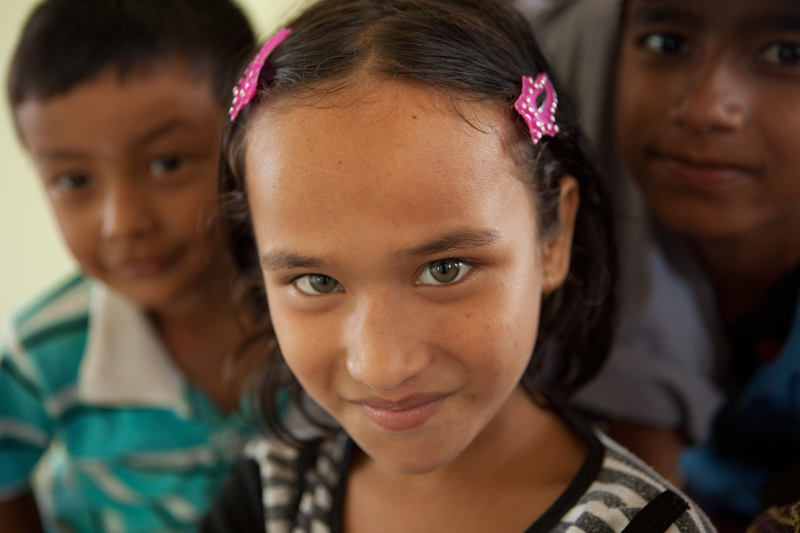
School girl in Surkhet, Nepal

that really resonate with me and stay with me for any length of time are not examples of shifting depth of field or low light marvel, but rather pieces that have touched me because of the story that they tell.

The story that we have to tell is also one facet of video making where we can stand out as being truly unique. Our stories are our songs where we reveal a part of ourselves. If our films are solely portfolios of technique and examples of what our tools can achieve, then we do not separate ourselves from our competition. We can all buy the same gear, gadgets and gizmos and with that run the risk of being button pushers.

I suggest that we all work backwards. That we define the message that we want to communicate and then choose the right tool that will appropriately fill that need. In order to do that, we need to step back and experience life itself. See what the world has to offer, discover our passions and have something worth talking about before we even begin to pick up a camera – whatever camera that may be.

Add to FacebookAdd to DiggAdd to Del.icio.usAdd to StumbleuponAdd to RedditAdd to BlinklistAdd to TwitterAdd to TechnoratiAdd to Yahoo BuzzAdd to Newsvine