VR – Virtual Reality – Will it Replace the Real Experience?

I just returned from the NAB (National Association of Broadcasters) Show held annually each April in Las Vegas. With 4 huge convention halls displaying the latest and greatest technology and gear used in broadcasting, it’s simply overwhelming. Since I’ve never been enamored with just the NAB 2016gear component of my business (still photography and video), but rather in how I can apply or enhance the story that I’m working on, I spend most of my time attending the conference tracks.
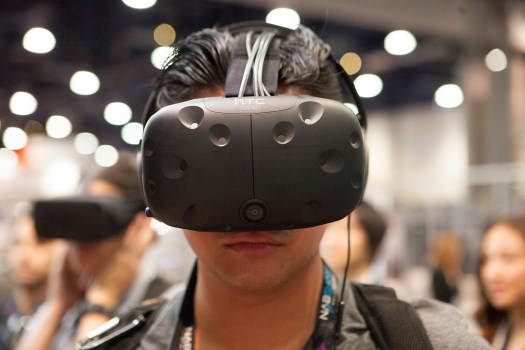
Every year, there seems to be a new buzzword. Two years ago it was all about 4K. Last year it was drones (UAVs) and this year it was all about VR (virtual reality) but not the VR of the 1980’s. I’m talking about VR that provides a totally immersive experience for the viewer. Even though I was a bit skeptical and didn’t really see opportunities beyond the gaming sector, I made it a point to check out the VR Pavilion and take a look at some cameras ranging from Kodak’s PixPro SP360 4 K ($499-$899) to Spericam’s V2 a 360° video camera (actually 6 cameras) no bigger than a tennis ball that records in 4K with automatic-stitching, WiFi and streaming baked right in, making viewing and sharing content easy (around $2500), to the high end Nokia Ozo selling for $60,000! As far as the viewer end, here are some of the headset options out there: Oculus Rift, Google Cardboard, and Samsung Gear VR

It wasn’t until I attended a session entitled, Being There – VR in News & Documentary that I began to realize the potential and possibilities of this technology. The panel consisted of filmmakers, journalists, and creative directors from news outlets (USA Today and Sky TV) who talked about how they were applying the tools and utilizing the medium. Like any new technology there are plenty of challenges in both the production and postproduction process, but with technology’s fast moving pace in this niche it’s only a matter of time before just about anyone and everyone will be able to create using this medium. One challenge right now is in stitching together the content in post that is created by 6 -10 cameras. It can be cumbersome and slow accompanied by hours of angst if the cameras haven’t been perfectly aligned and in sync with one another. A question was raised about the reluctance that viewers might have with not wanting to wear the necessary headset, which was one of the obstacles that kept 3D TV sets from being ubiquitous in all of our homes. The panelists answered by predicting that in a year’s time the headset will give way to a contact lens worn by the viewer.

As a story driven content creator, I needed to know why I would want to deliver a story in VR. After this session the light bulbs went off. Because it’s an immersive experience for the viewer, it can also be an incredibly empathic and emotional medium. Imagine the possibilities – red carpet events, concerts or documentaries where you want the viewer to have a truly immersive experience. VR also provides an opportunity for authenticity because it removes the layers between the journalist and the viewer as opposed to 2D, which could have been created on a sound stage.

Even though the principles of storytelling haven’t changed this is a medium that requires a new language or lexicon with new rules. For instance, there is no cropping in VR. There are two important considerations when creating VR. One is proximity and you have to get the camera in close – no more than 2 feet from a subject that the camera may be following. The other component is to have a narrator or presenter – a kind of tour guide that can direct the viewer through the experience. Usually it’s the journalist rather than a voiceover talent, which can be a bit unnerving in this medium or like the voice of God coming out of nowhere. An alternative to using a narrator would be to use graphical overlays that guide the viewer visually. All the panelists agreed that because it’s such an authentic experience for the viewer it’s a medium that’s conducive to creating empathy and moving people to take action. Some said because it is so authentic it may mislead people inadvertently to disconnect because they have no sense of danger and we run the risk of viewers becoming numb to the experience but only if the filmmaker doesn’t provide the opportunity for a call to action. Live streaming in VR is a game changer because now filmmakers can influence in real time.

I’m not yet convinced that it’s a medium for me or if I’m ready to be a pioneer and deal with what comes with that. The rewards and opportunities are there, as they usually are for frontrunners. That is if it isn’t just a passing fad and you’re willing to take that risk. There is already a trade association for VR creators, IVRPA (The International Virtual Reality Photography Association) so my guess is it’s more than a passing fad. In a world of couch potatoes or those stifled by fear, there may be plenty of people who will choose VR over the real experience.

Check it out for yourself.

VR Stories by USA Today Network

Immerse Yourself in Stories of America 

Google Play
https://play.google.com/store/apps/details?id=com.gannett.vrstories&hl=enand

iTunes App Store
https://itunes.apple.com/us/app/vr-stories-by-usa-today/id975006820?mt=8

Condition One*
Experience a Perilous World with At-Risk Species, and at a Factory Farm

Google Play
https://play.google.com/store/apps/details?id=com.conditionone.vrplayer_cardboard&hl=en

Platform agnostic streaming with or without Cardboard:
https://www.youtube.com/channel/UC3VWeehBnL_VL-92K6VImiw

Ryot – VR
Go Around the World to See New Perspectives, Regions, Cultures and People

Google Play
https://play.google.com/store/apps/details?id=com.apto.ryot_vr&hl=en

iTunes App Store
https://itunes.apple.com/us/app/ryot-vr/id1046058227?mt=8

Platform agnostic streaming with or without Cardboard:
http://www.ryot.org/virtualreality/the-second-line-a-parade-against-violence
(This piece is a RYOT and AP collaboration. Go inside New Orleans, one of our nation’s most culturally rich cities in a socially, politically, and emotionally potent moment in time.)

Google Cardboard
Launch Your Favorite VR Experiences, Discover New Apps, and Set Up a Viewer

Google Play
https://play.google.com/store/apps/details?id=com.google.samples.apps.cardboarddemo&hl=en

iTunes App Store
https://itunes.apple.com/us/app/google-cardboard/id987962261?mt=8

Platform agnostic streaming with or without Cardboard:
youtube.com/360
 

Five Ways Shooting Motion Will Make You a Better Still Photographer

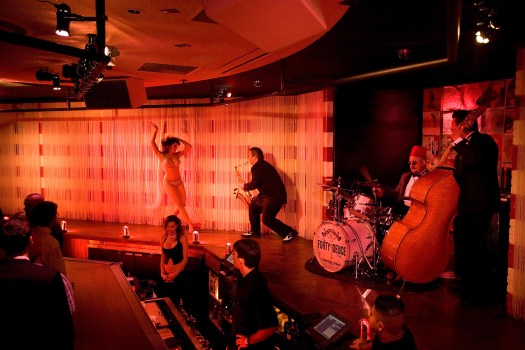
I’ve been shooting both mediums – video and still photographs – for over a decade. Some may say that I was an early adaptor of motionForty Deuce burlesque club, Las Vegas, Nevada, but that’s now how I look at it. In a way, I’ve been a motion shooter ever since I became a still photographer – not in the literal sense – but in how I approach the craft of photography.

I’m a storyteller; in fact that’s why I made photography a huge part of my life. I want to utilize my craft to tell the stories that I feel compelled to tell. I think in terms of paginations, like pages in a magazine or scenes in a film and I realize now that I have always approached still photography like a cinematographer.

Here are some tips I learned from shooting motion that will make you a better still photographer:

  • Cover it – Get comprehensive coverage – a variety of perspectives, focal lengths (wide, medium, tight and close-ups.) When shooting video, you always need plenty of b-roll to work with when editing a story. My still photography clients enjoy getting the variations that I shoot. It gives them an abundance of choice and I benefit by making more money.
  • Get sequences – Get mini stories of people interacting within the whole story. When I’m shooting, I think about how my shots will come together as part of the whole video. I approach still photography stories the same way – in paginations. How will I connect the still images to make the whole?
  • Get storytelling images – With still photography I need to make sure that my independent shots (or moments in time) will also be able to stand on their own and tell the story. They can’t just be “wowy zowy” images as Bob Gilka (former Director of Photography of the National Geographic) used to say when I showed him eye catching, colorful photos that didn’t say anything.
  • Action/motion – make the images feel. I started exploring motion because there were times when I found it difficult to convey the feeling of motion that I was trying to express in a still image. I find it is easier to convey the feeling of movement in a still image now because my eye is trained to look for the opportunities.
  • Give the images sound – (like a hammer hammering). Natural sound gives a video the element of reality. It’s almost like it gives the video a well-needed extra layer or dimension. When I’m shooting stills, I look for images that will illustrate the sound of the environment.

I usually incorporate both video and still components when working on personal projects. For my current project, Like A Woman, I’m shooting still environmental portraits and short 2-4 min. films. And when I travel, I’ll always take a digital audio recorder and microphone to capture good sound.

I’m headed to Vietnam tomorrow to shoot stills primarily, but I’ll be shooting with the eye of a hybrid.

5 Ways to Leap Forward and Get Unstuck

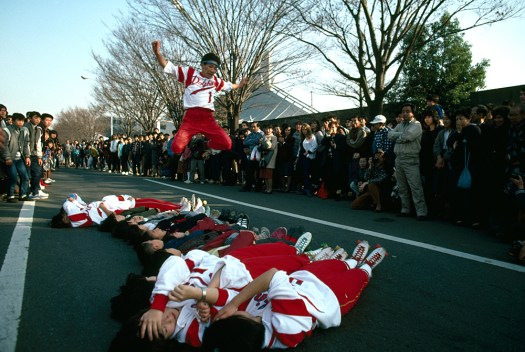
Roller skaters jump over teammates, Tokyo, JapanIt’s February 29th and that means we all get an extra day this year. Let’s celebrate leap year by taking action to leap forward – not just today, but every day this year and every year.

  • Finish something you started. This could be anything from an online course, a book you put down, a personal project etc. I always tell myself that a start is a start to nowhere if you don’t finish it.
  • Identify one thing that you’ve talked yourself out of (for all the right reasons) and take action on it. This could lead to the start of something. After you’ve faced your fear or resistance and have overcome your inertia – follow up with a plan for completion.
  • Toss out one bad habit. It’s easy to fall into a rut with bad habits. Identify one bad habit and change it. Start easy. If you find yourself starting your day in an unproductive manner change it. If you begin your day by checking your emails and then letting it consume your entire morning then start your day by tackling something that you keep putting off before you get distracted by someone else’s urgency.
  • Get rid of the resistance in your life. Are you letting toxic people derail you? Misery loves company but I’d rather hang out with people who energize me than those who bring me down. There are plenty of people on both sides of the misery camp. Surround yourself with those who add value to your life and stay away from those who suck the life out of you.
  • Tell yourself you can. Take notice how often you stop yourself by telling yourself you can’t. Really take note and every time you find yourself in that default mode of “I can’t” – tell yourself you can. You are your thoughts so be careful of what you tell yourself.

Why Playing it Safe is Bad for Business

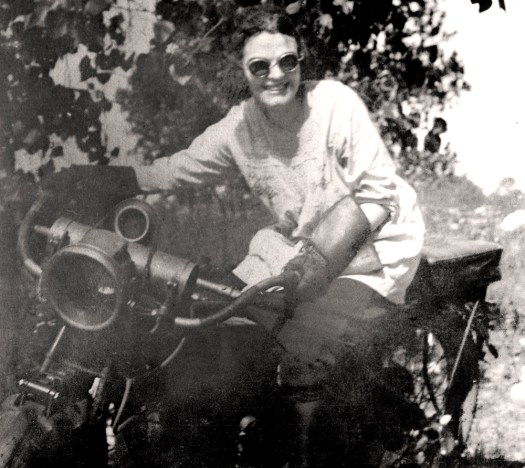
Gladys Mooney on motorcycle
My grandmother on a motorcycle. circa 1920’s or ’30’s.

Have you ever talked yourself out of doing something that you felt passionate about?

Have you ever bought into others’ advice, even though it was contrary to your own beliefs?

If you answered yes to either question then you are like most of us humans, and you second-guess yourself by buying into your fears.

Now ask yourself – Did anything good ever come out of NOT doing something? Other than stopping yourself from following foolish pursuits that may have put you in harms way, stopping yourself probably never led to a positive outcome. In my experience whenever I stopped myself from following my own instincts, it not only didn’t move me forward – it set me back.

So, why do we let resistance keep us from what we are meant to do? It’s fear of the unknown. And why do we let others’ resistance and fears stop us from taking a leap of faith? Can other people predict the outcome anymore than we can? Just because something didn’t work for someone else doesn’t mean it won’t work for you or me. There just are too many variables that play a part in whether someone succeeds or fails.

I’ll make one prediction – If you stop yourself from pursuing your big idea or even your small idea – it won’t happen.

So why are you letting resistance rule your life? That’s just plain stupid.

Watch this and then ask yourself – what are you waiting for?


7 Things I Learned About the Business of Photography

It’s a Business – You may catch some lucky breaks in your career or you may be an incredibly gifted photographer – but if you want to make a living taking pictures and sustain yourself financially,

Times Square New York City

you will need to manage your art and your career as a business. That means find a way to make a profit in pursuing your craft.

It’s Not Personal – Keep emotions out of your business decisions. This is a tough thing to manage because it’s usually at odds with the passion that energizes the creative side of you. I think my best work is very personal but I try to avoid the pitfalls of letting my emotions cloud my business decisions that are in my best interests. That could mean walking away from a job or a bad contract.

You’re Selling Value – If want to make money and stay in business, you need to understand your value or your photography’s value in the marketplace. Are you unique, have special skills or access to places other don’t, have one of a kind images, or are you simply a really good professional photographer who a client can hire with complete confidence? The answer to that question can help you assess your value in the marketplace. If you don’t know what your value is, then it will be very tough to sell yourself. You can’t sell what you don’t believe in.

“Always be Marketing” – I learned this from James Malinchak – America’s Big Money Speaker. I’ve never been comfortable selling myself, which is somewhat odd in that my dad was a great salesman. It always felt a bit disingenuous to me to toot my own horn, and no doubt I missed a lot of opportunities by not doing so. It’s tough to sell ones self and many of us are better off having a rep or an agency do that for us. But, I have found that the best marketing happens organically, when I’m at conference or a social gathering and connections are more personal.

Be Proactive Not Reactive – Change is inevitable. If you want to sustain your business, you can’t get complacent. Keep in mind two things: 1. Nothing lasts forever and 2. There will always be cycles of ups and downs. As Robert Frank said the other night when I heard him speak “Keep your eyes open”. He said that in answer to the question, “What advice would you give students?” and I’m sure he was speaking about creativity, but if you allow yourself to become complacent as an artist – your business will surely suffer.

Don’t Burn Bridges – Singer/songwriter Don Henley wrote; don-henley-don-henley-sometimes-you-get-the-best-light-from-a-burning“Sometimes you get the best light from a burning bridge”. Isn’t that the truth? It’s also a lesson that I have learned the hard way. Think twice before you say something or react in a way that might come back to bite you.

Relationships are Key – Most business people will tell you that their best clients have been from referrals. It’s a lot easier to create a bond with a new client when you have already been vetted. Some relationships are easier to manage than others. Some are good and some are toxic. It’s up to you to sort through which relationships you want to nurture or abandon.

More practical tips can be found in The Craft and Commerce of Video and Motion

The Value of the Experienced (Old) Photographer

I don’t think of my self as old, except at times when a part of my body doesn’t act or react the way it used to. But, I would say that many of my colleagues would call me old, chronologically speaking. The premature deaths of Glenn Frey, David Bowie, Natalie Cole and Alan Rickman – all in the span of a few weeks and all in their late ‘60’s, has given me pause to look at my own mortality. It has also given me resolve to make the most of each day.

The fact is there is nothing we can do about our age.

Gail Mooney with James Michener, Chesapeake Bay, MD
Gail Mooney with James Michener, Chesapeake Bay Photo © Thomas Kelly

Unlike other things in life that we can change, we can’t change our age. But we don’t need to allow a youth-obsessed culture, define our value. I’ve grown weary of the dismissive attitude our culture has about aging. It’s especially frustrating for me as a photographer, filmmaker, and creative entrepreneur. Creativity comes from the spirit within. Our spirit never ages, so neither does our desire and need to create. I’ve never felt more in tune with my spirit and my authentic self than I do now. I never imagined that would happen at this point in my life but I’ve never felt more creatively alive.

I get bewildered and frustrated when society perceives my value as somehow diminished, simply because of my age, but then I look at my assets.

  • Experience – There are no short-cuts when it comes to experience. It’s earned over years of trial and error on the job and in life.
  • Problem Solving – I wish I had kept track of all the problems I’ve solved on assignments as well as in personal life. Countless decisions and consequences to learn from. I’ve gotten pretty good at it.
  • Creativity – I take more chances and push myself in terms of my craft now, than at any other time in my career. I’m not afraid to try something different because I realize that failure is part of the process. So, I hate it when getting older is equated with getting stale. Sure, some folks do but there are so many people in my generation that are still incredibly vibrant and innovative. Check out my latest personal project, “Like A Woman”, short films and still portraits of women working in male-dominated professions.
  • Perspective – I’ve lived through profound changes in the span of my life. They haven’t always been easy to deal with. Technology has changed everything – how we do business, how we communicate, and how we interact, globally. My generation has experienced both the analog and the digital world. Hopefully, most of us are able to see the merits of each. Change is inevitable, it always has been. I’ve been around long enough to experience many cycles of change, and I can tell you for certain, nothing lasts forever. I try not to let change intimidate me, but rather let it excite me to embrace what it has to offer. That has opened me up to all sorts of possibilities.
  • Wisdom – It’s true that we get wiser as we age but only because we’ve had a lot more mistakes to learn from. Whether we’ve learned from our heartbreaks or from the stupid things we’ve done, we’ve grown despite it. Wisdom is kind of like experience – there are no short-cuts to getting there.

I’d love to hear others’ thoughts on this topic and their perspectives.


Business Tips for Photographers Who (Also) Shoot Video

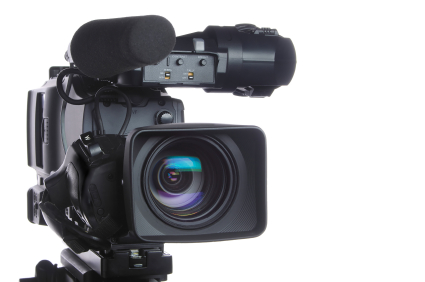
In the blogging world of photography and motion, there is a lot written about gear and how to use it, but precious little written about “the business”.  Chances are, if you are a photographer who has been in business for more than 10 years, then you know that technology has not only changed our tools, it has changed the way we do business.Professional high definition video camera, isolated on white background

For starters, we are doing business in a global economy, and with that comes pluses and minuses. One big plus is that we are able to reach a much wider audience, than ever before. That is, if you have an understanding of how to do that and take advantage of the opportunities that are out there.  The minus or downside is, if we don’t adapt our dated business models, in a business that has seen monumental changes, we will not be able to compete.

Commercial photographers are in the visual communications business.  We create imagery that delivers a message or tells a story for a variety of “markets” including; advertising, corporate, architectural and editorial.  Each market has a need for visual content and these days that encompasses both still photography and video.  In the last couple of years, the lines dividing these two mediums have faded away, at least in terms of how content is consumed in our culture.

Here are a couple of tips to help photographers prosper in our “multi-media” world:

  • Decide what your company will offer.  Will you only provide still imagery?  Or will you expand your business and offer both still photography and video? Are you quick to answer: “I don’t want anything to do with video”? The problem with that answer is that most of your clients will probably have a need for video.  Are you going to send them away to your competition?  Or will you keep your clients “in house” and take care of their video needs and hire or outsource your competition? That’s a different way of thinking and has the potential to broaden your revenue stream.
  • Decide what role you will play if your company does offer video?  Will you be the director and work with a camera operator?  Or will you assume the role of a DP (Director of Photography) and direct as well as operate the camera?
  • What will you outsource and what will you keep in house?  Maybe you want to expand your business by offering both still photography and motion, but you’d prefer to just shoot the still photography and outsource the video.  In that case, you could assume the role of producer and oversee or outsource the video production.
  • Reassess your insurance.  Video productions have a lot more variables. They also usually have larger crews.  More than likely, you will need to upgrade your current insurance policy to accommodate and cover that.
  • Change your paperwork.  Make sure that you go through your talent and property releases and modify the language for multi-media.  Change any boilerplate contract language to include video (motion).
  • Licensing.  Regardless, if you decide not to expand into video production, you will have to contend with the fact that your still images won’t always be used in a stand-alone fashion.  Many still images will be commissioned and/or licensed as part of multi-media projects and that has a dramatic effect on licensing. And if you do decide to expand into video production, in your role as a producer, you will be licensing other people’s work.
  • Understand new business models.  Let’s face it, things have changed in the business of photography.  Photography has become ubiquitous and the competition is fierce.  You are not only competing with professional photographers – you’re competing with semi-pros, amateurs AND video production companies.  One thing is certain, it’s never been more important to have an understanding of multiple mediums and to be unique and stand out amongst the noise. There are no templates you should follow.  You have to be authentic and true to yourself.

Check out more tips and information in my ePub, The Craft and Commerce of Video and Motion.


10 Things Freelance Photographers Should Do in 2016

Be optimistic – I’m going to start with the hardest one of all, because it’s really difficult to be optimistic these days.  But I find that if I can maintain a positive attitude and turn my thoughts to what is possible, I actually open myself up to more opportunities in my life, instead of creating more roadblocks.

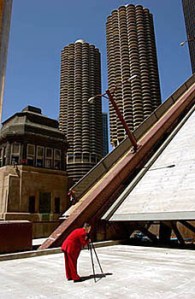
Be open to possibilities. – Be more flexible in how you perceive thingsphotographer on bridge, Chicago, IL and who you are. Change is always happening, but it’s usually gradual.  Most people don’t take notice until “change” forces their hand to act.  It’s always better to be proactive than reactive so embrace “change” as an ever-present fact of life that creates opportunities for those who are open to seeing them.

Collaborate – Photographers are very independent creatures and collaboration is not part of their norm. As the “photography” business continues to change, photographers will find that collaborating with other artists will make their own businesses stronger.

Diversify – I’m not quite so sure why so many photographers are so rigid in how they define who they are and what they do.  Having a “style” is great, but the trick is to not to be so narrowly defined by that style, so that when styles change, you don’t find yourself obsolete by your own design. It’s kind of like being type cast, where your audience or your clients can only see you in one way.

Concentrate more on “the story”– I had the opportunity to speak with a lot of still photographers and filmmakers this past year and I began to notice a difference in the conversations I was having with each.  Most times, filmmakers would be telling me a story, whereas still photographers would be telling me how they executed a photograph, or essentially telling me the “back story” of the creation of the image. It’s all interesting but “the story” is the bottom line – if that doesn’t come through to the viewer – the rest doesn’t matter – including how it was executed.

Be authentic – be true to yourself.  That means that you have to trust your gut instead of second guessing it.  This is hard, especially when things don’t always work out the way you had hoped.  Step away from the “noise” and listen to the voice inside.

Fail more. – Rejection is a tough pill to swallow but it usually means that you are either pushing yourself to try new things, you are too far ahead of your time or it just wasn’t meant to be.  If you look at successful people you’ll see that most have had failures and rejections in their lives but they stuck with it – instead of letting failure defeat them.

Self-Initiate more projects. – I don’t like to call non-commissioned work, “personal projects”. That co notates that there is no monetary value and these days, just the opposite could be true.  With more and more lopsided contracts  being presented to photographers for commissioned work, a photographer has a better chance to make more money and keep ownership of their work by creating self-initiated projects.  But they need to be prepared to work hard.

Forget about the past except to learn from mistakes. – You can’t change the past but you can learn from it and then, move on.  Look toward the future but make sure you take time to enjoy the “now”.

Realize that in the scheme of things, you are just one small speck in the universe. – I think we all get way too stressed about things that really don’t matter and we let those things control our life.  When we become more conscious of that, we really begin to live life.

Telling Your Family Story

This time of year we try to spend more time with our families and loved ones. It’s also a time of year when we reflect on the people who are no longer with us. For the most part, we rely on our memories and some scattered photographs or home movies and videos.

Some of my fondest memories are of my mother, father and grandparents sitting around the dinner table, long after the holiday meal was over and telling or retelling the family stories. Of course, everyone would recall the same story in an entirely different way – the way they remembered it.

Every family has stories – mine certainly does and I have started to

Mooney family, Easter Sunday, Chicago, IL  (1956-57?)
Mooney Family, Chicago, IL


collect information, photographs and even recordings of family members while they are still around to tell them. It’s such an easy thing to do with the tools that technology has provided – easy to use cameras, audio recorders,  and of course, phones that shoot photos and video.

I often think that as photographers and filmmakers we are not only the keepers of our own family stories but we are documenting the stories for other families, through our still images, recordings and videos. Essentially, we are creating an archive of our loved ones and the memories. I believe that is the most precious gift that I can give someone through the talents of my craft. In fact we set up a separate niche of our business, Conteur Productions, to do just that – to archive the family stories in beautifully crafted cinematic videos. The idea isn’t just to string together old still photographs and footage to music, but to capture the stories of our loved ones, on camera while they are still here to tell them in their voice. Imagine, the legacy we leave future generations? My mom is no longer alive but I wish I captured her telling her stories, if only to hear her giggle when she got to the punch line.

As the art of conversation, gives way to virtual communication in our culture, our family stories are fading away with each passing generation. Well, the stories are still there of course, but they often get overlooked in the distractions of our high tech culture. But at the end of the day, it’s our family stories that should be preserved. They remind us of who we are and where we came from and that is priceless.

So as you gather your family together this holiday season – start capturing those life’s moments. You’ll be glad you did.


What Does a Photographer Look Like?

When I started out as a commercial photographer more than three decades ago, it was a very different profession than it is today. It wasn’t just different in terms of technology – it was different culturally. When I went out into the workforce in 1977, it was definitely a man’s profession.

I never really thought of myself as a female photographer, just – a photographer. I didn’t think the additional gender adjective needed to be part of the conversation – yet it was at that time. Sometimes it surfaced in social settings. One time, an art director who I worked for, introduced me to a very famous photographer who shook my hand and said, “You don’t look like a photographer!” And I thought to myself, “what does a photographer look like?”

It was worse when the gender bias surfaced in the workplace. I’m not sure if having a male business partner made the situation better or worse. I do know that the assumption was always that my partner Tom Kelly, was the photographer and that I was either his rep or his assistant. That assumption negated itself during a pre-production meeting or on the job, but I needed to make my presence known.

Things have changed…….slowly, over the years in the photography profession. There are far more women in the industry now than when I first started. It’s certainly not the exclusive male dominated industry that it used to be, but there are plenty of professions that still are – the movie industry is a perfect example. There are plenty of other examples of gender bias in the workforce, which is what motivated my project, Like A Woman.

Like a Woman is a series of environmental still portraits and short films about women working in male dominated professions. The idea was first inspired by Lauren Greenfield’s Like A Girl campaign. I loved the campaign and even though I felt hopeful that younger girls are growing up a bit more empowered than girls of my generation, that statement “Like a Girl” still lingers as a demeaning remark. I wanted to flip the narrative and make the statement, Like A Woman an empowering expression said with pride.

To date, I’ve interviewed 5 women from all different professions – architecture, engineering, auto mechanics, organic farming and industrial photography.

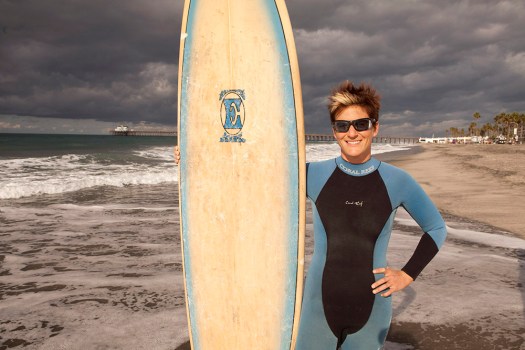
Jenna Close, Oceanside, CA
Jenna Close with surfboard, Oceanside, CA

I’ve just completed one on industrial photographer, Jenna Close. You can see it on the Like a Woman Vimeo Channel. Jenna demonstrates that women have come a long way in terms of having successful careers in photography, but she reminds me that there are still undertones of subtle gender bias. Things are changing, but until the gender adjectives disappear entirely from the conversation, we need to stay mindful and not drift into complacency.

If you know a woman working in a male dominated profession, who you think would make a great subject for Like A Woman, please contact me. mailto:gail@kellymooney.com