“Kickstarting” a Passion Project

For anyone who has been reading my blog, you know a few things about me – I love to dialog and share with others, my work and my pleasure are one in the same and I always have a passion project that I’m working on.
I can’t say that I’ve always been like this.  In the beginning of my career it was a lot harder to dialog and share with people – pre-social media and email.  And as my career took hold and I became busier with work, I didn’t have time for sharing or personal projects.  But for someone like me who is a dreamer, I was starting to burn out.

When I started exploring the video medium in the late 90’s, it triggered a spark in me.  I started thinking and dreaming about all the stories that I wanted to tell – that would be possible for me to tell – through this medium.  One of my first attempts at telling a story with video was a short documentary I did on my daughter’s youth symphony.  I couldn’t have picked a harder subject if I tried because it was all about sound, which I knew nothing about.  And anyone who has ever shot a musical concert knows that it’s almost impossible to do with only one camera.  But I naively pursued with this project and learned a lot in the process.

My next passion project was The Delta Blues Musicians that I envisioned as a multimedia project combining still environmental portraits of these musicians along with video interviews, capturing their life’s stories.  It was a lot of work and for the most part, I went it alone – doing everything myself.  For anyone who has ever tried to shoot both stills and video on the same job, you know it’s not an easy thing to do.  That project will always be near and dear to my heart and continues to reward me in ways that I never knew were possible.

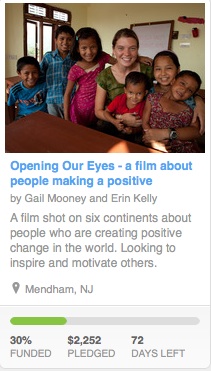
There have been other passion projects since these first two and my head is usually full of ideas that are rumbling around, just waiting for the right time to surface. I am in the midst of a project now, Opening Our Eyes that is perhaps the most ambitious one I’ve ever dreamed up. This past weekend I launched the project on Kickstarter.  Kickstarter is a website that posts creative projects for the purposes of finding funds. It’s a perfect example of crowd funding where one can donate anywhere from $1 to $10,000 to the project of their choice, and in the process make someone’s idea come to life.

I launched Opening Our Eyes on Thursday and within 3 days we reached 30 % of our goal. We still have a long way to go and have another 71 days to get fully funded.  The way Kickstarter works is that if you don’t get funded 100%, then all bets are off and you don’t receive anything.  So, I’m doing my best to do what I like the least and that is make a pitch for pledges.  My intent is to secure enough funds so that I can collaborate with a professional editor and raise the bar on the film that my daughter and I shot this past summer on our 99-day adventure around the world, about people who are making a positive difference in the world.

It’s really a win/win for anyone who chooses to give – even a pledge of $25 will get us closer to our goal and you’ll receive a DVD of our film when it’s finished.  So please check out our project on Kickstarter and pass this link along to others.  Ultimately our goal is to inspire and motivate other change-makers through the power of our film. We know we can do it with everyone’s help and it will make you feel good to give – it always does.

Add to FacebookAdd to DiggAdd to Del.icio.usAdd to StumbleuponAdd to RedditAdd to BlinklistAdd to TwitterAdd to TechnoratiAdd to Yahoo BuzzAdd to Newsvine

The Power of Sharing and Networking

I’ve always been an independent creature, starting with a year long backpacking odyssey as a 19 year old traveling solo, following the “hippie trail” around the world.  That sojourn led me to pursue a career as a still photographer, using my camera as a tool to gain access to people, their cultures and their stories.

I’ve had a great ride these past 30 years shooting assignments for high profile magazines that have taken me to all parts of the globe.  For the most part, I was a solo act, spending hours, days and weeks observing people, then becoming more intimate as I proceeded to get to know and tell their stories and share them with others.
When I started shooting motion and in particular digital video, eleven years ago I embraced the notion of collaboration.  Video production has a lot more facets to it than just the shoot and I knew that even though I knew how to capture reasonably good sound and edit a respectable rough cut with Final Cut Pro, I also knew that working with professional sound people and editors would raise the bar on the quality of my projects.
This past weekend, the value of collaboration, networking and using social media to get my ideas out to the universe, really hit home.  I had been asked to speak at the Photocine News Expo in Hollywood, CA about my latest documentary that I was working on, Opening Our Eyes. I had gotten to know two of the organizers of the event, Michael Britt and Lou Lesko, through social media. They had taken notice of my blog and my project, which I had decided to shoot with the HDSLR cameras and had written about it in their blog, PhotoCineNews.com.

I was honored and humbled to be speaking at the same event as some pretty heavy players like Vincent LaForet and Shane Hurlbut.  I was a bit intimidated at first, but I knew that I was there to share what I knew and that is how to get a passion project from just an idea – to a reality.  So, after returning from my 99-day journey, with just a couple of weeks to prepare a sample from some of the 145 hours of footage that were shot, I flew out to LA.

Here’s a rough cut of that 10-minute sample:  Opening Our Eyes – Tease

I suppose I can legitimately say that I have had a theatrical showing of my documentary in Hollywood.  True enough – but the real value for me this weekend was in sharing with my peers and making connections with people who I will work with in the future that will help me grow as a filmmaker and storyteller and more importantly who will bring their expertise to my film.

It’s an incredible time that we live in with a realm of possibility.  Literally anything is possible.  When you share and put things out to the universe – you just never know what you’ll get back.  I’ve learned that I share because it makes me feel good – not because I have expectations for an immediate or monetary return.  But each and every time I do share – I get back so much more in return.

Add to FacebookAdd to DiggAdd to Del.icio.usAdd to StumbleuponAdd to RedditAdd to BlinklistAdd to TwitterAdd to TechnoratiAdd to Yahoo BuzzAdd to Newsvine

Behind the Scenes DVD – or Not?

In a little more than a week, my 99-day journey trekking around the world with my daughter shooting a documentary, Opening Our Eyes will be over.  Or will it?  My work is really just beginning as I contemplate all we’ve done, people we’ve met and interviewed and how I will put this all together in an edited, finished film.

There are hundreds of ways I can edit this documentary and quite honestly, beginning the process and deciding the direction is always the most difficult.  But there will be a moment when the light bulb goes off and the vision will be clear as to how to make sense of it all.  Then it becomes easy as the story unfolds – as it should from my heart.  It’s the story that can only be told by me and this case, me and my daughter.

My daughter and others have urged me to do a behind-the-scenes DVD

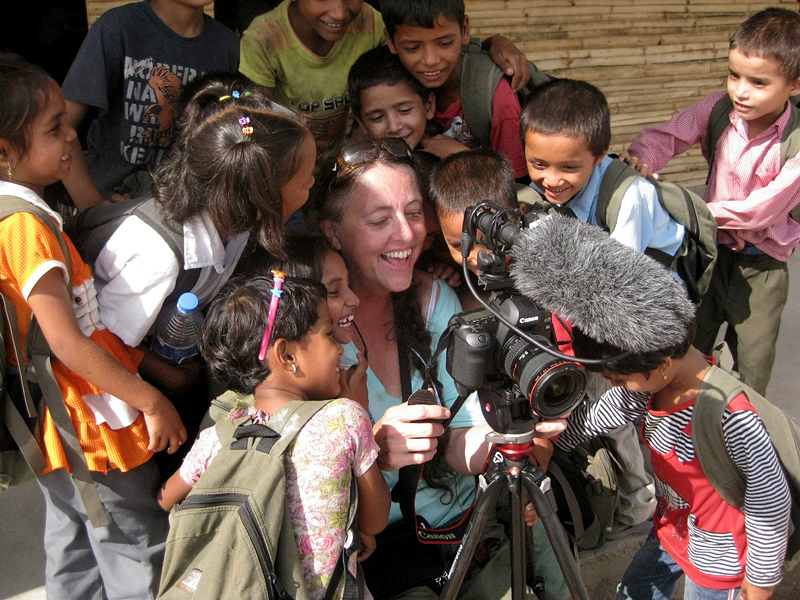
Gail at the Kopila Valley Primary School, Surkhet, Nepal

– she tells me “that’s what people want”,  to know more about the making of the film – more about the people behind the film.  As much as I agree with her and understand this interest on the part of the viewer, there is also a resistance to make myself part of the documentary.  With that said, a separate “behind-the-scenes” chapter could be the solution – to provide more information, without inserting the two of us into the film itself.

One thought does keep popping into my head that motivates me to provide a commentary on the why’s and how’s of this journey and the making of this film. Too many times when I’ve visited museums, I’ve been taken aback by some of the things that I over hear docents talking about in relation to the paintings.  They analyze and interpret what the artist meant by his choice of color, brush stroke and placement of objects within the art and how that related to what was going on in his life at that point in time.  I often wonder how they know that or even how can they be so sure?  Is it documented or is it really just someone’s interpretation that has become fact over the years?

My daughter and I do plan to sit down this week and attempt to do on-camera interviews – while we are still in the moment and before we get back to our normal lives.  Here’s where we need your help – tell us what you want to know.  Maybe you’re curious about how we survived the dynamic of a mother/daughter team for three plus months.  Maybe you want to know why we did this – or how we funded it.  Or maybe the questions are even more basic – what did we like? – what was difficult?– any surprises? etc. etc.  Perhaps you want to know more about the craft of shooting the doc– and how I went about that.  And maybe you don’t really want to know anything at all and just want to know about the subjects of our film.

But please tell me what you’re curious about – as far as the behind-the-scenes making of this film.  All questions are welcome – from the seemingly obvious to the more provocative.

Add to FacebookAdd to DiggAdd to Del.icio.usAdd to StumbleuponAdd to RedditAdd to BlinklistAdd to TwitterAdd to TechnoratiAdd to Yahoo BuzzAdd to Newsvine

Does a Canon 5D Mark II Make You a Cinematographer?

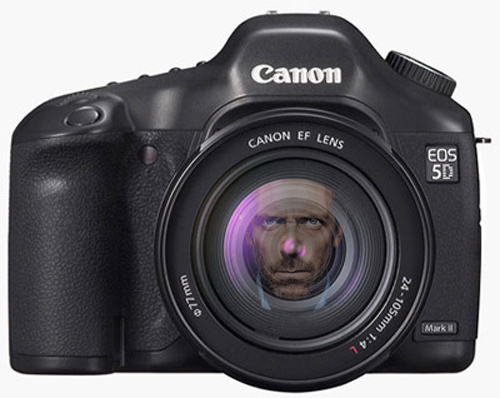
I read somewhere that a recent episode of the TV show “Housewas shot entirely with the Canon 5D Mark II.  A dozen thoughts ran through my head – Who would have thought that a prime time TV show would be shot with a still camera?  – Isn’t it amazing what technology has made possible? With a big production budget, why did they choose this camera? Did they back it up – just in case?

But the biggest thought that ran through my head was that this article oversimplifies the production process and leads you to believe that now just about anyone with a few thousand dollars can become a DP on a prime time TV show. In other words – when talking just about the camera, things get taken out of context.

What about the fact that they most likely had dozens of these hybrid cameras on set, with a crew of hundreds? Or that the sound guys were capturing the audio with tens of thousands of dollars worth of sophisticated equipment.  And then of course there is the post-production aspect where the file from the camera gets tweaked, modified and enhanced by professional colorists.

I think many times still photographers overlook the fact that there is a lot more to a large scale production than just the shoot and the camera.  And most of the time it goes way beyond the capabilities and role of the individual photographer who is used to working in a solo manner as opposed to collaboration.

Don’t get me wrong, there is a big part of me that absolutely loves my 5D and my 7D.  It allows me to deliver a motion product with a stunning visual.  But after shooting motion for 11 years, in addition to my 35 years shooting stills – I know that not only do I need to think differently when I shoot in motion but I also need to collaborate with others to be able to fulfill the needs of the production.

So when you hear that an entire movie was shot with the 5D – think beyond the camera.

Add to FacebookAdd to DiggAdd to Del.icio.usAdd to StumbleuponAdd to RedditAdd to BlinklistAdd to TwitterAdd to TechnoratiAdd to Yahoo BuzzAdd to Newsvine

What Makes a Successful Photographer?

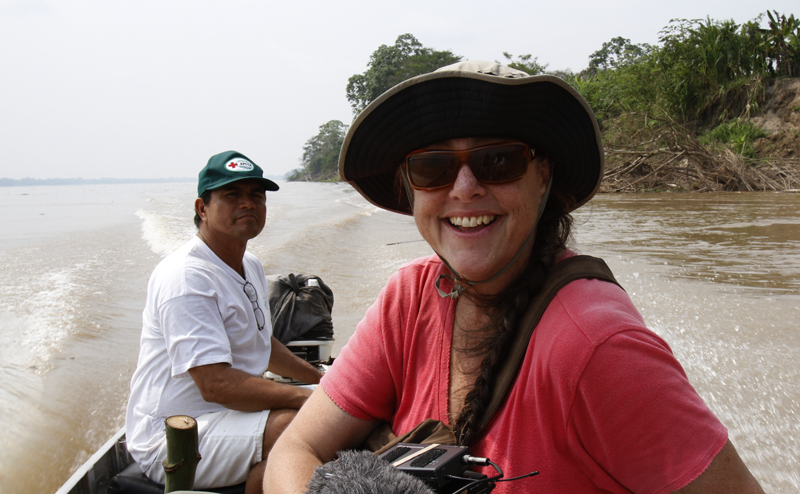
I woke up this morning before dawn, not able to sleep anymore and my mind spinning with random thoughts about where I’ve been and where I’m going. I’m in Iquitos, Peru right now, the last major outpost before the real jungle begins along the Amazon River.

Gail on the Amazon River, Peru

I had just spent a week visiting the jungle villages along the river as part of my documentary, Opening Our Eyes.

As I lay in bed, I thought about a recent conversation I had with someone about what it means to be a success. This person had made a comment to me that I must be a very successful photographer. This is not the first time that someone has made that remark and it always takes me by surprise and makes me think about the meaning of that word “success”.

I think that in this lukewarm economy and with the incredible changes that have affected the profession of photography (and print), I would have to say that a successful photographer is one who doesn’t need another job to support themselves. That they are able to make a living shooting photographs (or video).
But how does one achieve that, if that defines success?

Personally, I think that with any creative and competitive field, you have to be passionate about it and have the desire to pursue it no matter what. In other words you have to want to pick up a camera and take photographs without someone paying you or “validating” you in some way to do it. If you think about it from a buyer’s standpoint – why would they want to hire someone who isn’t passionate about it? So shoot and shoot for yourself – always have a personal project you’re doing.

So the question – how do you find the passion or keep it begs to be asked. There isn’t one answer to this question because it’s different for each of us but for me I need to be involved with other things besides photography to keep my interest in photography alive. I need to get beyond the science of photography and even the art. I’m interested in music, cooking, sewing, film, looking at impressionist paintings, taking walks in the woods and even people watching in New York City. I do all of these things and more to recharge myself and keep my passion alive for what I’m doing.

Photography is a visual means of communication. If you don’t have anything to say because you’ve just consumed yourself with the technical aspects of photography, then how will you be able to deliver a visual message – whether it be for a magazine or an annual report or even an advertisement.

Lastly, photography is something that you have to “do” to get better at it. You can’t just read about it in a book – you have to shoot – practice – perform. That is why shooting for yourself is imperative. If it’s been two months since you’ve picked up a camera and you head out to shoot a job – you do a disservice to your client. I don’t care how long you’ve been in business.

Here is how others have defined success:

“Successful people are simply those with successful habits”
Brian Tracy

“Your net worth to the world is usually determined by what remains after your bad habits are subtracted from your good ones”
Benjamin Franklin

“Practice means to perform over and over again in the face of all obstacles, some act of vision, of faith, of desire. Practice is a means of inviting the perfection desired.”
Martha Graham

So, am I a successful photographer? Perhaps – but there are photographers way more successful than me. But I am determined and I definitely have the desire and there is always something that I still want to achieve.

Add to FacebookAdd to DiggAdd to Del.icio.usAdd to StumbleuponAdd to RedditAdd to BlinklistAdd to TwitterAdd to TechnoratiAdd to Yahoo BuzzAdd to Newsvine

Professional Still Photographers as Amateur Videographers

These days many still photographers are frustrated when their clients decide to take their own pictures or get photos from amateurs who take photos that are good enough. And sometimes “good enough” is not only good enough – it’s pretty good because technology has enabled just about anyone to take a reasonably good photograph.

Indeed technology has lowered the bar to the entry into the realm of professional photography. But any pro knows there is more to “making” a good photo than the actual execution of an image. There are many problems to solve, and there’s the matter of being able to consistently make good photos.

But I must tell you, over the past year I have seen still photographers exhibit the same attitude that they abhor in their clients when it comes to the medium of video. As more and more still photographers embrace video because of hybrid cameras like the Canon 5D Mark II, many fall victim to the same line of thinking and that is if they buy a “good” camera that shoots “HD” video – that’s all they need to throw out the “video shingle” and they’re in business.

The problem is they lose sight of some very important things:
1. Shooting motion requires a different thought process
2. Audio is everything
3. Post production is very different for video than for still images
4. Video is a collaborative process

So when I get a question from a still photographer as to “what is a good video camera?” – I bounce the question right back at them and say – when an amateur photographer asks you what still camera takes good pictures – what do you say? Most quickly get the analogy and realize that while they are pros in the still photography world – buying a video camera or an HDSLR doesn’t make them professional a videographer. Motion is a wonderful medium, but get to learn the craft because it’s more than just the camera.

Add to FacebookAdd to DiggAdd to Del.icio.usAdd to StumbleuponAdd to RedditAdd to BlinklistAdd to TwitterAdd to TechnoratiAdd to Yahoo BuzzAdd to Newsvine

Heading Off Around the World

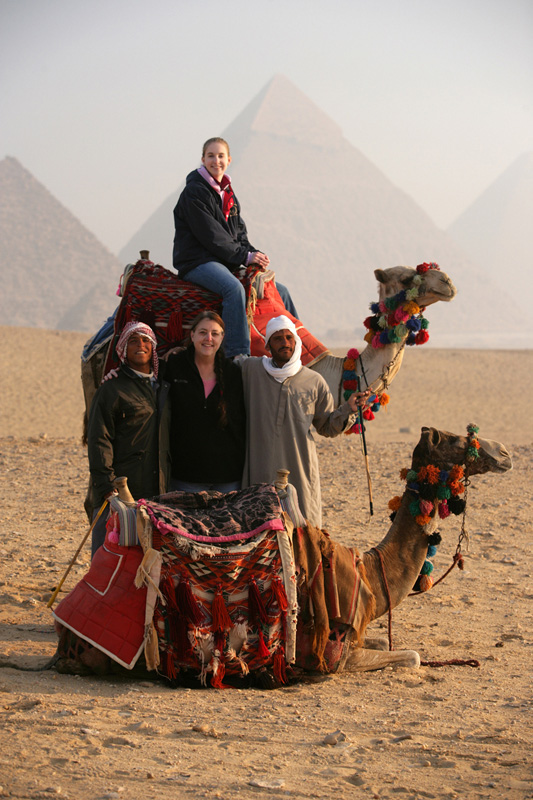
Gail and Erin in Egypt in 2006

It’s very early in the morning, my favorite time of day – no distractions and a whole new day ahead of me. But today’s a bit different, it’s the day before I leave on a 3-month journey around the world to take on probably the biggest personal project of my life and I have a million details running through my heads.

Just the other day I wrote about the “what if mentality” and how we sometimes fall victim of sabotaging ourselves by talking ourselves out of doing things. And today I have a whole host of “what if’s” running through my head. What if we can’t get into Bangkok or get out? There’s a State Department warning advising Americans not to travel to Thailand and we’ll be traveling with a doctor going into the northern hills – not an easy place to get in and out of in peaceful times. What if one of us gets sick? What if something gets stolen? What if one of our 27 flights get canceled or delayed? What if I don’t get the material I’m after for the documentary?

Certainly, lots of trepidations but I’m a pretty savvy traveler and I’m about as prepared as anyone can be. I try to remind myself of that and focus on the incredible journey ahead of us. I’ll be sharing this experience with my 23-year-old daughter and that in itself will be something we’ll never forget and create a special bond between us for the rest of our lives. We’ll not only be circling the globe together, we’ll be working together to create a documentary on people who are making a positive change in the world. Those connections will be life changing, and in fact one of our hopes is that our film will inspire others to do the same.

So one more day of details and then we’re off – first stop Entebbe, Uganda by way of Johannesburg, South Africa. Our last stop is Buenos Aires, Argentina via the jungles of Peru. Lots in between – lots of laughs, tears, lands and miles. I will be writing as often as I can and uploading when “connected”. And if I disappear at times – you’ll know why. You can follow our journey at Opening Our Eyes.

Add to FacebookAdd to DiggAdd to Del.icio.usAdd to StumbleuponAdd to RedditAdd to BlinklistAdd to TwitterAdd to TechnoratiAdd to Yahoo BuzzAdd to Newsvine

Should I Be Thinking of Video – Or Not?

I give a seminar to still photographers for ASMP entitled “Should I Be Thinking of Video?” It’s a broad overview of the different facets of video production along with how I have positioned myself in this medium and where I think some of the opportunities are. I’m quick to point out what it’s not – it’s not going to tell you everything you need to know to make video part of your business and it’s not about how to use your DSLR. And if anyone promises that they can teach you that in two hours – they’re lying. But most importantly, I can’t possibly answer the question “should I be shooting video” for each individual in the room. And that’s because there is no ONE answer to that question – that’s up to the individuals to decide for themselves.

I think perhaps I should point out some reasons why one shouldn’t be thinking of video:

Fear – Because you are consumed with fear of your future. It’s understandable to be afraid when the world as you know it,  is changing. But if you are so focused on the thought that you have to do something because technology has changed your business to the extent that it just isn’t there anymore, instead of focusing on how you can use technology to grow your business – then you’ll paralyze your mind to new possibilities.
The Camera – If you are getting into video because your still camera is capable of shooting video and you’re not concentrating on thinking and seeing in motion, then you’ll end up with isolated video clips that have no relation to one another and you’ll have a rude awakening in the editing room when you realize you have no clue on how you’re going to put together a cohesive story.
Because everyone else is – With all this talk of video of late, everyone feels they need to jump on board. The truth is video may not be the answer for some photographers. And it may not be the best medium for the markets you work in.

You should be thinking of video if:
• You think that motion and sound is the best way to visually communicate your clients’ story or message.
• You recognize the power of collaboration in this medium
• You understand that there’s a learning curve and there’s no magic bullet.

I cannot tell you if video is the answer for you – that’s up to you to make that decision for yourself. I can only tell you what’s involved and guide you through the process.

When my daughter was growing up, I was always careful not to make all her decisions for her. It was a hard thing to do because many times she wanted me to and I wanted to but I didn’t. I knew if I made all her decisions for her that I wouldn’t be doing her any favors in the long run – because sooner or later she’d be out on her own without me there telling her what she should or shouldn’t do. I think it was one of the hardest things I had to do as a parent.

It’s been challenge this year scheduling time for my production business, along with traveling around giving these seminars. As much as I enjoy sharing information with others through these seminars, I know that I need to be doing what I love most and that is being a visual communicator. So, I’m taking to the road on May 25th – around the world actually, working on a personal project Opening Our Eyes. I need to get back to some real quality time of creating. And the best part – my daughter decided that she wants to join me and be part of this – and she made this decision all on her own.

Add to FacebookAdd to DiggAdd to Del.icio.usAdd to StumbleuponAdd to RedditAdd to BlinklistAdd to TwitterAdd to TechnoratiAdd to Yahoo BuzzAdd to Newsvine

The Race To The Bottom and/or Video

I’m waking up to a beautiful day in San Diego and thinking about my old California days when I lived in Santa Barbara and attended Brooks Institute.  That was a long time ago but whenever I’m in southern California, my head goes back to my beginnings – my beginnings with my husband and partner and my beginnings of my career as a photographer.

Sounds funny now when I mention career and photographer in the same sentence.  But that’s the way it was back then (mid ‘70’s) when you had to be technically savvy to make a good photograph – a technically good photograph that is.  These days just about anybody can create a technically good photograph because of how technology has changed the tools of our trade.  And that’s why it’s gotten harder and harder to make a career out of photography.

It seems like there’s a race to the bottom in photography these days. By that I mean that a lot of photographers will do just about anything to get the job – from giving away rights to almost doing the job for nothing.  I almost can’t blame them when they are facing mounting bills and the phone rings less and less and they consistently get undercut by their peers.  On the other hand I have to wonder, is technology totally to blame for the race to the bottom or did we do it to ourselves?

I talk to lots of photographers these days because I give short seminars about video. A lot of photographers have clients who are asking for video and they want to respond to that.  A lot of photographers see their business dwindling as print needs dry up and as we move to electronic publishing. With that of course comes even more of a demand for video content. And a lot of photographers are there because still cameras are now capable of shooting video.

I cringe when I hear that someone’s motivation for getting into video is because of a tool.  I cringe because I know that it’s not about the tool and that one should really focus on what makes them unique – and how they “see” things.  Right now, you have to still be technically savvy to be able to produce decent videos – with good sound and edited well. Is it only a matter of time before technology makes these tools so good that just about anybody can shoot good video? Perhaps.

I strongly suggest that photographers get out of their solo independent ways of thinking and embrace collaboration when they move into video.  Get away from the tool centric way of thinking.  Surround yourself with people who you can work with – sound people, editors, and musicians.  Place more importance on thinking in motion and storytelling in motion.  And most importantly, produce your own videos, even if that means taking a chance.  Work directly with clients instead of being just one rung on the ladder.  Otherwise you’ll be on the content rung, which is way down at the bottom of ladders these days.

So, while I’m sitting here on a beautiful morning in San Diego and California dreaming – I’m remembering a lot of my peers from my old Brooks Institute days.  I think about what they are doing now – are they still working in photography?  I think the ones who are the ones who shot images that had some soul and went way beyond being technically perfect.

Add to FacebookAdd to DiggAdd to Del.icio.usAdd to StumbleuponAdd to RedditAdd to BlinklistAdd to TwitterAdd to TechnoratiAdd to Yahoo BuzzAdd to Newsvine

The “Dancing Inca” and Video

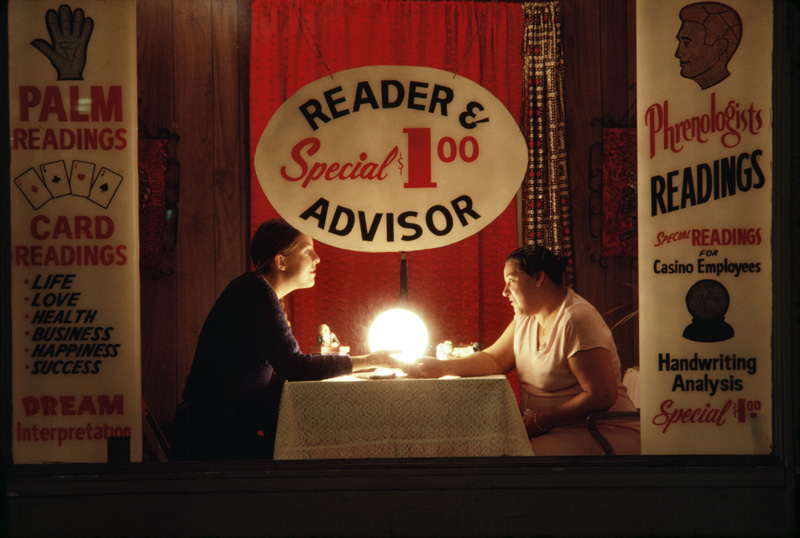
When I was a young woman, newly married, my mother decided to have a psychic come to her house one evening and hold individual sessions with all of her family members. My mother was searching for something at the time, which I didn’t know then but I do know now – but that’s a story for another time.

There were two things that I remember from that “psychic reading”. One was that he told me that in a past life I had been an Inca and that I had fallen off a cliff and had broken my hip. The second thing he told me was that I was going to be shooting video.

As for the Inca past life comment – I recently had to consult a chiropractor after a night of dancing at a fundraiser had left my right hip inflamed, sending shooting pains down my sciatic nerve. When the chiropractor asked me what I did to cause this, I told him about the dancing, but not the Inca part – that was probably best left unsaid.

As far as the video prediction, he had a crystal ball into my future, but at the time I thought – video? Are you kidding? I equated video with soap operas and really bad late night commercials. I was a young still photographer just getting a name in the magazine world and starting to make some money in the corporate sector. I couldn’t have been less interested in video at that time.

Fast forward to now. I’ve been shooting video with traditional video tools for over ten years. I give seminars to still photographers who may be thinking of getting into video and I have just made a big investment in both money and mental power and have embraced the HD DSLR tools for an upcoming project I am working on Opening Our Eyes.

I’m not the only still photographer thinking of video these days – it seems like everybody is. As print platforms give way to electronic ones like the iPad that debuted this past weekend, the way we communicate is rapidly changing and along with that there is a huge demand for video. On the April 12th cover of Time Magazine is a portrait of Steve Jobs and inside a review of the iPad entitled “Do We Need the iPad?” The writer Lev Grossman wraps up the article nicely:

“If I have a beef with the iPad, it’s that while it’s a lovely device for consuming content, it doesn’t do much to facilitate its creation. The computer is the greatest all-purpose creativity tool since the pen. It put a music studio, a movie studio, a darkroom and a publishing house on everybody’s desk. The iPad shifts the emphasis from creating content to merely absorbing and manipulating it. It mutes you, turns you back into a passive consumer of other people’s masterpieces. In that sense, it’s a step backward. Not much of a fairy-tale ending. Except for the people who are selling content. Read more: http://www.time.com/time/business/article/0,8599,1976932-2,00.html#ixzz0k3oIUDqY

In Time’s editor’s column “Ushering In a New Era”, Managing Editor Richard Stengel talks about making the magazine available on electronic devices like the iPad and Time will soon be delivering it’s entire contents to paying customers as a self contained application that can be downloaded to the iPad. Sports Illustrated is ready to go electronic as well.

If this doesn’t send a signal to still photographers the need to diversify and embrace video – what will?  With print moving to electronic delivery – the demand for video will increase. I sit on the National Board of ASMP and we recognize this changing paradigm. In fact that is exactly how I came to be involved with the Board of ASMP. I was asked to run for the Board because of my video experience. It’s been a year since I’ve been on the board and in that time I have set up a motion/video committee with the intention of gathering and sharing information about video production.  So far, through the efforts of the committee  an online resource for video was developed and has been uploaded to the ASMP website.

I continue to learn as technology drives us forward and I continue to network and collaborate with people. One person that I’ve learned a lot from is Richard Harrington of Rhed Pixel. Richard is one of those guys that never seem to sleep. He runs a successful business, teaches, writes and shares a lot of information on various forums like Creative Cow and on his own blog. I’ve also worked with Richard’s team of motion graphics animators on an industrial that I produced last year. I continue to learn from Richard who has just written a book called “From Still to Motion” that I can’t wait to get my hands on. It’s all about working with the hybrid DSLR cameras.

Looks like that psychic was right – at least about the video. Not sure about the past life Inca thing but it makes you wonder doesn’t it? Was it destiny? Or was it just that I was a restless soul at the time wanting to learn more about how I could tell a story and with what tools.  Not really sure – I’m just glad that I followed those instincts.

Add to FacebookAdd to DiggAdd to Del.icio.usAdd to StumbleuponAdd to RedditAdd to BlinklistAdd to TwitterAdd to TechnoratiAdd to Yahoo BuzzAdd to Newsvine