Serendipity

I have been completely buried with details, the last few weeks – everything from applying for visas, to booking flights within particular destinations to securing lodging for 98 nights – and doing it all on a shoestring budget. It’s been challenging, frustrating and necessary in order to get Opening Our Eyes off the ground.

I recently stumbled upon some interesting connections and communities while doing research for our travel needs. My daughter Erin had sent me a couple of links to insightful articles on Matador Network. I started exploring this network and website and was really impressed not only with the information that I found here but also by the “community” that had been built. Yesterday I had a great phone conversation with Matador’s CEO, Ross Borden and we discussed some very interesting ideas about how we could collaborate and share – so stay tuned and if you love travel and life – become a member of the Matador Network.

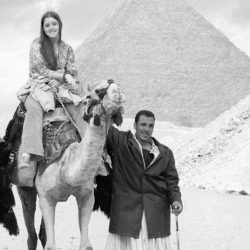
When I started my backpacking adventures over 35 years ago, I didn’t have an online community like the Matador Network – didn’t even have the Internet as we know it, or cell phones, Fedex or any other quick way to facilitate communication – I was pretty much cut off and out there – alone. Yet, I did have a “community” – meeting and talking with other travelers along the way – sharing tips and info, along with cautionary advice. There was definitely a community and it was in real time, face to face but unpredictable.

I started thinking about then and now when it comes to traveling and there is one thing that resonates with me as much today as it did then and that is making sure that I allow serendipity to happen when I travel. Serendipity – the things that happen that aren’t planned – the things that can only happen when you open yourself up to the unknown – when you are willing to take a chance – see what’s out there – follow your instincts and see where they take you.

So my daughter and I have built in “time” for our trip – time to linger and really absorb where we are – to get outside of ourselves and our own little “unit” and become part of where we are. My experience and wisdom from traveling all these years have taught me to plan ahead – but my instincts tell me to leave a little up to chance – and more importantly to be open to possibilities and opportunities. It’s the things that you never would have thought to plan – that are sometimes the most rewarding of all. But you have to open your eyes, take notice and cross into the unknown. That’s hard to do when you are traveling with other people because it’s easy to stay within the comfort of your own “tribe”. That’s one reason why I’ve traveled solo most of my life. But this time around my daughter and I will venture into the unknown, with a lot of trust, gut instincts, thrills and trepidations and see where it takes us – but also knowing that we have each other’s back. And that’s the best of both worlds.

Add to FacebookAdd to DiggAdd to Del.icio.usAdd to StumbleuponAdd to RedditAdd to BlinklistAdd to TwitterAdd to TechnoratiAdd to Yahoo BuzzAdd to Newsvine

Ten Things Still Photographers Need to Know About Video

1.    Buying a DSLR is only a start.  Choose the right tool for the job.  A DSLR might not be the right tool for many video productions.  And keep in mind that most shooters spend sometimes twice as much as the price of these cameras on add-ons to make these cameras a viable solution.
2.    It’s more than just the shoot. There are many facets to video production. In fact positioning yourself as just a camera operator may not be the best business model.
3.    Shooting video is a different mind set than shooting still images.  I think differently when shoot video.  I think in sequences and in storyboard mode – not in moments in time.
4.    Audio is everything.  You can have the best visual in the world but if you don’t capture your audio properly – you’ve got nothing.
5.    Shoot horizontals.  There are no vertical TV sets – yet.
6.    Editing – Again the shoot is just one part of video production.  Editing is just as important and there is a steep learning curve that comes with it. But learning to edit and editing your own material will make you a better shooter.
7.    There’s no standardization of codec’s and formats.  It’s like the Wild West when it comes to standardization of codec’s.  There is no standardization!  Every time a new camera gets rolled out – it seems like there’s yet another format.
8.    Output – Here’s where a lot of people get confused.  How are you going to output it?  What type of file?  What platform – TV, web, big screen?
9.    Interviews – A lot of video productions require on camera interviews.  Many times the interviews drive the story – or create the backbone of the audio track.  Pay attention to good interviews and interviewers to learn the art  of getting good sound bites.
10.    Collaboration – Video production is ripe for collaboration.  Still photographers are more independent creatures.  Learn to surround yourself with people that will make you look god.

Add to FacebookAdd to DiggAdd to Del.icio.usAdd to StumbleuponAdd to RedditAdd to BlinklistAdd to TwitterAdd to TechnoratiAdd to Yahoo BuzzAdd to Newsvine

Sustaining the Human Spirit

It’s been a tough year for a lot of people. It hasn’t been all that great for me but I’m thankful that I’m still able to make a living doing what I love – telling stories through still imagery and video. But it hasn’t been easy and this month in particular has truly taxed my spirit.

So how does one keep going when faced with the frustration of not getting “the job” and all the rest of the feelings that come with that – feelings of insecurity or hopelessness or worse? What does one do to rise above the negative feelings that will only lead to more negativity, anger and despair?

Yesterday was one of those days for me. Got a couple of emails that didn’t destroy me but left me pretty well bruised. For me many times my hurt manifests itself as anger – at least at first – which only makes things worse. So I try to put things in perspective and also try to understand. I try to understand why I didn’t get “the job” and use this knowledge to raise my own bar, so the next time I will land the job.
And if I’m feeling rejected on a personal level – I try to get outside myself and understand how my actions or words have affected someone else.

Sounds easy – but it’s easier said than done. Sometimes I don’t want to “understand” but rather I want to be understood. And when that doesn’t happen, I put up walls – barriers meant to protect me from being hurt again. That ends up doing more harm than good because it also prevents any positive things from entering my life. And many times those barriers that I erect give me a temporary safe haven – but end up being an empty place to be.

I am a passionate person and many times people are drawn to me because of that. I open myself up to people giving too much – too soon. People are drawn to my spirit and my strength and my ability to face my fears. They also know I’m the type of person who is there for them – they just know. A friend recently told me that during a difficult time – he knew I was there. Even though there was nothing I could do to make things right – he knew I was there and that was a comfort.

I think that pretty much sums up a basic need in all of us – to have someone we know who is there for us during the rough patches of life. I think we all need that and we all need a little understanding. If we know that or even sense that – we can get through difficult times.

Photographers are more vulnerable to bad times than most I think, because they are such independent creatures. They are usually out there doing a solo act. If they don’t have a support system in place with friends and family – they generally have a real hard time dealing with slumps.

One thing I love about working in video production is that it is a collaborative effort. You work with others and draw from their strengths. When working with the “right” group of people – it’s a wonderful thing. Even if you’re in charge and the buck stops with you – you know you have people who you can count on. That’s so important and basic to human happiness.

So when I have a bad day and I feel like my support system is non-existent – what do I do? I try to dig deep and find that inner strength in myself that others seem to find appealing and even take comfort in. And I hope I find it.

Add to FacebookAdd to DiggAdd to Del.icio.usAdd to StumbleuponAdd to RedditAdd to BlinklistAdd to TwitterAdd to TechnoratiAdd to Yahoo BuzzAdd to Newsvine

Funding A Personal Project

I have learned from past experience with other personal projects that getting funding for an idea is no easy task.  But I have also found that with a lot of careful planning, saving and budgeting I have been able to self fund my projects and have been compensated on many levels later on – after the projects are underway or near completion. As I continue to blog and to talk to people about Opening Our Eyes, the documentary my daughter and I are creating which involves us traveling around the world, I get asked a lot of questions.  One question that is asked quite frequently is “who is funding your project?”  The short answer is – we are self-funding our trip and our documentary.

I had managed to save up about 330,000 miles with Continental Airlines and another 329,000 points with American Express over the years.  I was saving them for something, just didn’t know what until a few months ago when I decided to cash all my points and miles in to subsidize our journey around the world.

So far, I have exhausted all but 4,000 Continental miles in ticketing my Round The World plane ticket as well as getting my daughter and I to, from and around South America.  My husband Tom donated his Continental miles to my daughter Erin for her Round The World fare.  I will still need to pay for airplane tickets to Iquitos, Peru from Lima as well as for flights to Nepal from Delhi, India. That still leaves picking up the costs of air or train tickets from Istanbul to Warsaw and Moscow. I will use about a third of my Amex points to pay for the flights from Lima to Iquitos, Peru because those tickets are costly.

I’ll use the rest of my American Express points to fund some of our accommodations, along with any hotel points that I have.  We’ll be staying at guesthouses, people’s homes and budget hotels whenever possible.  We’ll use public transportation for getting us around once we get to our destinations because renting a car isn’t in our budget.

Of course there’s food and miscellaneous expenses on the road like Internet and admission fees.  The vaccinations for the two of us have cost more than $1500 and the visa costs may reach $1000.  And we’ll both need backpacks and other personal needs for the trip.

My biggest expense will be for photo/video gear but that is the purpose of the trip.  I have pretty much figured out the gear that I’ll need: read my blog entry Putting Together a DSLR Video Kit.  When all is said and done, including buying an additional laptop as a backup, I’ll have spent about $12,000 on equipment needs.
So, how will I pay for it?  When my mother died about six years ago she left me a little money.  I never really wanted to spend it and was fortunate that I never had to – so I will use it for this project and this trip.  Somehow, I think she would love the idea of what her daughter and granddaughter were doing.  And if she were still here she might very well have wanted to join us.
I’ll be reaching out to Canon, Apple and others as potential sponsors.  I’m also reaching out to my friends and connections that I have made over the years for donations in kind. If you have any hotel points that you may not be using and would like to donate those points to our trip it would be greatly appreciated.  Or any other type of “in kind” donations you may provide.

Please email: gail@kellymooney.com or call 973-543-6868

Add to FacebookAdd to DiggAdd to Del.icio.usAdd to StumbleuponAdd to RedditAdd to BlinklistAdd to TwitterAdd to TechnoratiAdd to Yahoo BuzzAdd to Newsvine

Cultural Context and Photography

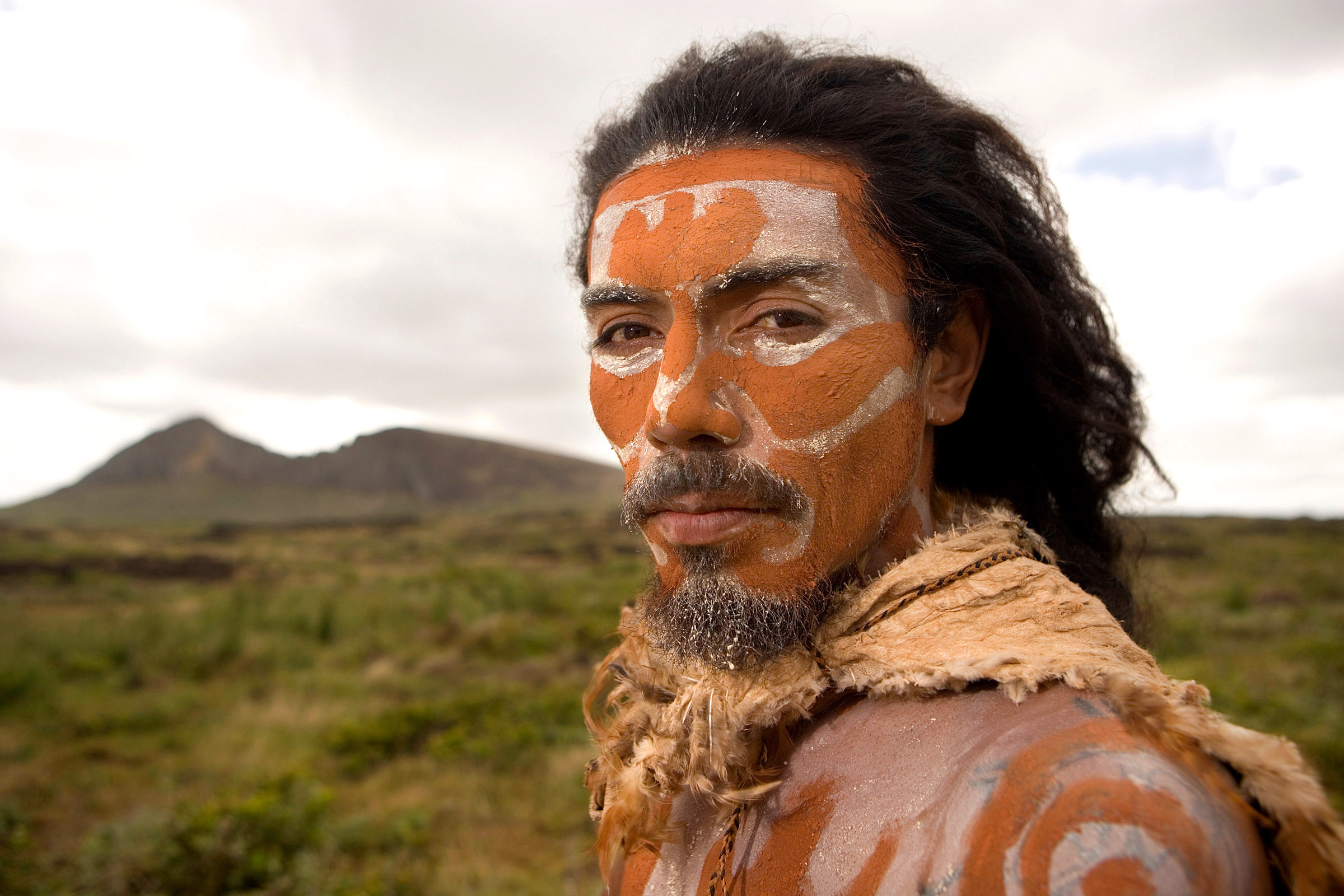
I became a photographer because of my passion for people and the cultures of the world. Photography has given me access to all sorts of people from various cultures and backgrounds. My camera is my tool – my means to my end. And that is to tell peoples’ stories through my images – whether they be still or moving.

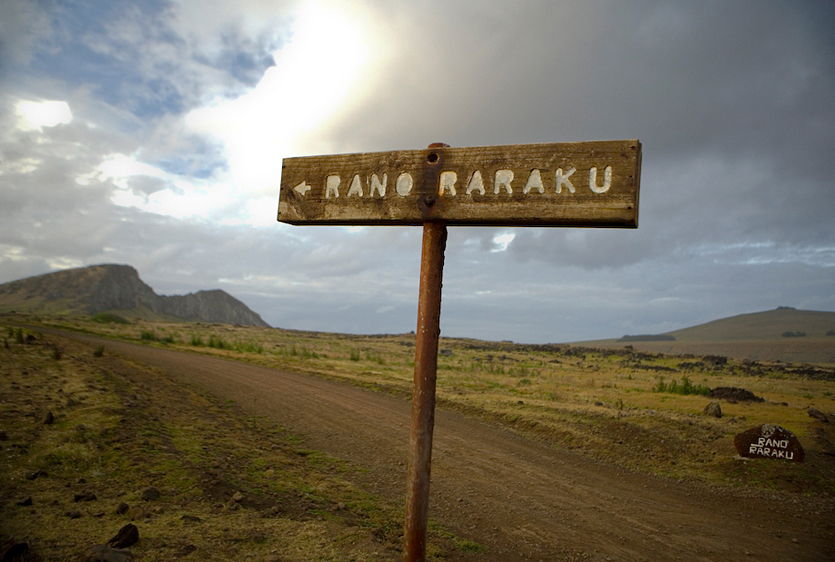
I was going through some images this week that I had shot in Easter Island a few years ago. Easter Island had always been a destination high on my list of “must sees” and it lived up to my every expectation. It was remote and wild with a constant wind that energized me. A place in the world that somehow felt untouched, unlike so many other destinations in the world that have suffered from the negative effects of the onslaught of visitors due to their own intrigue or beauty. In Easter Island the culture still felt real.

The first few days my partner and I spent driving around the island, which isn’t hard to do because of the virtue of its size. In the main town, I noticed that most of the people I saw out and about were men. Men with exotic looks riding through town bareback on horses with their long black hair blowing in the wind. It was quite a provocative sight speaking both as a photographer and as a woman.

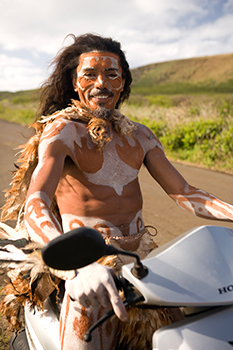
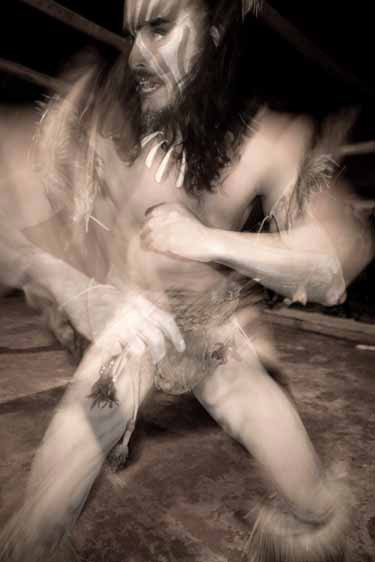
After attending a dance performance one evening I made arrangements to photograph one of the dancers – out in the natural environs of the island. I wanted to capture the spirit and the feeling of the people and the land. Tom, my partner and I met up with our subject who was in typical “western” attire and not made up. He asked us if we would transport his “weapons” in our vehicle as he couldn’t manage that on his scooter, and we obliged.

He followed behind us on his scooter to the location that we had previously scouted and then he proceeded to strip down to nothing. Here we were in this incredible wild environment between an extinct volcano and the sea with a native man totally naked standing in the road – applying his makeup, using the side mirror of our car. I instinctively knew that even though these were not the images that I had planned in my head – these were images that told the story of his culture in a unique context.

We went on to photograph a wonderful array of environmental portraits and at the end of the day we took a “crew” photo of our little group. And then he got back on his modern day scooter, in all his tribal glory and I took a few parting shots. It’s days like this that is why I became a photographer.

Add to FacebookAdd to DiggAdd to Del.icio.usAdd to StumbleuponAdd to RedditAdd to BlinklistAdd to TwitterAdd to TechnoratiAdd to Yahoo BuzzAdd to Newsvine

The DSLR as a Business Model

Sounds silly doesn’t it – “The DSLR as a Business Model”? That’s because it is silly to think that a camera can define or be a business model. But that’s what so many still photographers are doing – thinking that because they buy a DSLR capable of shooting video, they have gotten got into the business of video production.

Let’s start with the fact that in video production, the shoot and the camera is just one part of the process. There’s also sound, script writing, editing and output that one must know how to do or collaborate with people who know how. And if you position yourself as “just” a camera operator, you will quickly find out that not only you will have no ownership and control over the full process – but you will be missing out on making income on other facets of the video production process. For this reason, I position myself as a producer/director.

Even if you want to position yourself as a shooter, you shouldn’t be defining yourself by your tool – but by your vision. If you do define yourself by a camera that is very affordable and that lowers the bar on the entry level into video production – you’ll be competing with everyone else at that bottom level. Not to mention that shooting video is much different than shooting still images. I think and shoot differently when I’m shooting video – keeping my eye on the big picture and how I will get into and out of a shot.

Lastly, there are a lot of things I like about the DSLR’s, namely the extraordinary visual and the fact that I can shoot both mediums with one camera. But there are some shortcomings of these cameras that will keep you out of certain markets in the video arena.

Here are a few disadvantages these hybrid cameras have:

Audio – The built-in mic is not acceptable and the camera doesn’t have a professional XLR input. There is also no way to monitor audio with headphones. Best way to achieve good audio with these cameras is to capture it with a separate digital recorder like the Samson H4 Zoom.

Stability – With video you are shooting time in motion – not moments in time – so it’s critical to hold the camera steady. This is no easy feat when you have no brace points. Because you are shooting with the mirror up – you aren’t looking through the viewfinder and thus bracing your eye against the camera body. There are attachments that go over the LCD monitor and provide an eyepiece like the Zacuto Ez-finder.

Rolling Shutter or Jello Effect – The effect occurs when you quickly pan the camera and causes vertical lines to distort. So don’t do fast pans and eliminate anyone walking into and out of the frame quickly.

Editing – DSLR cameras record in AVCHD format using the H.264 codec. This usually means more time spent converting or rendering the files when you bring them into your editing system.

Frames Rates – 30P vs 24P – Converting your frame rate from 30P to 24P to achieve that film-like look – can be somewhat problematic with audio drifting and getting out of sync. Some cameras now have variable frame rates to choose from.

Bottom line – think beyond the camera if you’re thinking about getting into video production.  Define yourself by your vision – not your tool.

Add to FacebookAdd to DiggAdd to Del.icio.usAdd to StumbleuponAdd to RedditAdd to BlinklistAdd to TwitterAdd to TechnoratiAdd to Yahoo BuzzAdd to Newsvine

Findings From the ASMP Motion/Video Study

ASMP recently formed a Motion/Video Study Group to explore how members have embraced video. Video has become much more prevalent in visual communications as electronic publishing continues to replace traditional print media. The increased availability and low cost of broadband has enabled and created a huge demand for video. At the same time, there is a convergence of our tools as “hybrid” cameras are capable of shooting both stills and video.

As head of the Motion/Video Study Group, I spoke at length with fourteen ASMP members who have integrated video into their businesses.

Some General Observations:

As expected, there was a wide range in responses as well as in the markets that each participant works in.

• Participants are working all across the spectrum in the video/motion sector – from simple multimedia projects (still images with sound/music) to big budget broadcast spots for ad agencies.
• Most people have either been asked by their clients if they also shoot video or they have presented video as an up sell to their existing clients.
• Participants are positioning themselves as producers, directors, camera operators or all of the above. Many have set up production companies.
• Almost all participants have created partnerships or work in collaboration with others – sound people, editors and camera operators to name a few. Video production is based on collaboration because of it’s many facets.
• The learning curve can be steep – especially for editing and motion graphics applications.
• There is a lot of confusion and chaos in terms of file and codec standardization.
• Ownership and copyright are handled in a variety of ways depending on the production, the market and how one has positioned themselves. Traditionally in video, the camera operator is a hired gun and does not maintain ownership of the content. Depending on the market – the ownership and copyright is maintained by the end client or the production company.
• Most shooters invoice their still images and video as separate line items when shooting both mediums on a job.
• All see opportunities in the video medium in almost all markets.

To see the full report please go to http://asmp.org/tutorials/getting-started.html

I would love to hear from others who have added video to their businesses.

Mistakes People Make When Starting a Video Production Business

  • They focus too much on the “tools” and not the “technique”. These days video equipment is relatively cheap. Therefore the entry-level bar has been lowered for video production. Learn your skill set and be unique – have your own vision or point of view that separates you from the rest.
  • They skimp on the audio, tripod and lighting. The camera is just one piece of equipment you need. You also need independent external microphones to be able to capture good audio as well as a good tripod with a fluid head. If you’re going to be shooting indoors or doing interviews – you’ll  need some lighting equipment. You can either go the route of hot lights or LED panels which are portable and cool but costly.
  • They forget about the editing and output. Shooting  is one thing – editing it and getting it “out” is another. Learning to edit will make you a better shooter. You quickly realize in the editing room what you SHOULD have shot in the field.
  • They don’t diversify. This is important when first starting out. It will pay the bills and will help you get better at what you do. And it may also help you in find your niche.
  • They forget about marketing. Lots of people have equipment and even more people have great ideas but if they don’t promote their business, they’ll spend their days waiting for the phone to ring.
  • They don’t realize that business is about people – not just the tech. Work on your people skills and your business will flourish.
  • They don’t network. Networking of course is critical for  getting new business.  It’s also beneficial to network with other people in the video production business. Video production is all about collaboration, so it’s essential that you get to know shooters, sound mixers and editors. Join listserv groups and go to meet-ups in your area.
  • They under-estimate what a job will cost in both time and resources. There are many facets to video production – the shoot, audio, editing, music, graphics, motion graphics, scripts, voiceovers and delivery. If you won’t be facilitating all those facets – then you need to determine how much it will cost and present that in your estimate.
  • They don’t draw up a production schedule. This is essential to keeping a job on target. Make sure that each step of the project has a delivery date specified and signed off on.
  • They don’t realize that they are under insured. Many people coming from a still photography background don’t realize that their current insurance policy does not necessarily cover video production.
  • Add to FacebookAdd to DiggAdd to Del.icio.usAdd to StumbleuponAdd to RedditAdd to BlinklistAdd to TwitterAdd to TechnoratiAdd to Yahoo BuzzAdd to Newsvine

Video Production in the Deep Freeze

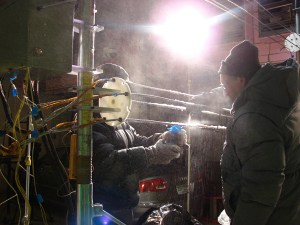
I just spent the last week in New Hampshire working on an “industrial” video for a new business venture that will be licensing an amazing new “ice” technology. It was perhaps the most challenging job that I’ve had in many years – especially from a technical level.  One day we worked from 8AM – midnight in a “cold room” at the US Army Cold Regions Research and Engineering Laboratory (CRREL) shooting “ice” experiments.  We were dealing with extremes on all levels.  The Russian scientists scientists– brilliant electrical engineers – were pushing their own boundaries as they ran tests with ice on power lines and automobiles and as much as I was witnessing this work in sub zero temperatures – it was amazing to watch them work. If I hadn’t been so busy with my own technical challenges – I would have loved to just observe them and try to get into their head.  scientists2You could almost see their brains working – just by watching their faces.  Then to see the triumph in their eyes when their experiments worked – what a thrill.  I now need to go to Russia.
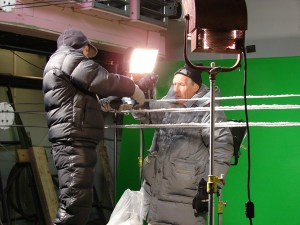
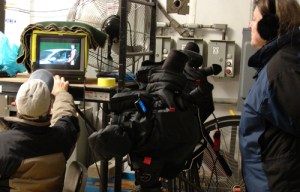
My partner Tom had done a great job with pre-production, making sure we would be fully prepared to work and have our equipment work in these extreme cold temperatures.  We put the cameras into “polar mittens” mittens to keep them warm and swapped out the warm packs as we shot late into the night.  We had to erect large “green screens” so that in post I can insert winter scenes.  Problem was our green screens were large pieces of fabric and the chill blowers were blowing them all over the place.  We tried to anchor them but in the end we had to turn the blowers off during the shoot. Thank goodness we didn’t need usable audio. We used hot lights and a lot of them.  Used every extension cord we had and every outlet in the room – 10,000 watts.  Ironic huh – hot lights in a “cold room”.  Because of that we had to leave the lights on the entire time because we knew that when we turned them off – we’d get condensation on the bulbs.  When we finally did break the set down at midnight – we turned the lights off, let them cool a bit and put garbage bags over them so that as they warmed we wouldn’t get moisture on them.  Didn’t really work too well though.  setWe did the same thing with the cameras and that worked great.  Because we had the lights on all day and were using long extension cords – one cord got over heated and actually melted and fused to itself.  The Russian electrical engineer noticed it – Thank God – or we would have burned down the building.
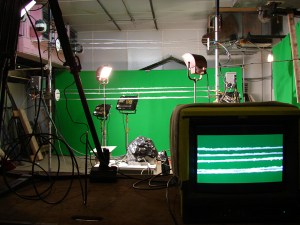
We shot an interview with another brilliant Russian scientist who was passionate about ice and also shot b-roll of all kinds of things, the campus (we were at Dartmouth), labs, refrigerators, icemakers and the computers in the cad labs. All in all things went quite well considering the adverse conditions we were working in and pushing our equipment and ourselves to the limit. One HUGE bummer was that the assistant that Tom had hired  – who came recommended from another photographer – quit after the first day.  We got through the shoot though – but had to muster up everything we had within us.  The client wrote today to say he was extremely pleased with the roughs he had seen and impressed with our fortitude on the shoot given the situation.

Now on to phase two – to record the narrative, research a ton of stock footage and photos, pick the music, work with the motion graphics team and put it all together.  As much as the postproduction inevitably involves a lot of work and long hours – I love this part.  This is where the story comes together and is really crafted.  And that’s always the best part for me.

Photos ©Sheldon Tefft

Are You a DP or a Hybrid? – What’s the Difference?

I’m searching for “the word” the “title” of what I am these days.  I’m a photographer.  I also shoot video but I hate the word “videographer” because it sounds a bit cheap to me or at least dated. I generally think to myself that I’m a “visionographer” but I tend to “title” myself as a “media producer”. With all the talk recently about getting into video, I feel the need to make a distinction between being a shooter or a DP as opposed to a producer.

There is nothing new about still photographers moving forward in their careers and segwaying into commercial motion work.  Traditionally they take on the role of the DP (Director of Photography).  Many times they don’t man the camera but direct the shooter instead.  Generally speaking they work in large crews and with agencies.  The biggest distinction is that most times it’s a “work for hire” situation because the production company owns the finished product.

With the explosion of video and in particular web video, come new buyers for this medium.  Buyers from the corporate world as well as institutions and even ad agencies that may have been historically just “print”.  With the advancement of technology and being able to deliver a high end product because of it – leaner and meaner small production companies have come along.  When you have a shooter using the RED and able to deliver not only the motion part of the job but able to pull stills from the shoot, once again still photographers feel threatened.

When I got started in video, I made a conscious decision to take on the producer’s role.  I could choose to shoot or edit or I could delegate these roles to outside contractors.  I could also form partnerships that were fluid as the needs may be.  But more importantly, I maintained ownership of the final product – which was what I was used to coming from my still photographer background.

Still photographers are essentially producers anyway so it’s not such a mental leap.  So when your client comes to you and asks you if you shoot video (and you don’t) think before you answer that with a NO answer.  It may be better to form some partnerships with people who do and not only keep the money in house – but not send your client off to someone who does.