Gearing Up For A HDSLR Documentary

Most people have no idea of how much really goes into planning for even the simplest films. My biggest job was to come up with the right mix of gear that would enable me to shoot both still images and video in a high-end way, yet remaining to be portable and lean as far as what we would be bringing with us. That can be an overwhelming task – but the more I break it down and prepare for it with a Plan A, B and C – the more confident and relaxed I feel as our departure date nears.

Please watch the  video that I created (nothing fancy) showing the gear that I’ll be bringing around the world on a 99 day shoot for my passion project Opening Our Eyes.

I’m embracing the HDSLR system since I want to shoot both stills and video but by no means is it streamlining my equipment needs. Quite the contrary, I’m bringing an assortment of lenses that I wouldn’t be taking if I were shooting with a traditional camera, as well as a lot of third party gear to augment audio capture and rigging for stabilization. What you don’t see in the video are the two (redundant) MacBooks that are essential when shooting any tapeless workflow.

Of course there are a million other details to cover for a 3 month trip around the world.
I’m still trying to determine my mobile phone and service needs. I’ve set up Skype on both laptops – yes 2 laptops because when you’re shooting tape less you are totally dependent on a computer and a back up if one fails. I’ll most likely upgrade my Blackberry because it’s been two years and that’s light-years in the tech world of communications. And I need to activate travel/medical emergency insurance as well as register my equipment with US Customs and add new gear to my business insurance policy.

There are also accommodations for 99 nights and a slew of internal airline tickets that needed to be taken care of. Read about it more at: Opening Our Eyes

Add to FacebookAdd to DiggAdd to Del.icio.usAdd to StumbleuponAdd to RedditAdd to BlinklistAdd to TwitterAdd to TechnoratiAdd to Yahoo BuzzAdd to Newsvine

Copyright and Video

As still photographers move and expand into video because of the convergence of their tools, they often ask me about copyright, licensing and usage and how to apply that to video.  Essentially they are trying to apply a licensing business model from their still photography and sometimes that doesn’t work in video production.

The biggest distinction between shooting video and shooting still images is that for the most part a video camera operator is just one of the many creative people involved in a video production.  So unless the camera operator is also the producer and in charge of the entire production, including the hiring of the crew, they will be working in a “work for hire” situation.  One video project can’t have every collaborator on a project maintaining ownership of their part of the whole.

Depending on the job and the market you work in will ultimately determine who will maintain ownership, copyright and control.  Generally speaking the end client or video production company holds the copyright to the finished production.  This is why I made a conscious decision when I got into video many years ago, to position myself as a producer and not “just” a content provider. I wanted to maintain creative control and ownership of my projects.

But even in still photography these days, I see more and more “work for hire” contracts, and in market sectors like editorial where that wasn’t the case just five years ago.  Sometimes I feel that in our efforts to protect copyright laws, we end up fighting for that right for big corporate entities that in turn grab those rights from the creators through lopsided contracts.

Something to think about – maybe with new eyes.  Perhaps we need to start thinking of ourselves as “publishers” rather than just content providers.  It’s never been more possible to be a publisher, because distribution has been democratized by the web, giving all of us a pipeline to a global audience.

It’s time to look at our creative businesses with new eyes and not just on the creative part of the process – but the business part as well.  I’d love to hear others’ thoughts and ideas on this topic.

Add to FacebookAdd to DiggAdd to Del.icio.usAdd to StumbleuponAdd to RedditAdd to BlinklistAdd to TwitterAdd to TechnoratiAdd to Yahoo BuzzAdd to Newsvine

Using Video to Market Your Business

Video is the hot topic these days. You’d think it was a new thing. But there’s nothing new about video – it’s been around almost as long as TV. What is new is that broadband has made online video viewing integral to the Internet experience.

In the last year alone we’ve seen an explosion of video viewing and sharing on social networking sites. Advertisers are shifting their marketing dollars to the Web and online ads are booming. Why? Because marketers know that the consumer is going online to see and hear more about the products they are thinking of buying. It’s one thing for a potential customer to see a static image accompanied by text and quite another to see a product in use and demonstrated, or to hear the story behind a company. Online Web videos can be linked and shared and are searchable, providing more possibilities for potential customers or clients to find you and what your company offers.

Using Video to Promote Photography

If you run a video production company, it’s a no-brainer that you’ll want to use video samples to promote your business. But video is also effective for promoting all types of businesses, including still photography.

You can import your still images into some type of non-linear editing system like Final Cut Pro, add a narrative track and/or music and create a video promo of your work for online viewing. This promo can also be uploaded to a mobile device giving you the ability to show your work to potential clients in a quick and interesting fashion, anywhere, anytime. Better than your typical “elevator speech” when someone asks “What do you do?”

Another very effective way to market and promote your photography business is to create a behind-the-scenes video. Everyone loves a story and this is a great way to tell people about your company as well as provide more information about yourself and how you work.

Read more about video and marketing in my article in Adbase Insight that came out yesterday “Use Video to Market Your Business.”

Add to FacebookAdd to DiggAdd to Del.icio.usAdd to StumbleuponAdd to RedditAdd to BlinklistAdd to TwitterAdd to TechnoratiAdd to Yahoo BuzzAdd to Newsvine

NAB – A Week of Gadgets, Geeks, and Great Inspiration

Today is the final day of NAB and as usual my head is exploding with ideas and information. But before everything totally leaves my head – I’ll share some cool things with everyone.

I come to NAB to learn, however this year I also needed to research and buy some things for my upcoming project Opening Our Eyes. In particular I was looking for a stabilization rig for my Canon 5D and 7D. My timing was perfect because at this year’s show just about every booth had gear for the DSLR cameras – the show was all about either the HDSLR or 3D. I settled on the Zacuto Striker because I wanted something lightweight and quick to put on a tripod. Zacuto had redesigned the plate making the weight distribution better and it felt just right for me. And that’s important – get the right rig for you – if at all possible visit a vendor where you can try these stabilization rigs out so that you buy the one that literally “fits” you and your needs.

One of the biggest buzz items was the HD Hero, a tiny wearable video camera for sports, made by GoPro and at the $200 show special – they sold out the first day. But check them out – even at the retail price of $300, they are amazing little cameras that can be used in all types of situations where you need something small.

RedRock Micro debuted their new HDSLR remote which uses sonar for auto follow focus. The booth was mobbed with attendees dying to get their hands on this accessory that is priced around $1000. Check out the review from the show floor at PhotoCineNews.

Canon unveiled their latest tapeless camera the XF305 that will give the Sony EX-3 a run for their money. Even as stunning as this camera is, Canon didn’t integrate that nice big chip/sensor that we see in their hybrid HDSLRs. But Panasonic did and they had their new prototype camera in a plexiglass box perched on a museum type pedestal. The Panasonic AG-AF100, is the first professional micro 4/3-inch video camcorder optimized for high-def recording. that did make use of that large sensor that everyone seems to be waiting for – stay tuned. Canon-are you watching and listening?

I’m maxed out right now with technology and information yet inspired and energized at the same time by the notion of possibilities. If you’re a still photographer singing the blues because of the lousy economy and the changing paradigm of print giving way to electronic delivery – I can only say one thing – convergence. Embrace that notion, get energized by the idea and open your mind to the possibilities and opportunities that are exploding in this new world of information technology.

Add to FacebookAdd to DiggAdd to Del.icio.usAdd to StumbleuponAdd to RedditAdd to BlinklistAdd to TwitterAdd to TechnoratiAdd to Yahoo BuzzAdd to Newsvine

Should I Be Thinking of Video – Or Not?

I give a seminar to still photographers for ASMP entitled “Should I Be Thinking of Video?” It’s a broad overview of the different facets of video production along with how I have positioned myself in this medium and where I think some of the opportunities are. I’m quick to point out what it’s not – it’s not going to tell you everything you need to know to make video part of your business and it’s not about how to use your DSLR. And if anyone promises that they can teach you that in two hours – they’re lying. But most importantly, I can’t possibly answer the question “should I be shooting video” for each individual in the room. And that’s because there is no ONE answer to that question – that’s up to the individuals to decide for themselves.

I think perhaps I should point out some reasons why one shouldn’t be thinking of video:

Fear – Because you are consumed with fear of your future. It’s understandable to be afraid when the world as you know it,  is changing. But if you are so focused on the thought that you have to do something because technology has changed your business to the extent that it just isn’t there anymore, instead of focusing on how you can use technology to grow your business – then you’ll paralyze your mind to new possibilities.
The Camera – If you are getting into video because your still camera is capable of shooting video and you’re not concentrating on thinking and seeing in motion, then you’ll end up with isolated video clips that have no relation to one another and you’ll have a rude awakening in the editing room when you realize you have no clue on how you’re going to put together a cohesive story.
Because everyone else is – With all this talk of video of late, everyone feels they need to jump on board. The truth is video may not be the answer for some photographers. And it may not be the best medium for the markets you work in.

You should be thinking of video if:
• You think that motion and sound is the best way to visually communicate your clients’ story or message.
• You recognize the power of collaboration in this medium
• You understand that there’s a learning curve and there’s no magic bullet.

I cannot tell you if video is the answer for you – that’s up to you to make that decision for yourself. I can only tell you what’s involved and guide you through the process.

When my daughter was growing up, I was always careful not to make all her decisions for her. It was a hard thing to do because many times she wanted me to and I wanted to but I didn’t. I knew if I made all her decisions for her that I wouldn’t be doing her any favors in the long run – because sooner or later she’d be out on her own without me there telling her what she should or shouldn’t do. I think it was one of the hardest things I had to do as a parent.

It’s been challenge this year scheduling time for my production business, along with traveling around giving these seminars. As much as I enjoy sharing information with others through these seminars, I know that I need to be doing what I love most and that is being a visual communicator. So, I’m taking to the road on May 25th – around the world actually, working on a personal project Opening Our Eyes. I need to get back to some real quality time of creating. And the best part – my daughter decided that she wants to join me and be part of this – and she made this decision all on her own.

Add to FacebookAdd to DiggAdd to Del.icio.usAdd to StumbleuponAdd to RedditAdd to BlinklistAdd to TwitterAdd to TechnoratiAdd to Yahoo BuzzAdd to Newsvine

The Race To The Bottom and/or Video

I’m waking up to a beautiful day in San Diego and thinking about my old California days when I lived in Santa Barbara and attended Brooks Institute.  That was a long time ago but whenever I’m in southern California, my head goes back to my beginnings – my beginnings with my husband and partner and my beginnings of my career as a photographer.

Sounds funny now when I mention career and photographer in the same sentence.  But that’s the way it was back then (mid ‘70’s) when you had to be technically savvy to make a good photograph – a technically good photograph that is.  These days just about anybody can create a technically good photograph because of how technology has changed the tools of our trade.  And that’s why it’s gotten harder and harder to make a career out of photography.

It seems like there’s a race to the bottom in photography these days. By that I mean that a lot of photographers will do just about anything to get the job – from giving away rights to almost doing the job for nothing.  I almost can’t blame them when they are facing mounting bills and the phone rings less and less and they consistently get undercut by their peers.  On the other hand I have to wonder, is technology totally to blame for the race to the bottom or did we do it to ourselves?

I talk to lots of photographers these days because I give short seminars about video. A lot of photographers have clients who are asking for video and they want to respond to that.  A lot of photographers see their business dwindling as print needs dry up and as we move to electronic publishing. With that of course comes even more of a demand for video content. And a lot of photographers are there because still cameras are now capable of shooting video.

I cringe when I hear that someone’s motivation for getting into video is because of a tool.  I cringe because I know that it’s not about the tool and that one should really focus on what makes them unique – and how they “see” things.  Right now, you have to still be technically savvy to be able to produce decent videos – with good sound and edited well. Is it only a matter of time before technology makes these tools so good that just about anybody can shoot good video? Perhaps.

I strongly suggest that photographers get out of their solo independent ways of thinking and embrace collaboration when they move into video.  Get away from the tool centric way of thinking.  Surround yourself with people who you can work with – sound people, editors, and musicians.  Place more importance on thinking in motion and storytelling in motion.  And most importantly, produce your own videos, even if that means taking a chance.  Work directly with clients instead of being just one rung on the ladder.  Otherwise you’ll be on the content rung, which is way down at the bottom of ladders these days.

So, while I’m sitting here on a beautiful morning in San Diego and California dreaming – I’m remembering a lot of my peers from my old Brooks Institute days.  I think about what they are doing now – are they still working in photography?  I think the ones who are the ones who shot images that had some soul and went way beyond being technically perfect.

Add to FacebookAdd to DiggAdd to Del.icio.usAdd to StumbleuponAdd to RedditAdd to BlinklistAdd to TwitterAdd to TechnoratiAdd to Yahoo BuzzAdd to Newsvine

What Video Storytelling is Not

It was bound to happen – still photographers shooting video like still images – as DSLR’s became hybrids, capable of shooting both stills and video.  I’m starting to see video clips strung together in a timeline – like a pagination of images in a magazine – but without a cohesive storyline told through edited sequences or an audio/narrative track telling the story.   It’s neither here nor there – not achieving the lingering power of a still photograph, nor utilizing the power of motion and sound to give a story more dimension.
The problem as I see it when I come across these “samples” is that these still photographers are not thinking in motion.

I think totally differently when I shoot video than when I shoot stills.  Stills are moments in time – video is time in motion.  That means that when I shoot video I’m always thinking about the big picture – how will I get into and out of a shot.  What is coming before this shot and what is coming after?  I know to think this way because I’ve edited my own material.  Editing video is a great way to learn how to be a better shooter.  It becomes very clear in the editing room – what you should have shot to be able to cut together a cohesive story.

I learned video storytelling at one of the Platypus Workshops from Dirck Halstead and PF Bentley.  PF continues to inspire me with his storytelling skills in the video medium as he explores shooting with an HD-DSLR.  Check out a couple of his videos – beautiful storytelling and creatively executed.

So once again – it’s not about the tool – the camera.  Don’t think that because you buy a DSLR capable of shooting video that’s all there is to it.  If you really want to use the power of these new cameras – it starts with your vision and how to relay that in motion.

Add to FacebookAdd to DiggAdd to Del.icio.usAdd to StumbleuponAdd to RedditAdd to BlinklistAdd to TwitterAdd to TechnoratiAdd to Yahoo BuzzAdd to Newsvine

Gearing Up With HD DSLR’s

Last week was incredibly stressful. I had been dealing with obtaining visas – a somewhat monumental task of which I had no control over, in preparation for my upcoming project Opening Our Eyes, that will literally take me around the world.

On one of my many trips to New York City, I went to B&H and purchased some gear I needed for the Opening Our Eyes documentary that I will be shooting. The gear I bought included – Canon 5D and Canon 7D cameras with extra batteries, (2) 16 GB Sandisk Extreme compact flash cards (I’ll need more), Manfrotto 190CX3 light weight carbon fiber tripod with the Manfrotto 701 fluid head (I needed a small tripod and head that will fit in a backpack),  Samson Zoom H4N digital audio recorder, 2 GB Sandisk SD card for audio, recorder, Rode Shotgun mic with “dead cat”, Delvcam Camera Mount Adaptor (this attaches to bottom of H4N Zoom recorder giving it a hot shoe plate), Rycote Hot Shoe Extension/Extender (this attaches to the hot shoe on the top of the camera giving you extra room for devices – for me, the H4N Zoom recorder and a shock mount for the Rode mic) an adaptor so I can hardwire my Tram lav to the Zoom digital recorder, XLR cords of various lengths, and a couple of Rugged Lacie portable hard drives (500GB)
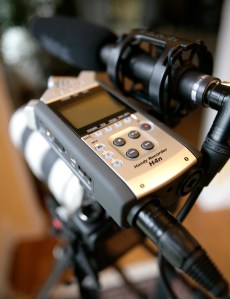
This weekend, I decided to familiarize myself with the new gear and do some testing. I was looking forward to getting back to my “purpose” for the trip and leave the administrative nightmares behind. I am not a shopper, nor am I a gadget freak. I buy new equipment when I have a need for it as opposed to because it exists. There’s something to be said about sticking with gear that you are comfortable with so that you can concentrate solely on the creative, but because of the pace of technology we are somewhat forced to keep current with our tools.

Whenever I add a new tool to my bag of tricks – I go through a process. First experiencing the thrill of something brand new in my hands. When I first took the Samson H4N Zoom out if it’s little coffin like plastic case and held it in my hands it was a sensual experience because of its design and what they make it out of. The second phase of the “new gear process” is reading the manuals and figuring out how things work. With the Zoom this was a bit frustrating and I am one who is already familiar with audio devices, so I can only imagine the frustration for someone who is not audio savvy. It’s such a sophisticated little mixer with so many choices that it took some time getting used to it. After much testing I settled on the 4Channel mode.

Over the weekend I tested both the Canon 5D and 7D cameras, recording sound with their internal mics as well as with a shotgun mic on camera plugged directly into the camera with an XLR to mini plug cord. I also tested both cameras, recording the audio separately through the H4N Zoom using the shotgun on the camera, and with the shotgun on a boom closer to the subject. Then I tested my Tram mic hard wired into the recorder and finally I did a test with the Tram and shotgun mics recorded on separate tracks on the Zoom.

After the tests, I brought both the video and audio files into Final Cut Pro. I had also purchased Philip Blooms 7D tutorial and in the workflow section he mentions how sluggish and problematic it is to work with the H264 files that come directly out of the camera. He recommends converting the files to Apple Pro Res LT either using compressor or MPEG StreamClip which is faster. I tried it both ways and he’s right the MPEG StreamClip is much faster. After I converted the files into Apple Pro Res LT, I imported them into Final Cut along with the WAV audio files. Incidentally, I shot everything at 24 frames a second and recorded the audio as WAV files at 48KHZ. In addition, I recorded sound through the camera, even though I was capturing my audio with an independent device. I knew I would use it as a reference when syncing the sound in post. My next step was to sync the audio files with the video/audio files coming from the camera. I used a clapper when recording so syncing was pretty easy. Philip Bloom mention using a software called PluralEyes for help with syncing audio and video in post but I have not yet purchased it. I did find out that you need to keep good organizational notes when shooting so that you can easily match up the audio files with the camera files later on. I decided that I like using the 4Channel mode with the digital recorder and using two external mics along with the stereo pair on the recorder. In post I can uncheck “stereo pair” and work on each channel independently.

So after a weekend of playing with the new gear, I went through the gamut of emotions from the thrill of newness to the incredible frustration of learning something new before the light bulb goes off. It will take a while to get to the third phase of the “new gear process” and that’s becoming very comfortable with the tools. And I can almost guarantee when that comfortable feeling start to happen, there will be something new that I’ll need to buy.

Add to FacebookAdd to DiggAdd to Del.icio.usAdd to StumbleuponAdd to RedditAdd to BlinklistAdd to TwitterAdd to TechnoratiAdd to Yahoo BuzzAdd to Newsvine

Ten Things Still Photographers Need to Know About Video

1.    Buying a DSLR is only a start.  Choose the right tool for the job.  A DSLR might not be the right tool for many video productions.  And keep in mind that most shooters spend sometimes twice as much as the price of these cameras on add-ons to make these cameras a viable solution.
2.    It’s more than just the shoot. There are many facets to video production. In fact positioning yourself as just a camera operator may not be the best business model.
3.    Shooting video is a different mind set than shooting still images.  I think differently when shoot video.  I think in sequences and in storyboard mode – not in moments in time.
4.    Audio is everything.  You can have the best visual in the world but if you don’t capture your audio properly – you’ve got nothing.
5.    Shoot horizontals.  There are no vertical TV sets – yet.
6.    Editing – Again the shoot is just one part of video production.  Editing is just as important and there is a steep learning curve that comes with it. But learning to edit and editing your own material will make you a better shooter.
7.    There’s no standardization of codec’s and formats.  It’s like the Wild West when it comes to standardization of codec’s.  There is no standardization!  Every time a new camera gets rolled out – it seems like there’s yet another format.
8.    Output – Here’s where a lot of people get confused.  How are you going to output it?  What type of file?  What platform – TV, web, big screen?
9.    Interviews – A lot of video productions require on camera interviews.  Many times the interviews drive the story – or create the backbone of the audio track.  Pay attention to good interviews and interviewers to learn the art  of getting good sound bites.
10.    Collaboration – Video production is ripe for collaboration.  Still photographers are more independent creatures.  Learn to surround yourself with people that will make you look god.

Add to FacebookAdd to DiggAdd to Del.icio.usAdd to StumbleuponAdd to RedditAdd to BlinklistAdd to TwitterAdd to TechnoratiAdd to Yahoo BuzzAdd to Newsvine

Fast, Cheap and Good

A colleague of mine, Blake Discher just wrapped up a seminar series for ASMP entitled I Stink at Negotiating. In his presentation, Blake says I tell my clients when they ask for fast, cheap and good – they can pick two.  Such a simple statement – but right on target as far as advice for negotiating.

Photographers want their clients to know the difference between what they can offer as professionals compared to any amateur with a camera.  They want to be paid accordingly for their experience.  They want their clients to understand the difference between what they bring to the table compared to a non professional.

But there seems to be a disconnect between that philosophy and how still photographers perceive themselves in terms of adding video to their business. Many think that by buying a DSLR camera that shoots stunning video visuals, that’s all it takes to get into the video production business. The problem is they are thinking the same way their clients are who can’t discern the difference between a professional and someone who has a camera that also shoots video.

Technology has once again lowered the bar for entry level into video production. And still photographers who equate buying a still camera capable of shooting video with being a professional motion shooter or videographer are forgetting some real important factors.

1.    You think totally differently when shooting video.
2.    There’s a lot more facets to video production than just the shoot.
3.    Most people who are working on professional motion productions and are using a DSLR or VSLR camera have spent more than twice the price of the camera on third party accessories.
4.    There’s a steep learning curve of other aspects of video production – namely capturing good audio, editing, and output.
5.    Video is a collaborative process with an entirely different workflow than still photography.

Still photographers have a hard time with #5 because by nature they are independent creatures used to controlling and doing everything themselves.  But video is all about collaboration and as soon as one realizes the power of networking, collaborating and partnerships – they understand the concept of video production and raising their own bar by collaborating with others.

I recently gave a seminar in Portland, OR where I had a chance to talk to Andy Batt who is quite knowledgeable with VSLR’s and has produced some beautiful work with them.  I learned a lot from Andy about some of the idiosyncrasies of theses cameras.  I don’t own one yet, although I will be purchasing a Canon 5d and 7D along with additional Zacuto accessories for a personal project I’ll be working on, where I will be shooting both stills and video and will be living out of a backpack for three months. So to economize on space – this seemed like the right way to go.
Andy and I do totally different things and work in totally different markets but we can learn from each other.  Andy works with large crews and on big productions.  I work more journalisticaly, with small crews in direct corporate and institutional markets.  But we both know that it’s not just about the equipment and it’s not a one size fits all when it comes to choices made in that regard.  We also know that it’s not a one size fits all when it comes to pricing and in terms of usage and licensing.  What might play in one market – simply won’t in another.

The point is buying a VSLR isn’t what will get you in the game of video production.  There’s more to it.  And there isn’t just a rack of template prices that apply to all.  We are hired for who we are, how we see, how we work and our experience. The ones who will be successful will understand that it’s not about just having a camera capable of shooting good visuals.  The ones who don’t understand will be expected to deliver Fast, Cheap and Good.

Add to FacebookAdd to DiggAdd to Del.icio.usAdd to StumbleuponAdd to RedditAdd to BlinklistAdd to TwitterAdd to TechnoratiAdd to Yahoo BuzzAdd to Newsvine