How Do You Tell the Story?

I’ve said it hundreds of times – “the story is everything”, “without a story, you’ve got pretty pictures to a soundtrack”. So, how do you tell a story? How do you do it?

A friend called me the other day, struggling with this very question, of how do you tell the story? He was putting together a multimedia piece and he had captured sound and had taken photos during an event and was about to record an audio interview. I wasn’t sure at first, if he was asking about the mechanics of how to edit a story together in Final Cut– or was he asking me for guidance on how to tell the story? Those are two completely different discussions.

I thought back to when I was just starting to learn video journalism and had taken the Platypus Workshop. We had to tell our commitment or our story idea to an instructor, before we could start executing it. If the idea wasn’t delivered clearly and concisely, we went back to the drawing board to nail down the idea or the focus.

Every story starts out with an idea. Ideas have always come pretty easily to me, usually in spurts. All sorts of environments or activities can trigger ideas.

Seth Godin did a blog about a week ago titled, Where do ideas come from? Here are a couple of my favorites:

  • Ideas come out of the corner of the eye, or in the shower, when we’re not trying
  • Ideas come in spurts, until you get frightened. Willie Nelson wrote three of his biggest hits in one week
  • Ideas occur when dissimilar universes collide
  • Ideas fear experts, but they adore beginner’s mind. A little awareness is a good thing
  • Ideas hate conference rooms, particularly conference rooms where there is a history of criticism, personal attacks or boredom

Once I get the idea, I then start focusing it in my head. I play out the movie in my mind. What is the message? Whose message is it – mine? – the client’s? What is the motivation for the piece? A call to action? Once I get a pretty clear idea of what the story is that I’m trying to tell, then I start to put the pieces together. First I gather and capture all the assets that I’ll need, the interviews, b-roll, still photos etc. Then, when it’s time to edit the story, I’ll have a much clearer focus of how I will edit the pieces together to deliver the message.

Right now, I’m editing a feature length documentary, that is made up of ten different stories about ten different people in various corners of the globe. All together, the ten stories are unified by the theme of “the power of the individual in making a difference in the world”. Essentially the idea is, global stories about the power of one. That has been my underlying story from the moment of concept, to shooting it, to editing it all together.

So, how do you tell the story?  For me, it’s focusing on the “idea” at all times and editing toward that purpose.  There are hundreds of ways to tell the same story, but you need to know what the story is before you can begin to tell it.

Add to FacebookAdd to DiggAdd to Del.icio.usAdd to StumbleuponAdd to RedditAdd to BlinklistAdd to TwitterAdd to TechnoratiAdd to Yahoo BuzzAdd to Newsvine

The Power of Sharing and Networking

I’ve always been an independent creature, starting with a year long backpacking odyssey as a 19 year old traveling solo, following the “hippie trail” around the world.  That sojourn led me to pursue a career as a still photographer, using my camera as a tool to gain access to people, their cultures and their stories.

I’ve had a great ride these past 30 years shooting assignments for high profile magazines that have taken me to all parts of the globe.  For the most part, I was a solo act, spending hours, days and weeks observing people, then becoming more intimate as I proceeded to get to know and tell their stories and share them with others.

When I started shooting motion and in particular digital video, eleven years ago I embraced the notion of collaboration.  Video production has a lot more facets to it than just the shoot and I knew that even though I knew how to capture reasonably good sound and edit a respectable rough cut with Final Cut Pro, I also knew that working with professional sound people and editors would raise the bar on the quality of my projects.

This past weekend, the value of collaboration, networking and using social media to get my ideas out to the universe, really hit home.  I had been asked to speak at the Photocine News Expo in Hollywood, CA about my latest documentary that I was working on, Opening Our Eyes. I had gotten to know two of the organizers of the event, Michael Britt and Lou Lesko, through social media. They had taken notice of my blog and my project, which I had decided to shoot with the HDSLR cameras and had written about it in their blog, PhotoCineNews.com.

I was honored and humbled to be speaking at the same event as some pretty heavy players like Vincent LaForet and Shane Hurlbut.  I was a bit intimidated at first, but I knew that I was there to share what I knew and that is how to get a passion project from just an idea – to a reality.  So, after returning from my 99-day journey, with just a couple of weeks to prepare a sample from some of the 145 hours of footage that were shot, I flew out to LA.

Here’s a rough cut of that 10-minute sample:  Opening Our Eyes – Tease

I suppose I can legitimately say that I have had a theatrical showing of my documentary in Hollywood.  True enough – but the real value for me this weekend was in sharing with my peers and making connections with people who I will work with in the future that will help me grow as a filmmaker and storyteller and more importantly who will bring their expertise to my film.

It’s an incredible time that we live in with a realm of possibility.  Literally anything is possible.  When you share and put things out to the universe – you just never know what you’ll get back.  I’ve learned that I share because it makes me feel good – not because I have expectations for an immediate or monetary return.  But each and every time I do share – I get back so much more in return.

Add to FacebookAdd to DiggAdd to Del.icio.usAdd to StumbleuponAdd to RedditAdd to BlinklistAdd to TwitterAdd to TechnoratiAdd to Yahoo BuzzAdd to Newsvine

My Love/Hate Relationship – Shooting Video With a DSLR

I’ve just spent the last 2 weeks intensely editing my footage shot on my 99-day journey around the world, shooting my passion project, Opening Our Eyes.  I wanted to get a trailer ready for the PhotoCine Expo that I’ll be speaking at this weekend in Los Angeles. I knew that I couldn’t possibly go through all 2900 gigabytes of content (145 hours), let alone cull it down to a finished sample in two weeks time.  So, I took a friend’s advice and decided to focus on only two of my ten subjects that I interviewed and shot b-roll on.

Even with going through only 20 percent of my footage has been a grueling and exhausting two weeks.  But it’s also given me a much better sense of working with and analyzing the files that come out of the Canon 5D Mark II and 7D.

Some of my loves:

  1. I love the picture quality
  2. I absolutely love the picture quality
  3. You can’t beat the picture quality

It’s true, the picture quality is stunning and worth putting up with SOME of the workarounds, depending on what type of job I’m working on.  If I’m shooting a corporate event and I need to record longer than 12-minute intervals, which is the case when someone is giving a talk, then I would opt not to use a DSLR because of the limitations on the duration of a clip.  And, regardless of the type of job I shoot, editing the files from these cameras is tedious because I need to transcode them into a file that will play well in Final Cut Pro.

Some of my hates:

  1. 12 minute clip duration – this really needs to change in the next generation of these hybrids in order to make it a more       workable camera
  2. Audio – Canon really needs to come up with a more professional solution for capturing good audio with the video on           one card.  I have used a JuidedLink pre-amp with a gain disabler on it but it’s still not as good as the audio I get when         I capture it to a separate digital recorder – in my case the Samson H4N Zoom.
  3. Having to transcode all the files into a codec like Apple Pro Res so that I can edit in FCP without stutters, stops and             drop frames.
  4. Stabilization is an issue but a solvable one thanks to rigs from Zacuto. And of course you can always use a tripod – and       really should if the situation warrants.

I’m sure I’ll come to other conclusions as I dig deeper into my content and I’ll share my thoughts as I continue to immerse myself in the post production part of this film.

Add to FacebookAdd to DiggAdd to Del.icio.usAdd to StumbleuponAdd to RedditAdd to BlinklistAdd to TwitterAdd to TechnoratiAdd to Yahoo BuzzAdd to Newsvine

Editing and Workflow for DSLR’s – The First Steps

In the Field
Depending on how you are working in the field and what you are shooting, your workflow and the way you organize and manage your media will vary somewhat. If you have a crew and are shooting a scripted video, then you will probably have a computer and technician on site, downloading media as it is shot, backing it up and checking it for focus.

If you’re working solo or with just one other person, which is how I have been working for the past 3 ½ months on my project, Opening Our Eyes,

Gail at the Kopila Valley Primary School, Surkhet, Nepal

then you don’t have the manpower to work that way. I downloaded all my footage, audio and stills at the end of the day. I rarely had the time or even the battery power on my computer (electricity was scarce at times) to look at what I had shot but I did do spot checks occasionally.

Regardless of how you work in the field,

Children at the Kopila Valley Primary School

it is essential to create redundant backups of all your content. I backed everything up to two portable external hard drives, after downloading the media to my laptop via card readers. There’s a nice software application called ShotPut Pro that lets you make up to 3 copies to different drives at a time, which speeds things up quite a bit. For the most part, I had organized my media by destination and subject with each folder containing the contents of a card. Whenever I shot an interview, I put a fresh card in the camera so that the content was automatically sorted out from the b-roll. Some shooters I’ve talked to who are used to shooting tape, archive each tape or card by making a disk image (DMG) of each which can be mounted on the computer, emulating the original card.


Back in the Editing Suite

The first thing I did when I returned from my 99-day journey, was to make two backups of all my material. After my media was backed up, I started to organize it. Everything had already been separated as far as destination and subject, but I needed to separate the stills from the video and the interviews from the b-roll – if any cards contained both. I also needed to match up the interview video footage with the audio files that had been captured by a separate recording device.

After getting all my media organized and sorted by destination, subject and file type, I renamed the files and added any relevant metadata – copyright and creator info etc. This can be done in Adobe Bridge. You can also look at the video files in Bridge to preview before transcoding them. Another way to preview your video files is by using QuickTime player. Because the files coming out of these hybrid cameras are compressed H.264 files, they do not play smoothly in Final Cut Pro, so they need to be transcoded into a codec like Apple Pro Res, before editing them. This can be done in Apple Compressor which comes with the Final Cut Pro Suite or MPEG Streamclip which is a free application.

You can choose to preview your video files first using Adobe Bridge or QuickTime player or another software tool, and then make a folder of “selects” and transcode just those files before importing them into FCP, or you can transcode everything and then import everything into Final Cut Pro.

After I organized my assets (stills, video and audio), I chose to transcode ALL my video files and import everything into Final Cut Pro. That way, not only could I preview everything smoothly, but I could also start adding information to the clips and organize them into bins within FCP. And with everything transcoded, I won’t have to leave FCP if I wanted to look at content that hadn’t been previously marked “selects”.

Getting to the Fun Part

Organizing, sorting, logging and transcoding is tedious work but it’s essential in order to be able to find things quickly when you need them, when you start laying down your storyline and want to keep focused. There’s nothing worse than having to break your train of thought while you’re editing and have to leave the program to find assets or prep them. Organizing is key – it’s not fun, but a necessary step in the process.

I will continue to slog through this initial process this week, in order to get through some of my content so that I can put together a sample for the PhotoCine News Expo that I’ve been asked to speak at this month. I have way too much material to go through everything, so I’ve decided to tackle the content from two of my subjects, which will make the task more manageable. It will also provide me with the reward of working on the “fun part” of editing by crafting a short story before moving on to daunting task of assembling the entire documentary. Check out this quick sample that I put together within 24 hours after getting off the plane. http://www.vimeo.com/14645594

Little by little things will come together and I’ll keep you posted as I go along.

Add to FacebookAdd to DiggAdd to Del.icio.usAdd to StumbleuponAdd to RedditAdd to BlinklistAdd to TwitterAdd to TechnoratiAdd to Yahoo BuzzAdd to Newsvine

The Power of Possibility

In my laziness and urge to get outside and make the most of my last two days in Sydney, Australia, I am cross posting a post that was on my Opening Our Eyes blog – so forgive me if you follow me there.

Yesterday, I uploaded this photo on my Facebook status

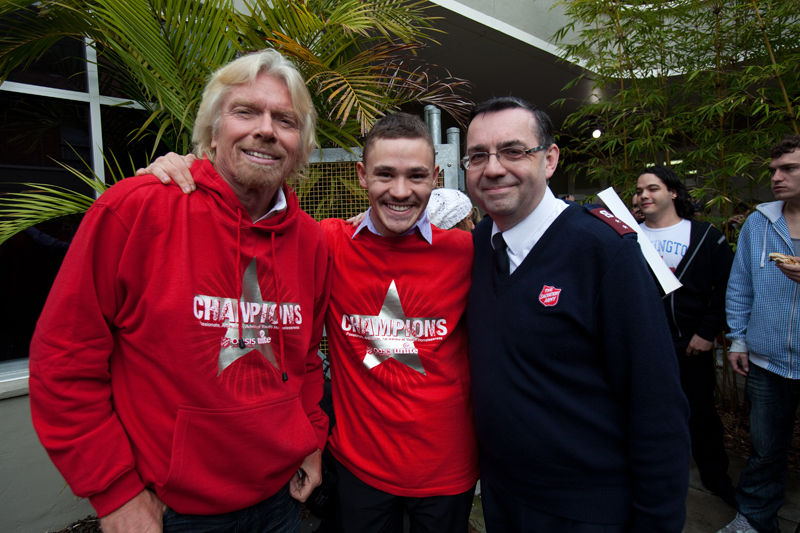
Sir Richard Branson, Damien, Captain Paul Moulds at Oasis in Sydney, Australia
. It got noticed as “celebrity” always does and one person remarked “hanging with the superstars”. I commented back saying that they were all “superstars”. Certainly, Captain Paul Moulds for the work that we devotes himself to with Oasis and reaching out to homeless youth in Australia and Sir Richard Branson for his generous support and making it possible.

But perhaps the biggest “superstar” is Damien, the young man in the middle who turned his life around from being on the streets with barely any hopes and dreams at all to having a job, a place to live and a bright future.

I was attending an event yesterday at Oasis where Branson was cutting the ribbon on the opening of a fitness center that his company Virgin had funded. But prior to the opening of the center, Branson and others listened to the stories of the “champions”, young people like Damien who against all odds, had redirected their lives to a better future. The stories were difficult to hear – stories about being abused – physically, sexually and emotionally. Stories about wanting to die and the attempts that they made on their lives because they felt unwanted and that they had no purpose.

I can’t even begin to really understand the horrors that these kids have faced in their young lives. I can’t even imagine how difficult it was for them to tell their stories, and yet they did so with grace, dignity and compassion for one another. They were there for each other and to show their gratitude to people like Paul Moulds and Richard Branson who make places like Oasis possible. One young man said – “without Oasis, I’d be dead”.

I will never forget that morning and it went far and beyond the thrill of meeting Sir Richard Branson and eating an egg sandwich that he had cooked on the grill. The most important thing I walked away from was being around a group of people with a like-minded purpose. A purpose of doing whatever they can to make a difference – a positive difference in the world. I could see, hear and feel the impact that Moulds and Branson had made in these young people’s lives. It was tangible and real – not just words on the pages of a foundation’s annual report.

As we wind up our time in Australia and head home for a few days break before heading down to South America, I am energized by something that Paul had mentioned during his interview. He was talking about an amazing documentary that was made about Oasis and the issues facing homeless youth in Australia. The documentary was two years in the making and gave an up close look into life on the street for these young people. Paul told me that after the documentary aired on Australian TV, the response and support that followed was astounding. It had made a real impact and prompted people into action – to help with donations or wanting to volunteer.

So I’m energized going forward that our little film will also create awareness and prompt others into action and what they can do to make a positive difference in the world. It’s a simple yet powerful thought and full of possibility – the power that’s within all of us to create change and make the world a better place for those that are less fortunate. The power of possibility – think about it.

Add to FacebookAdd to DiggAdd to Del.icio.usAdd to StumbleuponAdd to RedditAdd to BlinklistAdd to TwitterAdd to TechnoratiAdd to Yahoo BuzzAdd to Newsvine

The Hard Part About Working With DSLR’s

After two solid months of intensive shooting a documentary – shooting both stills and video with two DSLR cameras, the Canon 5D Mark II and 7D, I can honestly say working with these hybrids is not easy. And it certainly isn’t fast, especially if you are working in a small crew as we are.

Yes, the visual is stunning but I can’t help but think how many moments I may have missed that I probably would have gotten if I had been shooting with a video camera. When shooting motion, I have a constant mantra running through my head and that is “shoot and move”. That’s because you need a lot of footage at the end of the day and you need to edit your film. I’m not talking about working with a neatly storyboarded script and a Hollywood crew. I’m talking about working lean and mean and in a somewhat discreet way that is in order when shooting a documentary.

That really hit me last night while shooting on the streets of Sydney, Australia. My subject that I’m focusing on here is Paul Moulds from Oasis, which is a youth support network dealing with homeless street kids. I needed to hit the streets at night and knew that I not only had to be sensitive to the situations that I’d be shooting but also alert to the dangers. I’m positioning myself with a lot of expensive gear in tough neighborhoods where drugs and violence rule.

If ever before I needed to shoot and move and act quickly and keep a third eye out for any lurking danger. No time to stress on the importance of the perfection of the visual. I needed to get in close to the action – make sure my audio was being captured sufficiently and get the story. So even though I can tell you that my visual will be beautiful and lacking “noise” in the blacks – I probably would have gotten better and more meaningful coverage with a video camera.

I’m sure there will be plenty of you who will argue that there are journalists embedded in war zones with these cameras. And of course there’s Vincent LaFloret’s brilliant cinematic night films. But for me, I think there are times when I could have reacted faster with a video camera. And so I think – what’s more important – the resolution or the story?

Add to FacebookAdd to DiggAdd to Del.icio.usAdd to StumbleuponAdd to RedditAdd to BlinklistAdd to TwitterAdd to TechnoratiAdd to Yahoo BuzzAdd to Newsvine