The Making of a Documentary

Technically, I began working on my latest documentary, “Opening Our Eyes” about 7 months ago when the idea came to me. I had just seen Robert Frank’s show “The Americans” at the Met in New York City with a friend of mine and I commented to him that I was really yearning to get back to my beginnings and take a visual road trip.

Even though I had spent a lifetime traveling and shooting assignments for editorial and corporate clients, I never lost sight of my passion to explore with my camera.
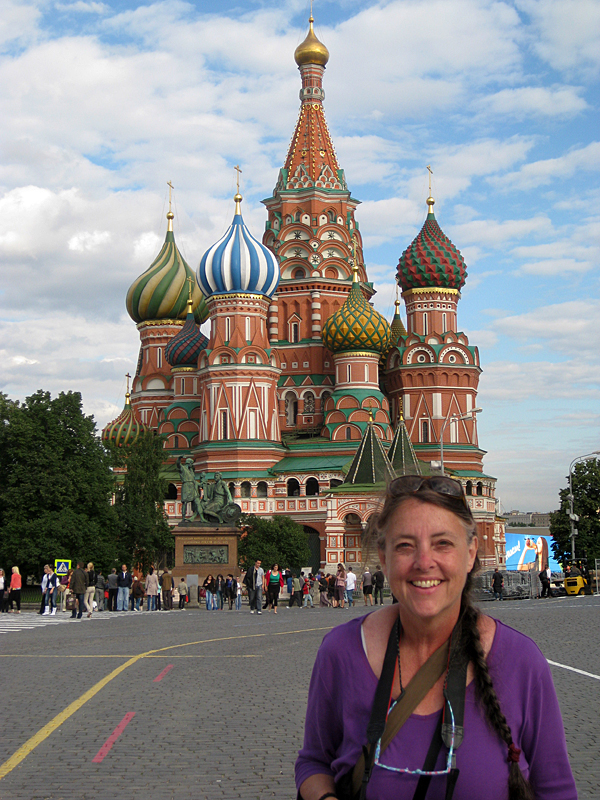
Gail at Red Square, Moscow

In the beginning, my explorations were through the lens of my still camera but when I started shooting motion about ten years ago, my tool of choice became a video camera and with that came self assigned documentaries.

It had been two years since my last passion project “Freedom Riders” and I was itching to start another. My daughter had just graduated from college, I was an emptynester and pretty much free to do as I pleased. I had accumulated over 300,000 airline miles, thousands of hotel award points and another 300,000 plus American Express points. I didn’t know what I was saving them for but it seemed like a good time to use them. So, I made a decision to take a trip around the world. I felt like I still had the energy and stamina to take on such a journey but something was missing – I needed a purpose.

The Idea
I have always been interested in the “common man” as opposed to the celebrity and the simple story that resonates in a viral way. I’m intrigued by people who go up against all odds, to right a wrong or fight for a cause and never give up. I usually side with the underdogs and am inspired by the Cinderella stories. And so after that day at the Met, an idea was born and that was to shine a spotlight on 6 people on 6 different continents who were making a positive difference in the world because it was their calling to do so.

Of course coming up with an idea is the easy part and many times those great ideas seem to drift away with time as one gets caught up in daily work and life. But this idea wasn’t going away – I knew it was the right time for me to bring these stories to life. My goal was to create individual videos about each of these people that would combine together as a feature documentary. My hope was that the film would not only create awareness of my subjects’ efforts, but also motivate others to create change.

The Pre-Production and Facilitation
Next came the hard part – making it a reality and the first step was figuring out how I would fund it. After working on 2 other self-assigned passion projects, I knew one thing and that is that it’s really hard to sell an idea. When I was in the planning stages of The Delta Bluesmen, I spent a lot of time applying for grant money and seeking funds from a variety of sources to no avail. I finally got frustrated and decided to self fund the project even though it meant taking it a bit slower and doing more of the work myself. My critics thought I was crazy to tackle a short film by myself and self fund it but I stuck to it and created a piece I’m proud of and which has brought many rewards to my life. So with that experience behind me, I took another leap of faith on my latest project and started the planning process. But perhaps most importantly, I focused on the fact that the positive aspects of working on a self-funded project is that it would be the way I wanted it to be – not compromised for the wrong reasons.

My first order of business was to send out a query to everyone I knew as well as use social media to find my subjects. My first subject was a given – a local young woman my daughter went to high school with, Maggie Doyne,
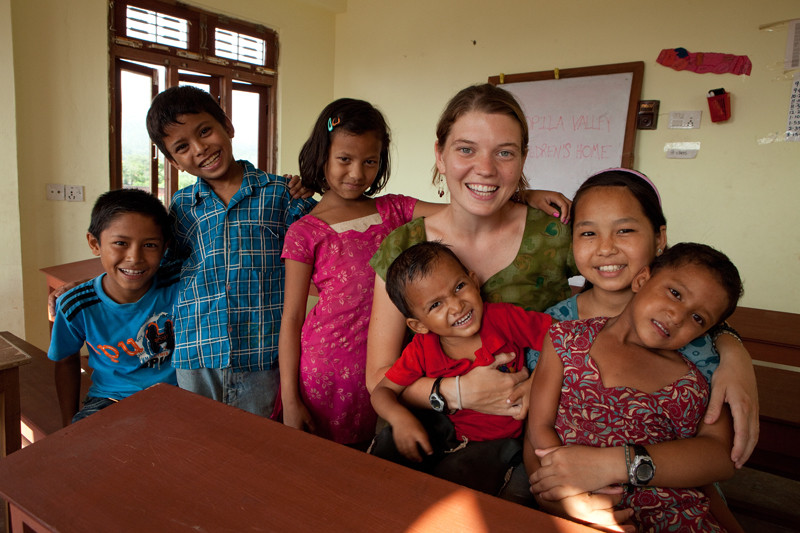
Maggie and some of her children

who opted not to trek off to college after high school. Instead she wound up in Nepal and built a home for orphaned children. She’s 23 years old now, has 30 children in her home and is in the process of building a school. Then my daughter Erin, expressed interest in working on this project with me. She knew she’s need to leave quit her job, sublet her apartment and say goodbye to her boyfriend for 3 months – but she wanted to be part of it. And so we became a duo and with that the project really took off with her support and help.

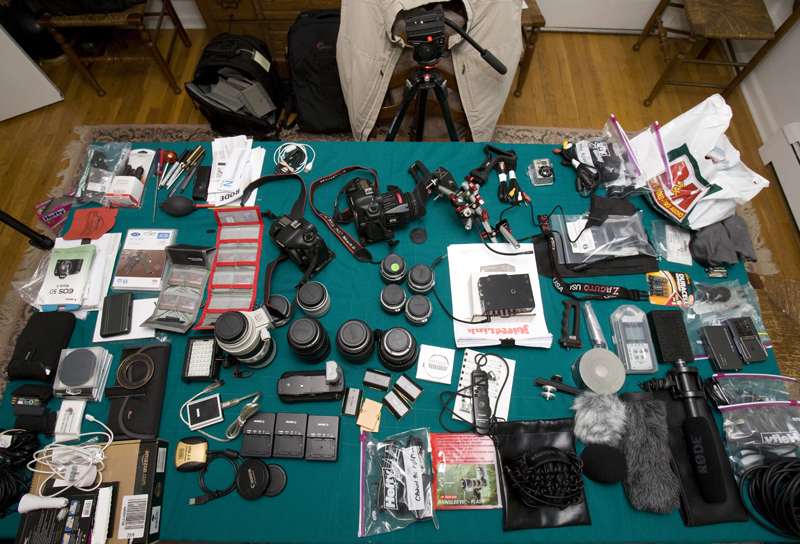
Since the project was self-funded, I had to be extremely creative with the budget – or lack thereof. So after nailing down our subjects across the globe, we started to plan the logistics –airline tickets, hotel rooms, visas, vaccinations and of course equipment needs. From January to May, I spent countless hours booking reward tickets with 14 airlines for 29 flights – a round the world itinerary with extra local hops thrown in. I’ve arranged for 99 nights of accommodations, staying with friends, friend of friends, using reward points, paying for budget hotels and bartering for other rooms. I had to bite the bullet and pay large sums for our vaccinations and visas and budget for our meals. Most importantly, I needed to purchase new gear because my intent was to shoot this project with the HDSLR cameras. I knew I wanted to shoot stills and video and also knew that I had to travel lean and mean so this seemed like the best solution. You can read more about the gear here.
The Execution
We are about one third through the shoot and have worked on 3 continents. The scheduling has turned out to be brilliant – we work hard and exhaust ourselves for chunks of time – anywhere from a week to ten days and then have a few days to recoup, catch up on sleep, write in our blogs, or just sightsee and take some still snapshots along the way. We’ve had a couple mother/daughter disagreements but for the most part we are having the time of our life and seeing the world. At this point we sometimes forget which currency we are using or what the exchange rate is or what our room number is but in the process of creating a film, we have built a lifetime of memories.

We have also created an audience who tune into our project blog religiously and follow our journey as we go along. But something remarkable is happening and that is evident in the comments we are getting. We are opening people’s eyes though our travels and our writings. We have connected our audience with our subjects and their endeavors and are building a global community. It has been truly inspirational meeting and working with our subjects and there are days that my heart is full to bursting and confirms my belief in this project.

Post-Production
When we return in September, my first priority will be to edit the videos that I promised in barter arrangements. And hopefully at the end of the month, I will begin the edit. It will most likely take me a month just to log and transcode the footage and sync the audio in the situations where it was captured independently. I’m confident in my editing abilities but I would love to work with a pro. So if there is a pro out there reading this who would love to get involved in a fabulous documentary – I’d love to hear from you.

Distribution
Not really thinking about this part right now other than to use social media and perhaps itunes and Amazon to distribute it. But I have faith in this project and something tells me that this will take on a life of its own. It’s a feel good story and we’ve already gotten a lot of support and interest.

At any rate it’s the trip of a lifetime and I’m taking it with my daughter so I’ve already been blessed.

Add to FacebookAdd to DiggAdd to Del.icio.usAdd to StumbleuponAdd to RedditAdd to BlinklistAdd to TwitterAdd to TechnoratiAdd to Yahoo BuzzAdd to Newsvine

Packing for 3-Month HDSLR Shoot – Too Much or Too Little?

When I embarked on my 3-month journey to create a documentary Opening Our Eyes, I posted a blog entry about what I was packing. http://tiny.cc/7pc9f

I received quite a few comments – publicly posted and otherwise and many people remarked that I was taking too much. After one month into this sojourn, I thought perhaps an update would be in order.

The main verdict is – my hunches were pretty much on target and I didn’t over pack. Sure it’s a lot to carry – but there are two of us and it all fits into two medium sized photo backpacks. I have used all the lenses that I brought except my old Nikon fixed lenses that I planned to use with the converter. Those I could have left behind – but the trip is not over yet so I’ll have to wait on that determination.

Bringing two camera bodies is a must if only from a back up point of view but when shooting stills as well as video, it’s a lot faster to have one dedicated for video and one for stills, especially when shooting with the Zacuto Z-Finder and rig.

And bringing two laptops has proven to be a very smart move. I had recently purchased a new Mac laptop with the latest operating system and there have been numerous times when I could not connect with the Internet – but the older laptop (2 years old) has had no problems. That and with limited Internet time, when we are able to get online, having two computers has saved a lot of arguments over computer time between my daughter and myself. We take full advantage in the airline club lounges to upload items and check email while waiting for flights. I have also had to rely on my extra laptop battery for the older Mac as the original battery was no longer holding a charge for more than an hour.

My audio equipment is sufficient and I am constantly switching back and forth between capturing my audio directly to the camera cards with the JuicedLink DT454 and separately with the H4n Zoom. One item I do not have that I really need is a male-to-male XLR cord. I found out that I couldn’t use my wireless set with either the JuicedLink or the Zoom because they both need male ends and I only have male to female XLR cords. I keep thinking there must be a solution that I’m overlooking so if someone has any thoughts – please let me know.

The small Matthews boom stand rig that I put together is terrific. It was meant to be used for table top studio shooting but for me it is perfect because it breaks down into multiple pieces, is light weight and easy to use.

I’m backing everything up onto two hard drives and I have just now used up the first two (500 G) drives. That leaves me with 6 more drives which is just about perfect depending on how much I will shoot.

Lastly, my iPod has helped with my sanity on these long flights and layovers and my Blackberry Tour phone has worked everywhere and it simply amazes me. Many times it has been our only connection to home. So I have to give kudos to Verizon and their global service. I’m truly impressed. Still a lot of remote places to go – so we’ll see how well it does as we move on.

I stop and think about the equipment we are carrying and the new technology and how this would not have been possible just 5 years ago. It’s an amazing time we live in and I’m taking full advantage of it. Can’t wait to see what the future will bring.

Add to FacebookAdd to DiggAdd to Del.icio.usAdd to StumbleuponAdd to RedditAdd to BlinklistAdd to TwitterAdd to TechnoratiAdd to Yahoo BuzzAdd to Newsvine

Having Fun with the GoPro Hero Helmet Cam

One of the great gadgets I saw at NAB this year was the HD Hero camera from GoPro.  It’s intended to be an adventure sports camera that can be mounted on anything from a surfboard to a helmet to the side of a vehicle but we’ve been having fun with it on our Opening Our Eyes journey going through markets and bazaars.

We had a fabulous day in Istanbul today before heading to our next subject in Warsaw, Poland.  After seeing some of the great landmarks in the city, we spent a couple of hours walking through the Grand Bazaar wearing this amazing little camera strapped to our head.  Depending on how fluid your stride is, you can get some stunning hi res imagery that gives a viewer the feeling that they are having the experience themselves.

You cannot preview the image you’ll get as there is no eyepiece, but the lens is a wide angle lens with auto exposure and auto focus so shooting blind isn’t such a crap shoot.  You have to do a bit of testing to determine how it reacts to various light conditions but the exposure compensates nicely as the lighting situation changes and it’s pretty much right on target.  The audio is also pretty good quality, at least for any b-roll shooting.

For the price and the ease of use, the imagery this camera shoots is spectacular and it’s a lot of fun shooting in situations where you might not be able to use a larger camera.  I’m suitably impressed and I haven’t even really tested all the capabilities.

We had a lot of fun today with it in the Grand Bazaar and  got a lot of funny looks and comments. Check out our walk through Istanbul’s Grand Bazaar and see for yourself.

Add to FacebookAdd to DiggAdd to Del.icio.usAdd to StumbleuponAdd to RedditAdd to BlinklistAdd to TwitterAdd to TechnoratiAdd to Yahoo BuzzAdd to Newsvine

Outside My Comfort Zone

The older one gets and the more settled one gets in their own ways, the more difficult it is to push oneself outside their own comfort zone.  I know this full well, as I am now immersed in a project and a journey where I’m pushing myself every minute of my day and will be doing so for the next three months.

I’m in Uganda, Africa right now and every day I face several challenges.  Everything from attending to my personal needs and safety, to negotiating taxi rides and reconfirming upcoming flights to making sure that I’m getting the content that I will need to create the documentary I’m working on, Opening Our Eyes.  Little things become much harder and take a lot longer to deal with than if I were at home.  And every minute it seems like I’m facing a new learning curve.

Last night, for some inexplicable reason I couldn’t get an internet connection with my laptop.  Nothing had changed from the night before when I was online for a good 3 hours, yet all of a sudden – I couldn’t get online.  Since I’m working with a digital workflow and totally dependent on a computer, I brought a backup laptop just in case.  The “just in case” scenario has already come into play and that backup laptop has become my connection.  A few weeks ago when I wrote the blog My DSLR Kit for My 3-Month Road Trip, I received numerous comments telling me that I was taking too much stuff.  A part of me agreed but after only one week into this trip, I have used every piece of gear that I had packed.  Call it paranoia or the voice of experience but I’m glad that I have the backup, regardless of the extra gear it necessitates.

Building a comfort zone happens gradually, where you set up your business and lifestyle and things click into place over time.  But nothing ever stays the same in life and if you’re not proactive, before you know it you get in a rut – whether it be a creative rut or otherwise and when change happens – and it always does – your comfort zone disappears regardless if you were the one that made that a conscious decision or not.

I’ve always known when to “rock my own boat”  – when I’ve become dangerously too complacent.  I knew at this point in my life it was time that I really push myself outside my norm and as hard as it is at times, I’m confident it will bring great rewards my way.  It already has.

Any time I leave the country, especially since I’m usually shooting when I do, I challenge myself on many levels.  Yesterday, we were following one of our subjects through a crowded downtown area in Kampala as she went about her errands and searched for just the right fabric in various shops. It was chaotic and a test of nerves as we made our way through the crowded streets dodging vendors, scooters and buses.  We were also testing our GoPro Hero helmet cam which was a lot of fun.  It was hard enough to blend in being the only “mzungus” (whites) on the street, let alone wearing a camera on your forehead.  But check out the VIDEO and see for yourself how it is to negotiate your way through the streets of Kampala.  And that’s what I love about this little “adventure sports” camera – it makes the viewer feel like they are part of the action.  You can also see what I mean when I say that I am pushing myself out of my comfort zone.

Add to FacebookAdd to DiggAdd to Del.icio.usAdd to StumbleuponAdd to RedditAdd to BlinklistAdd to TwitterAdd to TechnoratiAdd to Yahoo BuzzAdd to Newsvine

Shooting Video in the Field with the Canon 5D Mark II

The first two days of our Round the World Journey, shooting the documentary Opening Our Eyes has been quite full and I’ve faced numerous situations – really putting my tools to the test.

Our first full day was spent at the offices of Wrap Up Africa, which are located in Kampala, Uganda. In addition to shooting b-roll of tailors at work, we shot several interviews. Our main interview was with Wrap Up Africa’s founder, Letha Sandison, followed by interviews of a couple of her staff members. We also did interviews of some of the cancer victims that Letha has helped. Here is where I not only needed to be attentive to my technical details but be sensitive to the situation and the people that I was interviewing. Hearing some of their stories is heartbreaking and hard for many Americans to fathom. Sure, we all watch the travesties taking place throughout the world on the nightly news, but it’s quite another experience to speak with people who have experienced horrendous tragedies in their lives that are simply unimaginable.

One woman, Evelyn who works for Letha had been abducted and held captive by the LRA, which stands for the Lord’s Resistance Army, and is not exactly a charitable group. She managed to escape after most of her family had been killed in front of her. She is now raising three orphans who had been victims as well and works with Letha, helping others.

Our set up was simple and deliberately so. I set up the Canon 5D Mark II and captured my audio separately with the H4N Zoom. I had two mics – one shotgun on a small boom stand and another lav. I will sync them later in post. We chose a room that had ample window light as we are traveling with only a small camera light and nothing else. Our biggest challenge was that the cabinet installer decided to do his work the day we were shooting – so the sounds of hammering and drilling made up our ambient background sound. But the mics were placed close to our subjects and did a pretty good job of boosting their audio above the din of the environment.

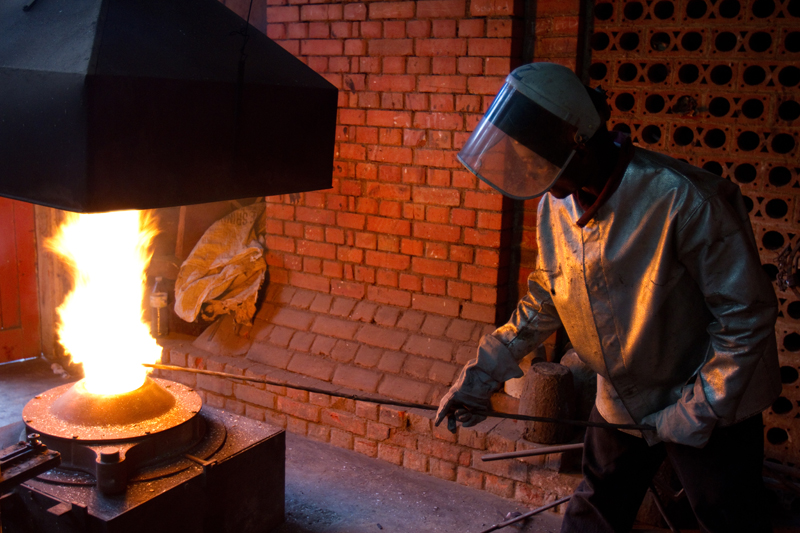
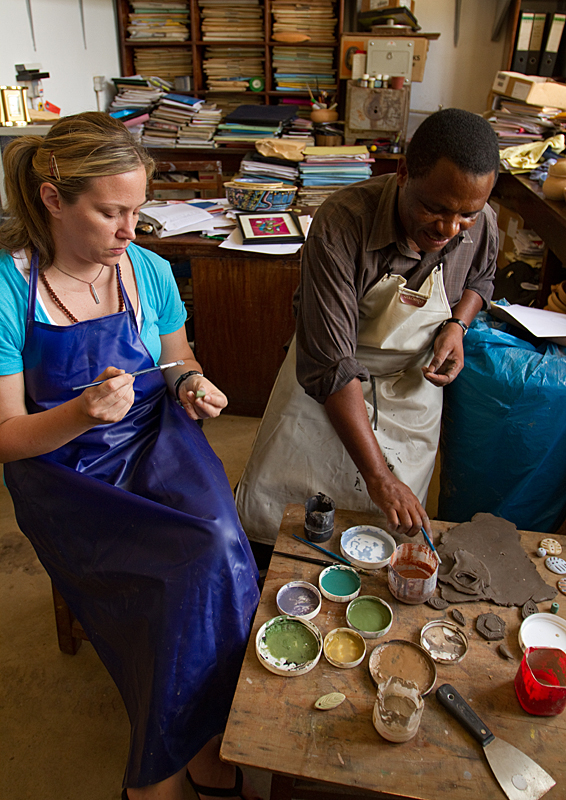
The next situation we faced was shooting b-roll in the dirty environments of a potter’s studio and a foundry. Again we used the Zoom to pick up the ambient sound of the environments. After a morning with the artists, we packed up quickly and headed to Mulago Hospital to visit the children’s cancer ward. We were not allowed to shoot video but we did shoot some still images and was happy to have the hybrid cameras that captured beautiful files – far better than frame grabs from a traditional video camera.

Then we headed to the market, which as usual is always a trying experience. For anyone who has traveled to congested third world environments, you know what I mean by “trying experience”. You must be aware of your personal belongings at all times, while shooting and I wish at times that I had eyes in the back of my head. On top of that I’m sensitive to those that don’t want to be photographed. It’s exhausting but at the same time exhilarating because of the exotic nature of the environment. My daughter wore the GoPro Hero helmet cam that is a tiny camera made for adventure sports but she had a lot of fun walking through the market recording the event with running video as we walked through the market.

I was shooting video with the Canon 5D Mark II and used a shotgun mic on top of the camera and run through a JuicedLink audio mixer. I’m embarrassed to say that somehow, even after lots of testing – I came back with no audio! Luckily the helmet cam Hero picked up very good ambient audio so I’m able to use that and layer it in post. In the chaos and confusion of the market, I probably didn’t set it up right and today I will do additional testing so as not to make that mistake in the future. But the video was captured beautifully and I will interweave those clips into the documentary with sound from the interviews and ambient sound from the Hero.

I am realizing one thing though and that there is nothing easy or streamlined when shooting video with these hybrid cameras. The results are stunning, but the shoot and workflow are much more tedious than when shooting with a video camera. Perhaps at the end of this three-month journey, I’ll be singing a different tune – I certainly hope so.

I’ll keep you posted as I get access to the Internet, which is iffy, and we’ve been off line for the last two days. But there’s something humbling about being off the grid and I’m learning to take it in stride and appreciate what I have. Today is Sunday and we are resting and storing up a bit of energy for the coming week. Please read more about our journey at Opening Our Eyes.

Add to FacebookAdd to DiggAdd to Del.icio.usAdd to StumbleuponAdd to RedditAdd to BlinklistAdd to TwitterAdd to TechnoratiAdd to Yahoo BuzzAdd to Newsvine

My DSLR Kit for a Three-Month Road Trip

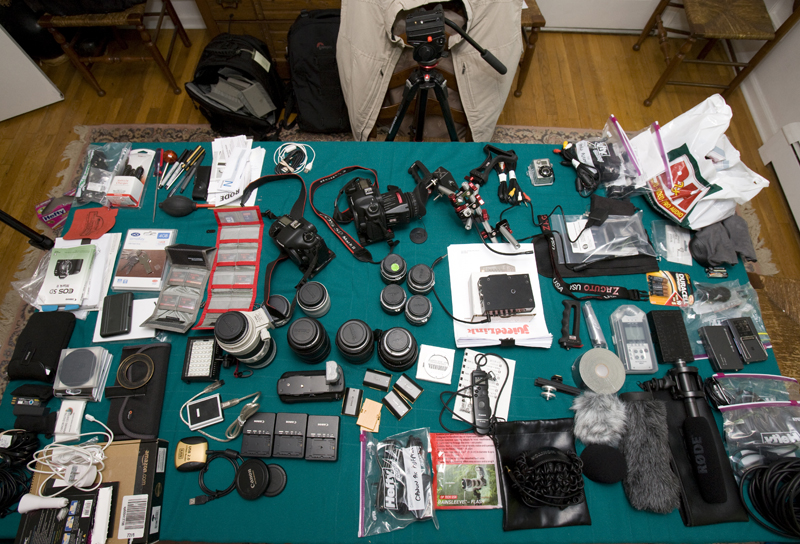
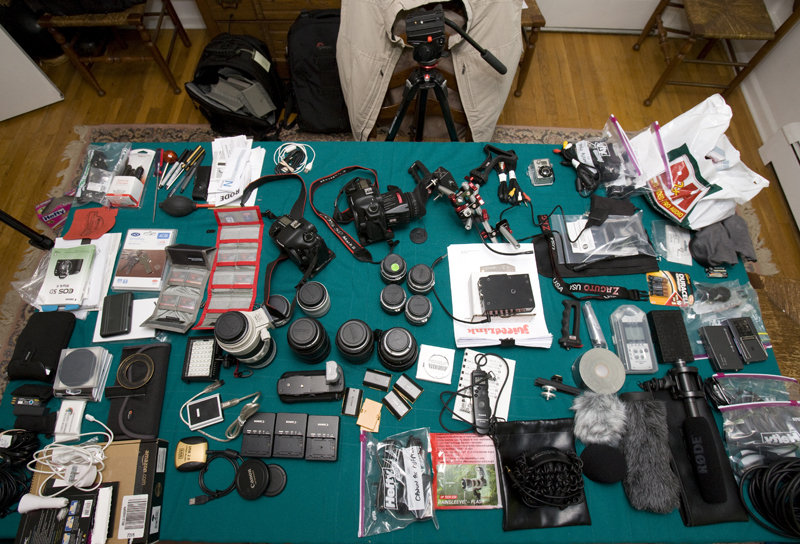
For those who have been following this blog you know that I’m getting ready to depart for a 3-month trip around the world creating a documentary with my daughter – Opening Our Eyes.  Here is what I’ve managed to fit into two backpacks – it just fits.  Thank goodness there’s two of us.
Please follow our journey http://www.openingoureyes.wordpress.com

Canon 5D Mark II
Canon 7D
Canon 16-35mm 2.8
Canon 24-70mm 2.8
Canon 70-200mm 2.8
Canon 70-300mm 4.5
Canon 1.4X tele extender
Canon 2X tele extender
Nikon/Canon lens adaptor
Nikkor 14mm rectilinear lens f2.8
Nikkor 50mm 1.4
Nikkor 85mm f2
6 Batteries for Canon
1 Battery grip for 5D
3 Battery chargers
Remote control for Canon
AC adaptor for Canon
Rycote Hot shoe extension
4 – 16 GB flash cards – all cards – Sandisk UGMA
4 – 8 GB flash cards
2 – 8 GB SDHC cards
2  – 4 GB SDHD cards
Neutral density filter kit
Polarizer
Epson P6000 digital wallet
Zoom H4n digital audio recorder
JuicedLink DT454  audio preamp
Rode shotgun mic
Tram lav mic
Sennheiser Transmitter/Wireless kit
“Dead Cats” (windscreens)
XLR cords
Headphones
HD Hero helmet camera with attachments
Flip HD
ManfrottoTripod and fluid head
Small Matthews boom stand for mic
Reflector
Zacuto Z-Finder

Zacuto Striker Rig
Flex DSLR remote
Lacie Rugged Hard drives – 4000 GB memory!
Firewire and USB cords
3 – card readers
2 MacBookPro Laptops
1 extra laptop battery
1 extra AC adaptor for laptop
Kindle
iPod
Blackberry Tour
2 Scotte Vests – with 22 pockets in each

Add to FacebookAdd to DiggAdd to Del.icio.usAdd to StumbleuponAdd to RedditAdd to BlinklistAdd to TwitterAdd to TechnoratiAdd to Yahoo BuzzAdd to Newsvine

Gearing Up For A HDSLR Documentary

Most people have no idea of how much really goes into planning for even the simplest films. My biggest job was to come up with the right mix of gear that would enable me to shoot both still images and video in a high-end way, yet remaining to be portable and lean as far as what we would be bringing with us. That can be an overwhelming task – but the more I break it down and prepare for it with a Plan A, B and C – the more confident and relaxed I feel as our departure date nears.

Please watch the  video that I created (nothing fancy) showing the gear that I’ll be bringing around the world on a 99 day shoot for my passion project Opening Our Eyes.

I’m embracing the HDSLR system since I want to shoot both stills and video but by no means is it streamlining my equipment needs. Quite the contrary, I’m bringing an assortment of lenses that I wouldn’t be taking if I were shooting with a traditional camera, as well as a lot of third party gear to augment audio capture and rigging for stabilization. What you don’t see in the video are the two (redundant) MacBooks that are essential when shooting any tapeless workflow.

Of course there are a million other details to cover for a 3 month trip around the world.
I’m still trying to determine my mobile phone and service needs. I’ve set up Skype on both laptops – yes 2 laptops because when you’re shooting tape less you are totally dependent on a computer and a back up if one fails. I’ll most likely upgrade my Blackberry because it’s been two years and that’s light-years in the tech world of communications. And I need to activate travel/medical emergency insurance as well as register my equipment with US Customs and add new gear to my business insurance policy.

There are also accommodations for 99 nights and a slew of internal airline tickets that needed to be taken care of. Read about it more at: Opening Our Eyes

Add to FacebookAdd to DiggAdd to Del.icio.usAdd to StumbleuponAdd to RedditAdd to BlinklistAdd to TwitterAdd to TechnoratiAdd to Yahoo BuzzAdd to Newsvine

NAB – A Week of Gadgets, Geeks, and Great Inspiration

Today is the final day of NAB and as usual my head is exploding with ideas and information. But before everything totally leaves my head – I’ll share some cool things with everyone.

I come to NAB to learn, however this year I also needed to research and buy some things for my upcoming project Opening Our Eyes. In particular I was looking for a stabilization rig for my Canon 5D and 7D. My timing was perfect because at this year’s show just about every booth had gear for the DSLR cameras – the show was all about either the HDSLR or 3D. I settled on the Zacuto Striker because I wanted something lightweight and quick to put on a tripod. Zacuto had redesigned the plate making the weight distribution better and it felt just right for me. And that’s important – get the right rig for you – if at all possible visit a vendor where you can try these stabilization rigs out so that you buy the one that literally “fits” you and your needs.

One of the biggest buzz items was the HD Hero, a tiny wearable video camera for sports, made by GoPro and at the $200 show special – they sold out the first day. But check them out – even at the retail price of $300, they are amazing little cameras that can be used in all types of situations where you need something small.

RedRock Micro debuted their new HDSLR remote which uses sonar for auto follow focus. The booth was mobbed with attendees dying to get their hands on this accessory that is priced around $1000. Check out the review from the show floor at PhotoCineNews.

Canon unveiled their latest tapeless camera the XF305 that will give the Sony EX-3 a run for their money. Even as stunning as this camera is, Canon didn’t integrate that nice big chip/sensor that we see in their hybrid HDSLRs. But Panasonic did and they had their new prototype camera in a plexiglass box perched on a museum type pedestal. The Panasonic AG-AF100, is the first professional micro 4/3-inch video camcorder optimized for high-def recording. that did make use of that large sensor that everyone seems to be waiting for – stay tuned. Canon-are you watching and listening?

I’m maxed out right now with technology and information yet inspired and energized at the same time by the notion of possibilities. If you’re a still photographer singing the blues because of the lousy economy and the changing paradigm of print giving way to electronic delivery – I can only say one thing – convergence. Embrace that notion, get energized by the idea and open your mind to the possibilities and opportunities that are exploding in this new world of information technology.

Add to FacebookAdd to DiggAdd to Del.icio.usAdd to StumbleuponAdd to RedditAdd to BlinklistAdd to TwitterAdd to TechnoratiAdd to Yahoo BuzzAdd to Newsvine

Gearing Up With HD DSLR’s

Last week was incredibly stressful. I had been dealing with obtaining visas – a somewhat monumental task of which I had no control over, in preparation for my upcoming project Opening Our Eyes, that will literally take me around the world.

On one of my many trips to New York City, I went to B&H and purchased some gear I needed for the Opening Our Eyes documentary that I will be shooting. The gear I bought included – Canon 5D and Canon 7D cameras with extra batteries, (2) 16 GB Sandisk Extreme compact flash cards (I’ll need more), Manfrotto 190CX3 light weight carbon fiber tripod with the Manfrotto 701 fluid head (I needed a small tripod and head that will fit in a backpack),  Samson Zoom H4N digital audio recorder, 2 GB Sandisk SD card for audio, recorder, Rode Shotgun mic with “dead cat”, Delvcam Camera Mount Adaptor (this attaches to bottom of H4N Zoom recorder giving it a hot shoe plate), Rycote Hot Shoe Extension/Extender (this attaches to the hot shoe on the top of the camera giving you extra room for devices – for me, the H4N Zoom recorder and a shock mount for the Rode mic) an adaptor so I can hardwire my Tram lav to the Zoom digital recorder, XLR cords of various lengths, and a couple of Rugged Lacie portable hard drives (500GB)

This weekend, I decided to familiarize myself with the new gear and do some testing. I was looking forward to getting back to my “purpose” for the trip and leave the administrative nightmares behind. I am not a shopper, nor am I a gadget freak. I buy new equipment when I have a need for it as opposed to because it exists. There’s something to be said about sticking with gear that you are comfortable with so that you can concentrate solely on the creative, but because of the pace of technology we are somewhat forced to keep current with our tools.

Whenever I add a new tool to my bag of tricks – I go through a process. First experiencing the thrill of something brand new in my hands. When I first took the Samson H4N Zoom out if it’s little coffin like plastic case and held it in my hands it was a sensual experience because of its design and what they make it out of. The second phase of the “new gear process” is reading the manuals and figuring out how things work. With the Zoom this was a bit frustrating and I am one who is already familiar with audio devices, so I can only imagine the frustration for someone who is not audio savvy. It’s such a sophisticated little mixer with so many choices that it took some time getting used to it. After much testing I settled on the 4Channel mode.

Over the weekend I tested both the Canon 5D and 7D cameras, recording sound with their internal mics as well as with a shotgun mic on camera plugged directly into the camera with an XLR to mini plug cord. I also tested both cameras, recording the audio separately through the H4N Zoom using the shotgun on the camera, and with the shotgun on a boom closer to the subject. Then I tested my Tram mic hard wired into the recorder and finally I did a test with the Tram and shotgun mics recorded on separate tracks on the Zoom.

After the tests, I brought both the video and audio files into Final Cut Pro. I had also purchased Philip Blooms 7D tutorial and in the workflow section he mentions how sluggish and problematic it is to work with the H264 files that come directly out of the camera. He recommends converting the files to Apple Pro Res LT either using compressor or MPEG StreamClip which is faster. I tried it both ways and he’s right the MPEG StreamClip is much faster. After I converted the files into Apple Pro Res LT, I imported them into Final Cut along with the WAV audio files. Incidentally, I shot everything at 24 frames a second and recorded the audio as WAV files at 48KHZ. In addition, I recorded sound through the camera, even though I was capturing my audio with an independent device. I knew I would use it as a reference when syncing the sound in post. My next step was to sync the audio files with the video/audio files coming from the camera. I used a clapper when recording so syncing was pretty easy. Philip Bloom mention using a software called PluralEyes for help with syncing audio and video in post but I have not yet purchased it. I did find out that you need to keep good organizational notes when shooting so that you can easily match up the audio files with the camera files later on. I decided that I like using the 4Channel mode with the digital recorder and using two external mics along with the stereo pair on the recorder. In post I can uncheck “stereo pair” and work on each channel independently.

So after a weekend of playing with the new gear, I went through the gamut of emotions from the thrill of newness to the incredible frustration of learning something new before the light bulb goes off. It will take a while to get to the third phase of the “new gear process” and that’s becoming very comfortable with the tools. And I can almost guarantee when that comfortable feeling start to happen, there will be something new that I’ll need to buy.

Add to FacebookAdd to DiggAdd to Del.icio.usAdd to StumbleuponAdd to RedditAdd to BlinklistAdd to TwitterAdd to TechnoratiAdd to Yahoo BuzzAdd to Newsvine

Funding A Personal Project

I have learned from past experience with other personal projects that getting funding for an idea is no easy task.  But I have also found that with a lot of careful planning, saving and budgeting I have been able to self fund my projects and have been compensated on many levels later on – after the projects are underway or near completion. As I continue to blog and to talk to people about Opening Our Eyes, the documentary my daughter and I are creating which involves us traveling around the world, I get asked a lot of questions.  One question that is asked quite frequently is “who is funding your project?”  The short answer is – we are self-funding our trip and our documentary.

I had managed to save up about 330,000 miles with Continental Airlines and another 329,000 points with American Express over the years.  I was saving them for something, just didn’t know what until a few months ago when I decided to cash all my points and miles in to subsidize our journey around the world.

So far, I have exhausted all but 4,000 Continental miles in ticketing my Round The World plane ticket as well as getting my daughter and I to, from and around South America.  My husband Tom donated his Continental miles to my daughter Erin for her Round The World fare.  I will still need to pay for airplane tickets to Iquitos, Peru from Lima as well as for flights to Nepal from Delhi, India. That still leaves picking up the costs of air or train tickets from Istanbul to Warsaw and Moscow. I will use about a third of my Amex points to pay for the flights from Lima to Iquitos, Peru because those tickets are costly.

I’ll use the rest of my American Express points to fund some of our accommodations, along with any hotel points that I have.  We’ll be staying at guesthouses, people’s homes and budget hotels whenever possible.  We’ll use public transportation for getting us around once we get to our destinations because renting a car isn’t in our budget.

Of course there’s food and miscellaneous expenses on the road like Internet and admission fees.  The vaccinations for the two of us have cost more than $1500 and the visa costs may reach $1000.  And we’ll both need backpacks and other personal needs for the trip.

My biggest expense will be for photo/video gear but that is the purpose of the trip.  I have pretty much figured out the gear that I’ll need: read my blog entry Putting Together a DSLR Video Kit.  When all is said and done, including buying an additional laptop as a backup, I’ll have spent about $12,000 on equipment needs.

So, how will I pay for it?  When my mother died about six years ago she left me a little money.  I never really wanted to spend it and was fortunate that I never had to – so I will use it for this project and this trip.  Somehow, I think she would love the idea of what her daughter and granddaughter were doing.  And if she were still here she might very well have wanted to join us.

I’ll be reaching out to Canon, Apple and others as potential sponsors.  I’m also reaching out to my friends and connections that I have made over the years for donations in kind. If you have any hotel points that you may not be using and would like to donate those points to our trip it would be greatly appreciated.  Or any other type of “in kind” donations you may provide.

Please email: gail@kellymooney.com or call 973-543-6868

Add to FacebookAdd to DiggAdd to Del.icio.usAdd to StumbleuponAdd to RedditAdd to BlinklistAdd to TwitterAdd to TechnoratiAdd to Yahoo BuzzAdd to Newsvine