
I was in Chicago a couple of weeks ago and stopped by Zacuto. Zacuto is a business that has made outfitting DSLR cameras for video a specialty. They have cleverly engineered an assortment of their 3rd party add-ons that take these cameras to a higher level. They have also provided solutions to overcome some of these cameras shortcomings. Depending on the genre you are working in, documentary work, corporate, indie films or photojournalism will ultimately determine which way you’ll need to “trick” these cameras out.
I was looking for products that were designed to help with camera stability, focus aids and audio when using the Canon 5D or 7D which I will soon be purchasing. My motivation for buying these cameras wasn’t because I was moving to video for the first time, because I’ve been shooting video for 11 years and already have a high-end HD camera – the Sony EX-1. The main reason that I will be buying these hybrid cameras is that I am undertaking a global project where I will be shooting both still images and video where I will literally be traveling around the world for a three month period and I can only bring what I can carry on my back. So taking two camera systems was out of the question.
I tested quite a few items at Zacuto but finally settled on the following solutions. For my audio needs I will use my existing Sennheiser shot gun mic and lav/transmitter/receiver kit. But I decided to capture my audio independently using the Samson H4 Zoom digital audio recorder and will sync it later in post. I also opted for the EZ-Finder that is an eyepiece that snaps on over the monitor. This not only makes it easier to focus in the sunlight, but provides a point of stabilization as well. Speaking of stabilization, I have also opted for the DSLR Sharp Shooter rig that comes with a shoulder mount, Zgrip Z-mount and mini baseplate with quick release adaptor. I supplemented that rig with a FLEX-DSLR remote trigger and a 3.4 lb. counterbalance weight.
I’m glad that I personally visited Zacuto and tried out the rig – fitted to me. It felt right and fit with the way I am accustomed to shooting. A hybrid solution that bridges the still photo and video worlds. I’ll need a lighter weight tripod and am hoping to keep my Manfrotto fluid head. I’ll need to purchase a backup MacBook Pro and portable hard drives because my workflow will be tapeless and therefore redundant.
That’s going to be a lot of gear on my back. Guess I’ll be packing light when it comes to my personal needs.


 in the process. We aren’t placing the value on what is unique in all of us – our vision. At the same time we’re placing too much value on the tool – in this case the camera. As technology accelerates the production of more sophisticated cameras that are cheaper and easier to use – and we’ve placed our value on being the technician – we’re in big trouble. Because ultimately anyone with a vision who has the “ability” to realize that vision, can put together a crew of technicians to facilitate their vision or idea – and do it cheaper these days because of technology. And there’s nothing wrong with that.
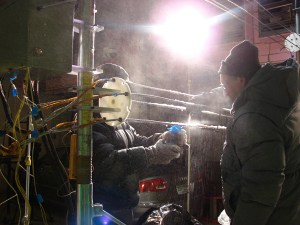 – brilliant electrical engineers – were pushing their own boundaries as they ran tests with ice on power lines and automobiles and as much as I was witnessing this work in sub zero temperatures – it was amazing to watch them work. If I hadn’t been so busy with my own technical challenges – I would have loved to just observe them and try to get into their head.
 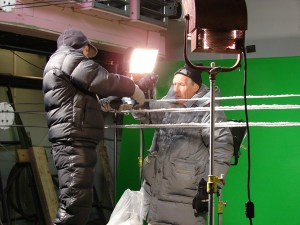 You could almost see their brains working – just by watching their faces. Then to see the triumph in their eyes when their experiments worked – what a thrill. I now need to go to Russia.
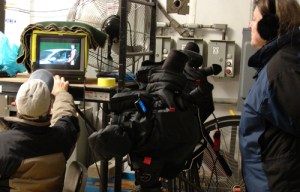 to keep them warm and swapped out the warm packs as we shot late into the night. We had to erect large “green screens” so that in post I can insert winter scenes. Problem was our green screens were large pieces of fabric and the chill blowers were blowing them all over the place. We tried to anchor them but in the end we had to turn the blowers off during the shoot. Thank goodness we didn’t need usable audio. We used hot lights and a lot of them. Used every extension cord we had and every outlet in the room – 10,000 watts. Ironic huh – hot lights in a “cold room”. Because of that we had to leave the lights on the entire time because we knew that when we turned them off – we’d get condensation on the bulbs. When we finally did break the set down at midnight – we turned the lights off, let them cool a bit and put garbage bags over them so that as they warmed we wouldn’t get moisture on them. Didn’t really work too well though.
 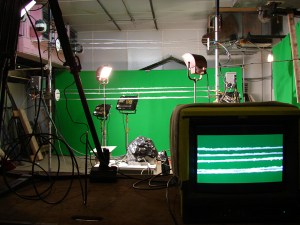 We did the same thing with the cameras and that worked great. Because we had the lights on all day and were using long extension cords – one cord got over heated and actually melted and fused to itself. The Russian electrical engineer noticed it – Thank God – or we would have burned down the building.
 Journeys of a Hybrid