

There’s a scene at the end of my favorite holiday movie “It’s a Wonderful Life”

where George Bailey, a character played by Jimmy Stewart is surrounded by his friends as they come to his aid and bail him out of his financial shortcomings, caused by his crazy Uncle Billy. I’ve seen this film at least a dozen times and ok – I admit it – I cry every time George Bailey’s little girl opens a book that mysteriously appears under the Christmas tree with the inscription “No man is a failure who has friends”.
I felt like George Bailey today when I saw the email from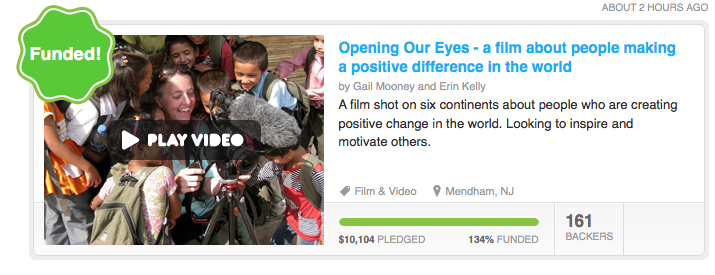 Kickstarter telling me that my daughter’s and my film project, Opening Our Eyes had been officially funded. We actually exceeded our goal of $7500 and raised just over $10,000! What a feeling – what a triumph and all possible because of our “friends”. Through crowd funding – our friends had helped us reach our goal and made our film a reality.
This would not have been possible just two years ago. But, Kickstarter and other crowd funding sites like it, provide other options for artists and entrepreneurs who are seeking funds to make their creative ideas come to life. Many times these ideas might not fit within the confines of what a traditional bank would finance, but there are some great ideas that have a chance now of becoming a reality – and we all benefit by that.
Here are some things that I have learned through the process of getting our film funded on Kickstarter.
• You have to do the work. Once you launch your project page on Kickstarter, you need to let potential backers know about it, using social media or email blasts or word of mouth. Just like getting traffic to your website, you can’t expect people to stumble upon your project and fund it.
• You have to make it fun. Have fun with the “rewards” that you offer your backers, and on Kickstarter every project must have rewards. People love to give, but they also love to feel like they are part of something or that they have helped to make something happen. If a backer contributed to my project at the $500 reward level, they will receive an Associate Producer credit in the film and on the project’s website, along with DVD’s of the film when it’s completed, as well as a signed print and an e-book from the project’s journey.
• Keep your financial goal realistic. Look at other projects that are similar to yours and see what the “market will bear”. See what has been successful and ask yourself why. Remember that if you ask for too much money and don’t meet 100% of your goal by the time the funding period is over for your project, then you won’t receive anything. Only projects that are successfully funded at 100%, will receive funds.
• Use social media and email blasts with common sense – don’t be obnoxious. If you do send emails – don’t send an email again to someone who has already backed your project. Ask people to share your project link on social media but don’t overdo it.
• Post updates on your project to keep your backers and potential backers informed. Use visuals if you have them, both on your page site as well as in your updates. Photographs and videos really give a project presence and are a must have. You want to stand out from the crowd.
• There is no such thing as a pledge too small. They say the average pledge on Kickstarter is around $25 and I can attest to that. Out of our 161 backers – 69 had made pledges of $25. It all adds up. And every time someone backs your project there is also the opportunity that they may share it with someone they know who may in turn make a contribution.
• Be grateful and appreciative. I made it a point to send each and every one of my backers a personal thank you note.
• Have faith – because anything is truly possible these days.


 Journeys of a Hybrid