What Every Photographer Needs to Know About Video?

Video is not a business model – it’s a medium – a medium that is well suited for storytelling and that’s in vogue right now for branding. Consumers today want to know more about a brand before they “buy into” it. 2014 NAB ShowWhen choosing a company’s product or a service, they want to know more about the company. They want to know the company’s story. They also have a limited attention span and want to be entertained. Video is in high demand right now and if you can fulfill your clients video needs, it can be good for your business. It all depends on how you position yourself in the marketplace.

In September, I attended the Next Video Conference and Expo in Pasadena, CA. One session, Make Content That Resonates and Multi-Purpose, given by Max Kaiser, Founder/Director of Hand Crank Films, really opened my eyes, to not only seeing how still photographers should be positioning themselves in today’s marketplace, but what they need to know about their competition. Max up sells his clients by listening to their needs and creating visual solutions to get their message out in a variety of different ways. A client may come to him and ask for a proposal to create a web video for a company’s website. Max shows the client how they can multi-purpose the content he creates for them for; YouTube pre-roll ads, sales meeting videos, TV spots, emails, social media platforms AND still images pulled from frame grabs. Max explained that because he shoots 6K, he is able to fulfill more of a client’s needs as well as put more money in his pocket.

A still photographer’s competition is not only other still photographers, but video production companies that are fulfilling more of a client’s communication needs. If you’re a photographer working in certain genres or markets like editorial, corporate or fashion you will need to provide mixed media solutions. There’s no reason a still photographer can’t provide mixed media for their clients, but they need to scale-up their way of thinking about their business and the role they play and become more of a visual assets producer, as fellow member and colleague Jan Klier calls himself.

Some things to keep in mind:

Greater demand – for mixed, integrated media. Video is not new. What’s new is that it is easier, faster and cheaper to distribute, stream and watch motion content online – anytime – anywhere. We are using our phones more and more as our go to place for news, shopping and even entertainment. Keep that in mind when you position your business and how your brand and products that you create,  fit into today’s communication channels.

Create from your own point of view and identify “the market” – Find a need and fill it – in your style. Market yourself to potential clients by listening to what their needs are and telling them how you can help them. Many times a client has a hard time articulating what they need in creative terms. That’s your job, translating how you can help them sell their brand in a creative way.

Make content that resonates and multi-purpose it. Video + Stills + Sound = Story telling messaging. Content should be well planned, scripted with high production values and should feel authentic. Up sell a client by explaining that they will get more – not just more footage or better quality footage – but more mileage out of it. That demonstrates value to a client by fulfilling more of their needs. When you demonstrate value – you can charge more and you keep the money in house (your house) It’s a win/win.

Video, Work for Hire and Copyright

Many still photographers who are new to video, ask me; “A client is asking me to sign a “work for hire” contract – What do I do?” By law, a creator holds copyright to their work. imagesHowever, when signing a work for hire contract, a creator relinquishes ownership to their work, transferring it to the client who commissioned the work.

Professional still photographers are accustomed to maintaining ownership and copyright to their work and use a business model based on licensing their images and charging for usage. Video production is a collaborative effort and contracts are generated by whoever is commissioning the work and paying the bill. Most contracts are work for hire agreements between the client (executive producer) and all the players on the team, from the director of photography to the sound engineer to the gaffer (lighting). However, when I have worked direct to client and assumed the role of producer, I have been successful in amending contracts so that I maintain the rights to any unused b-roll – that is if the subject matter isn’t proprietary.

If you are working on self-initiated projects like a narrative film, a documentary or just shooting independent motion clips for stock, as the creator of the work you hold the copyright. It’s important that you register the copyright of your work. If you are registering independent video clips, you register them just as you would your still images, using the VA form. I license my motion clips, just as I do my still images.

If you are registering a movie/film, you are registering the “whole” and you have the rights to use the content that is contained within the film in the context of that “whole”. When registering a movie use the PA form.

One thing to remember; if you are a still photographer getting into video production, please respect others’ intellectual property rights. I see too many photographers using mainstream music in their videos and I know they didn’t license the rights to that music because it would have been cost prohibitive. If I can’t afford to license mainstream music for my compilations, I either use royalty free music or I commission someone to create the score.

Here’s more information about copyright for motion and video as well as information about fair use:

Copyright Registration for Motion Pictures Including Video Recordings

Gail is President of the National Board of ASMP (American Society of Media Photographers)

Taking the High Road

Have you ever had a colleague or competitor try to marginalize you or bad mouth you view from trainin an effort to discredit you for his or her own personal gain? I’ve had it happen to me a few times and the one thing I’ve learned is that ultimately this type of negative behavior does more harm to the person who’s doing the “trash talking” more than the person on the receiving end.

At one point in my career I found myself competing with the same person on almost every job I was bidding on. I heard about it one day from the potential client who had put out the bid. Apparently, my colleague thought that if they discredited me, they would get the job. But it doesn’t work that way. What people don’t realize is that even though they may be successful in knocking out their competition, that doesn’t mean that they will get the job. What usually happens is they don’t and they end up making themselves look bad.

If this should happen to you in any areas of your life, here are some ways to deal with it:

  • Ignore them and let their negative behavior roll off your shoulders. I tell myself that it’s not my business what other’s think of me. It’s usually a reflection of their own anger and anger is a manifestation of their fears.
  • Misery loves company so negative people only get the ear of other negative people. This is not a crowd I want to belong to because sooner or later these folks will turn on each other. I’ve seen it happen hundreds of times.
  • I remind myself that someone doesn’t have to lose for me to win. That keeps me focused on what I’m doing instead of what everyone else is doing. As Mark Twain once said, “Comparison is the death of joy”.
  • Focus on who you are and what you are all about. Stay true to yourself and put your energy into telling the story you are here to tell. There is only one you. Maximize your potential and minimize the external petty bullshit in your life.
  • Be optimistic. Take down the walls and replace them with windows. Find other kindred spirits and join forces with them to inspire and motivate others. Pay no attention to the detractors who only want to control and destroy. Karma will take care of them – it always does.

I live in a very small town. In the recent election, we had a hotly contested seat for the board of education. One candidate ran a very negative campaign, focusing on discrediting his opponent who was better qualified for the job. I thought for sure the guy doing all the trash talking would win, but he didn’t. I guess I underestimated the citizens of my town. They chose the right candidate, the one who took the high road,  and karma prevailed.


A Word to Photographers

The bottom is getting crowded.

I read Seth Godin’s blog daily. He’s usually concise and right on target. His blog today, “clawing your way to the bottom” really hit home as far as what professional photographers are up against.

I used to make a lot of money 9th hole on combined golf course and air field, Arthur County, Nshooting stock – that is before the consolidation of agencies and the commoditization of stock. While it’s understandable why that happened when the world went “digital”, the prices and value of images has dropped so far that an “average” stock shooter can no longer make a living shooting stock.

I’m grateful that I never relied solely on stock photography to make a living. However, commissioned photography has not escaped the race to the bottom as far as photographers pricing themselves out of business. There’s only so low one can go on their fees. It’s a short fix to nowhere.

The solution is there for anyone who is willing to do the work – that is, make the effort to stay at the top of your game. Focus on the big picture. Be curious. Don’t panic. Stay away from trends., Focus on the story – not on the gear. Tell them a story. Live life because if you don’t – your work will show it.


Embrace the Word “Yes”

One should never start Open dooroff with an apology, so I won’t apologize for not posting on my blog. I have learned that rather than focusing on things that can’t be undone, it’s far better to focus on the things that I can do, going forward. The mind is a powerful tool. It can either defeat me or guide me in directions that I may not think are possible, if I have the capacity to embrace the word “yes” and be open and committed to possibilities.

My life consists of a series of choices. Most are small choices that I make on a daily basis like “what should I wear?” or “what should I prioritize for my business today?” Should I get that new promo out, write a new post for my blog, start looking at footage from a film that I’ve just started production on, or pay the bills? All these things are important, but not everything can be a priority, so choices need to be made.

I am keenly aware that all of the choices that I make throughout my day ultimately determine my future. But it’s easy to forget that and instead get caught up in a series of daily actions that really don’t lead anywhere. When I find myself spending more and more days without direction, I know I need a reset. I need to shift my thinking and start paying attention to some of my larger ideas, instead of dismissing them because it’s easier to tell myself “no” and give in to my resistance.

I suppose you could say I’ve been on hiatus at least in terms of writing for my blog. The truth is, I have been sidetracked by other things that I’ve had to make my priorities. But, I am also going through a “reset” period and shifting my thinking and paying attention to my ideas that aren’t going away. I,m embracing those ideas now and starting to break them down into actions. The tough part is staying focused on those actions and making them priorities on a daily basis. But when I do, I’m saying “yes” to possibilities and directing the future I want.

What Changed in Professional Photography and Why I’m Grateful

In a word – digital. The digital revolution has been a game changer, and not just for professional photographers, but just about anyone and everyone who has been in the “workforce” for more than 10 years.

When a “change” is so profound that it creates a cultural shift, as digital has in the way we do business and communicate with one another, we can’t ignore it. It’s pretty tough to be, as Joe Walsh says “I’m an analog man in a digital world”. It may seem like the “digital revolution” happened over night, but in fact it started many decades ago. Technology’s pace has risen exponentially over the last decade and will continue to escalate, thrusting change upon us. I think what we are experiencing now, is merely the tip of the iceberg.

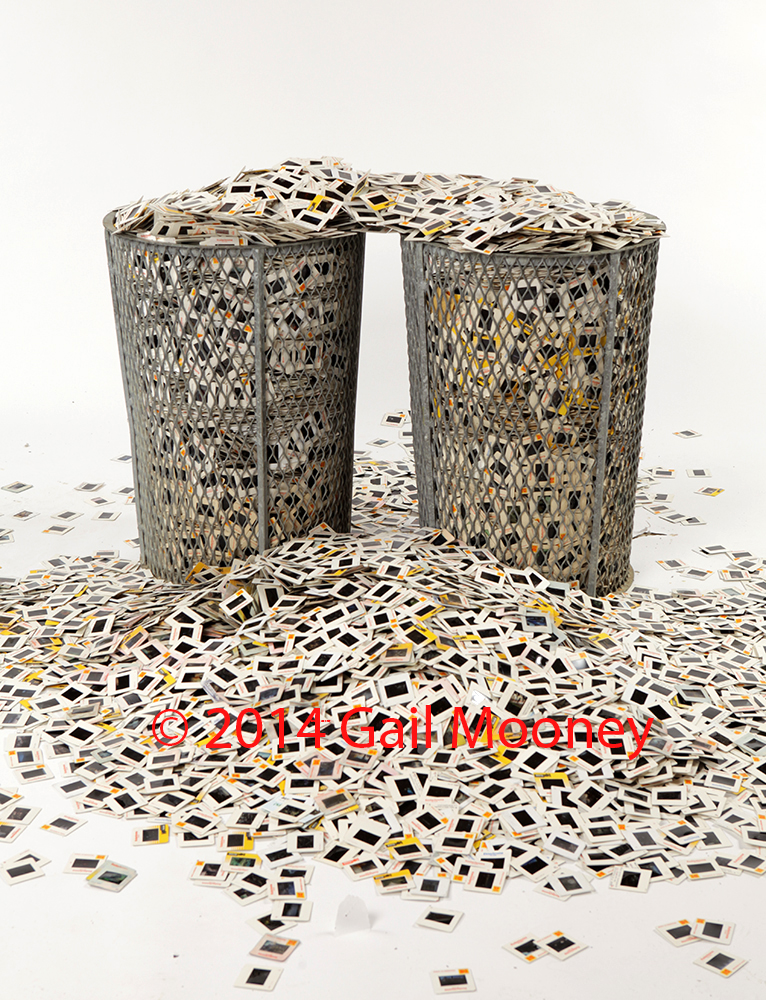
Tom and I have been spending time recently “purging” ourselves of all the things we’ve accumulated over the last 3 + decades that we really don’t need any longer. One of our biggest tasks has been to cull through hundreds of thousands of analog images – from 35mm “chromes” to 4×5 transparences as well as B&W and color negatives. It’s a daunting task and it’s super easy to get sidetracked down memory lane. But, we are steadily making progress sifting through the analog archives – digitizing anything worthy – Old transparenciesand tossing the rest.

When we first began our careers in still photography, we used to toss our assignment rejects (chromes) into big wire trash bins, like the ones you’d see on NYC sidewalks. Back then, photographers had to pretty much “nail” their exposures or the images got thrown away. Those were the days before auto focus cameras and many images also got tossed because they were out of focus. These bins filled up a long time ago, but for whatever reason we held onto them. So, now we are asking ourselves – should we take a 2nd look or just haul the bins of images out to the trash?

No doubt, we’ll just trash the images, but we did take a look at a few of them and I could see in an instant how our profession has changed for good. The technological skills that a professional photographer needed to learn and master just 10-15 years ago, have been replaced by highly advanced gear and software, making just about anyone able to shoot a reasonably good image, and call themselves a photographer. And whether we like it or not – that’s our competition.

In looking back, I realized that the single one thing that has kept me in business all these years, is that I never put technology first. Rather, I always focused on the “idea”. Nowadays, people call it “vision”, but regardless, the idea always came first and then figure out how to use technology to execute it. Funny thing is a lot of my ideas were ahead of the times, in terms of the possibility of making them happen – but that has changed. It seems like anything is possible now. I am grateful for the perspective I’ve gained over the many years that I’ve been in this business. One thing is for certain, change is a constant and I look forward to a future where I can make more of my ideas and dreams come true.

Expect the Unexpected – The Photographic Journey

My husband and I have been partners in marriage and in business for over 35 years. We have collected a lot of memories together over those years and because we are both photographers and filmmakers, we have recorded many of those moments.

_MG_6235GailMichener
Gail Mooney with James Michener. Chesapeake Bay, MD

I’ve been sifting through our analog archive of photographic prints and “chromes” lately in the process of purging other “stuff” in my life, that I no longer need. It is amazing how much stuff one can accumulate over the years. We have never been “consumers” in the typical sense. I’m almost embarrassed to say that we don’t even have a flat screen TV in our home – we do in our office, which is part of our home – but not in our living area. But we have somehow accumulated lots of folk art from a lifetime of travels, lots of photographic gear and hundreds of thousands of images.

As I continue to look through a lifetime of images, I occasionally pull a couple of photos out of the archive and share them on Facebook on “throw back Thursday”. What stands out to me in looking through a lifetime of photographs is that my husband and I have had an incredible journey together. I don’t think either one of us could have begun to imagine some of the experiences we have shared, when we first started out – I know I didn’t.

I’ll share one image and story with you. Tom and I had an assignment for Travel & Leisure to shoot a story on the Chesapeake and we had arranged to photograph Michener for the article. The day of the shoot, I brought my dog-eared paperback copy of Michener’s “Caravans”, that he had written in 1951. I had carried that paperback in my backpack for a year when I circled the globe the first time. I was told by some that I shouldn’t hand a paperback to Michener to sign – but I did anyway. He was touched, because he knew how important the book had been to me on my journey.

I remind myself daily to enjoy each day that I am given and to never underestimate what may be around the next corner. Expect the unexpected.


Another Year Gone By

When I was a kid, my year would begin and end around the school calendar – essentially September to June. Summertime was a delightful escape CoupleBicycleNZfrom the rituals of academia with lots of time to sleep late and do other things – or simply just do nothing.

I’ve been out of school a long time, but my annual calendar still seems to revolve around the “academic” year, with summers still spent relaxing and playing. As I enter into yet another year on this planet as my birthday approaches next week, I realize just how important it is to take time to simply relax and play. As a creative being, it is not only important to “play“– it is critical.

As I look back on the many years that have ticked by, I am profoundly grateful for the many blessings and people in my life who have made it a life well lived. My memory fails me at times but what I do consistently recall are all the little moments of laughter and levity. I have not amassed a fortune, but I have been very comfortable and never left wanting. But I realize that I have had a rich life indeed and the best times have always included experiences near and far with people who have entered into my life – sometimes for a moment – sometimes for the long haul.

I suppose you could say that my spirit has never aged and it is still as playful as it has always been. When I’m at my most creative, my spirit is shining through. It’s not hampered by self-doubts, fear or uncertainty. My spirit is forever curious and is always exploring. Rather than being fearful of what’s around the next corner, I am excited at the prospects of opening myself up to new ideas, places and people. It’s all those experiences and relationships that make up a life worth living.

So, as I face the start of another year, I look back at the smiles and laughs as well as the tears that I have encountered on my journey and I wouldn’t trade them for anything.


Golden Days – a Life in Photography

I’ve been sifting through a lifetime of images over the last few weeks, in a myriad of formats – prints, transparencies and digital files. Gail Mooney - early 1980's - New York CityWhat started out as a simple quest: to find photos of my daughter Erin at various ages in her life, for a bridal shower “game”, quickly turned into a major,  yet wonderful distraction.  I was looking through the visual archive of my life – my husband/ partner’s life – Erin’s life and all the family and friends that made up a lifetime.

In the “old days” it was more of a working chore to take photos of casual gatherings.  You needed to bring a camera, a flash and  lenses with you (not to mention film), to be able to document various life events.  Now, with cameras with us at all times in our phones, we are able to capture and share the moments of our lives, easily and all the time.  Sometimes, it almost seems like we are more intent on capturing and sharing our “moments” than we are just living those moments.

I can tell you that experiencing something through the lens of my camera is a totally different experience than just “being in the moment” for me. There have been times when I’ve been intensely photographing something, when I didn’t really feel like I was experiencing “the moment”.  I was shooting “the moment” but I wasn’t part of it.

My camera(s) have been a major part of my life.  They have provided me access to my dreams and still do.  As I looked through the decades of images, it was like reading chapters in a book, each unique yet connected and integral to my life’s journey.

As I thought about my journey, I realized that if I had one big “take away” – my curiosity for life is what drove me. There was always something I wanted to try or do or learn about – and so, I did.  That usually put me in a position where I moved forward, rather than be left behind.  I was lucky because it was organic to my nature.  I was smart and maybe a little brave because I listened to myself.

My passion nowadays is to photograph and film others’ stories as my continued curiosity leads me to another chapter in my life.

Enjoy and savor every one of life’s moments – they go by in the blink of an eye.

“With my maps and my faith in the distance – Moving farther on”     Jackson Browne

What is Your Value as a Professional Photographer?

Let’s face it, these days, professional photographers Bouncer at Pure Night Club, Las Vegas, NVaren’t only competing with other pros – they are competing with anyone and everyone with an iPhone. Before you get upset and kill the messenger – ask yourself “What is my value proposition?” What do you offer that your competition doesn’t’?

I started making a list of things that professional photographers could offer to boost their value to potential clients:

  • Skills – Do you have any unique skills that can set you apart from your competition? If you define yourself by a specialized piece of gear that’s new – keep in mind, you may have just 5 years or less before ‘everyone” has it.
  • Vision – Make sure your “vision” comes from you and isn’t just a copy of what’s “hot” or trendy at the moment.
  • Access – Do you have access that others don’t? I realized when I was shooting for National Geographic that I was given access to a lot of photo opportunities that others didn’t have. Sometimes these opportunities yield photo opps that are off limits to others and make some stand out portfolio samples.
  • Rapport – If you are working in video and part of your job is doing interviews, then having a good rapport with your subjects will give you results that only you will get. Good interviews are dependent on social chemistry.
  • Your audience or following – These days, even getting a commissioned assignment may be dependent on your own social media following. Advertisers want to capitalize on that if it’s the same target audience they are trying to reach.
  • Project management skills – Getting the shot is only one skill set that photographers need to compete. Clients expect you to manage the project from soup to nuts and deliver the goods. That could mean wrangling large crews, getting access or simply making sure that everything that needs to get done to complete a project – is done.
  • Sensitivity – Be sensitive not only to your clients’ needs and problems but to whomever you are working with. I know a very good photographer who began burning most of his bridges with his clients. He was more interested in getting his point across and making demands than he was listening to the needs of his clients.
  • Likeability – Similar to above. There are just too many photographers out there to choose from that if you aren’t likable – well – you may want to look for work that doesn’t require any social skills.

If all this sounds simple –  it is. It’s applying it that’s the tough part. But if you do, you will set yourself apart from your competition.

Thinking of moving into motion?  Check out The Craft and Commerce of Video and Motion