Einstein said “Logic will take you from A to B but imagination will take you anywhere.”
I have always had a vivid imagination, spending many waking and sleeping hours dreaming and picturing myself in all sorts of situations. Some of my dreams were just crazy ideas running through my head and some were very real dreams that I believed would come true. I was thinking about what I wanted in my life – not what I didn’t want.
Everyone has dreams for how they want their life to be but not everyone believes their dreams will manifest. The future has to become the present in one’s imagination. And one needs to commit to their idea for it to happen – not just have intentions. Intentions without conviction is a waste of energy.
At this point in my life, I have been focusing more and more on pursuing my thoughts and ideas that have been running through my head. It was a year ago, that I made the decision to embark on the biggest personal project of my life, Opening Our Eyes. I’m now in the midst of editing hundreds of hours of footage. It’s tedious because there is so much, and there are interviews in foreign languages that need to be translated and transcribed before I can edit them. All the files need to be transcoded, which is taking far longer than I imagined it would, but now that I have my workflow down, it’s going faster.
When I’m finished with this film, it will be the most satisfying and successful project I’ve ever worked on. I use the word successful to mean that it was an incredible accomplishment for me personally and professionally. That’s not to say that it won’t be financially rewarding, and in fact every personal project I have ever self-funded has always been profitable, just not immediately.
More importantly, by executing my ideas, without needing validation from someone else, I am following my purpose. I am doing what I’m meant to be doing in my life. That in itself is the biggest reward of all.
We all have our own music inside of us. Find yours. Don’t die with the music still inside of you.
The last two weeks have been enlightening and humbling for me, and I’ll try to share some of the thoughts that have been racing through my mind.
I was honored to be asked to speak about video, at ASMP’s Ohio Valley Chapter’s Photo Tech conference last week. It’s a great event and an enthusiastic and engaged group of people. I also had the pleasure of seeing Walt Jones presentation: “CGI – Friend or Foe”. Walt is a talented photographer and CGI artist. He is in my opinion a new breed of visual communicators. He started out by showing examples of “images” and asking the audience if they were photos or CGI. I was 100% wrong with every one of my guesses. The point is – I couldn’t tell the difference. I was in awe of the power of these relatively new tools that we as “image creators” have at our fingertips.
It really got me thinking that “seeing is NOT believing” anymore and the ramifications of that. I started thinking of the ethical consequences and how in the wrong hands this power can be misused. But as I tossed those thoughts around in my head, I realized that this is really nothing new as far as the power we, as visual creators have, to manipulate an image or skew the story or the message. Even before Photoshop and similar applications hit the scene, we as image creators could sway opinion or belief, just by what we chose to show, or not show. If you look back in history, photographs, film and TV, have swayed public opinion long before the tools of Photoshop and CGI.
Yesterday, I got an email from a photographer, Aaron Huey, with a link to his Ted talk. He told the story of the Lakota Sioux Indians through his words and his images. He presented a timeline of this tribe’s history through his words, as he showed his images of modern day Lakota on their reservation or as he refers to it – their prisoner of war camp. It was one of the most powerful Ted talks, I have ever seen. It also reinforced the notion of the “power” that we all have as visual creators.
I’ve been thinking about that power a lot, and the responsibility that comes with it and that I believe that we all have the obligation, to use it wisely. A few years ago, I created a documentary entitled Freedom’s Ride, a story about two diverse groups of high school students who rode the bus together to Alabama, tracing back the Civil Rights Movement of the 1960’s. The words of one teacher that I interviewed have stayed with me. He said, “we can pass all the laws we want – but we can’t legislate morality”. I’ve been thinking about that statement a lot this week. It’s never been more important than it is now, because of the tools of technology, that we make sure our moral compasses are in check and headed in the right direction.
For anyone who has been reading my blog, you know a few things about me – I love to dialog and share with others, my work and my pleasure are one in the same and I always have a passion project that I’m working on.
I can’t say that I’ve always been like this. In the beginning of my career it was a lot harder to dialog and share with people – pre-social media and email. And as my career took hold and I became busier with work, I didn’t have time for sharing or personal projects. But for someone like me who is a dreamer, I was starting to burn out.
When I started exploring the video medium in the late 90’s, it triggered a spark in me. I started thinking and dreaming about all the stories that I wanted to tell – that would be possible for me to tell – through this medium. One of my first attempts at telling a story with video was a short documentary I did on my daughter’s youth symphony. I couldn’t have picked a harder subject if I tried because it was all about sound, which I knew nothing about. And anyone who has ever shot a musical concert knows that it’s almost impossible to do with only one camera. But I naively pursued with this project and learned a lot in the process.
My next passion project was The Delta Blues Musicians that I envisioned as a multimedia project combining still environmental portraits of these musicians along with video interviews, capturing their life’s stories. It was a lot of work and for the most part, I went it alone – doing everything myself. For anyone who has ever tried to shoot both stills and video on the same job, you know it’s not an easy thing to do. That project will always be near and dear to my heart and continues to reward me in ways that I never knew were possible.
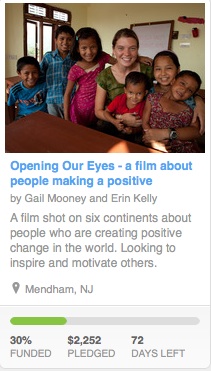
There have been other passion projects since these first two and my head is usually full of ideas that are rumbling around, just waiting for the right time to surface. I am in the midst of a project now, Opening Our Eyes that is perhaps the most ambitious one I’ve ever dreamed up. This past weekend I launched the project on Kickstarter. Kickstarter is a website that posts creative projects for the purposes of finding funds. It’s a perfect example of crowd funding where one can donate anywhere from $1 to $10,000 to the project of their choice, and in the process make someone’s idea come to life.
I launched Opening Our Eyes on Thursday and within 3 days we reached 30 % of our goal. We still have a long way to go and have another 71 days to get fully funded. The way Kickstarter works is that if you don’t get funded 100%, then all bets are off and you don’t receive anything. So, I’m doing my best to do what I like the least and that is make a pitch for pledges. My intent is to secure enough funds so that I can collaborate with a professional editor and raise the bar on the film that my daughter and I shot this past summer on our 99-day adventure around the world, about people who are making a positive difference in the world.
It’s really a win/win for anyone who chooses to give – even a pledge of $25 will get us closer to our goal and you’ll receive a DVD of our film when it’s finished. So please check out our project on Kickstarter and pass this link along to others. Ultimately our goal is to inspire and motivate other change-makers through the power of our film. We know we can do it with everyone’s help and it will make you feel good to give – it always does.
I’ve just spent the last 2 weeks intensely editing my footage shot on my 99-day journey around the world, shooting my passion project, Opening Our Eyes. I wanted to get a trailer ready for the PhotoCine Expo that I’ll be speaking at this weekend in Los Angeles. I knew that I couldn’t possibly go through all 2900 gigabytes of content (145 hours), let alone cull it down to a finished sample in two weeks time. So, I took a friend’s advice and decided to focus on only two of my ten subjects that I interviewed and shot b-roll on.
Even with going through only 20 percent of my footage has been a grueling and exhausting two weeks. But it’s also given me a much better sense of working with and analyzing the files that come out of the Canon 5D Mark II and 7D.
Some of my loves:
I love the picture quality
I absolutely love the picture quality
You can’t beat the picture quality
It’s true, the picture quality is stunning and worth putting up with SOME of the workarounds, depending on what type of job I’m working on. If I’m shooting a corporate event and I need to record longer than 12-minute intervals, which is the case when someone is giving a talk, then I would opt not to use a DSLR because of the limitations on the duration of a clip. And, regardless of the type of job I shoot, editing the files from these cameras is tedious because I need to transcode them into a file that will play well in Final Cut Pro.
Some of my hates:
12 minute clip duration – this really needs to change in the next generation of these hybrids in order to make it a more workable camera
Audio – Canon really needs to come up with a more professional solution for capturing good audio with the video on one card. I have used a JuidedLink pre-amp with a gain disabler on it but it’s still not as good as the audio I get when I capture it to a separate digital recorder – in my case the Samson H4N Zoom.
Having to transcode all the files into a codec like Apple Pro Res so that I can edit in FCP without stutters, stops and drop frames.
Stabilization is an issue but a solvable one thanks to rigs from Zacuto. And of course you can always use a tripod – and really should if the situation warrants.
I’m sure I’ll come to other conclusions as I dig deeper into my content and I’ll share my thoughts as I continue to immerse myself in the post production part of this film.
In the Field
Depending on how you are working in the field and what you are shooting, your workflow and the way you organize and manage your media will vary somewhat. If you have a crew and are shooting a scripted video, then you will probably have a computer and technician on site, downloading media as it is shot, backing it up and checking it for focus.
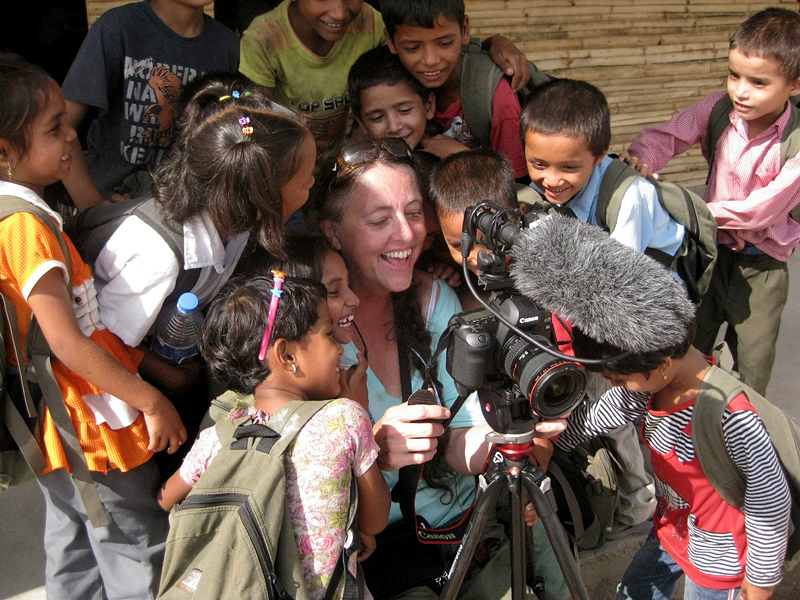
If you’re working solo or with just one other person, which is how I have been working for the past 3 ½ months on my project, Opening Our Eyes,
Gail at the Kopila Valley Primary School, Surkhet, Nepal
then you don’t have the manpower to work that way. I downloaded all my footage, audio and stills at the end of the day. I rarely had the time or even the battery power on my computer (electricity was scarce at times) to look at what I had shot but I did do spot checks occasionally.
Regardless of how you work in the field,
Children at the Kopila Valley Primary School
it is essential to create redundant backups of all your content. I backed everything up to two portable external hard drives, after downloading the media to my laptop via card readers. There’s a nice software application called ShotPut Pro that lets you make up to 3 copies to different drives at a time, which speeds things up quite a bit. For the most part, I had organized my media by destination and subject with each folder containing the contents of a card. Whenever I shot an interview, I put a fresh card in the camera so that the content was automatically sorted out from the b-roll. Some shooters I’ve talked to who are used to shooting tape, archive each tape or card by making a disk image (DMG) of each which can be mounted on the computer, emulating the original card.
Back in the Editing Suite
The first thing I did when I returned from my 99-day journey, was to make two backups of all my material. After my media was backed up, I started to organize it. Everything had already been separated as far as destination and subject, but I needed to separate the stills from the video and the interviews from the b-roll – if any cards contained both. I also needed to match up the interview video footage with the audio files that had been captured by a separate recording device.
After getting all my media organized and sorted by destination, subject and file type, I renamed the files and added any relevant metadata – copyright and creator info etc. This can be done in Adobe Bridge. You can also look at the video files in Bridge to preview before transcoding them. Another way to preview your video files is by using QuickTime player. Because the files coming out of these hybrid cameras are compressed H.264 files, they do not play smoothly in Final Cut Pro, so they need to be transcoded into a codec like Apple Pro Res, before editing them. This can be done in Apple Compressor which comes with the Final Cut Pro Suite or MPEG Streamclip which is a free application.
You can choose to preview your video files first using Adobe Bridge or QuickTime player or another software tool, and then make a folder of “selects” and transcode just those files before importing them into FCP, or you can transcode everything and then import everything into Final Cut Pro.
After I organized my assets (stills, video and audio), I chose to transcode ALL my video files and import everything into Final Cut Pro. That way, not only could I preview everything smoothly, but I could also start adding information to the clips and organize them into bins within FCP. And with everything transcoded, I won’t have to leave FCP if I wanted to look at content that hadn’t been previously marked “selects”.
Getting to the Fun Part
Organizing, sorting, logging and transcoding is tedious work but it’s essential in order to be able to find things quickly when you need them, when you start laying down your storyline and want to keep focused. There’s nothing worse than having to break your train of thought while you’re editing and have to leave the program to find assets or prep them. Organizing is key – it’s not fun, but a necessary step in the process.
I will continue to slog through this initial process this week, in order to get through some of my content so that I can put together a sample for the PhotoCine News Expo that I’ve been asked to speak at this month. I have way too much material to go through everything, so I’ve decided to tackle the content from two of my subjects, which will make the task more manageable. It will also provide me with the reward of working on the “fun part” of editing by crafting a short story before moving on to daunting task of assembling the entire documentary. Check out this quick sample that I put together within 24 hours after getting off the plane. http://www.vimeo.com/14645594
Little by little things will come together and I’ll keep you posted as I go along.
I returned back to the United States a couple of days ago and before I even did my laundry, I sat down to edit a quick behind-the-scenes interview video clip of my daughter and I discussing the documentary we had just finished shooting, traveling around the world. I was motivated by a deadline where I needed to provide a video clip from the project, right away.
I was fortunate in that we had just shot interviews of each other talking about the making of the film, while the experiences were still fresh in our heads. So it was relatively easy for me to pull a couple of soundbites from the interviews, sync the audio which had been recorded separately and add relevant B-roll. Within less than 24 hours after stepping off the plane, I had a 5 minute behind-the-scenes short. Nothing fancy, mind you but in addition to providing an opportunity for the film to get awareness, it forced me to start thinking about the overall structure of the piece.
The hardest part of editing is getting started – figuring out how the story will be told. In my case, I’m facing the daunting task of looking through 3 months of material – interviews, B-roll, still images, and behind-the-scenes footage that I need to figure out how I will put it all together. There are a dozen different directions where I could take this film in the editing process. I could choose to make each subject’s story an independent video, with the full length documentary being comprised of them all. Or I could weave the stories together – structuring the piece more thematically. Or I could include the mother/daughter aspect in the film and add some interview footage of the two of us talking about the project.
Just in putting together this quick sample, I have forced my mind to start thinking about the next step – crafting the story. My next deadline is to make a trailer for this film that hasn’t even been edited yet. I will be speaking at the PhotoCineNews Expo in LA in a couple of weeks and I’m motivated by this opportunity to present the workings of this project to a live audience.
As it turns out, jumping right into it was the best thing to do. I overcame the inertia that’s always present, and started focusing on how I was going to tell the story of not only our subjects but the experience itself.
In a little more than a week, my 99-day journey trekking around the world with my daughter shooting a documentary, Opening Our Eyes will be over. Or will it? My work is really just beginning as I contemplate all we’ve done, people we’ve met and interviewed and how I will put this all together in an edited, finished film.
There are hundreds of ways I can edit this documentary and quite honestly, beginning the process and deciding the direction is always the most difficult. But there will be a moment when the light bulb goes off and the vision will be clear as to how to make sense of it all. Then it becomes easy as the story unfolds – as it should from my heart. It’s the story that can only be told by me and this case, me and my daughter.
My daughter and others have urged me to do a behind-the-scenes DVD
Gail at the Kopila Valley Primary School, Surkhet, Nepal
– she tells me “that’s what people want”, to know more about the making of the film – more about the people behind the film. As much as I agree with her and understand this interest on the part of the viewer, there is also a resistance to make myself part of the documentary. With that said, a separate “behind-the-scenes” chapter could be the solution – to provide more information, without inserting the two of us into the film itself.
One thought does keep popping into my head that motivates me to provide a commentary on the why’s and how’s of this journey and the making of this film. Too many times when I’ve visited museums, I’ve been taken aback by some of the things that I over hear docents talking about in relation to the paintings. They analyze and interpret what the artist meant by his choice of color, brush stroke and placement of objects within the art and how that related to what was going on in his life at that point in time. I often wonder how they know that or even how can they be so sure? Is it documented or is it really just someone’s interpretation that has become fact over the years?
My daughter and I do plan to sit down this week and attempt to do on-camera interviews – while we are still in the moment and before we get back to our normal lives. Here’s where we need your help – tell us what you want to know. Maybe you’re curious about how we survived the dynamic of a mother/daughter team for three plus months. Maybe you want to know why we did this – or how we funded it. Or maybe the questions are even more basic – what did we like? – what was difficult?– any surprises? etc. etc. Perhaps you want to know more about the craft of shooting the doc– and how I went about that. And maybe you don’t really want to know anything at all and just want to know about the subjects of our film.
But please tell me what you’re curious about – as far as the behind-the-scenes making of this film. All questions are welcome – from the seemingly obvious to the more provocative.
In my laziness and urge to get outside and make the most of my last two days in Sydney, Australia, I am cross posting a post that was on my Opening Our Eyes blog – so forgive me if you follow me there.
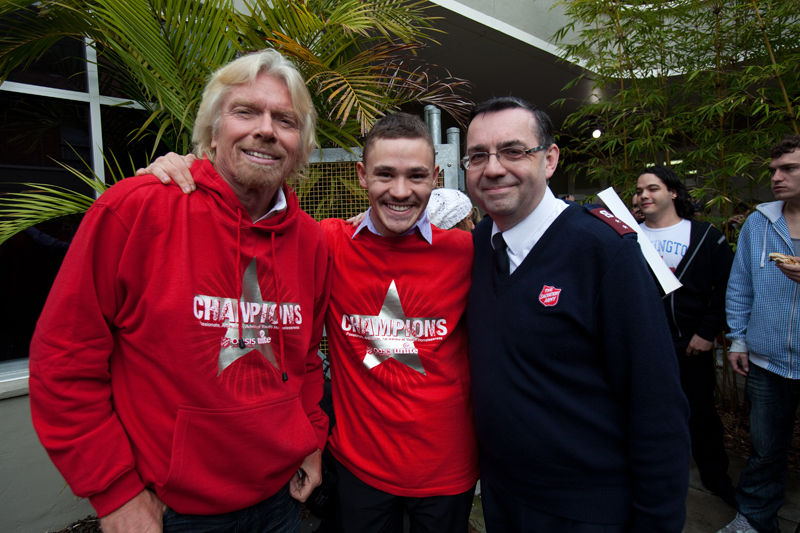
Yesterday, I uploaded this photo on my Facebook statusSir Richard Branson, Damien, Captain Paul Moulds at Oasis in Sydney, Australia. It got noticed as “celebrity” always does and one person remarked “hanging with the superstars”. I commented back saying that they were all “superstars”. Certainly, Captain Paul Moulds for the work that we devotes himself to with Oasis and reaching out to homeless youth in Australia and Sir Richard Branson for his generous support and making it possible.
But perhaps the biggest “superstar” is Damien, the young man in the middle who turned his life around from being on the streets with barely any hopes and dreams at all to having a job, a place to live and a bright future.
I was attending an event yesterday at Oasis where Branson was cutting the ribbon on the opening of a fitness center that his company Virgin had funded. But prior to the opening of the center, Branson and others listened to the stories of the “champions”, young people like Damien who against all odds, had redirected their lives to a better future. The stories were difficult to hear – stories about being abused – physically, sexually and emotionally. Stories about wanting to die and the attempts that they made on their lives because they felt unwanted and that they had no purpose.
I can’t even begin to really understand the horrors that these kids have faced in their young lives. I can’t even imagine how difficult it was for them to tell their stories, and yet they did so with grace, dignity and compassion for one another. They were there for each other and to show their gratitude to people like Paul Moulds and Richard Branson who make places like Oasis possible. One young man said – “without Oasis, I’d be dead”.
I will never forget that morning and it went far and beyond the thrill of meeting Sir Richard Branson and eating an egg sandwich that he had cooked on the grill. The most important thing I walked away from was being around a group of people with a like-minded purpose. A purpose of doing whatever they can to make a difference – a positive difference in the world. I could see, hear and feel the impact that Moulds and Branson had made in these young people’s lives. It was tangible and real – not just words on the pages of a foundation’s annual report.
As we wind up our time in Australia and head home for a few days break before heading down to South America, I am energized by something that Paul had mentioned during his interview. He was talking about an amazing documentary that was made about Oasis and the issues facing homeless youth in Australia. The documentary was two years in the making and gave an up close look into life on the street for these young people. Paul told me that after the documentary aired on Australian TV, the response and support that followed was astounding. It had made a real impact and prompted people into action – to help with donations or wanting to volunteer.
So I’m energized going forward that our little film will also create awareness and prompt others into action and what they can do to make a positive difference in the world. It’s a simple yet powerful thought and full of possibility – the power that’s within all of us to create change and make the world a better place for those that are less fortunate. The power of possibility – think about it.
Today was one of those days that are memorable and just make you feel good to be alive and affirm your life’s convictions. Even though I “worked” today – on my birthday – I realized once again that my “work” has never really felt like work at all, but rather a gift.
Once again, because I am a storyteller and a visual communicator by profession and have the great fortune to have been able to make a living doing so, I had the privilege of spending the afternoon with a remarkable woman. Her name is Ronni Kahn, CEO (Chief Energy Officer as she would say) and founder of Oz Harvest, a food rescue program in Sydney, Australia. What Ronni does is quite simple – yet far reaching. She has set up an organization that picks up food from events, parties, affairs etc. that would have normally been thrown away, and sends it over to various charities that feed the needy.
But one of the many remarkable things that Ronni has done was to use her connections and passion to change the law so that people and organizations who were willing to give away their perishable and left over food, could do so without fear of being sued or liable in the process of doing a good deed. Ronni made it happen because she saw the big picture and overcame the obstacles in the way.
We spent the afternoon with Ronni, first touring around the lovely coastal areas of Sydney, then filming her inspirational interview and ended the afternoon at the beach. One thing stuck with me that Ronni said during the interview. She told me that many people tell her that they would love to get involved and do something along the lines that she has done but that it just wasn’t the right time in their lives and then proceed to give her a variety of reasons of why they can’t. And then she said “if you want to do something – you just need to do it”. You need to stop making excuses and live in the “now”.
As I write this blog entry, her words are kicking around in my head and I realize how grateful I am that I am living in the “now” and doing what I feel I need to do. And that is the best birthday gift of all – nothing can ever top that.
I see a lot of confusion and misconceptions amongst still photographers as they embrace video using the DSLR camera. For many audio is an after thought which is a big mistake because audio is much more important than the visual. Unless you’re just laying down still images or video clips to music then you have to be able to capture good sound. Some things to consider and remember.
1. You’ll never get good sound with the camera microphone – only use the camera mic for reference audio.
2. Don’t buy a camera that won’t let you use external microphones – unless you will be capturing your audio separately and syncing it later in post.
3. If “running and gunning” – you can probably get away with using a mic mounted on the camera as long as you are close to your audio source. You can either use a mic with a mini plug and connect it to the camera OR you can run the mic via an xlr cord to a mixer like a JuicedLink or a Beachtek, which is much better, rendering a cleaner audio capture.
4. For interviews, most likely you won’t want your camera to be extremely close to your subject. So you won’t want to use a mic mounted on the camera – it’s too far away. I rig a shotgun mic on a boom stand and I also use a lav on the subject and run both into my camera if I’m using a traditional video camera or into my JuicedLink mixer if I want to capture the sound on the same card as the audio.
5. When using a DSLR camera, capturing your audio separately with a digital recorder is ideal. I use a Samson H4N Zoom that not only has a built in dual stereo mic but two XLR inputs. I run my shotgun mic and lav mic into the Zoom and then sync the sound later in post with software called Plural Eyes. Make sure you keep the audio on in the camera as well to use as a reference for syncing later on.
6. When using a device like the zoom that has a built in mic – remember that even though this is a quality mic – you MUST get the mic in close to your sound – no more than a foot away. I prefer not to use this mic but rather a shotgun because a shotgun is more focused and won’t pick up a lot of the ambient noise.
7. Use headphones. Don’t just look at your meters – wear headphones and make sure that you are getting quality sound. You could be picking up interference or static.
8. Always consider your audio even for your b-roll – you need some audio – even if you only intend it as ambient background sound.
9. I only use a wireless system when I need to. In cities like New York you can get a lot of interference on the frequencies. Always go wired if you can. And if you find yourself needing a wireless system, spend the money to get a system that has a good range.
10. Be quiet and tell your crew to be quiet as well. You never know when you’ll want to use the audio – even if you think you won’t need it.

 Some of my dreams were just crazy ideas running through my head and some were very real dreams that I believed would come true. I was thinking about what I wanted in my life – not what I didn’t want.








 Journeys of a Hybrid