Change

Change Who likes change? Other than needing a change of scenery every now and then, change is usually tough to take. I grew up with change. My family moved 10 times before I got out of high school.

Kindergarten, Chicago, IL

I was always the “new kid”. (Hint: I’m in the second to last row. I was also the “tall kid” even in Kindergarten)

No, my dad wasn’t in the military and we weren’t on the lam – he was just climbing the corporate ladder. He’d get promoted or there would be a new sibling and we’d move to a bigger house or he’d get promoted and transferred and we’d move to a totally different place leaving our friends and familiarities behind.

I’m not complaining, nor saying that I feel slighted by having that constant change in my life. It was the life I knew and I suppose I always looked at it with open eyes and curiosity about what was next to come. Of course, if I thought about the friends and sometimes family that I was leaving behind, it made it much harder.

Perhaps growing up in a constant state of change made me more flexible in dealing with all the changes affecting my business these days. Both still photography and video production have been profoundly changed by a bad economy and technology. Kind of like a double whammy. At least with technology the sword cuts both ways and also provides opportunities. It’s usually during the tough times when the economy is bad when innovation happens. Sometimes people just have to be forced to make changes in their lives, even if what they have been doing hasn’t been working. I was asked to speak at Cal Poly on the theme The Role of Mass Communication and Media Technology in Today’s Global Economy: A Multidiscipline Approach. Specifically, they wanted me to talk about how I was using technology to communicate in a global market. I started thinking about how this past year I had vigorously embraced new tools and a new business model, integrated with the Internet and social media to create a mixed media project that will ultimately result in a feature film, a book, an e-book and maybe even an exhibition. I didn’t have a big team behind me, nor did I have a lot of money. We had a two-person crew- myself and my daughter, an editor and my husband working the PR, the social media and the back support. We raised some money on Kickstarter with the help of our backers and we’ve had musicians offer us their music and talents to our film. We are extremely grateful for all of the support worldwide and it could never have happened without advances in technology.
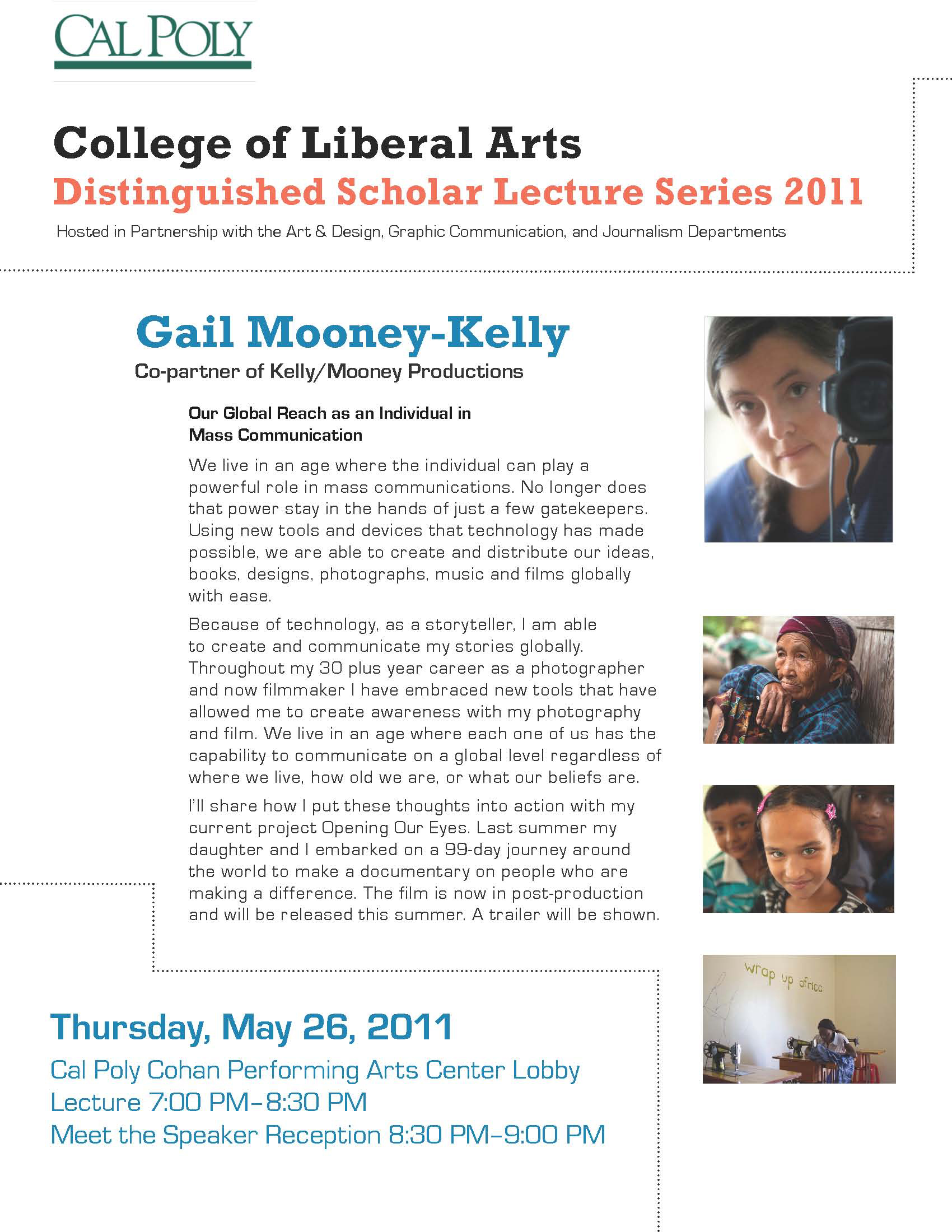
The fact is that we live in such an amazing time where something like this is even possible. It is a time of empowerment for the individual. Technology is democratizing and is leveling the playing field especially in terms of distribution. The locks are gone and the gates to distribution are open and affordable. Within a month of uploading the trailer to my film on Vimeo, it has been played in 95 countries – that’s almost ½ the countries in the world. What a staggering thought in terms of mass communication!

Going forward my ultimate plan at this point in time is to distribute the film through iTunes or Netflix and DVD’s through Amazon. More importantly, I would like to set up 100’s of screenings in communities all over America – maybe even all over the world – and use the film to move people to action. Kind of like a grass roots effort to motivate people to make a difference in their communities. Imagine what kind of an effect that would have if it spread virally through the world. Just Imagine.

Add to FacebookAdd to DiggAdd to Del.icio.usAdd to StumbleuponAdd to RedditAdd to BlinklistAdd to TwitterAdd to TechnoratiAdd to Yahoo BuzzAdd to Newsvine

Validation No Longer Necessary

There seems to be a prevailing attitude of doom and gloom. We have an economy that can’t seem to turn itself around and we’re bombarded by change that technology continues to thrust upon us.  We’re scared to death of the unknown and nobody seems to know what to do next and how to make any money doing it.

Yet, I’ve never been more hopeful in my life. Why?  Because I no longer need someone else to validate my ideas – and that is a powerful notion.  Those of us in the communication business seem to be particularly fearful. Some believe that the “news” business is dying because print publications – newspapers and magazines are folding every week.  But the “news” business is not dying – it’s just being delivered  in another way – electronically and globally.  There are no longer just a few gatekeepers with a lock on the playing field.

Human beings are social animals and we will always have the need to communicate with each other.  These days we can communicate with one another globally.  An idea or creation can be shared around the world in a matter of minutes.  Think of the power in that and think of how we can use that power and the opportunities it presents.  I could digress into a discussion on the ethics of this thought but I’d like to focus more on the reach and influence that each one of us has in creating awareness.

Many of us get enamored with the latest devices that enable us to deliver and receive information with speed and ease. As technology’s exponential growth continues to change our lives in every way imaginable, we will constantly be incorporating and upgrading new gadgets and devices as part of our lives.  We need to be mindful that these “toys” are merely enablers and that each one of us can use these tools to create and distribute our words, images, designs and ideas across the planet.

I think that we as creative’s or journalists underestimate ourselves sometimes.  Perhaps because we chose professions that aren’t lucrative – at least in terms of money.  However, what one is paid doesn’t necessarily correlate with one’s worth. We live in a time now where we can use our creative skills to really make a difference and to tell the stories that we feel need to be told. Mass communication has been democratized. We no longer need the traditional gatekeepers to validate our ideas.

I never would have dreamed that I would be able to circumvent the globe, create a documentary with only one other person in my crew  – my daughter and then distribute it internationally. I never imagined that I would have the power to create awareness on a global level like I did when I uploaded my trailer to Vimeo.  In a little more than a week’s time people in over 72 countries had played that video. Now in less than a month’s time, that trailer has been played in almost half the countries on the planet.  Staggering thought.

This was not a commissioned project by a network or a motion picture studio. If I had waited for that – it never would have happened. I assigned myself.  I was able to fund it by using my airline points, hotel rewards and doing trades with manufacturers for equipment.  I also successfully raised money via Kickstarter a crowd funding site  that made it possible for me to hire a professional editor. My daughter and I have been building an audience for our film since we started blogging about our journey. Our readers got more and more engaged as they followed us on our 99-day adventure around the world. They spread the word through Facebook and Twitter and via their own blogs and pretty soon word of our project spread virally. That was precisely our goal.  To use our tools and skills to create a film about the change makers of our world so that others would be inspired and motivated as to what they can do.

I often think about how things in my life and in history would have been different if we had the Internet when I was growing up.  For starters it would have had a huge effect on the Civil Rights Movement of the 60’s and the Vietnam War.  But everything happens in its own time and when it is meant to happen.  Change can be scary or it can be embraced and sometimes both at the same time.

Never stop dreaming. Never stop learning. Always listen to that inner voice.  Then use the means and the tools of the day to do the dance you are meant to do.

Add to FacebookAdd to DiggAdd to Del.icio.usAdd to StumbleuponAdd to RedditAdd to BlinklistAdd to TwitterAdd to TechnoratiAdd to Yahoo BuzzAdd to Newsvine

Snapshots With Words

Many of you have probably heard me say “still images are moments in time” and “video is time in motion”.  I think and I shoot differently in each of these mediums.

It is kind of like the difference between poetry (or the lyrics of a song) and prose.  In a poem, just as with the lyrics of a song, each word must “say” a whole lot just like a still photograph must convey everything in that one moment in time.  When writing prose you have all those other words to connect your thoughts. To be honest, I never took any writing courses in college and I did not find myself reading books of poetry in my off time.  But I did listen to a lot of music back then – still do – and there’s not a lot of difference between the lyrics of a well-crafted song and those in a poem.

When I was traveling last summer, I found myself mentally capturing images in my head as we went from destination to destination.  I started to type out these random thoughts on my blackberry and because of the nature of that device and the tiny keys, I typed out my thoughts in abbreviated fashion. My intent was never to share these thoughts with anyone, let alone pretend that I could write poetry, but I did share some of them, reluctantly and with trepidation, “testing the waters” so to speak.  I felt like I was standing on the edge of a dock and dipping my toe into the water while a friend egged me on and encouraged me to jump in.

I’ve continued writing my snapshots with words but I’ve become a bit more self-conscious these days with sharing these thoughts.  Perhaps I’ve become more guarded or maybe just too self-conscious to share.  I suppose that’s ok because what is most important is that I don’t let my own inhibitors and doubts stop me from writing.  When I first started writing down these words or poems or whatever label you want to put on them, perhaps I needed to share them with someone else. I needed to test the waters and when I did I got the necessary encouragement to jump in.

These days I try not to define myself too rigidly as to who or what I am by definitions and labels like photographer, filmmaker, writer or poet.  Ultimately, I use whatever tool works best to express the thoughts and stories that run through my mind. I continue to stick my toe into unfamiliar water and every now and then I get brave enough to jump in thanks to a little encouragement from my friends. I think we all need that in our lives – someone who we know we can bounce ideas off of without the fear of ridicule. As one of the subjects in my documentary beautifully stated “we’ve got to shine each other up”.

FaceTweet it!

Being Authentic

There are certain words and phrases that tend to become over used just because they seem to express the idea so well.  Ironically, the word authentic is becoming over used now in our culture and in a weird way is on the brink of becoming a contradiction to what it means.  So, I cautiously use the word “authentic” in the real sense to say – be who you are meant to be.  Be authentic.

When I returned from my round the world adventure this past Fall after completing the shooting aspect of a personal project, I discovered that people were responding to me in a different way. Perhaps they sensed there was something inside of me that they wanted to connect with.  It’s a very difficult thing to explain but I think what they were sensing, was my contentment.  I was content and feeling a sense of “satisfaction” because I was following “my purpose”, both personally and creatively and in the process I was discovering many other people,  all over the world, who were doing the same.

On the outside what may have seemed like just a very long, exotic “trip”, was really more of a journey.  It was a journey that I had begun a long time ago when I became an explorer, through my eyes and through my camera.  I use the word explorer in a literal and figurative sense. Throughout my life, in my never-ending nomadic need to explore the world and its peoples, I was finding my own vision and how I “saw” and I was sharing that with others.

Ethan G. Salwen expressed it beautifully in a recent post on his After Capture blog:

“We always say that learning photography is really learning to see, and this is true. But we tend to express this sentiment in relation to a very limited sense of seeing — the visual sense. Older photographers seem to continue to learn to see on a much deeper level, in terms of what it is to be a working artist and, most important, how this relates to their continual growth and satisfaction as an individual.”

I think Ethan nailed it by talking about “learning and seeing on a much deeper level and how this brings growth and satisfaction as an individual.”  I use the words “ being on purpose” to describe “satisfaction” within oneself.  I believe that as creative individuals, when we begin to find meaning in who we are and how that fits into the world, it will shine through our work.  Some use the word “vision” to describe that certain something that they see in someone’s creative work. Maybe that’s what was in the back of my mind when I came up with the title of my project and film, Opening Our Eyes.

In a way, I use my “eyes” and my camera to do what I do best – to share and connect with others.  When I travel, it is not to assimilate with a culture, but rather to learn and exchange our cultural uniqueness, embrace that and share it with others. When I’m being authentic and true to myself, that happens in a magical way.  When someone tells me that I’m the “real deal”, that is one of the highest compliments they can give me.

I think Susana Esmoris, one of the subjects of my documentary said it best.  “Live life intensely.  Wear the color that you want in life.  Dance what you want to dance.”

Add to FacebookAdd to DiggAdd to Del.icio.usAdd to StumbleuponAdd to RedditAdd to BlinklistAdd to TwitterAdd to TechnoratiAdd to Yahoo BuzzAdd to Newsvine

Just Say Yes

This past weekend at ASMP’s SB3 conference in LA, a young woman came up to me and said that I had given her an “ah ha” moment.  I asked her why and she reminded me of what I had said at a panel discussion the evening before.  A photographer had just told a story of how he saw himself in very specific terms as to what type of photography he did – he saw himself as wearing one hat.  But a client came to him with a job that didn’t fit into his norm and so he turned it down.  Then the client came back a few days later in desperation and asked him to please reconsider and he did.  The job ultimately turned into a lucrative and regular gig and he learned a powerful lesson and that was to open his head up more to possibilities.

I was in the audience and the moderator asked if anyone had a response to this story.  I said that I was really into saying yes more at this point in my life and career and that when I did, the universe was opening up and really great things were happening.  I could go on to list a number of examples of some good things that have happened but the point here is that negative energy breeds negativity and positive energy breeds hope and change and positive results.

It’s pretty tough these days to stay positive, with the photographic industry in a state of flux and the lackluster economy but it’s not impossible.  Some things I have found that help me stay positive are simple to implement in your life and others take a bit more practice.

  • For starters, stay away from the groaners and moaners who spend their time complaining.  That negativity is contagious – so get as far away from those people as you can.
  • Find something you do like and cultivate that passion.  It will show.  You’ll start to talk about it and people will be attracted to you because of it.  That attitude is contagious as well but is an attitude that you want to “catch”.
  • Embrace learning.  Growth always has hope and hope will renew your spirit.
  • Learn to let go of the things that don’t work out.  God knows I have had to abandon many expectations but I try to move on and replace them with new ones.
  • You can’t control what others do to you but you can control how you react. Empower yourself with that thought.
  • Think good thoughts in those moments right before you drift off to sleep.  When you are sleeping your subconscious takes over and if you have positive thoughts running through your head just before you go into that subconscious state – that is what will be reinforced.
  • When you are feeling low and nothing seems to be working – find something that is working and be grateful for that.  And know there are certainly others in the world that are far less fortunate than you.
  • Always remember that life is the greatest gift of all.  Embrace it, cherish it and make every day count.

When you say yes, you at least have a chance at a positive outcome.  When you say no – you’ve closed the door.  My reward that weekend was knowing that I gave someone an “ah ha” moment. Who knows what may come out of that?  What a powerful thought.  What a powerful word.

There were all kinds of “ah ha” moments this past weekend in Los Angeles at the SB3 conference.  There’s another SB3 conference in Philadelphia coming up – February 25-27.  Come and join others who embrace the positive notion of growth, hope and change.

Add to FacebookAdd to DiggAdd to Del.icio.usAdd to StumbleuponAdd to RedditAdd to BlinklistAdd to TwitterAdd to TechnoratiAdd to Yahoo BuzzAdd to Newsvine

Collaboration in Video and….

During one portion of my career, I spent a lot of time shooting still photography assignments for magazines like the National Geographic Traveler, Smithsonian and Travel & Leisure, to name a few. I was hired to shoot the images. A writer was hired to write the story.

Every magazine and every story worked differently as far as how I would collaborate with the writer. Sometimes the writer and I would just have a conversation about focus and approach and then we’d be off on our own, each bringing our own perspective to the piece.

Sometimes, I’d be given a manuscript that had already been written and I was expected to illustrate it. This worked well when I, the writer and the magazine would agree on the focus of the “story” and match our talents to that end. But there were times when a magazine would want very literal illustrations of the words, which not only stifled the images but weakened the words. One time I was asked to photograph “the lurkage of limousines.”

And then there were times when I went to a destination with a writer to do a story on that destination and even though we were there at the same time, we came back with different stories. I got my story done on site and the writer did most of his/her work after returning from the destination.

With video collaboration is essential because there are so many facets, each calling for different skill sets. Some collaborations occur simultaneously on set and some later in post-production but all have to work well in order to get to the same end in harmony. Harmony meaning, not just being able to get along but to communicate and work well together as one, but also where each respects each other’s role in the process.

It’s very tricky to assemble the right mix of people, but here are some important things to look for when building a team or even a partnership:

  • Trust – You have to be able to count on someone to do their job. And likewise, you have to also commit to uphold your end of the deal. The team is only as good as the weakest link. That becomes even more critical, the smaller the team is. If you’re only working with one person and you can’t count on them – you’ll be doing the work yourself. It’s important to know that someone has your back.
  • Working Style – While it’s not important for all to be morning people or night people or have similar working styles in that sense, it can be extremely frustrating for all concerned if there are procrastinators on the team. That’s because timing in video production is important for workflow. If someone doesn’t deliver when they promised – it holds up the whole production. We had one situation where a motion graphics artist held the entire post-production up for months.
  • Expertise – Surround yourself with experts. They will make you look good. But remember, just because someone is expensive doesn’t mean they are the best for your job. There could be someone who is more right for the project who is less expensive. Keep style and vision in mind. Talk to potential crew members and get references.
  • Right for the job – The “best” editor in terms of the commercial world might not be the right person for your project. For me, I want to work with an editor that is also interested in the project besides the money it pays. I look for an editor who will also bring a different perspective as to how the story gets told.
  • Bottom line – Work with people you can count on – otherwise the job might not get done.

Add to FacebookAdd to DiggAdd to Del.icio.usAdd to StumbleuponAdd to RedditAdd to BlinklistAdd to TwitterAdd to TechnoratiAdd to Yahoo BuzzAdd to Newsvine

SB3 – Get Inspired

If you haven’t registered for the ASMP Strictly Business 3 conference yet, I would highly suggest that you do so.  They will be held in three locations starting next week: January 21-23 in Los Angeles; February 25-27 in Philadelphia; and April 1-3 in Chicago.

There’s an incredible line up of speakers presenting workshops on pricing, estimating, copyright, workflow, strategic career planning, successful portfolios and branding and video production. I’ll be presenting two workshops: “Thinking in Motion” and “Shooting Video with the DSLR”.

Branding expert Colleen Wainwright will deliver her keynote “Making People Love You Madly: Selling Yourself in a Postmodern Marketplace”.  Tom Kennedy, whom I’ve know since his days at the National Geographic Magazine will give a keynote “Learning New Skills for the Changing Media Landscape”.

This conference series is meant for everyone, not just photographers who are beginning their careers.  In fact, I think that photographers who have been in business for many years will benefit equally, if not more than a shooter who is new to the business.

I have been in business for over 30 years and I have found that one of the most dangerous things that can happen to a creative person,  is for them to become complacent, especially in a business like photography.  It’s even more deadly to become complacent these days in our fast changing world of technology.  We not only need to stay current with our skills, we need to keep our vision fresh.

When I got into video and motion more than a decade ago, I was looking for something to excite me.  I felt that even though my business was successful and that I had accomplished many of my creative goals, the spark was getting dim inside me and at times I felt like I was reinventing the wheel.  So, I set out on a learning curve and have been soaking up information ever since.

I love to learn and I have found that the more I wonder and grow, the better off I am creatively and the more successful I am in business.  I’ve also found that networking and collaborating with my peers has opened my eyes to all sorts of possibilities that I never knew existed.  I think that’s what makes the SB3 conference so powerful – the sharing of information with our peers.  You don’t get that from online learning.

We live in a time where anything is possible.  Come to SB3 in LA, Philadelphia and Chicago and be prepared to be inspired.

Add to FacebookAdd to DiggAdd to Del.icio.usAdd to StumbleuponAdd to RedditAdd to BlinklistAdd to TwitterAdd to TechnoratiAdd to Yahoo BuzzAdd to Newsvine

Crowd Funding and What I’ve Learned

There’s a scene at the end of my favorite holiday movie “It’s a Wonderful Life”

It's a Wonderful Life

where George Bailey, a character played by Jimmy Stewart is surrounded by his friends as they come to his aid and bail him out of his financial shortcomings, caused by his crazy Uncle Billy. I’ve seen this film at least a dozen times and ok – I admit it – I cry every time George Bailey’s little girl opens a book that mysteriously appears under the Christmas tree with the inscription “No man is a failure who has friends”.

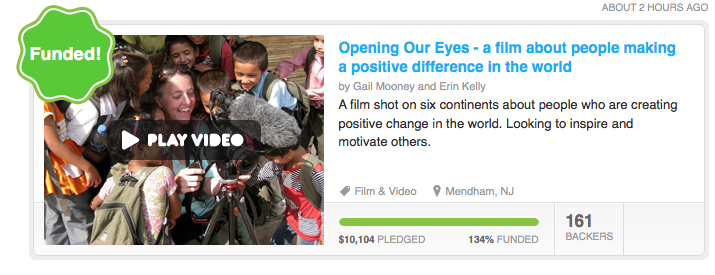
I felt like George Bailey today when I saw the email from Kickstarter telling me that my daughter’s and my film project, Opening Our Eyes had been officially funded.  We actually exceeded our goal of $7500 and raised just over $10,000! What a feeling – what a triumph and all possible because of our “friends”. Through crowd funding – our friends had helped us reach our goal and made our film a reality.

This would not have been possible just two years ago.  But, Kickstarter and other crowd funding sites like it, provide other options for artists and entrepreneurs who are seeking funds to make their creative ideas come to life. Many times these ideas might not fit within the confines of what a traditional bank would finance, but there are some great ideas that have a chance now of becoming a reality –  and we all benefit by that.

Here are some things that I have learned through the process of getting our film funded on Kickstarter.

•    You have to do the work.  Once you launch your project page on Kickstarter, you need to let potential backers know about it, using social media or email blasts or word of mouth.  Just like getting traffic to your website, you can’t expect people to stumble upon your project and fund it.
•    You have to make it fun.  Have fun with the “rewards” that you offer your backers, and on Kickstarter every project must have rewards.  People love to give, but they also love to feel like they are part of something or that they have helped to make something happen.  If a backer contributed to my project at the $500 reward level, they will receive an Associate Producer credit in the film and on the project’s website, along with DVD’s of the film when it’s completed, as well as a signed print and an e-book from the project’s journey.
•    Keep your financial goal realistic.  Look at other projects that are similar to yours and see what the “market will bear”.  See what has been successful and ask yourself why. Remember that if you ask for too much money and don’t meet 100% of your goal by the time the funding period is over for your project, then you won’t receive anything.  Only projects that are successfully funded at 100%, will receive funds.
•    Use social media and email blasts with common sense – don’t be obnoxious.  If you do send emails – don’t send  an email again to someone who has already backed your project.  Ask people to share your project link on social media but don’t overdo it.
•    Post updates on your project to keep your backers and potential backers informed.  Use visuals if you have them,  both on your page site as well as in your updates. Photographs and videos really give a project presence and are a must have. You want to stand out from the crowd.
•    There is no such thing as a pledge too small.  They say the average pledge on Kickstarter is around $25 and I can attest to that.  Out of our 161 backers – 69 had made pledges of $25.  It all adds up.  And every time someone backs your project there is also the opportunity that they may share it with someone they know who may in turn make a contribution.
•    Be grateful and appreciative.  I made it a point to send each and every one of my backers a personal thank you note.
•    Have faith – because anything is truly possible these days.

Add to FacebookAdd to DiggAdd to Del.icio.usAdd to StumbleuponAdd to RedditAdd to BlinklistAdd to TwitterAdd to TechnoratiAdd to Yahoo BuzzAdd to Newsvine

Don’t Become a Photo”saur”

A lot of people tell me that I’m way ahead of things since I got into video/motion over ten years ago. Most still photographers weren’t even thinking about video ten years ago. Neither was I. Nor did I have a crystal ball. But I am a visual communicator and that means that I am always looking for the best way to communicate the message or tell the story. And twelve years ago, it became possible and affordable for me to deliver the message with another medium. Not instead of still photography but in addition to it.

My desire to explore video and motion at the time, wasn’t coming from a “tool” point of view. It was coming from a cultural one. When I think about it, I wasn’t fascinated by the technology – I was fascinated by what people were doing with the technology. Fast forward a decade later and I’m just wowed by where all this has gone. Our culture has changed dramatically in the last ten years because of technology. And while that is still “fascinating” and like creative adrenalin, it’s also a game changer in how it has affected the business of photography.

Don’t get me wrong and think that my message is to tell you to get into video or multimedia so as not to become a photo”saur” and become extinct. That’s not what I’m saying. What I am saying is that the cultural psyche has changed. Take notice and adapt. That doesn’t just mean, change the subject matter you shoot or how you shoot it to stay “fresh”. And it doesn’t mean to buy a video camera or a hybrid and start shooting motion. Those are probably good ideas but probably not going to be what keeps you in business.

The old days aren’t coming back. The ways of doing business have changed. Technology is democratizing when it’s placed in everyone’s hands. Understand that. Know that your clients understand that. So, think past the tool and technique and focus more on who you are and what you can bring to your customers to stay relevant. Some thoughts to ponder:

• Who are you? (why do your customers come to you and not your competition?)
• What services do you offer your client? If you don’t offer video and your client needs to look elsewhere – you’ve lost an opportunity.
• Are you still a one-man band? I don’t mean you need a large staff but have you considered setting up a virtual company when you need it with editors, sound people etc.?
• Do you continue to learn?
• Are you still using a dated business model ? Consider different licensing strategies for new media.
• Do you utilize social media?
• Are you noticing who’s “coming up” – the new talent? Do you try to see them through your customer’s eyes.
• Are you interested in other things besides photography?
• Are you willing to take risks? Creatively and otherwise.
• Ask yourself the question – how would I have approached this if I was just starting out?
• Think of solutions – then look at those decisions at a total 180.

Learn. Grow. Adapt.

Don’t become a photo”saur” and become extinct.

Add to FacebookAdd to DiggAdd to Del.icio.usAdd to StumbleuponAdd to RedditAdd to BlinklistAdd to TwitterAdd to TechnoratiAdd to Yahoo BuzzAdd to Newsvine

Editing Tips for Multimedia and Video

A few days ago, I wrote a blog about “having a point” – or telling a story when you create multimedia pieces. Of course you have to have an overall idea and focus to start with, but below are some editing tips on how to make it come together in the editing room.

  • Edit with a purpose. Why are you making the “cut” where you are? Are you cutting on the action? Are you cutting on the beat of the music? What’s the reason behind your cut?
  • Set a pace or rhythm. Just like writing, where you have pauses in sentences with commas, edit your visuals to your narrative or interview soundbites, cutting after words and phrases.
  • Use image sequences to transition between different ideas and themes.
  • Let your images linger on the screen, giving time to breathe between them.
  • Cut on the beat or against the beat of music. Edit the music and let it become part of your piece, rather than just a background soundtrack.
  • Adjust the volume of your music – lowering it during interviews and raising it when there is no narrative or dialog.
  • Use audio fades between music cuts to soften the cut.
  • Insert room tone between cuts in interview soundbites, making the cuts less apparent.
  • Use interview footage sparingly – when introducing someone or when someone is expressing emotion on the screen.
  • Identify interview subject with name and title text in lower third.
  • Use text that’s easy to read and break it up over many slates. Leave the slate on the screen long enough to read twice.
  • Always start with your strongest images.
  • Don’t “move” all your still images – leave some static on the screen.
  • Don’t use dissolves.
  • When working with media from DSLR cameras, keep the media in the DCIM folders for logging and transferring into Final Cut Pro with the plug-in. If you have taken your media out of the DCIM folders – then create a new DCIM folder for the purposes of importing the media into FCP.

Remember to keep the story in mind at all times. When you think you have the story laid down in a rough cut – have friends over to watch it. Ask them what the story was. If they don’t know or can’t tell you, then you have more work to do.

Add to FacebookAdd to DiggAdd to Del.icio.usAdd to StumbleuponAdd to RedditAdd to BlinklistAdd to TwitterAdd to TechnoratiAdd to Yahoo BuzzAdd to Newsvine