The Power of Possibility

In my laziness and urge to get outside and make the most of my last two days in Sydney, Australia, I am cross posting a post that was on my Opening Our Eyes blog – so forgive me if you follow me there.

Yesterday, I uploaded this photo on my Facebook status
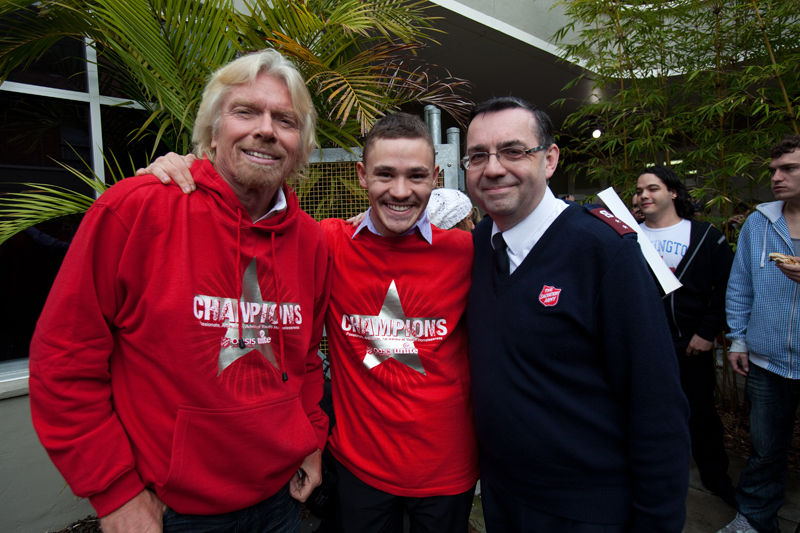
Sir Richard Branson, Damien, Captain Paul Moulds at Oasis in Sydney, Australia
. It got noticed as “celebrity” always does and one person remarked “hanging with the superstars”. I commented back saying that they were all “superstars”. Certainly, Captain Paul Moulds for the work that we devotes himself to with Oasis and reaching out to homeless youth in Australia and Sir Richard Branson for his generous support and making it possible.

But perhaps the biggest “superstar” is Damien, the young man in the middle who turned his life around from being on the streets with barely any hopes and dreams at all to having a job, a place to live and a bright future.

I was attending an event yesterday at Oasis where Branson was cutting the ribbon on the opening of a fitness center that his company Virgin had funded. But prior to the opening of the center, Branson and others listened to the stories of the “champions”, young people like Damien who against all odds, had redirected their lives to a better future. The stories were difficult to hear – stories about being abused – physically, sexually and emotionally. Stories about wanting to die and the attempts that they made on their lives because they felt unwanted and that they had no purpose.

I can’t even begin to really understand the horrors that these kids have faced in their young lives. I can’t even imagine how difficult it was for them to tell their stories, and yet they did so with grace, dignity and compassion for one another. They were there for each other and to show their gratitude to people like Paul Moulds and Richard Branson who make places like Oasis possible. One young man said – “without Oasis, I’d be dead”.

I will never forget that morning and it went far and beyond the thrill of meeting Sir Richard Branson and eating an egg sandwich that he had cooked on the grill. The most important thing I walked away from was being around a group of people with a like-minded purpose. A purpose of doing whatever they can to make a difference – a positive difference in the world. I could see, hear and feel the impact that Moulds and Branson had made in these young people’s lives. It was tangible and real – not just words on the pages of a foundation’s annual report.

As we wind up our time in Australia and head home for a few days break before heading down to South America, I am energized by something that Paul had mentioned during his interview. He was talking about an amazing documentary that was made about Oasis and the issues facing homeless youth in Australia. The documentary was two years in the making and gave an up close look into life on the street for these young people. Paul told me that after the documentary aired on Australian TV, the response and support that followed was astounding. It had made a real impact and prompted people into action – to help with donations or wanting to volunteer.

So I’m energized going forward that our little film will also create awareness and prompt others into action and what they can do to make a positive difference in the world. It’s a simple yet powerful thought and full of possibility – the power that’s within all of us to create change and make the world a better place for those that are less fortunate. The power of possibility – think about it.

Add to FacebookAdd to DiggAdd to Del.icio.usAdd to StumbleuponAdd to RedditAdd to BlinklistAdd to TwitterAdd to TechnoratiAdd to Yahoo BuzzAdd to Newsvine

The Hard Part About Working With DSLR’s

After two solid months of intensive shooting a documentary – shooting both stills and video with two DSLR cameras, the Canon 5D Mark II and 7D, I can honestly say working with these hybrids is not easy. And it certainly isn’t fast, especially if you are working in a small crew as we are.

Yes, the visual is stunning but I can’t help but think how many moments I may have missed that I probably would have gotten if I had been shooting with a video camera. When shooting motion, I have a constant mantra running through my head and that is “shoot and move”. That’s because you need a lot of footage at the end of the day and you need to edit your film. I’m not talking about working with a neatly storyboarded script and a Hollywood crew. I’m talking about working lean and mean and in a somewhat discreet way that is in order when shooting a documentary.

That really hit me last night while shooting on the streets of Sydney, Australia. My subject that I’m focusing on here is Paul Moulds from Oasis, which is a youth support network dealing with homeless street kids. I needed to hit the streets at night and knew that I not only had to be sensitive to the situations that I’d be shooting but also alert to the dangers. I’m positioning myself with a lot of expensive gear in tough neighborhoods where drugs and violence rule.

If ever before I needed to shoot and move and act quickly and keep a third eye out for any lurking danger. No time to stress on the importance of the perfection of the visual. I needed to get in close to the action – make sure my audio was being captured sufficiently and get the story. So even though I can tell you that my visual will be beautiful and lacking “noise” in the blacks – I probably would have gotten better and more meaningful coverage with a video camera.

I’m sure there will be plenty of you who will argue that there are journalists embedded in war zones with these cameras. And of course there’s Vincent LaFloret’s brilliant cinematic night films. But for me, I think there are times when I could have reacted faster with a video camera. And so I think – what’s more important – the resolution or the story?

Add to FacebookAdd to DiggAdd to Del.icio.usAdd to StumbleuponAdd to RedditAdd to BlinklistAdd to TwitterAdd to TechnoratiAdd to Yahoo BuzzAdd to Newsvine

A Birthday Gift

Today was one of those days that are memorable and just make you feel good to be alive and affirm your life’s convictions. Even though I “worked” today – on my birthday – I realized once again that my “work” has never really felt like work at all, but rather a gift.

Once again, because I am a storyteller and a visual communicator by profession and have the great fortune to have been able to make a living doing so, I had the privilege of spending the afternoon with a remarkable woman. Her name is Ronni Kahn, CEO (Chief Energy Officer as she would say) and founder of Oz Harvest, a food rescue program in Sydney, Australia. What Ronni does is quite simple – yet far reaching. She has set up an organization that picks up food from events, parties, affairs etc. that would have normally been thrown away, and sends it over to various charities that feed the needy.

But one of the many remarkable things that Ronni has done was to use her connections and passion to change the law so that people and organizations who were willing to give away their perishable and left over food, could do so without fear of being sued or liable in the process of doing a good deed. Ronni made it happen because she saw the big picture and overcame the obstacles in the way.

We spent the afternoon with Ronni, first touring around the lovely coastal areas of Sydney, then filming her inspirational interview and ended the afternoon at the beach. One thing stuck with me that Ronni said during the interview. She told me that many people tell her that they would love to get involved and do something along the lines that she has done but that it just wasn’t the right time in their lives and then proceed to give her a variety of reasons of why they can’t. And then she said “if you want to do something – you just need to do it”. You need to stop making excuses and live in the “now”.

As I write this blog entry, her words are kicking around in my head and I realize how grateful I am that I am living in the “now” and doing what I feel I need to do. And that is the best birthday gift of all – nothing can ever top that.

Thanks Ronni for a wonderful and memorable day.

Add to FacebookAdd to DiggAdd to Del.icio.usAdd to StumbleuponAdd to RedditAdd to BlinklistAdd to TwitterAdd to TechnoratiAdd to Yahoo BuzzAdd to Newsvine

Professional Still Photographers as Amateur Videographers

These days many still photographers are frustrated when their clients decide to take their own pictures or get photos from amateurs who take photos that are good enough. And sometimes “good enough” is not only good enough – it’s pretty good because technology has enabled just about anyone to take a reasonably good photograph.

Indeed technology has lowered the bar to the entry into the realm of professional photography. But any pro knows there is more to “making” a good photo than the actual execution of an image. There are many problems to solve, and there’s the matter of being able to consistently make good photos.

But I must tell you, over the past year I have seen still photographers exhibit the same attitude that they abhor in their clients when it comes to the medium of video. As more and more still photographers embrace video because of hybrid cameras like the Canon 5D Mark II, many fall victim to the same line of thinking and that is if they buy a “good” camera that shoots “HD” video – that’s all they need to throw out the “video shingle” and they’re in business.

The problem is they lose sight of some very important things:
1. Shooting motion requires a different thought process
2. Audio is everything
3. Post production is very different for video than for still images
4. Video is a collaborative process

So when I get a question from a still photographer as to “what is a good video camera?” – I bounce the question right back at them and say – when an amateur photographer asks you what still camera takes good pictures – what do you say? Most quickly get the analogy and realize that while they are pros in the still photography world – buying a video camera or an HDSLR doesn’t make them professional a videographer. Motion is a wonderful medium, but get to learn the craft because it’s more than just the camera.

Add to FacebookAdd to DiggAdd to Del.icio.usAdd to StumbleuponAdd to RedditAdd to BlinklistAdd to TwitterAdd to TechnoratiAdd to Yahoo BuzzAdd to Newsvine

I Don’t Believe in Re-Inventing Myself

I hear an awful lot of people these days saying they are re-inventing themselves. I always take pause when I hear that because I think to myself that I don’t want to re-invent myself.

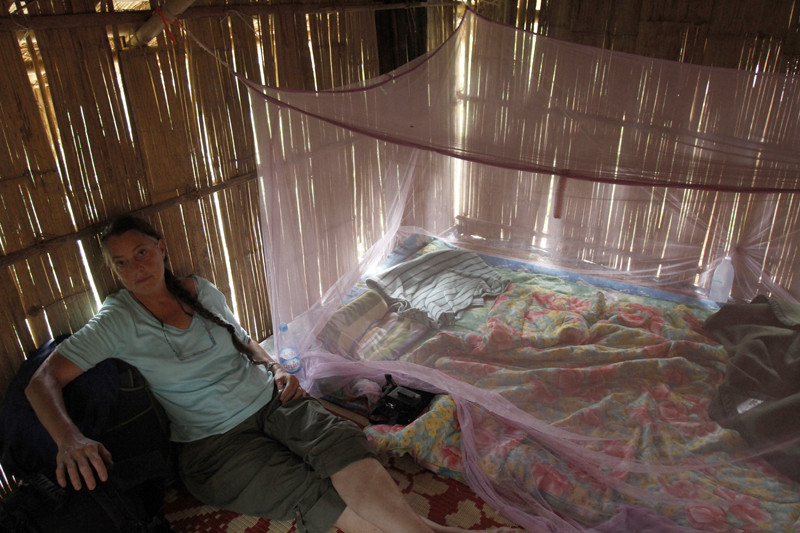
Gail in bamboo hut in hill tribe village, northern Thailand

I like who I am and what I do – so why change it? It doesn’t really matter to me if I’m in vogue or doing what everyone else is. What matters is that I’m true to myself.

Don’t get me wrong – I’m not stuck in the 1970’s and wishing for the good old days. It’s just that I’ve always kind of done what moves me – what I just have to do. So in that sense I suppose one would say that I re-invent myself on a daily basis. But in fact I’ve always lived my life and pursued my career based on what that little voice or “inner self” is telling me to do.

Has that inner voice always been right? Many times when things don’t have the kind of outcome that I expected, I’d probably say that my inner voice led me astray. But in fact, the outcome was what it was meant to be – even though it wasn’t what I wanted. Things happen for a reason and things happen when they are meant to happen.

There have been times when I’m in such a hurry – in pursuit of my dream – that I don’t stop and realize that my dream is happening right then and there. On those days when I feel that I’m just a day away from where I want to be – I try to remind myself that maybe I’m already there.

In my 99-day journey around the world, I try to remind myself on a daily basis – not to look ahead to my next destination but to relish the one I’m in. A powerful thought and an even more powerful action.

So as I continue on following what that inner voice is telling me, I realize this is what I’m meant to do and this is the time that I’m meant to do it. I believe that and know that this is all happening for a reason. This is my path and where it will lead, I’m not certain. But I’ll follow along with faith and good judgment and never feel forced to re-invent myself.

Add to FacebookAdd to DiggAdd to Del.icio.usAdd to StumbleuponAdd to RedditAdd to BlinklistAdd to TwitterAdd to TechnoratiAdd to Yahoo BuzzAdd to Newsvine

Beyond the HDSLR and the G4 iPhone

Everyone these days seem obsessed with the tools. The blogosphere is full of tech talk but few mention the art of storytelling. Without that, we are left with technique with no apparent message – or one that is weak at best.

When I think about it, the videos and photographs

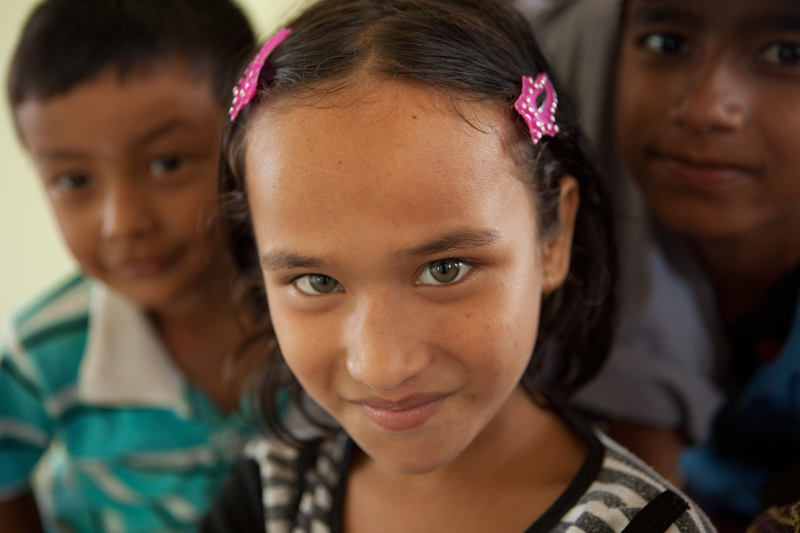
School girl in Surkhet, Nepal

that really resonate with me and stay with me for any length of time are not examples of shifting depth of field or low light marvel, but rather pieces that have touched me because of the story that they tell.

The story that we have to tell is also one facet of video making where we can stand out as being truly unique. Our stories are our songs where we reveal a part of ourselves. If our films are solely portfolios of technique and examples of what our tools can achieve, then we do not separate ourselves from our competition. We can all buy the same gear, gadgets and gizmos and with that run the risk of being button pushers.

I suggest that we all work backwards. That we define the message that we want to communicate and then choose the right tool that will appropriately fill that need. In order to do that, we need to step back and experience life itself. See what the world has to offer, discover our passions and have something worth talking about before we even begin to pick up a camera – whatever camera that may be.

Add to FacebookAdd to DiggAdd to Del.icio.usAdd to StumbleuponAdd to RedditAdd to BlinklistAdd to TwitterAdd to TechnoratiAdd to Yahoo BuzzAdd to Newsvine

Staying Connected

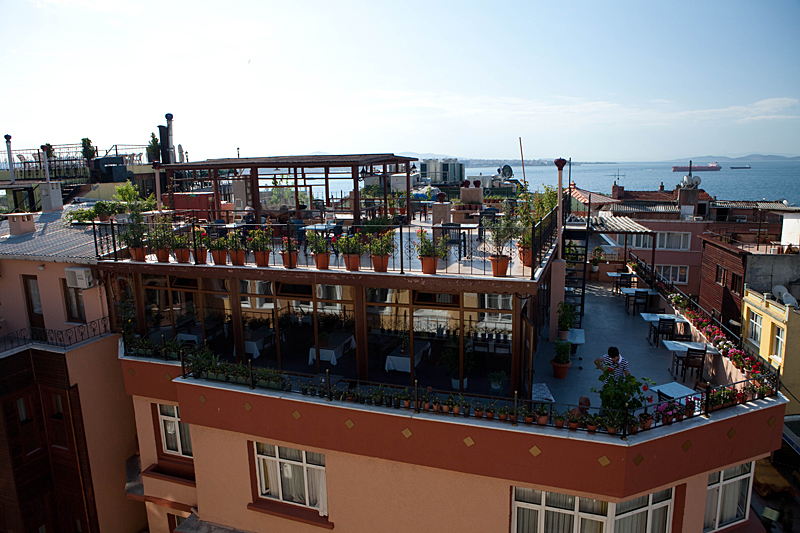
I’m sitting on the rooftop of my small hotel in Istanbul on a glorious morning.  In front of me is the Blue Mosque,

Blue Mosque

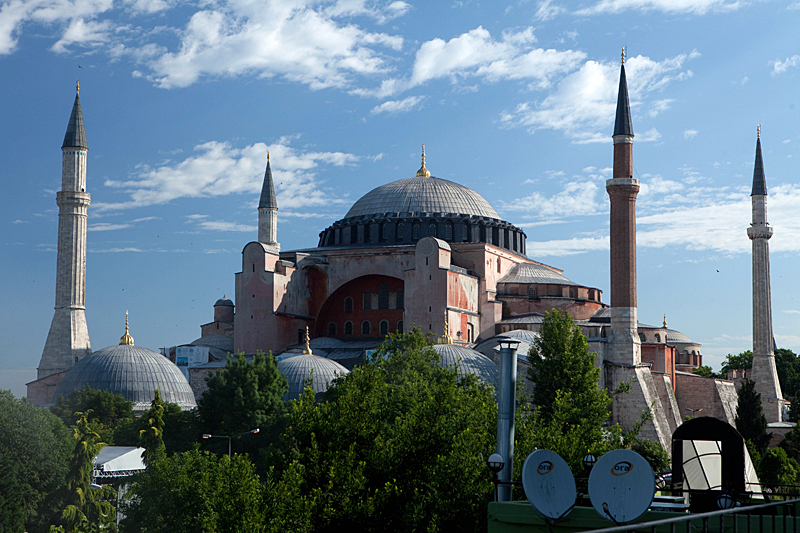
behind me Hagia Sophia

Hagia Sophia

and to the left the Bosphorus Strait.  I’m feeling blessed that I can experience these sights in my lifetime and even more fortunate that I can see them with my daughter Erin.

From the rooftop of our hotel.

We are about 1/3 through our journey of circling the globe creating a documentary on people who are making a positive change in the world  – Opening Our Eyes. Just like at home, I relish the quiet peace of the early mornings when I take time to reflect on what’s ahead in my day or write down the random thoughts that pulse through my mind.  The mornings are my time and even in the hustle and bustle of moving from one destination to the next, I try to take this time for myself.

As I look across other rooftop gardens and watch as people start their day, I’m thinking about my first travels and how so different it was back in the early 1970’s to stay in touch with people back home.  There was no Internet, nor cell phones and making a call required investing some time in a telephone exchange office until they placed your overseas call and directed you to a booth.  Because it was so costly, you crossed your fingers that someone would be home or that you wouldn’t get a busy signal – no answering machines back then.  And if you were so fortunate to connect , you made every word and minute count and talked rapidly.  Every once in awhile I would get a letter from home that was either sent to the local American Express office or to General Post.  It still amazes me that I got anything in the mail back then and somewhere in my boxes of memorabilia are those precious letters waiting to be discovered some rainy day.
Nowadays it seems that one is always connected.  Even when I’ve been in somewhat remote spots without Wifi or wired connection, my global phone has worked and I’ve gotten emails.  It’s great to be able to stay connected and with that comes a sense of security.  But it’s also easy to be too connected and miss some of the nuances of the culture you are in.  Like everything there is a fine balance.

Many people asked me how I was going to be able to keep in touch with clients when I was gone and wasn’t I worried that being away for a 3-month period would be detrimental to my business.  I’m very fortunate that I have a partner and husband Tom who is holding down the fort while I’m gone – paying the bills, servicing our clients, marketing and everything else that goes into keeping a business alive in a struggling economy.  I’m also taking full advantage of the time we live in and the ease of staying connected through emails and blogs.  Not only am I able to stay in touch with clients,  I am keeping them abreast of my project and building a larger audience and presence in the process.

It’s an amazing time we live in and having grown up when I did, I take none of this for granted.   I’m going to sign off for now and take myself offline to connect with the place I’m in – the people, the culture, the landmarks – the sights, the smells and the sounds.  Thanks for listening and more importantly for all your thoughts, comments, Facebook posts and emails and keeping me connected

Add to FacebookAdd to DiggAdd to Del.icio.usAdd to StumbleuponAdd to RedditAdd to BlinklistAdd to TwitterAdd to TechnoratiAdd to Yahoo BuzzAdd to Newsvine

My DSLR Kit for a Three-Month Road Trip

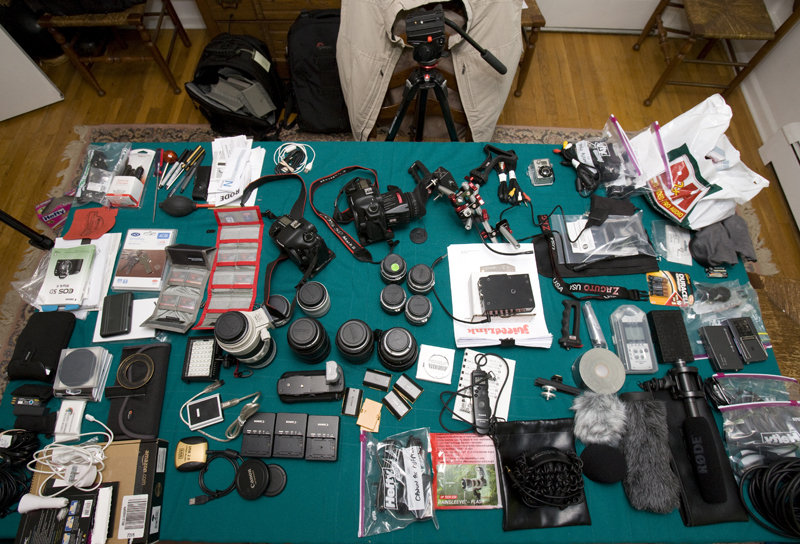
For those who have been following this blog you know that I’m getting ready to depart for a 3-month trip around the world creating a documentary with my daughter – Opening Our Eyes.  Here is what I’ve managed to fit into two backpacks – it just fits.  Thank goodness there’s two of us.
Please follow our journey http://www.openingoureyes.wordpress.com

Canon 5D Mark II
Canon 7D
Canon 16-35mm 2.8
Canon 24-70mm 2.8
Canon 70-200mm 2.8
Canon 70-300mm 4.5
Canon 1.4X tele extender
Canon 2X tele extender
Nikon/Canon lens adaptor
Nikkor 14mm rectilinear lens f2.8
Nikkor 50mm 1.4
Nikkor 85mm f2
6 Batteries for Canon
1 Battery grip for 5D
3 Battery chargers
Remote control for Canon
AC adaptor for Canon
Rycote Hot shoe extension
4 – 16 GB flash cards – all cards – Sandisk UGMA
4 – 8 GB flash cards
2 – 8 GB SDHC cards
2  – 4 GB SDHD cards
Neutral density filter kit
Polarizer
Epson P6000 digital wallet
Zoom H4n digital audio recorder
JuicedLink DT454  audio preamp
Rode shotgun mic
Tram lav mic
Sennheiser Transmitter/Wireless kit
“Dead Cats” (windscreens)
XLR cords
Headphones
HD Hero helmet camera with attachments
Flip HD
ManfrottoTripod and fluid head
Small Matthews boom stand for mic
Reflector
Zacuto Z-Finder

Zacuto Striker Rig
Flex DSLR remote
Lacie Rugged Hard drives – 4000 GB memory!
Firewire and USB cords
3 – card readers
2 MacBookPro Laptops
1 extra laptop battery
1 extra AC adaptor for laptop
Kindle
iPod
Blackberry Tour
2 Scotte Vests – with 22 pockets in each

Add to FacebookAdd to DiggAdd to Del.icio.usAdd to StumbleuponAdd to RedditAdd to BlinklistAdd to TwitterAdd to TechnoratiAdd to Yahoo BuzzAdd to Newsvine

Photographers/Filmmakers as Publishers/Producers

It’s been a busy year, trying to manage jobs and lots of road trips giving seminars for ASMP to photographers who may be contemplating video.  I’ve enjoyed meeting my peers and sharing information through my presentations as well as on my blog, but I need to take some time to get back in the field and capture my own “moments” and “motion”. I need to spend some time “doing” right now and ultimately that will make what I have to share that more valuable and meaningful. So I will be embarking in a couple of weeks on a “passion project” that will take me around the world for 99 days.

It’s an exciting time to be working on a personal project because of various distribution possibilities and portals that are in everybody’s hands.  Ten years ago when I got started in video, technology made it possible for me to create documentaries and films without the need of large crews and big budgets.  And now with the web, fast download speeds, video host sites, mobile devices and itunes – I can – we all can be publishers and producers and get our content out globally. The pipelines have been democratized and it’s a very empowering position.

I’ve spent a career on the road and on assignment for various publications and corporations.  I’ve been fortunate to have worked for magazines like National Geographic Traveler, Smithsonian and Travel & Leisure shooting stories on destinations and people all over the world. I suppose you could say that I lived the life I dreamed of. I was shooting these assignments at a time when magazines were giving me ample time in the field to come back with a story – back when travel magazines ran stories as opposed to survey pieces or celebrity profiles. More importantly, I maintained the copyright of my images and was free to market them as I wished after a standard embargo period was over – usually around 90 days.

These days many publishers issue “work for hire” contracts, so essentially photographers are giving up their copyright. Photographers have always been strong advocates for copyright and I include myself in that position.  But in our advocacy to keep strong copyright laws in place, we end up fighting for that right for large corporations and publishing empires who ultimately take away our copyright in lopsided contracts.  And for the most part these contracts are not negotiable.  You either agree and take the job or you don’t.

These days because of technology we can be our own publishers and deliver our stories and other content in a number of different ways.  Sure it means taking the risk up front but that in itself brings its own rewards. It’s very liberating to be shooting and answering only to myself – not second-guessing someone else.  I take more chances creatively because I’m not afraid to fail.  And every time I’ve ever done that, I’ve grown and the rewards have been many – both creatively and financially.

I don’t know exactly how and where my Opening Our Eyes project will be distributed when I complete my journey.  But these days – it could be a book, a multimedia exhibition, a feature film distributed through itunes or on a DVD through Amazon, various magazine articles or broadcast.  I could package the journey and the back-story and give talks to universities.  An endless sea of possibilities.  What an amazing time we live in where we can all make our dreams come true.

Add to FacebookAdd to DiggAdd to Del.icio.usAdd to StumbleuponAdd to RedditAdd to BlinklistAdd to TwitterAdd to TechnoratiAdd to Yahoo BuzzAdd to Newsvine

Shooting With the Canon 5D Mark II

Two weeks from today, I will depart for a 99-day journey circling the globe working on a passion project Opening Our Eyes.  It will be both an adventure and a humbling experience.  But right now I’m getting down to the wire and trying to tie up a million loose ends.

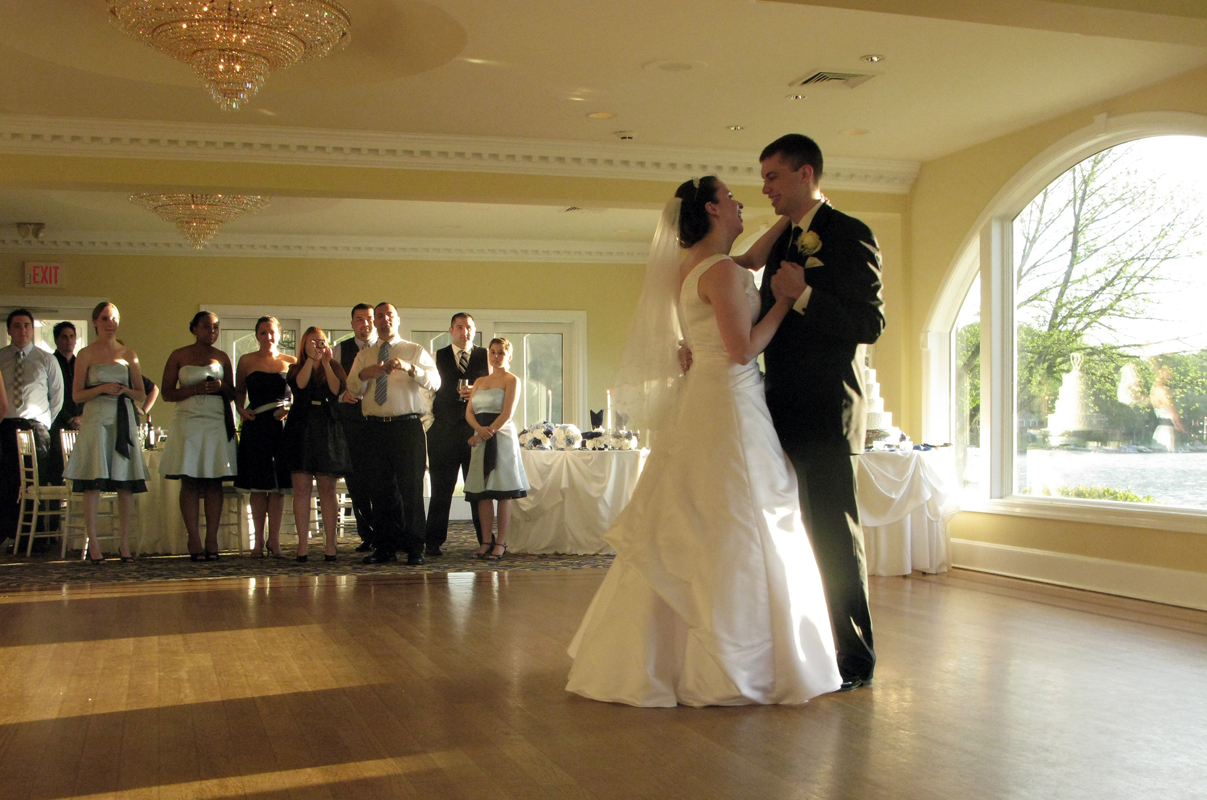
This past weekend, I took a break from the details to attend the wedding of my nephew – my sister’s oldest son.

Chris and Trish Saal ©Thomas Kelly

I thought this would be a great opportunity to really do a test run with my new Canon 5D Mark II with the Zacuto rig Striker.  I wanted to capture good audio as well so I ran the Rode mic via XLR connection to the JuicedLink DT454.  To be honest, I was going to capture the audio two different ways – via the JuicedLink and also straight from the mic to the camera via mini jack, but I forgot to bring the XLR to mini jack cord so I ended up capturing all my audio via the JuicedLink. Because the 5D has had a firmware upgrade where I was able to turn off the AGC, I used the JuicedLink with the AGC disabler turned off. But until Canon issues a firmware upgrade for the 7D that allows you to turn off the AGC, you can use the JuicedLink to disable it.

Ultimately this combination was a nice way of working candidly.  I had the Rode mic and JuicedLink attached to an extender on the top of the camera, although I will probably attach the JuicedLink to the Zacuto rig in the future, leaving just the mic on the camera’s hot shoe.  But either way, I was able to get good ambient sound and/or spontaneous sound bites from people. I had done previous testing to know that I first needed to calibrate the camera audio by going into manual settings and dialing the audio down half way.  Then I dialed the volume down on the JuicedLink to whatever setting is necessary according to the meter levels.  In a noisy atmosphere with loud music like a wedding reception, I had it dialed way down.  You never want “hot” audio where the volume levels are spiked.

The image is simply stunning and I am really sold on the look. I shot in late afternoon sunlight as well as on a dark dance floor and the camera handled both beautifully.  The Striker rig with the Zacuto Z-Finder Pro 3Xworked great for stabilization and I didn’t find the focusing to be as hard as I thought it would be.  The Z-Finder Pro 3X is very sharp with built in diopters.  The striker is light and with the camera strap around my neck, it was easy to be in standby mode, relieving some of the stress on my hands.

I did notice though that I tended to start shooting more with a still “moment” mentality rather than in video/motion b-roll.  When I shoot video I have a mantra running through my head to “shoot and move” – meaning shoots lots of variations, from wide shots to close-ups from a variety of angles.  When shooting at the reception I found myself defaulting to one spot – rather than covering the angles and focal lengths, but then again I was caught up in the “personal” moment of the event so I wasn’t thinking too much about “getting the job done”.

All in all I have to say that I really loved working with this camera and I definitely love the “feel” of the images.  I can’t wait to really test it out over the next three months, and I’ll keep you posted.  See a short video “snippet”.

Add to FacebookAdd to DiggAdd to Del.icio.usAdd to StumbleuponAdd to RedditAdd to BlinklistAdd to TwitterAdd to TechnoratiAdd to Yahoo BuzzAdd to Newsvine