These days many still photographers are frustrated when their clients decide to take their own pictures or get photos from amateurs who take photos that are good enough. And sometimes “good enough” is not only good enough – it’s pretty good because technology has enabled just about anyone to take a reasonably good photograph.
Indeed technology has lowered the bar to the entry into the realm of professional photography. But any pro knows there is more to “making” a good photo than the actual execution of an image. There are many problems to solve, and there’s the matter of being able to consistently make good photos.
But I must tell you, over the past year I have seen still photographers exhibit the same attitude that they abhor in their clients when it comes to the medium of video. As more and more still photographers embrace video because of hybrid cameras like the Canon 5D Mark II, many fall victim to the same line of thinking and that is if they buy a “good” camera that shoots “HD” video – that’s all they need to throw out the “video shingle” and they’re in business.
The problem is they lose sight of some very important things:
1. Shooting motion requires a different thought process
2. Audio is everything
3. Post production is very different for video than for still images
4. Video is a collaborative process
So when I get a question from a still photographer as to “what is a good video camera?” – I bounce the question right back at them and say – when an amateur photographer asks you what still camera takes good pictures – what do you say? Most quickly get the analogy and realize that while they are pros in the still photography world – buying a video camera or an HDSLR doesn’t make them professional a videographer. Motion is a wonderful medium, but get to learn the craft because it’s more than just the camera.
I hear an awful lot of people these days saying they are re-inventing themselves. I always take pause when I hear that because I think to myself that I don’t want to re-invent myself.
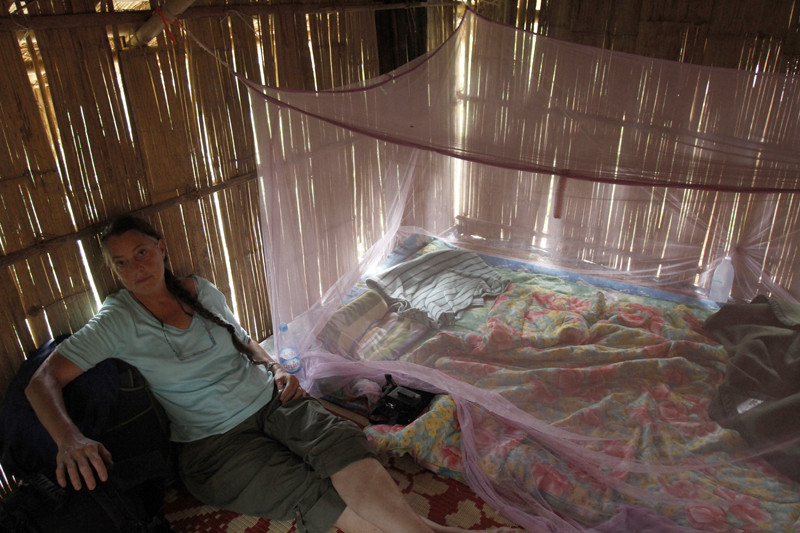
Gail in bamboo hut in hill tribe village, northern Thailand
I like who I am and what I do – so why change it? It doesn’t really matter to me if I’m in vogue or doing what everyone else is. What matters is that I’m true to myself.
Don’t get me wrong – I’m not stuck in the 1970’s and wishing for the good old days. It’s just that I’ve always kind of done what moves me – what I just have to do. So in that sense I suppose one would say that I re-invent myself on a daily basis. But in fact I’ve always lived my life and pursued my career based on what that little voice or “inner self” is telling me to do.
Has that inner voice always been right? Many times when things don’t have the kind of outcome that I expected, I’d probably say that my inner voice led me astray. But in fact, the outcome was what it was meant to be – even though it wasn’t what I wanted. Things happen for a reason and things happen when they are meant to happen.
There have been times when I’m in such a hurry – in pursuit of my dream – that I don’t stop and realize that my dream is happening right then and there. On those days when I feel that I’m just a day away from where I want to be – I try to remind myself that maybe I’m already there.
In my 99-day journey around the world, I try to remind myself on a daily basis – not to look ahead to my next destination but to relish the one I’m in. A powerful thought and an even more powerful action.
So as I continue on following what that inner voice is telling me, I realize this is what I’m meant to do and this is the time that I’m meant to do it. I believe that and know that this is all happening for a reason. This is my path and where it will lead, I’m not certain. But I’ll follow along with faith and good judgment and never feel forced to re-invent myself.
Everyone these days seem obsessed with the tools. The blogosphere is full of tech talk but few mention the art of storytelling. Without that, we are left with technique with no apparent message – or one that is weak at best.
When I think about it, the videos and photographs
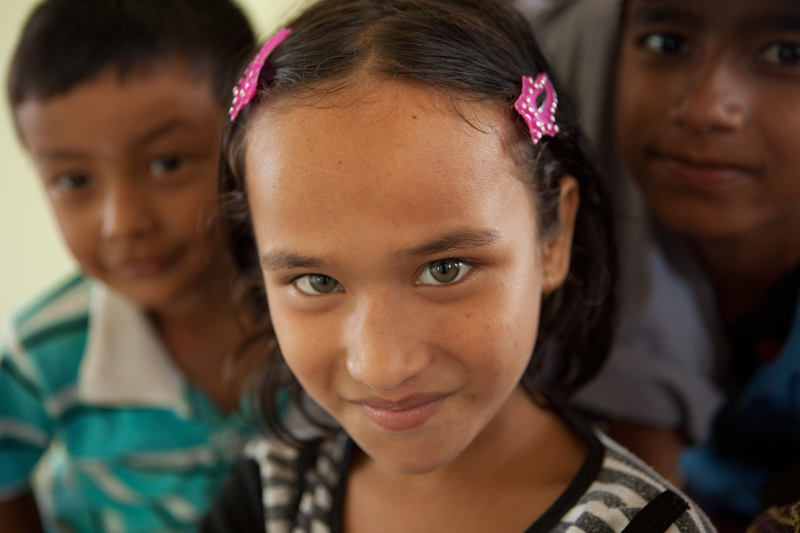
School girl in Surkhet, Nepal
that really resonate with me and stay with me for any length of time are not examples of shifting depth of field or low light marvel, but rather pieces that have touched me because of the story that they tell.
The story that we have to tell is also one facet of video making where we can stand out as being truly unique. Our stories are our songs where we reveal a part of ourselves. If our films are solely portfolios of technique and examples of what our tools can achieve, then we do not separate ourselves from our competition. We can all buy the same gear, gadgets and gizmos and with that run the risk of being button pushers.
I suggest that we all work backwards. That we define the message that we want to communicate and then choose the right tool that will appropriately fill that need. In order to do that, we need to step back and experience life itself. See what the world has to offer, discover our passions and have something worth talking about before we even begin to pick up a camera – whatever camera that may be.
Technically, I began working on my latest documentary, “Opening Our Eyes” about 7 months ago when the idea came to me. I had just seen Robert Frank’s show “The Americans” at the Met in New York City with a friend of mine and I commented to him that I was really yearning to get back to my beginnings and take a visual road trip.
Even though I had spent a lifetime traveling and shooting assignments for editorial and corporate clients, I never lost sight of my passion to explore with my camera.
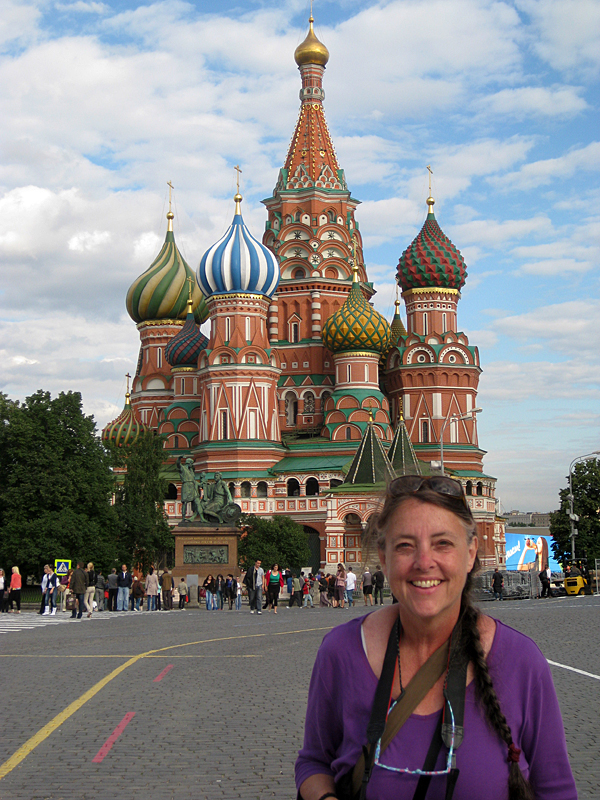
Gail at Red Square, Moscow
In the beginning, my explorations were through the lens of my still camera but when I started shooting motion about ten years ago, my tool of choice became a video camera and with that came self assigned documentaries.
It had been two years since my last passion project “Freedom Riders” and I was itching to start another. My daughter had just graduated from college, I was an emptynester and pretty much free to do as I pleased. I had accumulated over 300,000 airline miles, thousands of hotel award points and another 300,000 plus American Express points. I didn’t know what I was saving them for but it seemed like a good time to use them. So, I made a decision to take a trip around the world. I felt like I still had the energy and stamina to take on such a journey but something was missing – I needed a purpose.
The Idea
I have always been interested in the “common man” as opposed to the celebrity and the simple story that resonates in a viral way. I’m intrigued by people who go up against all odds, to right a wrong or fight for a cause and never give up. I usually side with the underdogs and am inspired by the Cinderella stories. And so after that day at the Met, an idea was born and that was to shine a spotlight on 6 people on 6 different continents who were making a positive difference in the world because it was their calling to do so.
Of course coming up with an idea is the easy part and many times those great ideas seem to drift away with time as one gets caught up in daily work and life. But this idea wasn’t going away – I knew it was the right time for me to bring these stories to life. My goal was to create individual videos about each of these people that would combine together as a feature documentary. My hope was that the film would not only create awareness of my subjects’ efforts, but also motivate others to create change.
The Pre-Production and Facilitation
Next came the hard part – making it a reality and the first step was figuring out how I would fund it. After working on 2 other self-assigned passion projects, I knew one thing and that is that it’s really hard to sell an idea. When I was in the planning stages of The Delta Bluesmen, I spent a lot of time applying for grant money and seeking funds from a variety of sources to no avail. I finally got frustrated and decided to self fund the project even though it meant taking it a bit slower and doing more of the work myself. My critics thought I was crazy to tackle a short film by myself and self fund it but I stuck to it and created a piece I’m proud of and which has brought many rewards to my life. So with that experience behind me, I took another leap of faith on my latest project and started the planning process. But perhaps most importantly, I focused on the fact that the positive aspects of working on a self-funded project is that it would be the way I wanted it to be – not compromised for the wrong reasons.
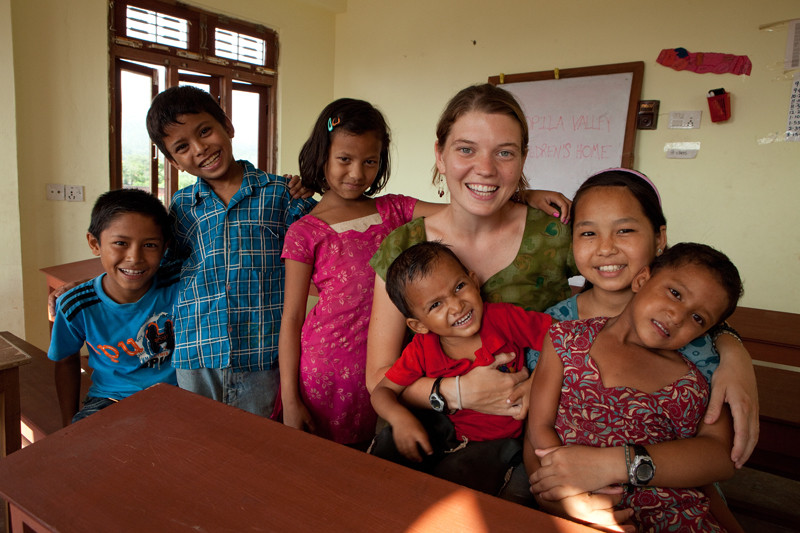
My first order of business was to send out a query to everyone I knew as well as use social media to find my subjects. My first subject was a given – a local young woman my daughter went to high school with, Maggie Doyne,
Maggie and some of her children
who opted not to trek off to college after high school. Instead she wound up in Nepal and built a home for orphaned children. She’s 23 years old now, has 30 children in her home and is in the process of building a school. Then my daughter Erin, expressed interest in working on this project with me. She knew she’s need to leave quit her job, sublet her apartment and say goodbye to her boyfriend for 3 months – but she wanted to be part of it. And so we became a duo and with that the project really took off with her support and help.
Since the project was self-funded, I had to be extremely creative with the budget – or lack thereof. So after nailing down our subjects across the globe, we started to plan the logistics –airline tickets, hotel rooms, visas, vaccinations and of course equipment needs. From January to May, I spent countless hours booking reward tickets with 14 airlines for 29 flights – a round the world itinerary with extra local hops thrown in. I’ve arranged for 99 nights of accommodations, staying with friends, friend of friends, using reward points, paying for budget hotels and bartering for other rooms. I had to bite the bullet and pay large sums for our vaccinations and visas and budget for our meals. Most importantly, I needed to purchase new gear because my intent was to shoot this project with the HDSLR cameras. I knew I wanted to shoot stills and video and also knew that I had to travel lean and mean so this seemed like the best solution. You can read more about the gear here.
The Execution
We are about one third through the shoot and have worked on 3 continents. The scheduling has turned out to be brilliant – we work hard and exhaust ourselves for chunks of time – anywhere from a week to ten days and then have a few days to recoup, catch up on sleep, write in our blogs, or just sightsee and take some still snapshots along the way. We’ve had a couple mother/daughter disagreements but for the most part we are having the time of our life and seeing the world. At this point we sometimes forget which currency we are using or what the exchange rate is or what our room number is but in the process of creating a film, we have built a lifetime of memories.
We have also created an audience who tune into our project blog religiously and follow our journeyas we go along. But something remarkable is happening and that is evident in the comments we are getting. We are opening people’s eyes though our travels and our writings. We have connected our audience with our subjects and their endeavors and are building a global community. It has been truly inspirational meeting and working with our subjects and there are days that my heart is full to bursting and confirms my belief in this project.
Post-Production
When we return in September, my first priority will be to edit the videos that I promised in barter arrangements. And hopefully at the end of the month, I will begin the edit. It will most likely take me a month just to log and transcode the footage and sync the audio in the situations where it was captured independently. I’m confident in my editing abilities but I would love to work with a pro. So if there is a pro out there reading this who would love to get involved in a fabulous documentary – I’d love to hear from you.
Distribution
Not really thinking about this part right now other than to use social media and perhaps itunes and Amazon to distribute it. But I have faith in this project and something tells me that this will take on a life of its own. It’s a feel good story and we’ve already gotten a lot of support and interest.
At any rate it’s the trip of a lifetime and I’m taking it with my daughter so I’ve already been blessed.
I’ve been working quite a bit lately with both the Canon 5D Mark II and the Canon 7D, shooting video. I’ve been shooting video with traditional video cameras for the last 11 years so I wasn’t in the dark as to how to shoot motion. But I’m not ashamed to say that I’ve made my share of mistakes with these hybrids.
Here are a few to watch out for:
Don’t forget about audio. So many still photographers forget the importance of audio and then what they are left with are a bunch of video clips with lousy or unusable sound.
Don’t capture audio with the camera mic. You’ll never get good sound if you do. I also stay away from plugging in an external mic with the mini stereo plug.
Don’t turn off the camera mic when using an independent audio recorder. It’s always good to have the audio recorded to cards through the camera to use as a reference when syncing the sound later in post.
Don’t discount reading the manuals. A lot of shooters think since they are coming from a photographic background, they don’t need to read the manuals. There are big differences when shooting video – make sure you read the manuals about some of the nuances and avoid making stupid mistakes.
Don’t shoot video like a still photographer. Remember video is time in motion – so let motion play out in the camera. Let subjects move in and out of your frame. Let the camera roll – don’t shoot moments in time.
Don’t forget about the story and sequencing. I usually see the big picture when I’m shooting. I think about the finished completed movie in my mind’s eye so when I’m shooting I’m always thinking about what is coming next – where will I go from this shot – where did I come from. If you don’t think like this then you’ll have a disconnected mess that won’t be easy to edit.
Don’t be sneaky. These cameras look and are still cameras. Don’t deceive people into thinking that you’re not shooting video and/or sound.
Get it right in camera. Unlike still photographs, video doesn’t do as well when it’s over manipulated or corrected in post, especially when trying to crop or enlarge the image.
Don’t skimp on you shots. When shooting b-roll video – you’ll need lots of it to tell the story in post. Shoot different focal lengths as well as angles for variety to cut to.
10. Don’t shoot verticals. I know, I know there will be some of you that will disagree with me but if you want a vertical – don’t turn the camera sideways – crop the vertical in post. A contradiction perhaps to #9 you say. Well there are always exceptions.
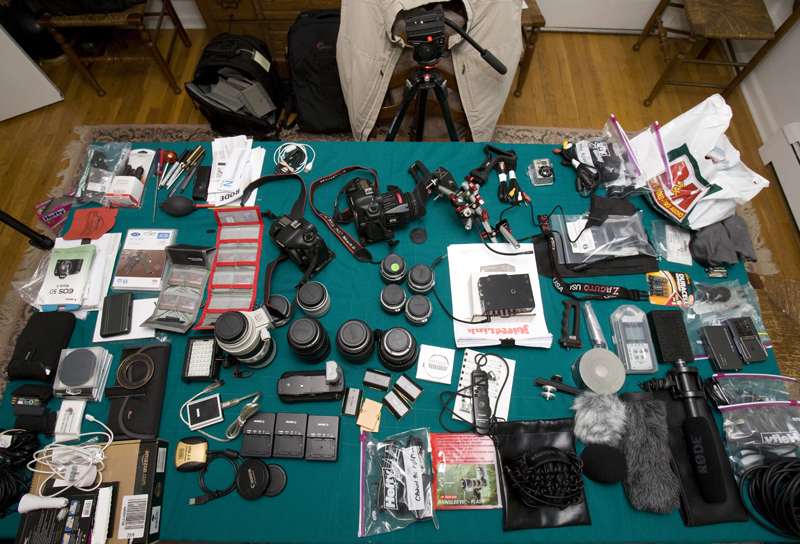
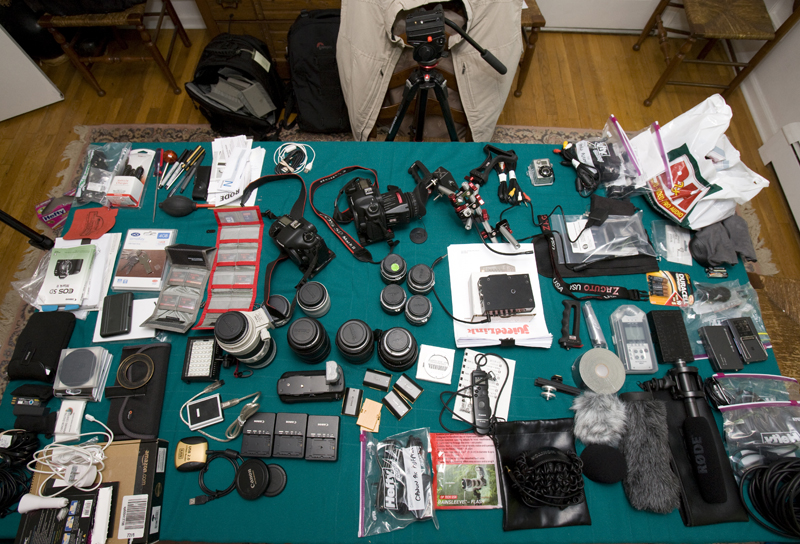
When I embarked on my 3-month journey to create a documentary Opening Our Eyes, I posted a blog entry about what I was packing. http://tiny.cc/7pc9f
I received quite a few comments – publicly posted and otherwise and many people remarked that I was taking too much. After one month into this sojourn, I thought perhaps an update would be in order.
The main verdict is – my hunches were pretty much on target and I didn’t over pack. Sure it’s a lot to carry – but there are two of us and it all fits into two medium sized photo backpacks. I have used all the lenses that I brought except my old Nikon fixed lenses that I planned to use with the converter. Those I could have left behind – but the trip is not over yet so I’ll have to wait on that determination.
Bringing two camera bodies is a must if only from a back up point of view but when shooting stills as well as video, it’s a lot faster to have one dedicated for video and one for stills, especially when shooting with the Zacuto Z-Finder and rig.
And bringing two laptops has proven to be a very smart move. I had recently purchased a new Mac laptop with the latest operating system and there have been numerous times when I could not connect with the Internet – but the older laptop (2 years old) has had no problems. That and with limited Internet time, when we are able to get online, having two computers has saved a lot of arguments over computer time between my daughter and myself. We take full advantage in the airline club lounges to upload items and check email while waiting for flights. I have also had to rely on my extra laptop battery for the older Mac as the original battery was no longer holding a charge for more than an hour.
My audio equipment is sufficient and I am constantly switching back and forth between capturing my audio directly to the camera cards with the JuicedLink DT454 and separately with the H4n Zoom. One item I do not have that I really need is a male-to-male XLR cord. I found out that I couldn’t use my wireless set with either the JuicedLink or the Zoom because they both need male ends and I only have male to female XLR cords. I keep thinking there must be a solution that I’m overlooking so if someone has any thoughts – please let me know.
The small Matthews boom stand rig that I put together is terrific. It was meant to be used for table top studio shooting but for me it is perfect because it breaks down into multiple pieces, is light weight and easy to use.
I’m backing everything up onto two hard drives and I have just now used up the first two (500 G) drives. That leaves me with 6 more drives which is just about perfect depending on how much I will shoot.
Lastly, my iPod has helped with my sanity on these long flights and layovers and my Blackberry Tour phone has worked everywhere and it simply amazes me. Many times it has been our only connection to home. So I have to give kudos to Verizon and their global service. I’m truly impressed. Still a lot of remote places to go – so we’ll see how well it does as we move on.
I stop and think about the equipment we are carrying and the new technology and how this would not have been possible just 5 years ago. It’s an amazing time we live in and I’m taking full advantage of it. Can’t wait to see what the future will bring.
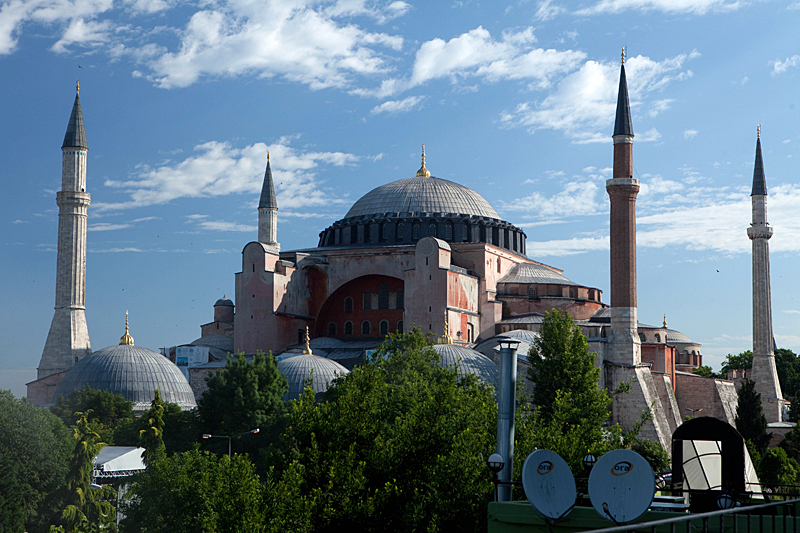
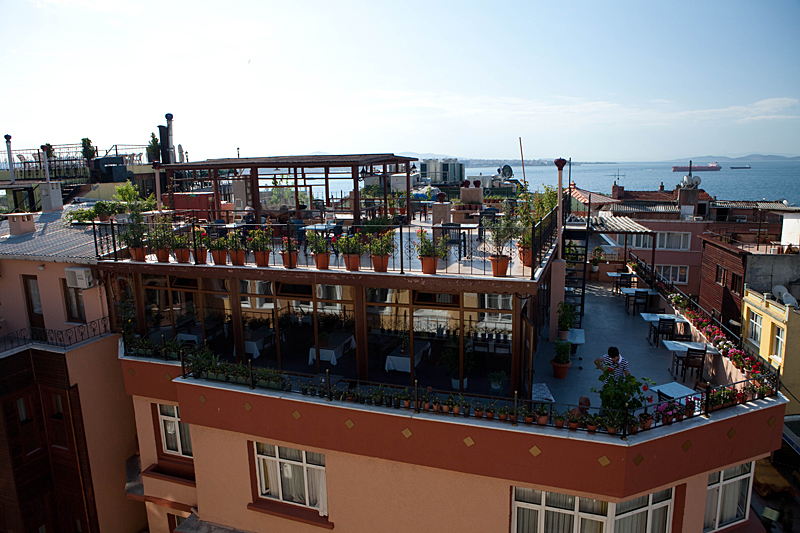
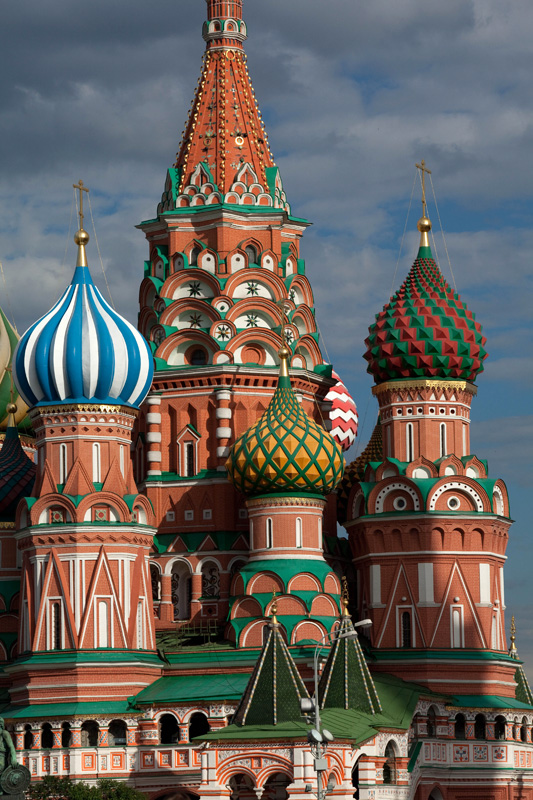
I’m sitting on the rooftop of my small hotel in Istanbul on a glorious morning. In front of me is the Blue Mosque,
Blue Mosque
behind me Hagia Sophia
Hagia Sophia
and to the left the Bosphorus Strait. I’m feeling blessed that I can experience these sights in my lifetime and even more fortunate that I can see them with my daughter Erin.
From the rooftop of our hotel.
We are about 1/3 through our journey of circling the globe creating a documentary on people who are making a positive change in the world – Opening Our Eyes. Just like at home, I relish the quiet peace of the early mornings when I take time to reflect on what’s ahead in my day or write down the random thoughts that pulse through my mind. The mornings are my time and even in the hustle and bustle of moving from one destination to the next, I try to take this time for myself.
As I look across other rooftop gardens and watch as people start their day, I’m thinking about my first travels and how so different it was back in the early 1970’s to stay in touch with people back home. There was no Internet, nor cell phones and making a call required investing some time in a telephone exchange office until they placed your overseas call and directed you to a booth. Because it was so costly, you crossed your fingers that someone would be home or that you wouldn’t get a busy signal – no answering machines back then. And if you were so fortunate to connect , you made every word and minute count and talked rapidly. Every once in awhile I would get a letter from home that was either sent to the local American Express office or to General Post. It still amazes me that I got anything in the mail back then and somewhere in my boxes of memorabilia are those precious letters waiting to be discovered some rainy day.
Nowadays it seems that one is always connected. Even when I’ve been in somewhat remote spots without Wifi or wired connection, my global phone has worked and I’ve gotten emails. It’s great to be able to stay connected and with that comes a sense of security. But it’s also easy to be too connected and miss some of the nuances of the culture you are in. Like everything there is a fine balance.
Many people asked me how I was going to be able to keep in touch with clients when I was gone and wasn’t I worried that being away for a 3-month period would be detrimental to my business. I’m very fortunate that I have a partner and husband Tom who is holding down the fort while I’m gone – paying the bills, servicing our clients, marketing and everything else that goes into keeping a business alive in a struggling economy. I’m also taking full advantage of the time we live in and the ease of staying connected through emails and blogs. Not only am I able to stay in touch with clients, I am keeping them abreast of my project and building a larger audience and presence in the process.
It’s an amazing time we live in and having grown up when I did, I take none of this for granted. I’m going to sign off for now and take myself offline to connect with the place I’m in – the people, the culture, the landmarks – the sights, the smells and the sounds. Thanks for listening and more importantly for all your thoughts, comments, Facebook posts and emails and keeping me connected
I’ve traveled most of my life and I’m almost always with my camera. I’ve experienced the good and the bad and the difficulty and the ease when taking photographs on my travels. Some cultures are open to being photographed and some not. I’m not just talking about the rules and regulations concerning photographing landmarks and such, which has certainly changed since 911, but rather the receptiveness of the people in various countries.
It used to be that the people in “third world” destinations were leery of being photographed and superstitious. That has given way to more of an attitude of wanting money for every click of your shutter in their direction. But then there are some cultures that it’s a bit of a surprise how open the people are to being photographed.
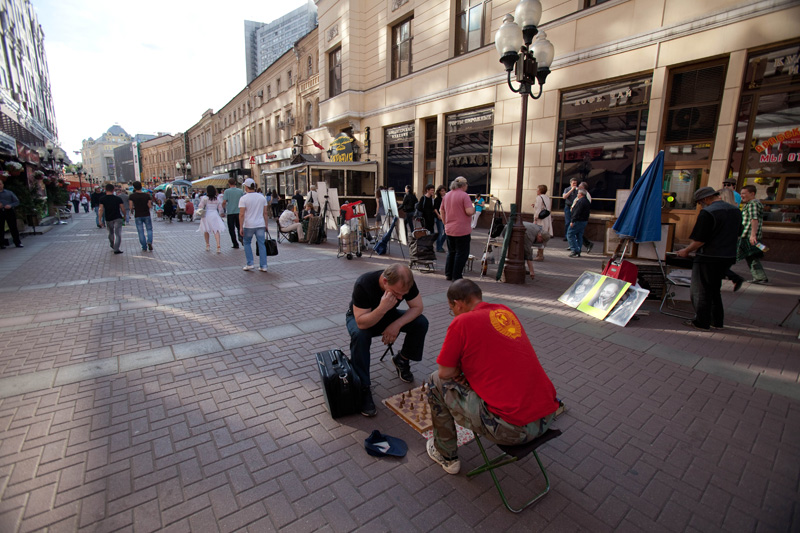
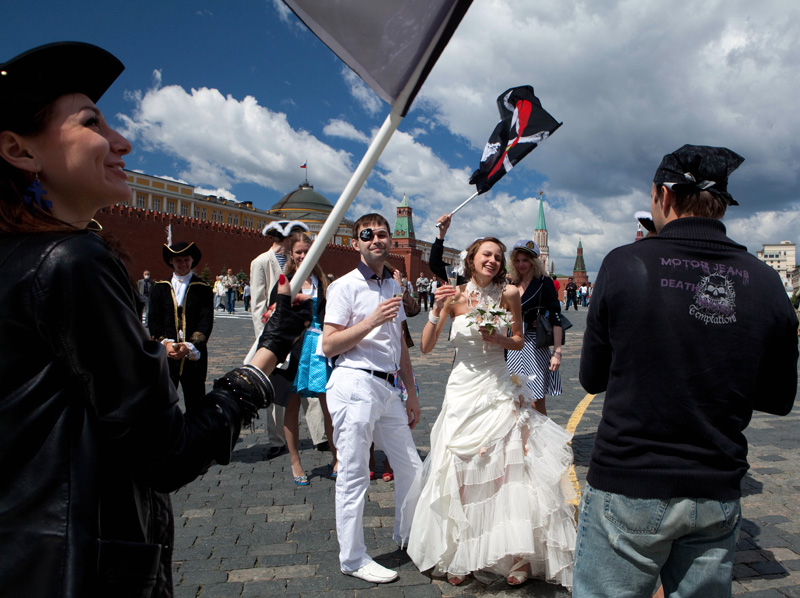
Istanbul was certainly one destination where the people were quite accepting of photography. And surprisingly, Moscow is another city where I have found that photography is a lot less restrictive than I thought. Aside from some museums where cameras are not allowed, I have found that shooting on the streets of this city hasn’t been a problem at all. Quite different than I imagined and in fact a bit of a contrast to what I’ve experienced lately in my own country where I feel like I’m an intruder with my camera or worse, feeling like I’m breaking the law.
It’s a fine balance when arriving in a new destination and feeling out the situation as to what is or isn’t off limits to a camera. One needs to be observant and respectful and work into the culture gradually. When photographing people, I don’t go up and ask them if I can take their picture. It’s not because I’m trying to be sneaky, but rather I don’t want a posed moment and that’s exactly what happens if I ask permission first. However, after I’ve taken a few shots and a person has noticed me, I will then question with body language if it’s ok to take pictures. If they say no, I respect their wishes and move on.
I’m on a long extended shoot right now creating a documentary Opening Our Eyes with my daughter Erin. In our free time, we are doing a bit of sightseeing and photographing the landmarks and people of the destinations we are in. From time to time we want a picture of the two of us in a quintessential setting and we seek out just the right person to take our picture. We have discovered that picking the right person is an art in itself and quickly find out if our hunch in who we ask to take the picture proves right. We have acquired quite a collection of photos that people have taken of us from the terrible to the pretty good. It’s always funny to see other people’s eye and how they frame us in the shot.
We have another two months for our journey and it will be interesting to see the cultural differences with regards to photography. I hope that we won’t encounter the obstacles that seem to be popping up more and more in the US when it comes to taking pictures. I wonder – is the change in attitude because of security or is it because everyone has a camera these days with the ever-present cell phones and maybe people are just tired of being photographed.
I became a visual artist , not as a photographer, not as a filmmaker, but as a storyteller using images and later video to tell the tales of other cultures, lands and people through my eyes and my journeys. My camera was my tool – it was a means to an end. The end being the story that needed to be told.
I’ve spent the last 30 some years documenting the world through my lens, whether it be for magazines like the National Geographic Traveler, Smithsonian or Travel & Leisure or for major corporations. I’ve been blessed and have truly lived a charmed life. But there have been times when I’ve started to go off kilter – or stray from the essence of my being. It’s easy to do, especially in a culture that is obsessed with the drive to succeed – the definition of success being to make a lot of money and have a lot of “things”. Don’t get me wrong – I also enjoy the rewards that money brings – but for me that means having the resources that help me to live a full life.
A few years back I was shooting a documentary on the Delta Blues Musicians and I spent a memorable afternoon with blues drummer Sam Carr. As we were winding up our conversation under the shade of old tree he sat back and said “I’ve lived a rich man’s life in a poor man’s shoes”. That comment has stayed with me over time and when Sam died last year, I was told that his family was grateful for the interview that I captured that day and used his comment as his epitaph. I was humbled and honored, but mostly felt richly rewarded that my personal project had touched the lives of others.
As we wind up our first stop in Africa on our round-the-world trip, some of the fears and trepidations I had that came with taking a risk, and heading out to the unknown for 3 months, have vanished. In their place is the calming realization that this was what I needed to do at this point in my life and I was grateful I had the means to do it and the stamina to travel on a shoestring budget. Africa puts things into perspective – this vast continent is so wild, colorful, rich, poor, exhausting and exhilarating all at the same time. Africa has taken its hold on me and has sparked my true spirit.
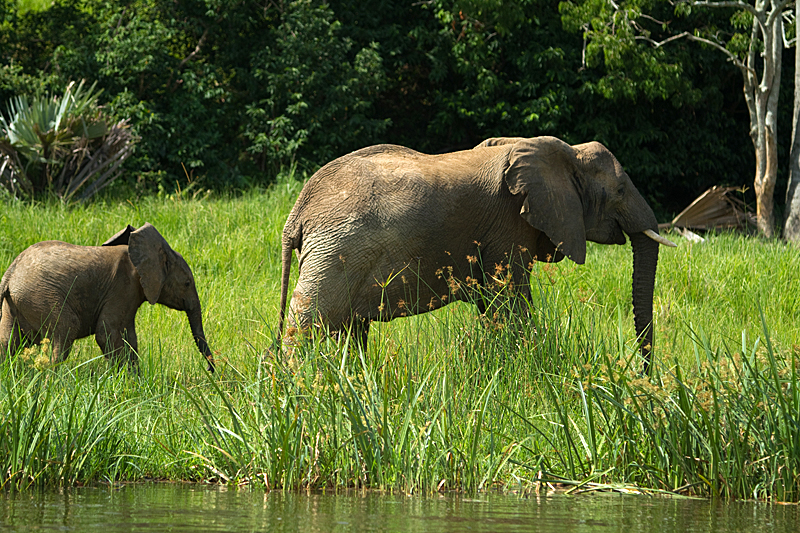
My daughter and I decided to take some time to get out of the city and go to Murchison Falls National Park, after shooting the first part of our documentary about people making a positive difference in the world. We saw
Elephants along the Nile
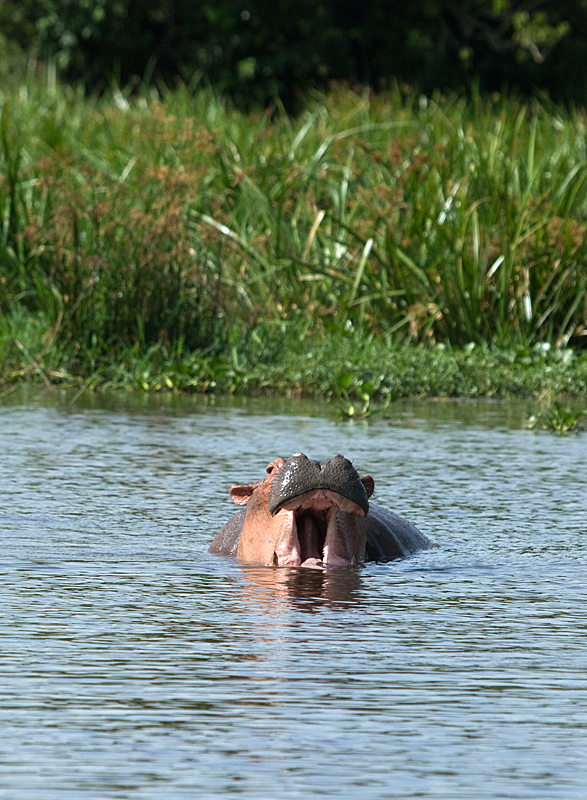
elephants, hippos,
Hippo on the Nile
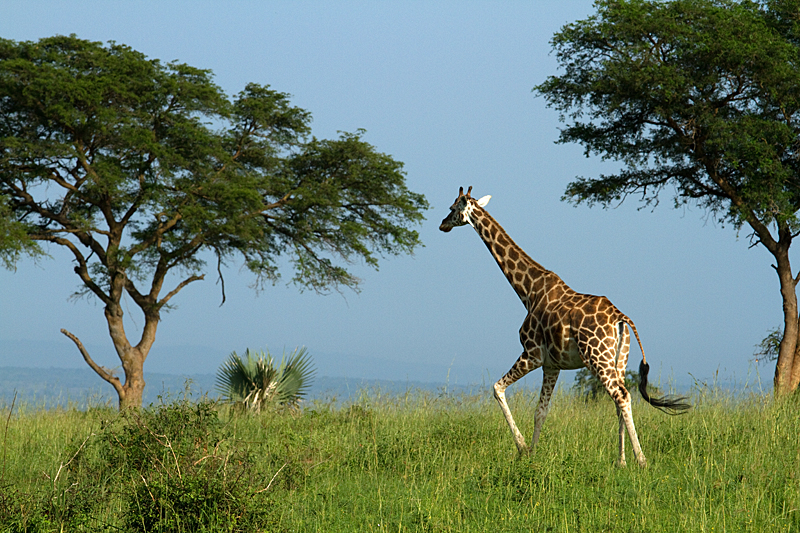
giraffes,
Giraffe, Murchison Falls National Park, Uganda
antelope, cape buffalo, baboons,
Baboon, Murchison Falls National Park, Uganda
slept in a tent and sat by a fire in the evenings under a canopy of stars that stretched from horizon to horizon. We chatted with people from countries all over the globe – all of us different yet with a common cause – the love of the journey.
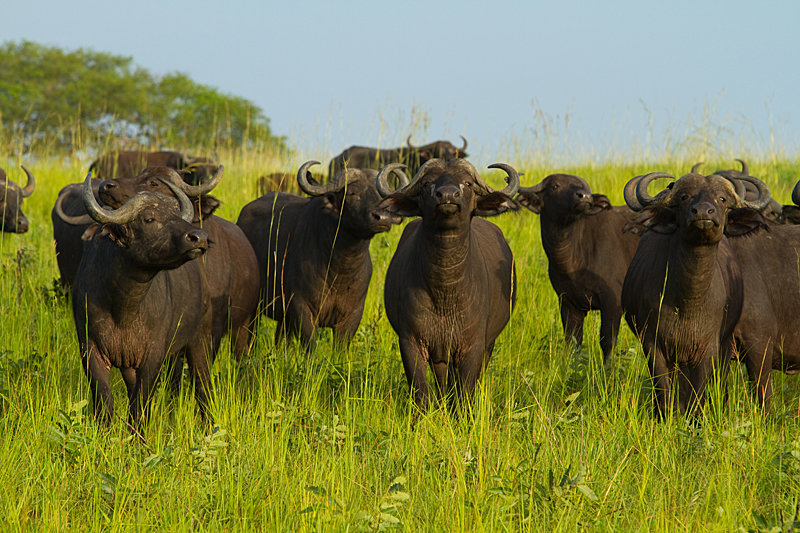
Of course I shot still photos
Cape Buffalo, Murchison Falls National Park, Uganda
as well as some VIDEO but more importantly I absorbed this rich experience and it energized my spirit and my soul. This is the “fire” that I need every now and then. I think we all need a spark every once in awhile and to get past the science of the photographic craft and back to the essence of the art and the story. That is what ultimately leads us to create the kind of visuals that will resonate with others. That spark is different for all of us but nevertheless an essential ingredient for the creative process. It’s not the tools, nor the techniques that define the message or create the images that strike a lasting chord with those who see them. I was fortunate that I learned that years ago and now I’m reminded of those lessons as I get back to my beginnings.
We leave Africa today and continue our journey – next stop Istanbul, Turkey and then on to Poland where our next subject awaits.
I’ve been reading a lot of the still photography forums over the past few weeks and I’ve seen a lot of questions about capturing sound with the hybrid HDSLR’s. I’ve also seen some misleading information so I’ve decided to take a few minutes to clear up some misconceptions.
First – Audio is everything in video. People can tolerate a mediocre image but if they can’t understand or hear the audio – they won’t watch. See for yourself – turn the sound down on your TV and see how long you stay interested in the program – even if the image is stunning.
Second – You have many options of capturing audio with the HDSLR’s depending on what you are shooting. I think many still photographers assume everyone is going to be shooting “indie films” with crews. One of the things I find appealing about some of the new technology is that you don’t necessarily need a large crew and a Hollywood budget. And sometimes, if discretion is in order, you’re better off with a small crew. With that said – you should know how to capture good audio.
Third – NEVER use the camera to capture audio – it just isn’t good enough. And I would probably say that you shouldn’t plug an external mic into the camera via the mini plug. I don’t think the audio quality is good enough, especially for an interview.
Fourth – Either use a pre-amp with XLR inputs like a Beachtek or JuicedLink and an external microphone. Make sure you get the mic close to the audio you want to capture. And most importantly monitor the audio through a good set of headphones.
Fifth – Capture your audio independently with a good quality digital recorder like the Samson H4n Zoom and sync it later in post. Syncing sound in post is a snap with a great software application called Plural Eyes.
Lastly – Audio is everything! And remember as you add video to your skill set, you’ll be using your ears as much as your eyes.











 Journeys of a Hybrid