How Do You Tell the Story?

I’ve said it hundreds of times – “the story is everything”, “without a story, you’ve got pretty pictures to a soundtrack”. So, how do you tell a story? How do you do it?

A friend called me the other day, struggling with this very question, of how do you tell the story? He was putting together a multimedia piece and he had captured sound and had taken photos during an event and was about to record an audio interview. I wasn’t sure at first, if he was asking about the mechanics of how to edit a story together in Final Cut– or was he asking me for guidance on how to tell the story? Those are two completely different discussions.

I thought back to when I was just starting to learn video journalism and had taken the Platypus Workshop. We had to tell our commitment or our story idea to an instructor, before we could start executing it. If the idea wasn’t delivered clearly and concisely, we went back to the drawing board to nail down the idea or the focus.

Every story starts out with an idea. Ideas have always come pretty easily to me, usually in spurts. All sorts of environments or activities can trigger ideas.

Seth Godin did a blog about a week ago titled, Where do ideas come from? Here are a couple of my favorites:

  • Ideas come out of the corner of the eye, or in the shower, when we’re not trying
  • Ideas come in spurts, until you get frightened. Willie Nelson wrote three of his biggest hits in one week
  • Ideas occur when dissimilar universes collide
  • Ideas fear experts, but they adore beginner’s mind. A little awareness is a good thing
  • Ideas hate conference rooms, particularly conference rooms where there is a history of criticism, personal attacks or boredom

Once I get the idea, I then start focusing it in my head. I play out the movie in my mind. What is the message? Whose message is it – mine? – the client’s? What is the motivation for the piece? A call to action? Once I get a pretty clear idea of what the story is that I’m trying to tell, then I start to put the pieces together. First I gather and capture all the assets that I’ll need, the interviews, b-roll, still photos etc. Then, when it’s time to edit the story, I’ll have a much clearer focus of how I will edit the pieces together to deliver the message.

Right now, I’m editing a feature length documentary, that is made up of ten different stories about ten different people in various corners of the globe. All together, the ten stories are unified by the theme of “the power of the individual in making a difference in the world”. Essentially the idea is, global stories about the power of one. That has been my underlying story from the moment of concept, to shooting it, to editing it all together.

So, how do you tell the story?  For me, it’s focusing on the “idea” at all times and editing toward that purpose.  There are hundreds of ways to tell the same story, but you need to know what the story is before you can begin to tell it.

Add to FacebookAdd to DiggAdd to Del.icio.usAdd to StumbleuponAdd to RedditAdd to BlinklistAdd to TwitterAdd to TechnoratiAdd to Yahoo BuzzAdd to Newsvine

Don’t Let the Music Die Inside You

Einstein said “Logic will take you from A to B but imagination will take you anywhere.”

I have always had a vivid imagination, spending many waking and sleeping hours dreaming and picturing myself in all sorts of situations. Some of my dreams were just crazy ideas running through my head and some were very real dreams that I believed would come true. I was thinking about what I wanted in my life – not what I didn’t want.

Everyone has dreams for how they want their life to be but not everyone believes their dreams will manifest. The future has to become the present in one’s imagination. And one needs to commit to their idea for it to happen – not just have intentions. Intentions without conviction is a waste of energy.

At this point in my life, I have been focusing more and more on pursuing my thoughts and ideas that have been running through my head. It was a year ago, that I made the decision to embark on the biggest personal project of my life, Opening Our Eyes. I’m now in the midst of editing hundreds of hours of footage. It’s tedious because there is so much, and there are interviews in foreign languages that need to be translated and transcribed before I can edit them. All the files need to be transcoded, which is taking far longer than I imagined it would, but now that I have my workflow down, it’s going faster.

When I’m finished with this film, it will be the most satisfying and successful project I’ve ever worked on. I use the word successful to mean that it was an incredible accomplishment for me personally and professionally. That’s not to say that it won’t be financially rewarding, and in fact every personal project I have ever self-funded has always been profitable, just not immediately.

More importantly, by executing my ideas, without needing validation from someone else, I am following my purpose. I am doing what I’m meant to be doing in my life. That in itself is the biggest reward of all.

We all have our own music inside of us. Find yours. Don’t die with the music still inside of you.

Add to FacebookAdd to DiggAdd to Del.icio.usAdd to StumbleuponAdd to RedditAdd to BlinklistAdd to TwitterAdd to TechnoratiAdd to Yahoo BuzzAdd to Newsvine

The Power of Yes

I’ve just experienced one of the most extraordinary weekends of my life – all because I said yes.  Barely more than a week ago, I sent an email with a link to the trailer of my documentary to Rebecca Self,

Rebecca Self at the European Summit for Global Transformation

who I was introduced to by two of the subjects in my film, Letha Sandison and Maggie Doyne.

Letha Sandison and Maggie Doyne

Rebecca is an amazing woman – she’s a connector of change makers.  The day after Rebecca got my email, she replied “Would you consider coming to Amsterdam this weekend and showing your trailer at The European Summit for Global Transformation.  My first thought was “wow” – and with a title like that, it was bound to be a gathering of very interesting people.  My next thought was, “it’s not possible – there’s not enough time – the airfare will be high” etc. etc.  All very practical thoughts – right?

And then I flipped it and told myself all the reasons I should say yes. I ‘d have the opportunity to show a culturally diverse audience a sample of my film and talk about the idea behind it. I would get to see Letha and Maggie again because they were going to be speaking.  And most importantly, I would be spending the weekend with people that not only believed that anything is possible – but are making the impossible happen, together. So I replied to Rebecca and said YES.

For two days I listened, as all kinds of people told their stories – people who are actively doing things that are making our world a better place. They awed me with their courage, their commitment and their passion.  But the most empowering part of the conference was connecting with these people, who were not only there to talk about what they were doing, but also to network with others to help them make their commitments a reality.

As I write this, on my last night in Amsterdam. I’m ready to head out to have one final dinner with some of the most fascinating  people I have ever met.  It has been a powerful weekend, being part of this group of people, from all over the world that are making extraordinary things happen.  This is what my film is all about – the power of the individual, working together to make things happen – across the globe.

To be able to show my ten-minute trailer to these amazing change makers was an honor and reward in itself.  But to spend the weekend with such a unique group of people who believe that anything is possible, was extraordinary and fortified me as I go forward in editing over 150 hours of footage.

I have a friend who is always telling me that I need to say “no” more often – because I tend to spread myself too thin.  But this time, I was glad I said “yes”.

Add to FacebookAdd to DiggAdd to Del.icio.usAdd to StumbleuponAdd to RedditAdd to BlinklistAdd to TwitterAdd to TechnoratiAdd to Yahoo BuzzAdd to Newsvine

The Thin Line Between Work and Pleasure

I’ve always been lucky because there’s a very thin line between my work and my personal life. That’s because I’ve never looked at what I do for a living as work, or at least if one defines work in negative terms.

I became a photographer and later a filmmaker because I’m a born storyteller and the camera is a means to that end for me. I come from a long line of storytellers, as evidenced by boxes of old letters telling the tales of family long gone. While they may have told their tales by pen, through their words, I have chosen the camera as my tool to tell the stories that I have to tell. So how could I possibly equate the word work with the professional life that I’ve built – telling the stories of people and companies around the world? It’s in my blood.

Sure, there have been jobs through the years that seem a lot more like work than others, especially when a client hasn’t trusted their instincts in why they hired me by allowing me to trust mine. But there have been so many other jobs where I’ve had to pinch myself to believe that they’re real.

I’m also a firm believer in following my instincts and that has led to many rewarding opportunities in my life. I’ve been doing that a lot lately and the universe is opening up for me. I’ve stopped waiting for someone else to validate me in order for me to pursue a project that I’m passionate about. I’ve stopped telling myself all the reasons that I shouldn’t do something and I’ve replaced them with all the reasons that I should. I think about the pros and don’t dwell on the cons. And that’s because I’ve blurred the lines between work and pleasure.

I’ve just completed a 99-day journey shooting a documentary on change makers – people who were making a positive difference in the world. Over the weekend I got an email, inviting me to show my ten-minute tease at the opening of the European Summit For Global Transformation in Amsterdam, this weekend. I immediately started to discount it, telling myself that I didn’t have enough notice etc. etc. Then I saw it differently – I saw it as an incredible opportunity to not only show the tease of my film but to network with like minded people. So, this evening I’m headed to Amsterdam.

Years ago when I was traveling a lot, shooting for magazines like Travel & Leisure and National Geographic Traveler, as I departed for my trips, my mother always used to say – “have a nice vacation”. I used to get annoyed because I thought that she didn’t recognize the fact that I was working and not going on vacation. But, as I reflect back on the “work dynamic” that I’ve set up for myself, I think – maybe she was the one that had it right. It’s been one long pleasure trip.

Add to FacebookAdd to DiggAdd to Del.icio.usAdd to StumbleuponAdd to RedditAdd to BlinklistAdd to TwitterAdd to TechnoratiAdd to Yahoo BuzzAdd to Newsvine

Remembering John Lennon on His 70th Birthday

Lennon would have turned 70 years old today.  That’s hard to believe. It’s been 30 years since his tragic death and I often wonder, like so many others, what John would have done over the past three decades if he had lived. No doubt he would have been true to himself, because he always was.  That was his appeal.

Even as a young girl, I was drawn to John, he was “my favorite Beatle”. There was something exciting about him – and I always felt like he was giving it to me “straight”.  People just seemed to connect with him because of his sincerity. He was his own person and he was following his own path.  When his second son Sean was born, Lennon dropped out of the music limelight to raise him. A lot of people thought he was crazy to do that – to take a break from the music scene at the pinnacle of his career.  But that was John following his bliss, staying true to himself.

“People say I’m crazy doing what I’m doing,
Well they give me all kinds of warnings to save me from ruin,
When I say that I’m o.k. they look at me kind of strange,
Surely your not happy now you no longer play the game,”

“People asking questions lost in confusion,
Well I tell them there’s no problem,
Only solutions,
Well they shake their heads and they look at me as if I’ve lost my mind,
I tell them there’s no hurry…
I’m just sitting here doing time,”

I’ve been very fortunate over these past few months, to be around other extraordinary people, the subjects of my film, who are staying true to their own convictions as they pursue the life they are meant to live. You can read more about these people here.  Like John, they are imagining the world to be a better place.  They are activists for change and they live their lives in that pursuit. John would have loved them.

So, today my thoughts are on John and what he left us – his music of course, but more importantly his beautiful spirit and his belief that things can be better.  In traversing around the world this summer, I met so many other inspiring people who believed the same thing and were following their own bliss,  making the world a better place for all of us.

Happy Birthday John, you are missed.

Add to FacebookAdd to DiggAdd to Del.icio.usAdd to StumbleuponAdd to RedditAdd to BlinklistAdd to TwitterAdd to TechnoratiAdd to Yahoo BuzzAdd to Newsvine

the

10 Things I’ve Learned Circling the Globe

I came across an interesting blog yesterday “20 Things I’ve Learned From Traveling Around the World for Three Years”, by Gary Arndt. It was pretty much on target with my observations from my very short journey of a little more than 3 months. But it got me thinking about what I have learned on these travels.

Erin and Gail and children of village along Amazon River, Peru

To travel is to experience and learn and also an opportunity to show other people from other cultures what an American (U.S. citizen) really is, beyond the news, the music and Hollywood movies.

1. People are good – Like Gary, I’d have to agree that for the most part most human beings are good. Sure there are schemers, con artists and thieves in just about every culture, but for the most part – people are good.
2. Government policies don’t always reflect who the people are – U.S. citizens are not all warmongers and not every Afghani is a terrorist.
3. The media exaggerates – Because we all get our news these days in abbreviated and sensationalized TV content – it’s distorted. I almost changed my plans to go to Thailand because of the coverage of the political unrest, which in actuality was contained to only certain sections of Bangkok.
4. There aren’t just “ugly Americans” there are “ugly tourists” – people around the world seem to equate badly behaving tourists as “ugly Americans”. I have found bad behavior is not solely exclusive to “Americans” or U.S. citizens – I have witnessed really bad manners from all types of tour groups – French, German, British, Japanese, Argentinean – you name it. I think it is more of a reflection of a “group” dynamic than a cultural one.
5. U.S. citizens are misunderstood – I find this is more common in countries that are more “westernized” than countries where you would think more of a discord would be present. For example – I found the people in Egypt friendly, curious and informed, unlike other “westernized” countries where the attitude was more of one of disdain. In other words, the more “westernized” a country was there seemed to be more of a preconceived yet narrow minded and naïve attitude about what an “American” was.
6. Cultural naiveté – Guess what folks – when you join those tour groups and they take you to the “untouched villages” along the Amazon River or to the hill tribe villages in the mountains of northern Thailand – they’re probably bringing you to government sanctioned tribal villages where the people have made it a business of “dressing up” for you. Some locals that I met referred to these places as “human zoos”. It’s kind of like expecting to see everyone in the U.S. wearing cowboy attire – I mean outside of Texas and Montana that doesn’t really exist anymore.
7. The Internet has changed the travel experience – you can pretty much get connected anywhere – anytime. My blackberry worked in some of the most remote places in the world. I could almost always get a cell signal – the irony was that I didn’t always have electricity to charge my battery. If you want to really get away – leave your laptop, iphones and blackberrys behind.
8. Go with the flow – don’t focus on what you miss from home whether that is a Starbucks coffee or a hamburger – discover the richness of the country you are in – the food – the music. As we become more and more connected with each other across the globe – we are beginning to lose our cultural differences.
9. I am a diplomat for my country – sure there are things that I don’t like about my country, the United States. But when I travel, I feel that this is my opportunity to interact with the people where I am visiting and to give them perhaps a more true picture of what an American is – beyond what the news and Hollywood portrays us as. That is if people give me a chance – if they haven’t closed their mind.
10. I am grateful that I can travel – and I think that everyone should travel – outside his or her country and culture. Don’t just visit the tourist sites but try to get out of the cities and interact with the people. The best thing about this journey is that our purpose was not to see the sights but to connect with the people. That made it meaningful and memorable.

Add to FacebookAdd to DiggAdd to Del.icio.usAdd to StumbleuponAdd to RedditAdd to BlinklistAdd to TwitterAdd to TechnoratiAdd to Yahoo BuzzAdd to Newsvine

Behind the Scenes DVD – or Not?

In a little more than a week, my 99-day journey trekking around the world with my daughter shooting a documentary, Opening Our Eyes will be over.  Or will it?  My work is really just beginning as I contemplate all we’ve done, people we’ve met and interviewed and how I will put this all together in an edited, finished film.

There are hundreds of ways I can edit this documentary and quite honestly, beginning the process and deciding the direction is always the most difficult.  But there will be a moment when the light bulb goes off and the vision will be clear as to how to make sense of it all.  Then it becomes easy as the story unfolds – as it should from my heart.  It’s the story that can only be told by me and this case, me and my daughter.

My daughter and others have urged me to do a behind-the-scenes DVD

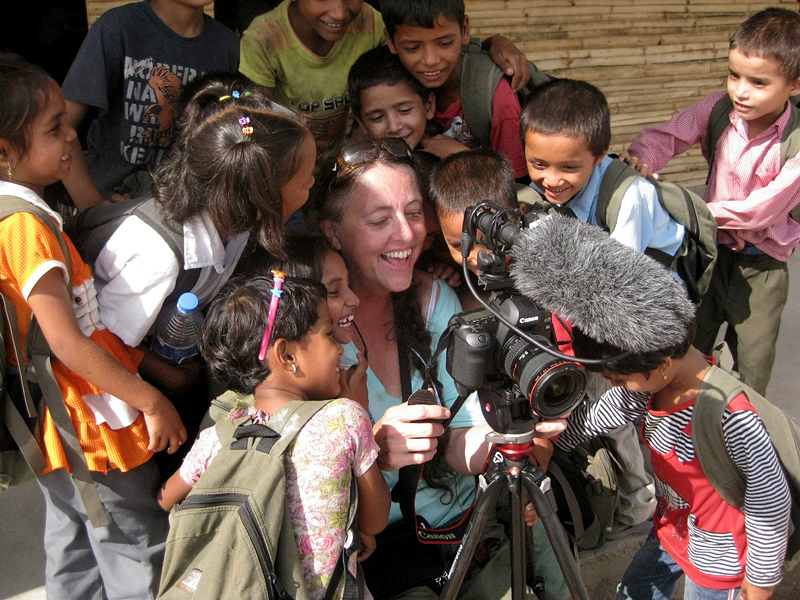
Gail at the Kopila Valley Primary School, Surkhet, Nepal

– she tells me “that’s what people want”,  to know more about the making of the film – more about the people behind the film.  As much as I agree with her and understand this interest on the part of the viewer, there is also a resistance to make myself part of the documentary.  With that said, a separate “behind-the-scenes” chapter could be the solution – to provide more information, without inserting the two of us into the film itself.

One thought does keep popping into my head that motivates me to provide a commentary on the why’s and how’s of this journey and the making of this film. Too many times when I’ve visited museums, I’ve been taken aback by some of the things that I over hear docents talking about in relation to the paintings.  They analyze and interpret what the artist meant by his choice of color, brush stroke and placement of objects within the art and how that related to what was going on in his life at that point in time.  I often wonder how they know that or even how can they be so sure?  Is it documented or is it really just someone’s interpretation that has become fact over the years?

My daughter and I do plan to sit down this week and attempt to do on-camera interviews – while we are still in the moment and before we get back to our normal lives.  Here’s where we need your help – tell us what you want to know.  Maybe you’re curious about how we survived the dynamic of a mother/daughter team for three plus months.  Maybe you want to know why we did this – or how we funded it.  Or maybe the questions are even more basic – what did we like? – what was difficult?– any surprises? etc. etc.  Perhaps you want to know more about the craft of shooting the doc– and how I went about that.  And maybe you don’t really want to know anything at all and just want to know about the subjects of our film.

But please tell me what you’re curious about – as far as the behind-the-scenes making of this film.  All questions are welcome – from the seemingly obvious to the more provocative.

Add to FacebookAdd to DiggAdd to Del.icio.usAdd to StumbleuponAdd to RedditAdd to BlinklistAdd to TwitterAdd to TechnoratiAdd to Yahoo BuzzAdd to Newsvine

The Power of Possibility

In my laziness and urge to get outside and make the most of my last two days in Sydney, Australia, I am cross posting a post that was on my Opening Our Eyes blog – so forgive me if you follow me there.

Yesterday, I uploaded this photo on my Facebook status

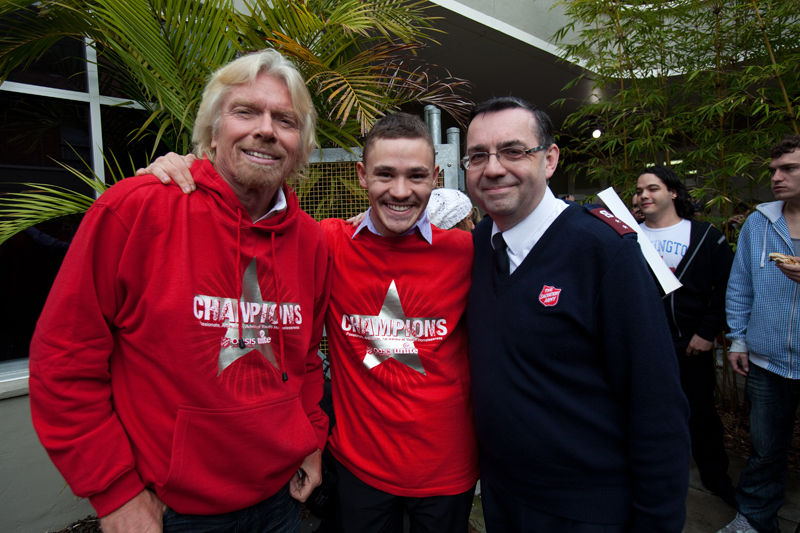
Sir Richard Branson, Damien, Captain Paul Moulds at Oasis in Sydney, Australia
. It got noticed as “celebrity” always does and one person remarked “hanging with the superstars”. I commented back saying that they were all “superstars”. Certainly, Captain Paul Moulds for the work that we devotes himself to with Oasis and reaching out to homeless youth in Australia and Sir Richard Branson for his generous support and making it possible.

But perhaps the biggest “superstar” is Damien, the young man in the middle who turned his life around from being on the streets with barely any hopes and dreams at all to having a job, a place to live and a bright future.

I was attending an event yesterday at Oasis where Branson was cutting the ribbon on the opening of a fitness center that his company Virgin had funded. But prior to the opening of the center, Branson and others listened to the stories of the “champions”, young people like Damien who against all odds, had redirected their lives to a better future. The stories were difficult to hear – stories about being abused – physically, sexually and emotionally. Stories about wanting to die and the attempts that they made on their lives because they felt unwanted and that they had no purpose.

I can’t even begin to really understand the horrors that these kids have faced in their young lives. I can’t even imagine how difficult it was for them to tell their stories, and yet they did so with grace, dignity and compassion for one another. They were there for each other and to show their gratitude to people like Paul Moulds and Richard Branson who make places like Oasis possible. One young man said – “without Oasis, I’d be dead”.

I will never forget that morning and it went far and beyond the thrill of meeting Sir Richard Branson and eating an egg sandwich that he had cooked on the grill. The most important thing I walked away from was being around a group of people with a like-minded purpose. A purpose of doing whatever they can to make a difference – a positive difference in the world. I could see, hear and feel the impact that Moulds and Branson had made in these young people’s lives. It was tangible and real – not just words on the pages of a foundation’s annual report.

As we wind up our time in Australia and head home for a few days break before heading down to South America, I am energized by something that Paul had mentioned during his interview. He was talking about an amazing documentary that was made about Oasis and the issues facing homeless youth in Australia. The documentary was two years in the making and gave an up close look into life on the street for these young people. Paul told me that after the documentary aired on Australian TV, the response and support that followed was astounding. It had made a real impact and prompted people into action – to help with donations or wanting to volunteer.

So I’m energized going forward that our little film will also create awareness and prompt others into action and what they can do to make a positive difference in the world. It’s a simple yet powerful thought and full of possibility – the power that’s within all of us to create change and make the world a better place for those that are less fortunate. The power of possibility – think about it.

Add to FacebookAdd to DiggAdd to Del.icio.usAdd to StumbleuponAdd to RedditAdd to BlinklistAdd to TwitterAdd to TechnoratiAdd to Yahoo BuzzAdd to Newsvine

The Hard Part About Working With DSLR’s

After two solid months of intensive shooting a documentary – shooting both stills and video with two DSLR cameras, the Canon 5D Mark II and 7D, I can honestly say working with these hybrids is not easy. And it certainly isn’t fast, especially if you are working in a small crew as we are.

Yes, the visual is stunning but I can’t help but think how many moments I may have missed that I probably would have gotten if I had been shooting with a video camera. When shooting motion, I have a constant mantra running through my head and that is “shoot and move”. That’s because you need a lot of footage at the end of the day and you need to edit your film. I’m not talking about working with a neatly storyboarded script and a Hollywood crew. I’m talking about working lean and mean and in a somewhat discreet way that is in order when shooting a documentary.

That really hit me last night while shooting on the streets of Sydney, Australia. My subject that I’m focusing on here is Paul Moulds from Oasis, which is a youth support network dealing with homeless street kids. I needed to hit the streets at night and knew that I not only had to be sensitive to the situations that I’d be shooting but also alert to the dangers. I’m positioning myself with a lot of expensive gear in tough neighborhoods where drugs and violence rule.

If ever before I needed to shoot and move and act quickly and keep a third eye out for any lurking danger. No time to stress on the importance of the perfection of the visual. I needed to get in close to the action – make sure my audio was being captured sufficiently and get the story. So even though I can tell you that my visual will be beautiful and lacking “noise” in the blacks – I probably would have gotten better and more meaningful coverage with a video camera.

I’m sure there will be plenty of you who will argue that there are journalists embedded in war zones with these cameras. And of course there’s Vincent LaFloret’s brilliant cinematic night films. But for me, I think there are times when I could have reacted faster with a video camera. And so I think – what’s more important – the resolution or the story?

Add to FacebookAdd to DiggAdd to Del.icio.usAdd to StumbleuponAdd to RedditAdd to BlinklistAdd to TwitterAdd to TechnoratiAdd to Yahoo BuzzAdd to Newsvine

True Convergence With the DSLR Cameras

I read today that mega publishing company Conde Nast “names a new president as company seeks new business model”. http://adage.com/mediaworks/article?article_id=145071

“The historical priorities that have served our company so well — great content, best-in-class magazines, key client relationships – remain the cornerstone of what we do, but we need to move beyond the magazine,” said Mr. Townsend, who remains CEO, in the statement.”

Wow – so one of the biggest publishing companies is realizing that electronic delivery and the internet isn’t an afterthought or an add on to their print pubs.  That would have been unheard of just 2 years ago, but with the proliferation of mobile devices, including the iphone, ipad and other “i” devices, we really are seeing a shift in the way we communicate.

Photographers should definitely take notice of this and understand that they need to think differently themselves. Imagery and workflow that worked in the print world just isn’t going to fly in the world of “i” devices. You need to think and see differently when creating for electronic devices that are capable of showcasing still images, video and sound.  And it’s no longer sufficient to just regurgitate still imagery for the web or pick up a hybrid camera and switch into live mode and shoot video that will adequately convey a message in motion.  It goes beyond the tool – it’s thinking, seeing and anticipating in motion.  After 11 years of shooting motion and over 30 years of shooting still images, my mind seamlessly makes the switch a hundred times a day between thinking and seeing in “moments in time” or “time in motion”. It’s a bit analogous to being fluent in a foreign language when you find yourself thinking in the language rather than needing to do the translations anymore in your head.

Many still shooters who are just beginning to shoot video are so consumed with the technical aspects of the tool, they forget that they need to think and shoot differently when shooting video.  I see a lot of people moving the camera, rather than letting movement take place in front of the camera.  And I see a lot of independent clips shot and then put together in a video timeline, but with no connection to one another or unity in a sequence.  Basically, a slide show of video clips – but not a story sequence.

It takes time to get to the point where you think in motion, especially if you’ve been a still shooter for many years.  My instincts are now that I know when to pick up the right tool – a video camera or a still camera, rather than choose the tool without meaning to the subject that I will be shooting.  I choose the tool that will best communicate the message.

The best advice I can give to still shooters who want to move into video is for them to stop compartmentalizing the two mediums.  Don’t define yourself as a videographer or a still shooter that does sports or weddings or commercial work.  As print gives way to electronic delivery, our clients need to communicate in a different way and we need to be creative in delivering their message and choose the best tool that will do that.  If we can think like that then there is true convergence – not only with our tools but the way we think.

It’s no wonder that publishing houses are hiring shooters with skills entrenched in both mediums.  They need creative’s who think differently – not just in moments in time or time in motion, but a true blend that only a hybrid shooter can deliver.  That’s my best advice that I can offer to people just starting out as photographers or videographers – don’t separate the two – become a hybrid and learn to communicate creatively with the right tool at the right time.

Add to FacebookAdd to DiggAdd to Del.icio.usAdd to StumbleuponAdd to RedditAdd to BlinklistAdd to TwitterAdd to TechnoratiAdd to Yahoo BuzzAdd to Newsvine