Crowd Funding and What I’ve Learned

There’s a scene at the end of my favorite holiday movie “It’s a Wonderful Life”

It's a Wonderful Life

where George Bailey, a character played by Jimmy Stewart is surrounded by his friends as they come to his aid and bail him out of his financial shortcomings, caused by his crazy Uncle Billy. I’ve seen this film at least a dozen times and ok – I admit it – I cry every time George Bailey’s little girl opens a book that mysteriously appears under the Christmas tree with the inscription “No man is a failure who has friends”.

I felt like George Bailey today when I saw the email from Kickstarter telling me that my daughter’s and my film project, Opening Our Eyes had been officially funded.  We actually exceeded our goal of $7500 and raised just over $10,000! What a feeling – what a triumph and all possible because of our “friends”. Through crowd funding – our friends had helped us reach our goal and made our film a reality.
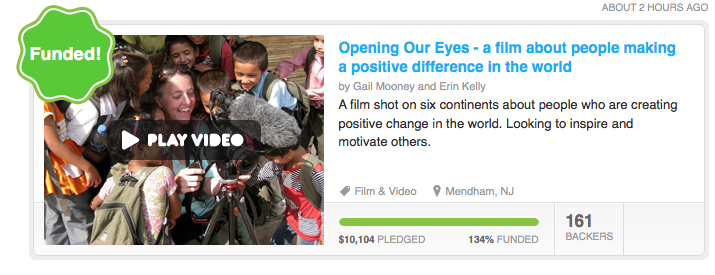
This would not have been possible just two years ago.  But, Kickstarter and other crowd funding sites like it, provide other options for artists and entrepreneurs who are seeking funds to make their creative ideas come to life. Many times these ideas might not fit within the confines of what a traditional bank would finance, but there are some great ideas that have a chance now of becoming a reality –  and we all benefit by that.

Here are some things that I have learned through the process of getting our film funded on Kickstarter.

•    You have to do the work.  Once you launch your project page on Kickstarter, you need to let potential backers know about it, using social media or email blasts or word of mouth.  Just like getting traffic to your website, you can’t expect people to stumble upon your project and fund it.
•    You have to make it fun.  Have fun with the “rewards” that you offer your backers, and on Kickstarter every project must have rewards.  People love to give, but they also love to feel like they are part of something or that they have helped to make something happen.  If a backer contributed to my project at the $500 reward level, they will receive an Associate Producer credit in the film and on the project’s website, along with DVD’s of the film when it’s completed, as well as a signed print and an e-book from the project’s journey.
•    Keep your financial goal realistic.  Look at other projects that are similar to yours and see what the “market will bear”.  See what has been successful and ask yourself why. Remember that if you ask for too much money and don’t meet 100% of your goal by the time the funding period is over for your project, then you won’t receive anything.  Only projects that are successfully funded at 100%, will receive funds.
•    Use social media and email blasts with common sense – don’t be obnoxious.  If you do send emails – don’t send  an email again to someone who has already backed your project.  Ask people to share your project link on social media but don’t overdo it.
•    Post updates on your project to keep your backers and potential backers informed.  Use visuals if you have them,  both on your page site as well as in your updates. Photographs and videos really give a project presence and are a must have. You want to stand out from the crowd.
•    There is no such thing as a pledge too small.  They say the average pledge on Kickstarter is around $25 and I can attest to that.  Out of our 161 backers – 69 had made pledges of $25.  It all adds up.  And every time someone backs your project there is also the opportunity that they may share it with someone they know who may in turn make a contribution.
•    Be grateful and appreciative.  I made it a point to send each and every one of my backers a personal thank you note.
•    Have faith – because anything is truly possible these days.

Add to FacebookAdd to DiggAdd to Del.icio.usAdd to StumbleuponAdd to RedditAdd to BlinklistAdd to TwitterAdd to TechnoratiAdd to Yahoo BuzzAdd to Newsvine

Editing Tips for Multimedia and Video

A few days ago, I wrote a blog about “having a point” – or telling a story when you create multimedia pieces. Of course you have to have an overall idea and focus to start with, but below are some editing tips on how to make it come together in the editing room.

  • Edit with a purpose. Why are you making the “cut” where you are? Are you cutting on the action? Are you cutting on the beat of the music? What’s the reason behind your cut?
  • Set a pace or rhythm. Just like writing, where you have pauses in sentences with commas, edit your visuals to your narrative or interview soundbites, cutting after words and phrases.
  • Use image sequences to transition between different ideas and themes.
  • Let your images linger on the screen, giving time to breathe between them.
  • Cut on the beat or against the beat of music. Edit the music and let it become part of your piece, rather than just a background soundtrack.
  • Adjust the volume of your music – lowering it during interviews and raising it when there is no narrative or dialog.
  • Use audio fades between music cuts to soften the cut.
  • Insert room tone between cuts in interview soundbites, making the cuts less apparent.
  • Use interview footage sparingly – when introducing someone or when someone is expressing emotion on the screen.
  • Identify interview subject with name and title text in lower third.
  • Use text that’s easy to read and break it up over many slates. Leave the slate on the screen long enough to read twice.
  • Always start with your strongest images.
  • Don’t “move” all your still images – leave some static on the screen.
  • Don’t use dissolves.
  • When working with media from DSLR cameras, keep the media in the DCIM folders for logging and transferring into Final Cut Pro with the plug-in. If you have taken your media out of the DCIM folders – then create a new DCIM folder for the purposes of importing the media into FCP.

Remember to keep the story in mind at all times. When you think you have the story laid down in a rough cut – have friends over to watch it. Ask them what the story was. If they don’t know or can’t tell you, then you have more work to do.

Add to FacebookAdd to DiggAdd to Del.icio.usAdd to StumbleuponAdd to RedditAdd to BlinklistAdd to TwitterAdd to TechnoratiAdd to Yahoo BuzzAdd to Newsvine

“Here’s an Idea – Have a Point”

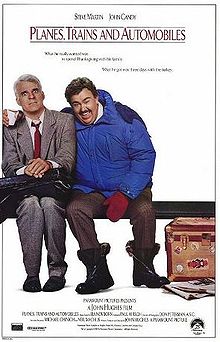
One of my favorite holiday movies is “Planes, Trains and Automobiles” with Steve Martin and John Candy. There’s a great scene in the movie where Steve Martin loses it and starts a rant directed toward Candy’s character, Del Griffith. Del, is a “nice guy” who talks incessantly. Martin’s character, Neal Page, an uptight ad man, frustrated by the day’s travel mishaps, finally explodes at his travel companion Del after one too many stories and says – “here’s an idea – when you tell a story, have a point!”

Am I the only one who has been oversaturated with multimedia and video pieces that are little more than pretty visuals to music? Don’t get me wrong, there are plenty of pieces that I do like, but there are far too many where I get bored and bail mid-way through because there is no point – there is no story.

Worse yet, the audio or music track many times feels like it has no connection to the visuals. It may be a great piece of music and provide pacing for the video, but it doesn’t complement the story. And there are times that the music is the most interesting part about the piece – if you take it away, what do you have? Most likely a pagination of moving and/or still images – like pages in a magazine or prints on a gallery wall. Independent and isolated vignettes with a music track – but no story- just eye candy.

What holds my interest is a story, where all the elements of audio, music, video clips, stills, text and narrative are parts of the whole and each one is integral in telling the story. I don’t think I’m alone in being interested in the story. Humans have enjoyed “the story” since the beginning of time. It doesn’t matter if it’s told verbally in a one on one conversation, in a multimedia piece, or in a major motion picture – a good story is a key ingredient for human interest. We all love a good story.

Personally, there is so much out there to watch these days on any given site that hosts videos, if I’m going to invest time in viewing something – I want it to have a point. If it doesn’t when I get to the end – I feel somehow let down.

I’m sure some of you will disagree with me on these thoughts and many of you may get loads of satisfaction from watching pretty visuals laid down to music and that’s OK. I’ve just had my fill of pretty content splashed before me, becoming a blurred palette in my head.

So, here’s an idea – have a point.

Add to FacebookAdd to DiggAdd to Del.icio.usAdd to StumbleuponAdd to RedditAdd to BlinklistAdd to TwitterAdd to TechnoratiAdd to Yahoo BuzzAdd to Newsvine

Yoda Who?

Twice this past weekend, while in conversation with friends, I had been referred to as Yoda. The second time it happened, I asked “Who is Yoda?” That’s right. I didn’t really know who Yoda was, even though I had heard the character’s name referenced over the years. I knew he was from Star Wars or Star Trek or some movie like that. But I had never seen either of those movies, so I wasn’t sure.

Shocking isn’t it? Or that’s what a friend thought when I “fessed up” to never having seen Star Wars – none of them – not even the first one. The truth is, I’m not a science fiction fan. I love fantasy, and spend my life living a fantasy, or trying to, but sci fi is too much of a stretch for me, as far as having the ability to come true – and I’m a believer that fantasies can come true.

I followed a link that my friend forwarded which led me to all things Yoda and I was instantly hooked by his wisdom. The more I learned about Yoda, the more intrigued I became. I had found my soulmate, an ugly little troll like creature with a glowing green wand, but with the wisdom of the ages.

Some of my favorite Yoda-isms:

  • “Fear is the path to the dark side. Fear leads to anger. Anger leads to hate. Hate leads to suffering.”
  • “So certain are you. Always with you it cannot be done. Hear you nothing that I say?”
  • “Train yourself to let go of everything you fear to lose.”
  • “You will find only what you bring in.”
  • “Always in motion is the future.”

I have been instructed to go “old school” over the holidays and watch the first three Star Wars films, which I will endeavor to do. So, forgive me all you “trekkies” (just kidding), but what do you call a Star Wars fan or in my case a Yoda fan?

Add to FacebookAdd to DiggAdd to Del.icio.usAdd to StumbleuponAdd to RedditAdd to BlinklistAdd to TwitterAdd to TechnoratiAdd to Yahoo BuzzAdd to Newsvine


How Do You Tell the Story?

I’ve said it hundreds of times – “the story is everything”, “without a story, you’ve got pretty pictures to a soundtrack”. So, how do you tell a story? How do you do it?

A friend called me the other day, struggling with this very question, of how do you tell the story? He was putting together a multimedia piece and he had captured sound and had taken photos during an event and was about to record an audio interview. I wasn’t sure at first, if he was asking about the mechanics of how to edit a story together in Final Cut– or was he asking me for guidance on how to tell the story? Those are two completely different discussions.

I thought back to when I was just starting to learn video journalism and had taken the Platypus Workshop. We had to tell our commitment or our story idea to an instructor, before we could start executing it. If the idea wasn’t delivered clearly and concisely, we went back to the drawing board to nail down the idea or the focus.

Every story starts out with an idea. Ideas have always come pretty easily to me, usually in spurts. All sorts of environments or activities can trigger ideas.

Seth Godin did a blog about a week ago titled, Where do ideas come from? Here are a couple of my favorites:

  • Ideas come out of the corner of the eye, or in the shower, when we’re not trying
  • Ideas come in spurts, until you get frightened. Willie Nelson wrote three of his biggest hits in one week
  • Ideas occur when dissimilar universes collide
  • Ideas fear experts, but they adore beginner’s mind. A little awareness is a good thing
  • Ideas hate conference rooms, particularly conference rooms where there is a history of criticism, personal attacks or boredom

Once I get the idea, I then start focusing it in my head. I play out the movie in my mind. What is the message? Whose message is it – mine? – the client’s? What is the motivation for the piece? A call to action? Once I get a pretty clear idea of what the story is that I’m trying to tell, then I start to put the pieces together. First I gather and capture all the assets that I’ll need, the interviews, b-roll, still photos etc. Then, when it’s time to edit the story, I’ll have a much clearer focus of how I will edit the pieces together to deliver the message.

Right now, I’m editing a feature length documentary, that is made up of ten different stories about ten different people in various corners of the globe. All together, the ten stories are unified by the theme of “the power of the individual in making a difference in the world”. Essentially the idea is, global stories about the power of one. That has been my underlying story from the moment of concept, to shooting it, to editing it all together.

So, how do you tell the story?  For me, it’s focusing on the “idea” at all times and editing toward that purpose.  There are hundreds of ways to tell the same story, but you need to know what the story is before you can begin to tell it.

Add to FacebookAdd to DiggAdd to Del.icio.usAdd to StumbleuponAdd to RedditAdd to BlinklistAdd to TwitterAdd to TechnoratiAdd to Yahoo BuzzAdd to Newsvine

Don’t Let the Music Die Inside You

Einstein said “Logic will take you from A to B but imagination will take you anywhere.”

I have always had a vivid imagination, spending many waking and sleeping hours dreaming and picturing myself in all sorts of situations. Some of my dreams were just crazy ideas running through my head and some were very real dreams that I believed would come true. I was thinking about what I wanted in my life – not what I didn’t want.

Everyone has dreams for how they want their life to be but not everyone believes their dreams will manifest. The future has to become the present in one’s imagination. And one needs to commit to their idea for it to happen – not just have intentions. Intentions without conviction is a waste of energy.

At this point in my life, I have been focusing more and more on pursuing my thoughts and ideas that have been running through my head. It was a year ago, that I made the decision to embark on the biggest personal project of my life, Opening Our Eyes. I’m now in the midst of editing hundreds of hours of footage. It’s tedious because there is so much, and there are interviews in foreign languages that need to be translated and transcribed before I can edit them. All the files need to be transcoded, which is taking far longer than I imagined it would, but now that I have my workflow down, it’s going faster.

When I’m finished with this film, it will be the most satisfying and successful project I’ve ever worked on. I use the word successful to mean that it was an incredible accomplishment for me personally and professionally. That’s not to say that it won’t be financially rewarding, and in fact every personal project I have ever self-funded has always been profitable, just not immediately.

More importantly, by executing my ideas, without needing validation from someone else, I am following my purpose. I am doing what I’m meant to be doing in my life. That in itself is the biggest reward of all.

We all have our own music inside of us. Find yours. Don’t die with the music still inside of you.

Add to FacebookAdd to DiggAdd to Del.icio.usAdd to StumbleuponAdd to RedditAdd to BlinklistAdd to TwitterAdd to TechnoratiAdd to Yahoo BuzzAdd to Newsvine

The Power We Have as Visual Creators

The last two weeks have been enlightening and humbling for me, and I’ll try to share some of the thoughts that have been racing through my mind.

I was honored to be asked to speak about video, at ASMP’s Ohio Valley Chapter’s Photo Tech conference last week.  It’s a great event and an enthusiastic and engaged group of people.  I also had the pleasure of seeing Walt Jones presentation:  “CGI – Friend or Foe”.  Walt is a talented photographer and CGI artist.  He is in my opinion a new breed of visual communicators.  He started out by showing examples of “images” and asking the audience if they were photos or CGI.  I was 100% wrong with every one of my guesses.  The point is – I couldn’t tell the difference.  I was in awe of the power of these relatively new tools that we as “image creators” have at our fingertips.

It really got me thinking that “seeing is NOT believing” anymore and the ramifications of that.  I started thinking of the ethical consequences and how in the wrong hands this power can be misused. But as I tossed those thoughts around in my head, I realized that this is really nothing new as far as the power we, as visual creators have, to manipulate an image or skew the story or the message.  Even before Photoshop and similar applications hit the scene, we as image creators could sway opinion or belief, just by what we chose to show, or not show.  If you look back in history, photographs, film and TV, have swayed public opinion long before the tools of Photoshop and CGI.

Yesterday, I got an email from a photographer, Aaron Huey, with a link to his Ted talk.  He told the story of the Lakota Sioux Indians through his words and his images.  He presented a timeline of this tribe’s history through his words, as he showed his images of modern day Lakota on their reservation or as he refers to it – their prisoner of war camp.  It was one of the most powerful Ted talks, I have ever seen.  It also reinforced the notion of the “power” that we all have as visual creators.

I’ve been thinking about that power a lot, and the responsibility that comes with it and that I believe that we all have the obligation, to use it wisely.  A few years ago, I created a documentary entitled Freedom’s Ride, a story about two diverse groups of high school students who rode the bus together to Alabama, tracing back the Civil Rights Movement of the 1960’s. The words of one teacher that I interviewed have stayed with me.  He said, “we can pass all the laws we want – but we can’t legislate morality”.   I’ve been thinking about that statement a lot this week.  It’s never been more important than it is now, because of the tools of technology, that we make sure our moral compasses are in check and headed in the right direction.

Add to FacebookAdd to DiggAdd to Del.icio.usAdd to StumbleuponAdd to RedditAdd to BlinklistAdd to TwitterAdd to TechnoratiAdd to Yahoo BuzzAdd to Newsvine

Should You Be Thinking About Video?

For the past two years I’ve been traveling around the country presenting a seminar called “Should I Be Thinking of Video” for ASMP (American Society of Media Photographers.  This seminar had become quite popular with still photographers as interest in video escalated, partly due to the hybrid cameras and partly due to the increased demand for video content for the web and mobile devices.  The iPad in particular is a game changer and everyone seems to be keen on either creating video content or buying it.

With this rush to find or produce video, I’ve seen quite of few people attend these seminars because they feel they have to get onboard.  A few weeks ago, someone in the audience, who appeared quite annoyed, raised their hand and said, “but you didn’t answer the question – should I be thinking of video”.  He went on to say that there was nothing new about video and weren’t there plenty of videographers already out there. I replied that he needed to answer that question himself.  I could only provide him with background information about video production but that decision as far as if he should embrace video was for him to make.  I also said that yes there were plenty of videographers out there working in traditional markets that have been around for decades.  What is new is the increased demand for video because we as a society are moving more toward an electronic means of communication and away from print.

I think the most important point here is that no matter what creative path you may wish to pursue, you need to have a reason for doing it.  For me, I started shooting video more than a decade ago because as a storyteller, I felt the need for motion and sound to adequately tell the stories that I wanted to tell.  I certainly wasn’t chasing a trend – not that video is a trend.  Just like in still photography, it’s not about the tool or the camera, it’s about your vision and if you don’t know why or if you should be shooting video then how can you possibly have a clear vision.

I can probably better answer the question “should you be thinking of video?” this way.  If it’s because you have a camera that is also capable of shooting in video mode then then the answer is no – you shouldn’t be thinking of video, because you will be a technician or a button pusher and will compete with every other person who has that same tool. But if you are thinking, seeing and feeling projects and stories that are all about motion and sound, then you’ve answered that question for yourself.

Add to FacebookAdd to DiggAdd to Del.icio.usAdd to StumbleuponAdd to RedditAdd to BlinklistAdd to TwitterAdd to TechnoratiAdd to Yahoo BuzzAdd to Newsvine

“Kickstarting” a Passion Project

For anyone who has been reading my blog, you know a few things about me – I love to dialog and share with others, my work and my pleasure are one in the same and I always have a passion project that I’m working on.

I can’t say that I’ve always been like this.  In the beginning of my career it was a lot harder to dialog and share with people – pre-social media and email.  And as my career took hold and I became busier with work, I didn’t have time for sharing or personal projects.  But for someone like me who is a dreamer, I was starting to burn out.

When I started exploring the video medium in the late 90’s, it triggered a spark in me.  I started thinking and dreaming about all the stories that I wanted to tell – that would be possible for me to tell – through this medium.  One of my first attempts at telling a story with video was a short documentary I did on my daughter’s youth symphony.  I couldn’t have picked a harder subject if I tried because it was all about sound, which I knew nothing about.  And anyone who has ever shot a musical concert knows that it’s almost impossible to do with only one camera.  But I naively pursued with this project and learned a lot in the process.

My next passion project was The Delta Blues Musicians that I envisioned as a multimedia project combining still environmental portraits of these musicians along with video interviews, capturing their life’s stories.  It was a lot of work and for the most part, I went it alone – doing everything myself.  For anyone who has ever tried to shoot both stills and video on the same job, you know it’s not an easy thing to do.  That project will always be near and dear to my heart and continues to reward me in ways that I never knew were possible.

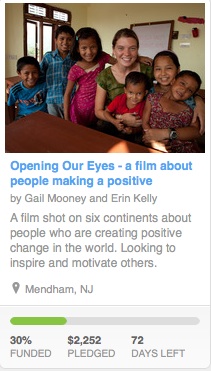
There have been other passion projects since these first two and my head is usually full of ideas that are rumbling around, just waiting for the right time to surface. I am in the midst of a project now, Opening Our Eyes that is perhaps the most ambitious one I’ve ever dreamed up. This past weekend I launched the project on Kickstarter.  Kickstarter is a website that posts creative projects for the purposes of finding funds. It’s a perfect example of crowd funding where one can donate anywhere from $1 to $10,000 to the project of their choice, and in the process make someone’s idea come to life.

I launched Opening Our Eyes on Thursday and within 3 days we reached 30 % of our goal. We still have a long way to go and have another 71 days to get fully funded.  The way Kickstarter works is that if you don’t get funded 100%, then all bets are off and you don’t receive anything.  So, I’m doing my best to do what I like the least and that is make a pitch for pledges.  My intent is to secure enough funds so that I can collaborate with a professional editor and raise the bar on the film that my daughter and I shot this past summer on our 99-day adventure around the world, about people who are making a positive difference in the world.

It’s really a win/win for anyone who chooses to give – even a pledge of $25 will get us closer to our goal and you’ll receive a DVD of our film when it’s finished.  So please check out our project on Kickstarter and pass this link along to others.  Ultimately our goal is to inspire and motivate other change-makers through the power of our film. We know we can do it with everyone’s help and it will make you feel good to give – it always does.

Add to FacebookAdd to DiggAdd to Del.icio.usAdd to StumbleuponAdd to RedditAdd to BlinklistAdd to TwitterAdd to TechnoratiAdd to Yahoo BuzzAdd to Newsvine

The Power of Yes

I’ve just experienced one of the most extraordinary weekends of my life – all because I said yes.  Barely more than a week ago, I sent an email with a link to the trailer of my documentary to Rebecca Self,

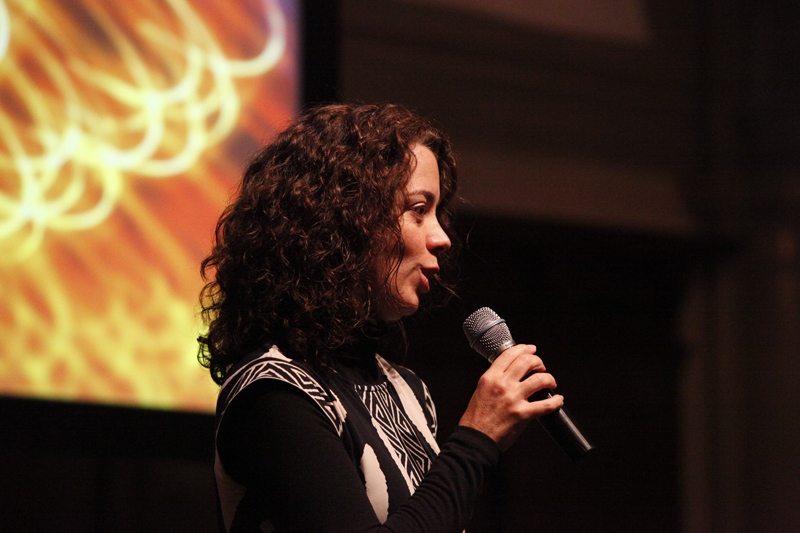
Rebecca Self at the European Summit for Global Transformation

who I was introduced to by two of the subjects in my film, Letha Sandison and Maggie Doyne.

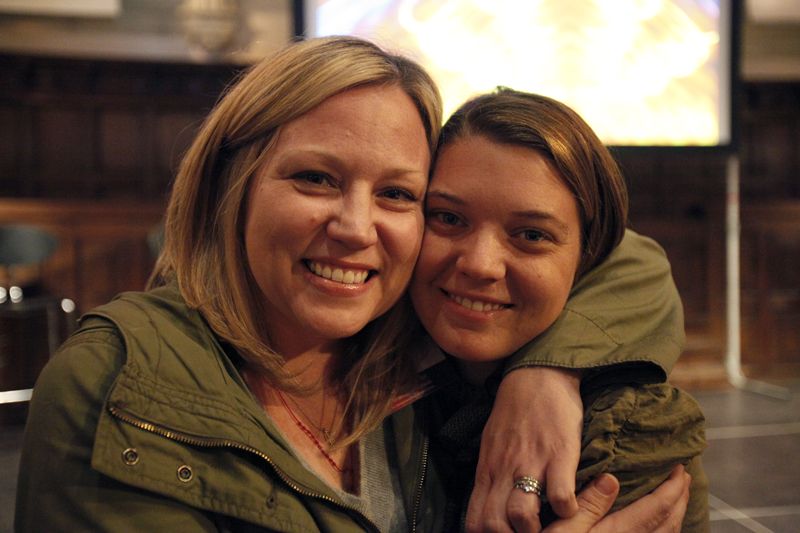
Letha Sandison and Maggie Doyne

Rebecca is an amazing woman – she’s a connector of change makers.  The day after Rebecca got my email, she replied “Would you consider coming to Amsterdam this weekend and showing your trailer at The European Summit for Global Transformation.  My first thought was “wow” – and with a title like that, it was bound to be a gathering of very interesting people.  My next thought was, “it’s not possible – there’s not enough time – the airfare will be high” etc. etc.  All very practical thoughts – right?

And then I flipped it and told myself all the reasons I should say yes. I ‘d have the opportunity to show a culturally diverse audience a sample of my film and talk about the idea behind it. I would get to see Letha and Maggie again because they were going to be speaking.  And most importantly, I would be spending the weekend with people that not only believed that anything is possible – but are making the impossible happen, together. So I replied to Rebecca and said YES.

For two days I listened, as all kinds of people told their stories – people who are actively doing things that are making our world a better place. They awed me with their courage, their commitment and their passion.  But the most empowering part of the conference was connecting with these people, who were not only there to talk about what they were doing, but also to network with others to help them make their commitments a reality.

As I write this, on my last night in Amsterdam. I’m ready to head out to have one final dinner with some of the most fascinating  people I have ever met.  It has been a powerful weekend, being part of this group of people, from all over the world that are making extraordinary things happen.  This is what my film is all about – the power of the individual, working together to make things happen – across the globe.

To be able to show my ten-minute trailer to these amazing change makers was an honor and reward in itself.  But to spend the weekend with such a unique group of people who believe that anything is possible, was extraordinary and fortified me as I go forward in editing over 150 hours of footage.

I have a friend who is always telling me that I need to say “no” more often – because I tend to spread myself too thin.  But this time, I was glad I said “yes”.

Add to FacebookAdd to DiggAdd to Del.icio.usAdd to StumbleuponAdd to RedditAdd to BlinklistAdd to TwitterAdd to TechnoratiAdd to Yahoo BuzzAdd to Newsvine