For the past two years I’ve been traveling around the country presenting a seminar called “Should I Be Thinking of Video” for ASMP (American Society of Media Photographers. This seminar had become quite popular with still photographers as interest in video escalated, partly due to the hybrid cameras and partly due to the increased demand for video content for the web and mobile devices. The iPad in particular is a game changer and everyone seems to be keen on either creating video content or buying it.
With this rush to find or produce video, I’ve seen quite of few people attend these seminars because they feel they have to get onboard. A few weeks ago, someone in the audience, who appeared quite annoyed, raised their hand and said, “but you didn’t answer the question – should I be thinking of video”. He went on to say that there was nothing new about video and weren’t there plenty of videographers already out there. I replied that he needed to answer that question himself. I could only provide him with background information about video production but that decision as far as if he should embrace video was for him to make. I also said that yes there were plenty of videographers out there working in traditional markets that have been around for decades. What is new is the increased demand for video because we as a society are moving more toward an electronic means of communication and away from print.
I think the most important point here is that no matter what creative path you may wish to pursue, you need to have a reason for doing it. For me, I started shooting video more than a decade ago because as a storyteller, I felt the need for motion and sound to adequately tell the stories that I wanted to tell. I certainly wasn’t chasing a trend – not that video is a trend. Just like in still photography, it’s not about the tool or the camera, it’s about your vision and if you don’t know why or if you should be shooting video then how can you possibly have a clear vision.
I can probably better answer the question “should you be thinking of video?” this way. If it’s because you have a camera that is also capable of shooting in video mode then then the answer is no – you shouldn’t be thinking of video, because you will be a technician or a button pusher and will compete with every other person who has that same tool. But if you are thinking, seeing and feeling projects and stories that are all about motion and sound, then you’ve answered that question for yourself.
What a difference a year makes. I’ve been going to Photo Expo since it started, whenever that was some 20 or 30 years ago. It used to be held at the Coliseum, New York’s old convention center, when it was much smaller. Over the years Photo Expo got bigger and bigger, with huge sections of the floor devoted to lab equipment and hundreds of other booths displaying everything from cameras to computer software.
The last few years the Expo has gotten smaller. Gone is all the lab equipment of course, but also not present are some of the big vendors like Adobe and Apple. This year was the first year there was another photographic event happening simultaneously, called “Shoot NYC….an advanced photography forum”. This event was hosted by Hasselblad and Broncolor, and just few blocks away from Javits. I didn’t get a chance to get down there but I heard rave reviews from those who went saying it felt like it was geared more for the “professional”.
One difference I have noticed over the years of attending Photo Expo is the shift in the attendees, more toward retail photographers and prosumers. That was reflected both on the floor and in the seminar selections. There was an entire seminar track this year devoted to weddings and portraits. Another sign of the times was seeing an entire seminar track devoted to video and multimedia, as opposed to one or two seminar choices in previous years. I could only find one seminar this year about stock photography; actually it was about microstock in particular. That’s a big change from when there were a dozen seminars relating to stock photography to choose from.
I presented a seminar with Paula Lerner called “Multimedia and Video” and was part of a panel for a seminar called “Ethics and Photography” which was streamed live globally, but I did find time to sit in on a couple of very interesting sessions. One of my favorites was “Affordably Simple Marketing”, given by Juliette Wolf Robin. She provided a lot of terrific tangible information. I also enjoyed seeing and hearing Lauren Greenfield talking about her documentary work. And even though I’m not a teacher, I found “Teaching in the 21st Century” quite interesting. As always Blake Discher’s seminar on “Sales and Negotiating for Photographers” was fantastic and fresh. I also attended ASMP‘s annual member meeting where Tom Kennedy spoke about the new media landscape which was right on target.
The floor was smaller and as mentioned before, Adobe and Apple not present. Canon and Nikon had a lot of action and interest with their hybrid DSLR cameras as expected and I saw a lot more third party gear for the hybrids displayed – Zacuto rigs, Redrock Micro rigs, and Glidecams, along with fluid head video tripods. This trend is not going away and in fact isn’t a trend at all, as we move more and more toward electronic publishing with magazines scrambling to produce versions for the iPad and get their app designed.
The annual “bash” was more of a bust, leaving people hungry and thirsty due to no food being offered (except bags of potato chips) and a cash bar. It was held at the Intrepid, which sounded like it was going to be interesting, but not a great venue for a party. But it was nice to see my friends and colleagues and catch up with them.
It will be interesting to see what this event will look like next year – I can only guess that there will be plenty more changes.
For anyone who has been reading my blog, you know a few things about me – I love to dialog and share with others, my work and my pleasure are one in the same and I always have a passion project that I’m working on.
I can’t say that I’ve always been like this. In the beginning of my career it was a lot harder to dialog and share with people – pre-social media and email. And as my career took hold and I became busier with work, I didn’t have time for sharing or personal projects. But for someone like me who is a dreamer, I was starting to burn out.
When I started exploring the video medium in the late 90’s, it triggered a spark in me. I started thinking and dreaming about all the stories that I wanted to tell – that would be possible for me to tell – through this medium. One of my first attempts at telling a story with video was a short documentary I did on my daughter’s youth symphony. I couldn’t have picked a harder subject if I tried because it was all about sound, which I knew nothing about. And anyone who has ever shot a musical concert knows that it’s almost impossible to do with only one camera. But I naively pursued with this project and learned a lot in the process.
My next passion project was The Delta Blues Musicians that I envisioned as a multimedia project combining still environmental portraits of these musicians along with video interviews, capturing their life’s stories. It was a lot of work and for the most part, I went it alone – doing everything myself. For anyone who has ever tried to shoot both stills and video on the same job, you know it’s not an easy thing to do. That project will always be near and dear to my heart and continues to reward me in ways that I never knew were possible.
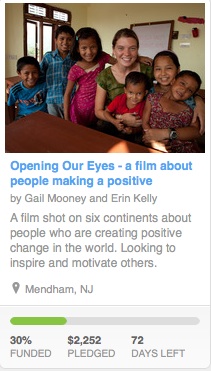
There have been other passion projects since these first two and my head is usually full of ideas that are rumbling around, just waiting for the right time to surface. I am in the midst of a project now, Opening Our Eyes that is perhaps the most ambitious one I’ve ever dreamed up. This past weekend I launched the project on Kickstarter. Kickstarter is a website that posts creative projects for the purposes of finding funds. It’s a perfect example of crowd funding where one can donate anywhere from $1 to $10,000 to the project of their choice, and in the process make someone’s idea come to life.
I launched Opening Our Eyes on Thursday and within 3 days we reached 30 % of our goal. We still have a long way to go and have another 71 days to get fully funded. The way Kickstarter works is that if you don’t get funded 100%, then all bets are off and you don’t receive anything. So, I’m doing my best to do what I like the least and that is make a pitch for pledges. My intent is to secure enough funds so that I can collaborate with a professional editor and raise the bar on the film that my daughter and I shot this past summer on our 99-day adventure around the world, about people who are making a positive difference in the world.
It’s really a win/win for anyone who chooses to give – even a pledge of $25 will get us closer to our goal and you’ll receive a DVD of our film when it’s finished. So please check out our project on Kickstarter and pass this link along to others. Ultimately our goal is to inspire and motivate other change-makers through the power of our film. We know we can do it with everyone’s help and it will make you feel good to give – it always does.
I’ve always been an independent creature, starting with a year long backpacking odyssey as a 19 year old traveling solo, following the “hippie trail” around the world. That sojourn led me to pursue a career as a still photographer, using my camera as a tool to gain access to people, their cultures and their stories.
I’ve had a great ride these past 30 years shooting assignments for high profile magazines that have taken me to all parts of the globe. For the most part, I was a solo act, spending hours, days and weeks observing people, then becoming more intimate as I proceeded to get to know and tell their stories and share them with others.
When I started shooting motion and in particular digital video, eleven years ago I embraced the notion of collaboration. Video production has a lot more facets to it than just the shoot and I knew that even though I knew how to capture reasonably good sound and edit a respectable rough cut with Final Cut Pro, I also knew that working with professional sound people and editors would raise the bar on the quality of my projects.
This past weekend, the value of collaboration, networking and using social media to get my ideas out to the universe, really hit home. I had been asked to speak at the Photocine News Expo in Hollywood, CA about my latest documentary that I was working on, Opening Our Eyes. I had gotten to know two of the organizers of the event, Michael Britt and Lou Lesko, through social media. They had taken notice of my blog and my project, which I had decided to shoot with the HDSLR cameras and had written about it in their blog, PhotoCineNews.com.
I was honored and humbled to be speaking at the same event as some pretty heavy players like Vincent LaForet and Shane Hurlbut. I was a bit intimidated at first, but I knew that I was there to share what I knew and that is how to get a passion project from just an idea – to a reality. So, after returning from my 99-day journey, with just a couple of weeks to prepare a sample from some of the 145 hours of footage that were shot, I flew out to LA.
I suppose I can legitimately say that I have had a theatrical showing of my documentary in Hollywood. True enough – but the real value for me this weekend was in sharing with my peers and making connections with people who I will work with in the future that will help me grow as a filmmaker and storyteller and more importantly who will bring their expertise to my film.
It’s an incredible time that we live in with a realm of possibility. Literally anything is possible. When you share and put things out to the universe – you just never know what you’ll get back. I’ve learned that I share because it makes me feel good – not because I have expectations for an immediate or monetary return. But each and every time I do share – I get back so much more in return.
I’ve just spent the last 2 weeks intensely editing my footage shot on my 99-day journey around the world, shooting my passion project, Opening Our Eyes. I wanted to get a trailer ready for the PhotoCine Expo that I’ll be speaking at this weekend in Los Angeles. I knew that I couldn’t possibly go through all 2900 gigabytes of content (145 hours), let alone cull it down to a finished sample in two weeks time. So, I took a friend’s advice and decided to focus on only two of my ten subjects that I interviewed and shot b-roll on.
Even with going through only 20 percent of my footage has been a grueling and exhausting two weeks. But it’s also given me a much better sense of working with and analyzing the files that come out of the Canon 5D Mark II and 7D.
Some of my loves:
I love the picture quality
I absolutely love the picture quality
You can’t beat the picture quality
It’s true, the picture quality is stunning and worth putting up with SOME of the workarounds, depending on what type of job I’m working on. If I’m shooting a corporate event and I need to record longer than 12-minute intervals, which is the case when someone is giving a talk, then I would opt not to use a DSLR because of the limitations on the duration of a clip. And, regardless of the type of job I shoot, editing the files from these cameras is tedious because I need to transcode them into a file that will play well in Final Cut Pro.
Some of my hates:
12 minute clip duration – this really needs to change in the next generation of these hybrids in order to make it a more workable camera
Audio – Canon really needs to come up with a more professional solution for capturing good audio with the video on one card. I have used a JuidedLink pre-amp with a gain disabler on it but it’s still not as good as the audio I get when I capture it to a separate digital recorder – in my case the Samson H4N Zoom.
Having to transcode all the files into a codec like Apple Pro Res so that I can edit in FCP without stutters, stops and drop frames.
Stabilization is an issue but a solvable one thanks to rigs from Zacuto. And of course you can always use a tripod – and really should if the situation warrants.
I’m sure I’ll come to other conclusions as I dig deeper into my content and I’ll share my thoughts as I continue to immerse myself in the post production part of this film.
In the Field
Depending on how you are working in the field and what you are shooting, your workflow and the way you organize and manage your media will vary somewhat. If you have a crew and are shooting a scripted video, then you will probably have a computer and technician on site, downloading media as it is shot, backing it up and checking it for focus.
If you’re working solo or with just one other person, which is how I have been working for the past 3 ½ months on my project, Opening Our Eyes,
Gail at the Kopila Valley Primary School, Surkhet, Nepal
then you don’t have the manpower to work that way. I downloaded all my footage, audio and stills at the end of the day. I rarely had the time or even the battery power on my computer (electricity was scarce at times) to look at what I had shot but I did do spot checks occasionally.
Regardless of how you work in the field,
Children at the Kopila Valley Primary School
it is essential to create redundant backups of all your content. I backed everything up to two portable external hard drives, after downloading the media to my laptop via card readers. There’s a nice software application called ShotPut Pro that lets you make up to 3 copies to different drives at a time, which speeds things up quite a bit. For the most part, I had organized my media by destination and subject with each folder containing the contents of a card. Whenever I shot an interview, I put a fresh card in the camera so that the content was automatically sorted out from the b-roll. Some shooters I’ve talked to who are used to shooting tape, archive each tape or card by making a disk image (DMG) of each which can be mounted on the computer, emulating the original card.
Back in the Editing Suite
The first thing I did when I returned from my 99-day journey, was to make two backups of all my material. After my media was backed up, I started to organize it. Everything had already been separated as far as destination and subject, but I needed to separate the stills from the video and the interviews from the b-roll – if any cards contained both. I also needed to match up the interview video footage with the audio files that had been captured by a separate recording device.
After getting all my media organized and sorted by destination, subject and file type, I renamed the files and added any relevant metadata – copyright and creator info etc. This can be done in Adobe Bridge. You can also look at the video files in Bridge to preview before transcoding them. Another way to preview your video files is by using QuickTime player. Because the files coming out of these hybrid cameras are compressed H.264 files, they do not play smoothly in Final Cut Pro, so they need to be transcoded into a codec like Apple Pro Res, before editing them. This can be done in Apple Compressor which comes with the Final Cut Pro Suite or MPEG Streamclip which is a free application.
You can choose to preview your video files first using Adobe Bridge or QuickTime player or another software tool, and then make a folder of “selects” and transcode just those files before importing them into FCP, or you can transcode everything and then import everything into Final Cut Pro.
After I organized my assets (stills, video and audio), I chose to transcode ALL my video files and import everything into Final Cut Pro. That way, not only could I preview everything smoothly, but I could also start adding information to the clips and organize them into bins within FCP. And with everything transcoded, I won’t have to leave FCP if I wanted to look at content that hadn’t been previously marked “selects”.
Getting to the Fun Part
Organizing, sorting, logging and transcoding is tedious work but it’s essential in order to be able to find things quickly when you need them, when you start laying down your storyline and want to keep focused. There’s nothing worse than having to break your train of thought while you’re editing and have to leave the program to find assets or prep them. Organizing is key – it’s not fun, but a necessary step in the process.
I will continue to slog through this initial process this week, in order to get through some of my content so that I can put together a sample for the PhotoCine News Expo that I’ve been asked to speak at this month. I have way too much material to go through everything, so I’ve decided to tackle the content from two of my subjects, which will make the task more manageable. It will also provide me with the reward of working on the “fun part” of editing by crafting a short story before moving on to daunting task of assembling the entire documentary. Check out this quick sample that I put together within 24 hours after getting off the plane. http://www.vimeo.com/14645594
Little by little things will come together and I’ll keep you posted as I go along.
I returned back to the United States a couple of days ago and before I even did my laundry, I sat down to edit a quick behind-the-scenes interview video clip of my daughter and I discussing the documentary we had just finished shooting, traveling around the world. I was motivated by a deadline where I needed to provide a video clip from the project, right away.
I was fortunate in that we had just shot interviews of each other talking about the making of the film, while the experiences were still fresh in our heads. So it was relatively easy for me to pull a couple of soundbites from the interviews, sync the audio which had been recorded separately and add relevant B-roll. Within less than 24 hours after stepping off the plane, I had a 5 minute behind-the-scenes short. Nothing fancy, mind you but in addition to providing an opportunity for the film to get awareness, it forced me to start thinking about the overall structure of the piece.
The hardest part of editing is getting started – figuring out how the story will be told. In my case, I’m facing the daunting task of looking through 3 months of material – interviews, B-roll, still images, and behind-the-scenes footage that I need to figure out how I will put it all together. There are a dozen different directions where I could take this film in the editing process. I could choose to make each subject’s story an independent video, with the full length documentary being comprised of them all. Or I could weave the stories together – structuring the piece more thematically. Or I could include the mother/daughter aspect in the film and add some interview footage of the two of us talking about the project.
Just in putting together this quick sample, I have forced my mind to start thinking about the next step – crafting the story. My next deadline is to make a trailer for this film that hasn’t even been edited yet. I will be speaking at the PhotoCineNews Expo in LA in a couple of weeks and I’m motivated by this opportunity to present the workings of this project to a live audience.
As it turns out, jumping right into it was the best thing to do. I overcame the inertia that’s always present, and started focusing on how I was going to tell the story of not only our subjects but the experience itself.
I came across an interesting blog yesterday “20 Things I’ve Learned From Traveling Around the World for Three Years”, by Gary Arndt. It was pretty much on target with my observations from my very short journey of a little more than 3 months. But it got me thinking about what I have learned on these travels.
Erin and Gail and children of village along Amazon River, Peru
To travel is to experience and learn and also an opportunity to show other people from other cultures what an American (U.S. citizen) really is, beyond the news, the music and Hollywood movies.
1. People are good – Like Gary, I’d have to agree that for the most part most human beings are good. Sure there are schemers, con artists and thieves in just about every culture, but for the most part – people are good.
2. Government policies don’t always reflect who the people are – U.S. citizens are not all warmongers and not every Afghani is a terrorist.
3. The media exaggerates – Because we all get our news these days in abbreviated and sensationalized TV content – it’s distorted. I almost changed my plans to go to Thailand because of the coverage of the political unrest, which in actuality was contained to only certain sections of Bangkok.
4. There aren’t just “ugly Americans” there are “ugly tourists” – people around the world seem to equate badly behaving tourists as “ugly Americans”. I have found bad behavior is not solely exclusive to “Americans” or U.S. citizens – I have witnessed really bad manners from all types of tour groups – French, German, British, Japanese, Argentinean – you name it. I think it is more of a reflection of a “group” dynamic than a cultural one.
5. U.S. citizens are misunderstood – I find this is more common in countries that are more “westernized” than countries where you would think more of a discord would be present. For example – I found the people in Egypt friendly, curious and informed, unlike other “westernized” countries where the attitude was more of one of disdain. In other words, the more “westernized” a country was there seemed to be more of a preconceived yet narrow minded and naïve attitude about what an “American” was.
6. Cultural naiveté – Guess what folks – when you join those tour groups and they take you to the “untouched villages” along the Amazon River or to the hill tribe villages in the mountains of northern Thailand – they’re probably bringing you to government sanctioned tribal villages where the people have made it a business of “dressing up” for you. Some locals that I met referred to these places as “human zoos”. It’s kind of like expecting to see everyone in the U.S. wearing cowboy attire – I mean outside of Texas and Montana that doesn’t really exist anymore.
7. The Internet has changed the travel experience – you can pretty much get connected anywhere – anytime. My blackberry worked in some of the most remote places in the world. I could almost always get a cell signal – the irony was that I didn’t always have electricity to charge my battery. If you want to really get away – leave your laptop, iphones and blackberrys behind.
8. Go with the flow – don’t focus on what you miss from home whether that is a Starbucks coffee or a hamburger – discover the richness of the country you are in – the food – the music. As we become more and more connected with each other across the globe – we are beginning to lose our cultural differences.
9. I am a diplomat for my country – sure there are things that I don’t like about my country, the United States. But when I travel, I feel that this is my opportunity to interact with the people where I am visiting and to give them perhaps a more true picture of what an American is – beyond what the news and Hollywood portrays us as. That is if people give me a chance – if they haven’t closed their mind.
10. I am grateful that I can travel – and I think that everyone should travel – outside his or her country and culture. Don’t just visit the tourist sites but try to get out of the cities and interact with the people. The best thing about this journey is that our purpose was not to see the sights but to connect with the people. That made it meaningful and memorable.
I woke up at 4 AM this morning after only a few hours of sleep – my body going through some major jet lag after over 22 hours of flying from Sydney, Australia to New York City via Los Angeles. Yesterday, my full day back, was spent taking care of essentials – like getting my gear to Canon for a full check up and cleaning,
Gear for my first go round.
and a visit to the Apple Genius Bar because my new laptop seems to have a living organism living behind the monitor which shrinks and grows depending on the climate I’m in, and of course taking care of my own personal needs.
As I lay awake in the pre-dawn hours, my mind was spinning with thoughts on what I had to get done before heading to South America on Saturday for the second leg of our documentary Opening Our Eyes. I have only 4 days to recuperate, rest up and gear up for the next leg. The bad part is, I’ve only got 4 days – the good part is, I have those 4 days, and can approach the second leg of this journey with the advantage of having a fresh experience in the field to draw from and make some changes in terms of gear I’m taking on the next leg. More importantly, because my turn around is short, I’m able to stay focused and remain in the mindset of the project.
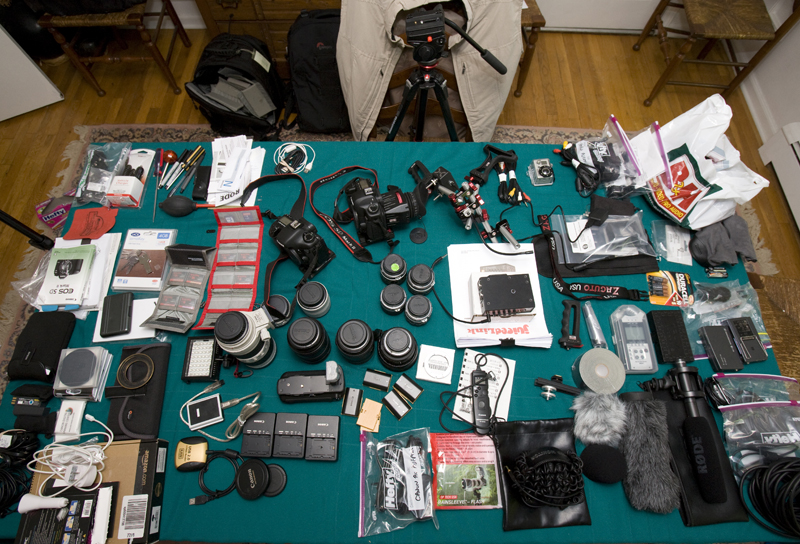
So as I go over the gear that I brought on my first leg with lessons learned in my head and prepare for the next stint, I’ll share my thoughts with you:
• A good tripod is critical – if you don’t have a decent tripod for video, you can’t get fluid movement, so don’t even try. A locked down shot is better than a jerky shot in motion. I needed to travel light with all the flights that I faced, so I went for a carbon tripod with a fluid head that would fit in a suitcase to eliminate the need for another check on bag. So, for this next leg, I’m seriously thinking of taking my larger tripod because I don’t have as many flights where excess baggage charges could mount up.
• You can never have enough batteries when shooting with a DSLR workflow and by that I mean everything from the camera batteries (and buy lots of them if you can find them for the Canon 5D and 7D) to the expendables for the DT454 JuicedLink audio preamp, which takes 9 volts to the Samson H4N Zoom which takes AA’s. By the way, speaking of batteries, don’t make the mistake I made once by not powering the H4N Zoom off before changing the batteries. The manual mentions that by doing so, files can get corrupted. A couple of my audio files did get corrupted – the information was there, but it couldn’t be read.
• I’m leaving my over priced Nikon to Canon lens converter, along with my old Nikon glass at home – I never used them – never felt the need for what I was shooting.
• I want to get more attachments for my GoPro Hero Cam because there are so many ways to use this camera – it’s amazing and I’m having a ball thinking of all the possibilities in how I can use it. The Hero cam will always be part of my gear kit.
• Always check what audio cords you’ll be needing. I embarrassed to say that I carried around my wireless kit but couldn’t use it with the Zoom because I needed a mini to male XLR cord and didn’t have it.
• Take 10-20% more memory storage than you think you will need when you’re shooting video. Video is a memory glut. I had been warned by some people that the Lacie Rugged hard drives that I were taking with me, didn’t have a very good track record – but as I write this, my content backups from my Lacie Rugged drives ( over 2000 gigabytes (doubled) ) are transferring to my desktop OWC terabyte drives and seem to be fine so the Lacies did their job. However, they are bulky and I’m going to be getting a couple of 500 gig drives that are more compact. Any suggestions for compact firewire external drives?
• Wish I bought the follow focus with my Zacuto rig. It’s expensive but would have been a real added bonus for visually highlighting one of the beauties of these cameras – the depth of field range that they have.
• Also wish I had a portable dolly like the Indislider but just couldn’t fit it in this trip. As it was, there were some items that I didn’t need to take and will be leaving behind this next leg.
• Wish I brought more mini tools – screwdrivers, allan wrenches etc.
• My Blackberry Tour Verizon phone blew me away. Even when I was in the northern hill tribe villages of Thailand, staying in a bamboo hut without electricity and plumbing – I was able to get my email on my phone! I’m impressed Verizon – I really am. Finding electricity to charge my phone was another matter.
• I could not have survived the 30 flights circling around the world i if I didn’t have my iPod. Thanks Apple.
Feel free to comment and share your thoughts of what has or hasn’t worked for you in the field and you can save me from making potential mistakes as I take on my next leg of this Journey August 7th. We are first headed to the Amazon area of Peru and then down to Buenos Aires, Argentina – again two diverse areas in terms of culture and climate.
Many still shooters make the same mistake when jumping over to video – they only think about the camera and the shoot. When this happens, what quickly follows is mild to severe panic when they realize that audio is even more important than the visual and post-production is video is far different than in stills. On top of that, if you shoot video like a still photographer – you’ll want to kick yourself when you get in the editing room.
The good news is there are plenty of resources when embracing these various skills and learning curves than when I started shooting video over ten years ago.
Here’s a few great sites, listservs and blogs that you should bookmark:

 This seminar had become quite popular with still photographers as interest in video escalated, partly due to the hybrid cameras and partly due to the increased demand for video content for the web and mobile devices. The iPad in particular is a game changer and everyone seems to be keen on either creating video content or buying it.






 Journeys of a Hybrid