5 Tips for Filmmakers (and other artists) for Building an Audience

The good news for Indie filmmakers, musicians, photographers and new media artists is that technology enables us to take control and distribute our own work to the masses or a more targeted niche audience.  The bad news is that even though we are able to reach a global audience without giving the lion’s share of our profits to an agent or distributor – it’s a lot of hard work.

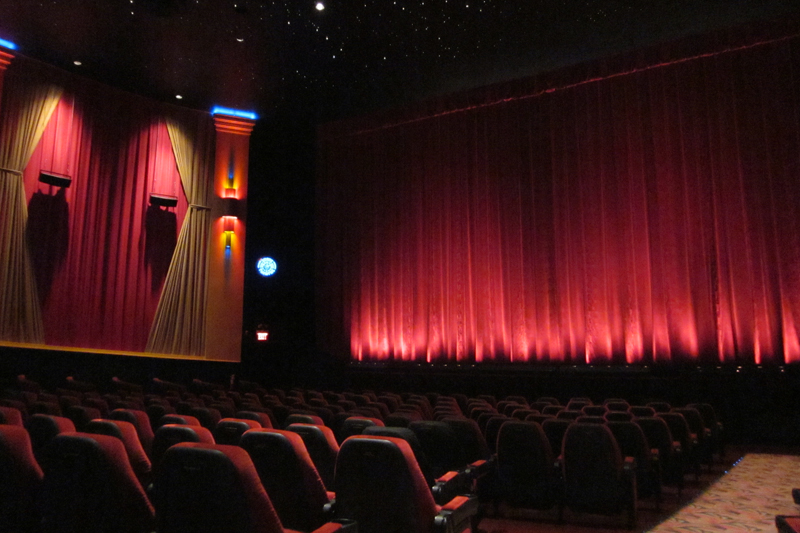
When I completed final production on my first feature documentary, Opening Our Eyes, I knew I was hardly finished with this film, not if I wanted people to see it. theater interioeIMG_0150Since most filmmakers make their movies to be seen, they need to decide how they want their movies distributed and marketed.  As a filmmaker, do you want to delegate this task to a distribution company or do it yourself?  Will you be one of the lucky 1% of filmmakers who get their films picked up for distribution?  If not, do you have a plan on how to do that?
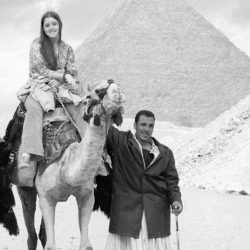
1. Identify and build audience – Regardless if you decide to sign with a distributor or distribute your work yourself, the most important part of marketing and distributing a film is to identify and build your audience – and you should start building your audience before the film is finished.  As soon as I made a commitment to make a film, I started blogging about it.  I created a blog specifically about the film where my daughter and I talked about preparing for and taking a 99-day journey around the world. I also wrote about the making of the film on this blog where I talked about gearing up for it as well as the post-production process.  I didn’t realize it at the time, but I was building our niche audience.

2. Have a social media plan:

  • Decide on platforms – Twitter, Facebook, Tumblr, Google+, YouTube, Vimeo
  • Carve out the time to engage
  • Decide where the content will come from – behind the scenes photos or footage, blogs, podcasts?
  • Who and where is your audience? Find other Facebook groups or pages and followers who are interested in the same topic as yours.  Collaborate. Build your Twitter followers same way.

3. Finding true fans – Since most filmmakers will most likely NOT have a mega hit with huge profits, the best thing a filmmaker can do is build their “true fan” base.  First you should ask yourself how many “true fans” would you need to sustain yourself as a filmmaker? And by true fan, I mean people who are willing to buy whatever you are selling, be it a book, a DVD, a music download or a t-shirt.  The key to growing your core “true fans” is to engage them by sharing interesting content as opposed to just selling something.

4. Be consistent and stick with it – Like anything else, building an audience takes time.  Be prepared to constantly interact and engage your audience by sharing relevant and interesting content with them.  You’re building a tribe or a community.

5. Find likely partners – Making films is a collaborative effort.  Similarly, for filmmakers to be successful in marketing their films they need to find their core niche.  One great way to find your niche audience is to identify like minded groups and share links.  The non-profit my daughter works for partnered with us and we frequently share each other’s news with our followers.

How Video Has Helped My Still Photography Business

After a slow spell, which I can’t say I ever get used to after 30 plus years of freelancing, the phone started ringing.  The calls were all in regards to still photography assignments.  Having been a still photographer for most of my life, that wasn’t unusual, but what was interesting was that I beat out my competition – other still photographers – because I knew video.

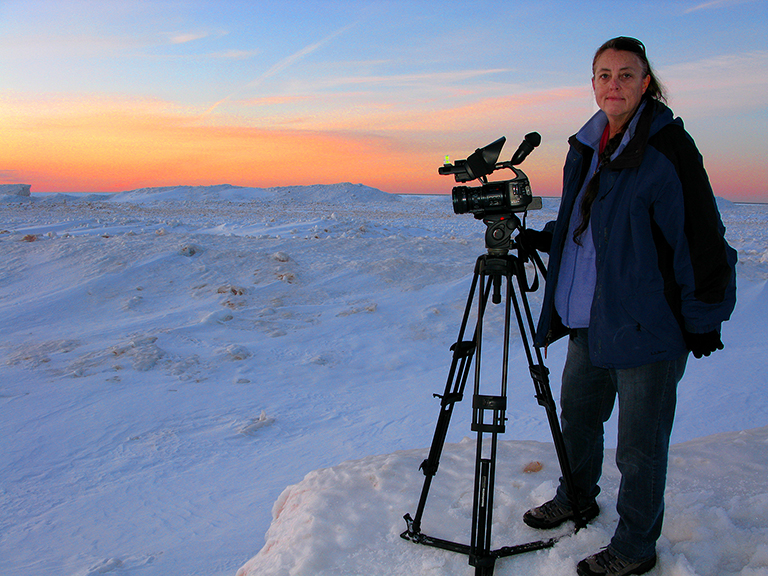
Times have sure changed. When I started exploring the medium of video, over 15 years ago, I didn’t abandon my still photography10Ft.WaveI simply added another skill set.  Most of my clients over the years have hired me to shoot one or the other, and sometimes both.  But what I see happening now is that as print moves to electronic delivery, my still photographic clients are also looking for a “photographer” that can shoot video components on a still photography assignment.  They need multimedia content for mobile devices and online platforms that cry out for movement and sound.

I don’t think of myself as a “still photographer” or a “videographer”.  First of all, I absolutely hate the word videographer because it smacks of a dated notion of what video used to be.  I think of myself as an “imaging professional” or sometimes a “new media producer” or sometimes just a “storyteller” because that’s what I do – I tell a client’s story, or deliver their message to their targeting audience.  I don’t define myself by the tool I use.

With convergence happening not only in the cameras we shoot with but in the media we create, I will opt for the “tool” or camera(s) that enable me to tell the story I need to tell, in the best way possible.  I’ve been thinking that way since I first forayed into video.  It’s nice to know that now my clients are thinking that way too.

Moving Into Motion – What is Your Why?

Over the last couple of years, in addition to maintaining my video production company and making a feature film, I have been teaching seminars and consulting still photographers who are thinking of getting into “motion”.  Many times I start out by asking participants why they want to get into motion.  The most common answer I get is “because it seems like that is where everyone is headed”.  That is perhaps the worst answer and reason a photographer – or anyone else, can give.

I suppose I could just do a show and tell and demonstrate the cool gear I have and how to use it, and I do talk about gear, but I would be remiss if I didn’t stress the “why” question.  Video is a medium that is all about story telling.  While a still photograph can also tell a story, video, by it’s very nature of incorporating visuals and sound, has the power to deliver a message or story in a very emotional way.  This is why many non-profits use video in their fund raising efforts – they have found that when they deliver their message with video – people give more money.

I got a call recently from someone who had just lost a close relative and they wanted their personal affects photographed.  My first question of course was why.  The obvious answer would be that they wanted these “things” archived.  But what they really wanted or the why in this case was that, these items evoked memories and memories are attached to feelings and it is those feelings that people want to archive when someone close to them dies. So, I felt my job was to capture and preserve those feelings for the ones who are left behind.  I knew if I didn’t approach the job like that, I would end up with images of just “things” and that would be more like a catalog of objects.

I was trying to unravel the “why” because that is what I’m best at.  My cameras and other tools of my trade – don’t do that for me – my heart and mind play a major role in that process and I believe that many times, this is what sets me apart from my competition. Photographers who don’t question the why, end up with images or video that may be beautifully executed but don’t emote or tell the story in a meaningful way.

I thought that perhaps the best way to approach this “job” would be to add a voice to it.  Even though the deceased can’t tell their story – their family and friends – can.  I also knew that I didn’t want to confuse the issue with video interviews because it could be a distraction, rather than add to the overall piece.  The decision was made to approach the job as a multimedia piece, using still images and sound recordings from relatives.

Interviewing is an art and it’s also something that can either make a piece strong – or end up as a disaster.  Like a bad script, an interview can either strengthen a piece or just as easily, weaken it.  It really is dependent on the person who is doing the interview. When done well, interviews will bring a unique voice and point of view to a project and that cannot be copied.  For example, I could do an interview with someone and hit all the right marks that I’m going for, as far as tone, emotion and connection.  I could give someone else the same list of questions and ask them to interview the same subject and they would get entirely different results.  It all comes down to rapport and that is not a one size fits all type of thing. Interviewing skills are difficult to teach, because invariably people want more of a black and white list of do’s and don’ts of the process. A great interview is really about having a good conversation with someone – but you leave your part out of the piece, when you edit it.  It’s comes down to good listening skills and rapport.  Sounds easy, but people either have these skills or they don’t.

I’ve thought about this a lot over the years that I’ve been shooting video and I always start with the “why”.  Why is it that I am really good at interviewing my subjects?  I can’t really pinpoint the reason(s), other than to say that I’m really interested in what people are telling me – and they sense that.  That’s just me and it always has been.

I became a photographer because of my insatiable curiosity in peoples’ stories – not because I was interested in photography.  My camera is a means to that end, whether it is a video camera, a still camera or a camera that is capable of shooting both.  I always start with the “why” and pick the camera and medium that best answers that question.

I am currently working on my 3rd ePub.  It is about the business of motion/video with lots of great tips and advice that will help you stay in business as you cross over into other mediums.  Stay tuned and in the meantime – start defining your “why”. Check out Simon Sinek’s TED talk – it will inspire.

Vision vs Trends

I find that many creative (and not so creative) people confuse the meaning of the two words – vision and trends.  When someone has a vision, they see past the status quo, whereas by the time something becomes a trend – it is status quo.  Seems clear to me, and yet for the most part, the common perception of what a trend is – hot, successful, youthful, revolutionary – really isn’t visionary at all, because by the time it becomes a trend – everyone is doing it.

Case in point.  Four years ago, when I joined the board of ASMP, some may have seen me as a visionary because of my early foray into video.  Four years later, it seems like everybody is doing video.  Does that make me a visionary?  Perhaps.  But I need to make a very important point here, and that is when I started shooting video almost 15 years ago, it was not because I had a vision, that the future of photography would be video.  It was because I saw myself then – and still do – as a storyteller and one who delivers the visual message, with whatever creative tools do it best.

I get super frustrated with people who define me by the type of camera (tool) I choose to use.  Anyone who has heard me speak, knows my mantra is “it’s not about the tool”. So for anyone to narrowly define me by this one particular medium – video – instead of  understanding that I foresee the  “future of photography” in the broadest sense of the word “photography”,  – are only seeing me through their own “narrow” lens.

I’ve spent a lifetime, trying not to pigeonhole myself into one genre or medium and to stay true to myself and what my instincts are telling me, rather than to jump on the latest trend. I can tell you this – by the time something is trendy – there’s nothing gutsy or visionary about jumping on that bandwagon.

Being visionary is:

  • Taking a risk based on instincts instead of emulating the latest trend.
  • Being concerned about the substance of something – not just the packaging and the veneer. Thinking that way will make you outlive any trend.
  • Being afraid, yet still being brave enough to act on what your inner voice is telling you.
  • Managing to be bold enough to come forward with an idea that is not the popular opinion du jour.
  • Not getting in your own way by seeing yourself through only one narrow lens – In the early 1900’s, when the automobile hit the scene, the folks in the horse and buggy business who saw themselves in the transportation business survived – the ones who saw themselves as in the horse and buggy business………well we know what happened to them.

I won’t get into politics here, except to say that sadly these days, so many of our world “leaders” are not visionaries and we desperately need leaders who are. But that takes courage and going against the status quo.  It’s far easier to follow others, after they have paved the way.  That’s not only a lack of vision – that’s bad leadership.

Mistakes Professional Still Photographers Make When “Moving” to Video

1.  They forget about the story – it’s not your camera that tells the story – it’s the person using the camera. Pretty visuals, slapped into a motion timeline with music, doesn’t necessarily tell a story.  Video is a story telling medium – don’t forget that.

2.  They think they already know how to shoot – if you think because you are a professional photographer and all you need to do is get a camera with a “video mode” on it, you are mistaken. Shooting in motion is far different than shooting still images. An experienced motion shooter can spot a video shot by a still photographer with little know how, right away.

3.  Thinking audio isn’t important – audio is more important than the visual when producing video.  Hire a sound person to do it right, but don’t discount it.

4.  Thinking the DSLR camera is all you need for video productions – this is a biggie.  How are you going to go after professional video jobs if this is the only tool in your kit?  Sure you can rent a RED – but make sure you are as proficient with this tool as your competition is before hanging out your “motion” shingle.

5.  Positioning themselves just as DP’s or Directors and thinking you’ll maintain ownership of your work. If you assume the role of a camera operator, DP or even a director – you will be in a work for hire position in most markets.  Position yourself as a producer – shoot if you want to – and direct – but realize that you’ll be just one rung on the “content ladder”.

6.  They don’t learn interview skills – this is what separates the pros from the still shooters who have DSLR cameras and think that’s all they need.  I’d say about  70% of my work includes on camera interviews.  Even though I ask the questions- I’m not on camera, my subject is.   I not only need to know how to ask the right questions and get great audio, but I need to produce a usable interview clip for an editor. That means knowing how to get great soundbites. This is one area I excel in – it’s all about rapport with your subject.

7.  They try to compete in “old business model” markets – Everyone wants to shoot broadcast spots and feature films (or short films) so they think that after shooting motion for only a few months – or even a year – they will be able to compete in the high end business of video production.  First, this market, like the still photography market,  has changed drastically, mostly marginalized by still photographers who are just starting to shoot motion,  shooting jobs for next to nothing because they have no understanding of this “business”.

8.  Learning the “how to’s” in terms of gear – but nothing about the business – this is also a biggie.  There are so many “how to shoot motion” workshops and roadshows out there but no one seems to be teaching the business end of things.  Still photographers think they already know “the business” but quickly realize that they don’t, and they put themselves out of business in this medium – before they’ve barely started.

9.  Teaching “how to” workshops in video with little or no experience – I can’t tell you how many photographers have called me for technical advice about some pretty basic stuff in terms of video,  and four months later they are teaching workshops. Please don’t become part of the problem and send more shooters out into this field without teaching them something about business. And if you are considering taking a workshop – do your homework and take the workshop from someone who is accomplished in this field and has done something.

10. They forget about the story – I know that’s #1 but it needs reinforcing.

ASMP and Motion

I’m on the National Board of Directors of the ASMP, The American Society of Media Photographers.  About four years ago, I was asked if I had ever thought about running for the board.  The person who had asked me this question, knew that I had been shooting video in addition to still photography and thought that it might be a good idea to have someone on the board who had an understanding of this medium.  That was four years ago, and even though I had been shooting video for over 10 years – the “explosion” of this medium (in terms of the demand) had really just started.

I did run, served three years, ran again and got elected. I’ve shared my knowledge of this medium through meetings, seminars, blogs, emails and during Q&A’s when I screen my film.

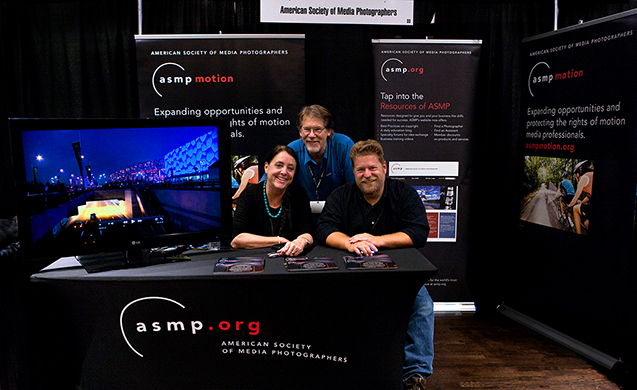
Gail Mooney, Tom Kelly and Chris Hollo at ASMP booth, DV East

This past Wednesday, I spent my day manning the ASMP booth at DV East Expo. Former national board member (and now President of the ASMP Tennessee Chapter) Chris Hollo and my partner Tom Kelly joined me.  We were well prepared with a large flat screen monitor displaying a loop of our members work. I was intimate with the reel as I had just finished editing it and I was very impressed with the quality of the work.  It certainly was an attention grabber.

So, what was ASMP, a trade organization of still photographers, doing at a video expo? Essentially, we were there to provide a community and reach out to other professionals who are shooting both mediums and provide information about sound business practices.  If this demographic does not understand the value of copyright or value the concept of licensing, then it will ultimately affect the way business is done in the still photography industry.

Some people may think that ASMP is becoming too inclusive or is creating more of a problem by suggesting that video may be the answer for its members, only for them to find out, that industry is glutted as well.  The old business models of bloated production companies with fat budgets are hanging on for dear life, along with the old business models of the film industry.  But if you think outside the box, especially in terms of how you structure your photography business – the opportunities are out there.

ASMP doesn’t cease to be an advocate for its still photographers who have no interest in motion – it’s actually making the entire industry healthier by educating the hybrid competition.  A lot of the people I talked to yesterday, shot both still photography and video, but even the ones who just shot video – called themselves “photographers” and they all had questions about “the business”.

I’m so closely associated with  “video” by members of this society; they tend to forget that I am a photographer.  I don’t call myself a photographer simply because I spend 50% of my time shooting still images, or call myself a videographer because I spend the other 50% of my time producing video. I don’t want to define myself by my tools, at all. I “see” as a photographer, with the vision of a filmmaker and the heart of a storyteller.  I also have a strong desire to stay in business doing what I love to do.  By being an advocate for sound business practices across these mediums, I get a lot more back than I give.  All photographers’ benefit, regardless of what type of cameras they shoot with.

Friend and fellow board member Ed McDonald, tells his own story about how he had become too rigid at one point in his career, as far as how he perceived himself and what kind of photographer he was. He found that when he became more flexible in how he “defined” himself, his business got better. As I think about Ed’s story, I know we have a lot in common.  For me, when I stopped restricting myself to just shooting still images – not only my business got better – so did my still photography. Shooting motion has made me a better still photographer because it has made me a better storyteller.

I got an email late last night from someone I ran into at the expo.  They wrote:

“Thanks for your vision and inspiration and all you’ve done for ASMP.”  So simple and so poignant and I thought – “isn’t that what I was supposed to do?”

Pioneering in Video

I’ve been in China for the past two weeks, teaching video journalism to some of the best photojournalists in China.  Last night at dinner, the top director of the program told me (via my interpreter) that Xinhua, China’s biggest news agency, was setting up their multimedia department to stay current with how news is communicated in this day and age.  She thanked me for teaching and inspiring her journalists in this medium and said that I was an honorable “pioneer”.

I never set out to be a pioneer when I first started shooting video and motion in the mid ‘90’s – I merely recognized that when the “tools” of this medium became affordable, it was now possible for me to tell my stories in another dynamic way.  But I never turned my back on still photography and I would say that it still makes up about 50% of my business – at least in the time that I devote to it.  I would also say that while I spend 50% of my time split between both mediums – I make more than 75% of my income from shooting motion – capitalizing on not just making income from shooting video but also on the other elements like editing.

I started thinking about the aspect of being a pioneer and the more I thought about it, the more I realized that I wasn’t trying to set new ground at all – I was really just challenging myself and more importantly staying true to why I became a photographer and that was to communicate.

I’ve given a lot of workshops to still photographers who want to move into video.  Generally there are two types of photographers – the ones who think that because they have been “shooting” for many years, they “just” need to understand a new mode on their cameras and the ones who embrace the fact that this is an entirely different medium and they understand that they are novices, and are eager to learn how to communicate in a different way.  It’s usually the cocky photographers that fail miserably and end up with a string of unconnected “moments in time” to a music track.

Ever since the first DSLR that incorporated a video mode hit the scene, I’ve seen more and more still shooters, move into motion.  After only a couple of months, I even see some of them teaching workshops.  It amazes me, because many times some of these same shooters have been hypercritical of “amateurs” coming into their profession with their auto everything “point and shoot” cameras.  I’ve had some shooters tell me that they aren’t going into motion, because they think that when these tools  become easier to use and more automated – the same thing that has happened to the profession of still photography will happen in video.  I disagree with this notion but more importantly I think that this attitude is usually a mechanism people use to talk themselves out of challenging themselves and are reluctant to “change. ” Just like when still photography moved from film to digital – the ones who got left behind were usually the ones who tried to convince themselves that digital would never be as good as film.

I cannot take credit for being a pioneer in video.  There are many who came before me that were true pioneers and I feel that would discredit them and their efforts.  I’m simply a storyteller and I’m happy that I’m still passionate enough about telling the story that I continue to find the best way to tell the stories that I am meant to tell.

Thanks to the gracious people in China and the Xinhua News Agency for recognizing and embracing the future and being keen to learn.  Perhaps many of these students will not shoot multimedia – but learning how to shoot in motion has made me a better still photographer and will make them better shooters as well.

Teaching Video Journalism in China

Chinese flag, Beijing, China.
Chinese flag, Beijing, China. (Photo credit: Wikipedia)

I’m sitting in the Continental (United) airport lounge at EWR, waiting to board a flight for Beijing.  I’m headed to China for 4 weeks to teach Chinese journalists, video journalism.  My mind is spinning with ideas, questions and the usual array of “what ifs” as I take on another adventure.

About two years ago, I started saying “yes” to opportunities that presented themselves to me – or at the very least, I began to consider opportunities, rather than to talk myself out of things, right off the bat.  Because, of that mind set, I’ve been going where life seems to take me and it has presented quite a few interesting adventures.  It’s not that I’m foolhardy and doing things on a whim – it’s that I have been listening to myself – my inner voice – and it has been my guiding force.

I’m told that the Chinese are hungry for “western” knowledge.  But what I have to teach them is something universal, and that is – how to tell a story – using the medium of video.  Seems so basic and simple – how to tell a story – and I suppose it is, but like anything else, it’s simple if you understand it.  The key to understanding something is to have the desire to learn.  Some people say they want to learn – but that’s different than really having the desire to learn.

Some folks feel threatened by this seemingly insatiable desire of the Chinese to learn all things western.  I’m also finding that when people feel threatened by something – they try to “stop” whatever it is they are feeling threatened by.  It’s one of those stupid human tricks that folks have played since the beginning of mankind.  I process this behavior pattern as unproductive and unsustainable. It rarely works as far as eliminating a perceived threat.  You simply can’t totally eliminate desire.

Rather than stop others from growth – a better way is to better yourself.  I’d rather put my energies into where I want to go in my life – than in trying to squash other people’s hopes and dreams.  I’ve also found that what goes around – comes around.  When you “give” and “help” others – you ultimately create a better world – or “space” for everyone.

So, as my mind races this morning with my hopes, my expectations and enthusiasm – I try to keep the nagging doubts and fear at bay.  I tell myself that it’s natural to have concerns.  But I also tell myself that I can either let my concerns consume me and turn into fear or I can welcome the “unknown” and embrace the opportunity at hand.  I’ll let my inner voice guide me because it seems to be doing a good job.

Add to FacebookAdd to DiggAdd to Del.icio.usAdd to StumbleuponAdd to RedditAdd to BlinklistAdd to TwitterAdd to TechnoratiAdd to Yahoo BuzzAdd to Newsvine

Paying it Forward – It’s Amazing

I got the best email yesterday. It was from a young man who had attended a seminar I had given at Yale for ASMP on “Should I Be Thinking of Video”. I remember that evening well. I had recently returned from a 3-month journey circling the globe with my daughter creating a documentary on people making a positive difference in the world.
I was still very much in the same head-set that I had been for the past few months – one full of peace and belief in myself. I had just come off an intensive period where I was “walkin’ the walk” and I was practicing what I preached.

The young man, Brian, wrote, that he had attended my seminar with his father, who was a photographer and that he, himself had grown up wanting to make movies. So, my seminar was a perfect combination for them. Then Brian wrote “That night you inspired me.” My heart jumped when I read it. He went on to remind me of things that I had said that evening – about overcoming fears in order to realize your dreams – in my case traveling the world to make a movie. Leaving the known behind – for the unknown. Telling yourself “yes” instead of giving yourself reasons not to.

Brian said that he had recently landed his first job of his career as a structural engineer. He loved it, but he also had a great desire to travel. That night he went home and furiously “googled” anything about traveling the world and beyond. He came across the website of “Engineers Without Borders” and as serendipity would have it, they were having their monthly meeting that week.

To make a long, but interesting story, short, Brian went to that meeting that week, and talked with some people during a break who were organizing a trip to a village in India.

©Brian Skelcher

Then they invited him to go with them in February. He was astounded. And then he did the same thing many of us do in similar situations – he started giving himself every rational reason why he shouldn’t/couldn’t possibly do something like this. In Brian’s case – how could he ask his new boss for 3 weeks of time off?

That night when Brian heard me speak, was about a year and a half ago. In the email he sent to me yesterday, he talked about spending the last year editing his 15 hours of footage, down to a 40 minute piece. He told me that it hadn’t been easy and that he frequently read my blog posts where I had written about my similar experiences with post-production – magnified. What I had shared had helped him through it – angst and all.

My favorite line in his email read:

“So, I’m finally done with my movie, although there’s things I wish I had done differently, I did my best and I’m glad it’s finished! The final product is one thing, but the journey to get there is another, and the past 18 months have been such an amazing experience for me! I owe it all to you! Sorry for the long email but I’ve been waiting 18 months to tell you my story!!”

Brian just launched a Kickstarter campaign to send another engineer to Nepal for a similar project. You can find out more about it here: http://www.kickstarter.com/projects/videotaping/welcome-to-abheypur-the-movie

I think back on that evening and the year and a half in between. I’ve gone through two tough winters, doing the kind of work that needs to be done, but nevertheless takes its toll on my heart and my soul. That evening, my spirit was alive and well. Brian and others felt it and it moved them to a place they wanted to be. And now, after a tough winter, that same “energy” has come back around to me through Brian’s email. It has reminded me to stay the course and stay on purpose. Thanks Brian.

Add to FacebookAdd to DiggAdd to Del.icio.usAdd to StumbleuponAdd to RedditAdd to BlinklistAdd to TwitterAdd to TechnoratiAdd to Yahoo BuzzAdd to Newsvine

Monetization of Photography in Spite of a Lousy Economy

I talk to a lot of photographers. I don’t define the word “photographer” by the type of camera he or she shoots with. Whether someone is shooting with a still camera, a traditional video camera, a motion picture film camera or a hybrid camera that shoots both stills and motion – a “photographer” these days is apt to embrace more than one of these tools.

Regardless of the tools you may use, I’ve come up with a few tips on how photographers can stay afloat and make money in this continued stagnant economy.

  • Think outside the box – don’t think of yourself as one who just shoots still images. Even your “still” clients will have a need for motion imagery these days.  It may not warrant the need for them to hire a big video production crew to make a broadcast spot.  But it could be one of your corporate clients needs a “talking head” for their website. Even if you don’t shoot motion or don’t want to – collaborate with someone who has these skills to fill your client’s needs instead of sending your clients  elsewhere.
  • You don’t need someone else to commission your services in order for you to make a living. When photographers take on personal projects, not only are they creating a buzz and getting noticed by potential clients, they are also creating their own “content” to monetize. It is possible now to get our content to market without the need of a middleman. Portals are open and plentiful to all.
  • Take advantage of what is “free”, rather than be put out of business by it. There are so many ways to build your brand and get noticed without spending a fortune. The costs of building and maintaining a website have dropped significantly because of advances in technology. And utilizing social media to create a buzz and get the word out about your company is virtually free with Facebook, Twitter,LinkedIn and YouTube. But be prepared to do the work and discipline yourself because this territory is ripe with distractions.
  • Re-purpose your content. If you’ve been blogging or have something useful to share – consider packaging your “knowledge” into ePubs, podcasts or “how to” webinars. One thing I’ve learned about making an ePub is that you can either do it yourself or hire a formatter so that it gets to market quickly – via Amazon, Barnes and Noble or the iTunes platform. Price it right – and offer more than one ePub at a time. (I’m working on my 2nd ePub now) In this market, if someone has just spent $3 or $4 to buy your ePub and they see you have another one for sale – it’s not a big stretch for them to buy that other book you offer at the same time.
  • Collaborate with others. Partner with others to put on webinars, podcasts, call in phone seminars etc. Use this opportunity to build your own brand. Don’t always feel that you have to be the only “act” offered. In fact many times, if you join forces with other creatives, it will get you further than if you are the only speaker in a half filled room. Get out there and get noticed and learn from your colleagues at the same time.
  • Be authentic. I cringe when I write that word because it has become a bit trite. I guess in a way I have always been authentic. In fact I just can’t help myself. If you are true to yourself, you will be ready, eager and able to work hard on your dreams. And hard work is exactly what is necessary to make it in this profession.  You’ve got to want it bad enough in order to do the work. If you are a clone of other photographers, you’re career will be short lived. I guarantee the photographers that you are emulating will be “moving on” because their passion is driving them to new things. So, what happens to the cloned versions then?
  • Don’t focus solely on the money. Easy to say and really hard to embrace when you can’t pay your mortgage. But look at any successful person – I don’t care which business you choose to look toward in terms of finding successful people – but you’ll see that most people who have “made it big” were not driven by the money. I’m not saying that money is not important, but if you are solely focused on the money and not on the act of creating – it will show.   Being too focused on the  money part of the equation, can sometimes push it away. People sense it. It’s human nature to want to be around a “winner” – not someone who is begging for a job to keep them afloat financially.
  • Be patient. Everything turns around. While the old days and ways of doing things won’t come back, better opportunities will replace them. Don’t be paralyzed by your own fears. Do what you can that won’t cost you a lot of money and there is plenty you can do. Work social media, learn new skills – audio, editing, writing etc., network with people, create new content for ePubs, webinars, and podcasts. Use your imagination, pursue what you are passionate about and when the economy turns around – you’ll be ready.

Add to FacebookAdd to DiggAdd to Del.icio.usAdd to StumbleuponAdd to RedditAdd to BlinklistAdd to TwitterAdd to TechnoratiAdd to Yahoo BuzzAdd to Newsvine