The last couple days have been eye opening as well as reminders as to why I have embarked on this project www.openingoureyes.net. Maybe I needed a reminder at this point in my life that you only go around once and to make the most of it. And after spending a couple days with Ronni Kahn, CEO of Oz Harvest, I got that reminder and it affirmed in my mind why I took a risk, took on a personal project and took off for 3 months on a journey with my daughter around the world.
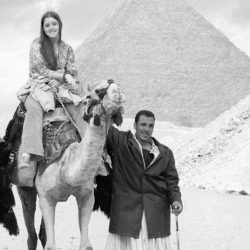
But Ronni reminded me how important it is that you really only have the “now” in your life because you don’t know what tomorrow may bring. I remember when I first embraced the notion of living in the “now”. I was 19 years old and hitchhiking around the world. I remember a consistent remark from people who stopped to pick me up and bring me a bit further along on my journey. Many of them said, “I wish I had done what you’re doing when I was your age”. I never lost sight of that and have always lived my life with the thought that if I don’t do “it“ now, I may never get the chance again.
No one really knows what tomorrow will bring – that’s the mystery of life. The best-laid plans are never givens and the surprises and unexpected moments are many times the most rewarding.
Tonight, I had a simple yet memorable dinner with my 23-year-old daughter Erin. As we ate our pizza and had a lovely, inexpensive bottle of wine – we took notice that here we were in Sydney, Australia, overlooking the Sydney Opera House and it all seemed so surreal. But it was real, it a moment in time that we made happen, that we didn’t postpone until the “perfect” time in the future and a time that we will always have and always remember. We were living in the “now” moment.
Many still shooters make the same mistake when jumping over to video – they only think about the camera and the shoot. When this happens, what quickly follows is mild to severe panic when they realize that audio is even more important than the visual and post-production is video is far different than in stills. On top of that, if you shoot video like a still photographer – you’ll want to kick yourself when you get in the editing room.
The good news is there are plenty of resources when embracing these various skills and learning curves than when I started shooting video over ten years ago.
Here’s a few great sites, listservs and blogs that you should bookmark:
These days many still photographers are frustrated when their clients decide to take their own pictures or get photos from amateurs who take photos that are good enough. And sometimes “good enough” is not only good enough – it’s pretty good because technology has enabled just about anyone to take a reasonably good photograph.
Indeed technology has lowered the bar to the entry into the realm of professional photography. But any pro knows there is more to “making” a good photo than the actual execution of an image. There are many problems to solve, and there’s the matter of being able to consistently make good photos.
But I must tell you, over the past year I have seen still photographers exhibit the same attitude that they abhor in their clients when it comes to the medium of video. As more and more still photographers embrace video because of hybrid cameras like the Canon 5D Mark II, many fall victim to the same line of thinking and that is if they buy a “good” camera that shoots “HD” video – that’s all they need to throw out the “video shingle” and they’re in business.
The problem is they lose sight of some very important things:
1. Shooting motion requires a different thought process
2. Audio is everything
3. Post production is very different for video than for still images
4. Video is a collaborative process
So when I get a question from a still photographer as to “what is a good video camera?” – I bounce the question right back at them and say – when an amateur photographer asks you what still camera takes good pictures – what do you say? Most quickly get the analogy and realize that while they are pros in the still photography world – buying a video camera or an HDSLR doesn’t make them professional a videographer. Motion is a wonderful medium, but get to learn the craft because it’s more than just the camera.
I see a lot of confusion and misconceptions amongst still photographers as they embrace video using the DSLR camera. For many audio is an after thought which is a big mistake because audio is much more important than the visual. Unless you’re just laying down still images or video clips to music then you have to be able to capture good sound. Some things to consider and remember.
1. You’ll never get good sound with the camera microphone – only use the camera mic for reference audio.
2. Don’t buy a camera that won’t let you use external microphones – unless you will be capturing your audio separately and syncing it later in post.
3. If “running and gunning” – you can probably get away with using a mic mounted on the camera as long as you are close to your audio source. You can either use a mic with a mini plug and connect it to the camera OR you can run the mic via an xlr cord to a mixer like a JuicedLink or a Beachtek, which is much better, rendering a cleaner audio capture.
4. For interviews, most likely you won’t want your camera to be extremely close to your subject. So you won’t want to use a mic mounted on the camera – it’s too far away. I rig a shotgun mic on a boom stand and I also use a lav on the subject and run both into my camera if I’m using a traditional video camera or into my JuicedLink mixer if I want to capture the sound on the same card as the audio.
5. When using a DSLR camera, capturing your audio separately with a digital recorder is ideal. I use a Samson H4N Zoom that not only has a built in dual stereo mic but two XLR inputs. I run my shotgun mic and lav mic into the Zoom and then sync the sound later in post with software called Plural Eyes. Make sure you keep the audio on in the camera as well to use as a reference for syncing later on.
6. When using a device like the zoom that has a built in mic – remember that even though this is a quality mic – you MUST get the mic in close to your sound – no more than a foot away. I prefer not to use this mic but rather a shotgun because a shotgun is more focused and won’t pick up a lot of the ambient noise.
7. Use headphones. Don’t just look at your meters – wear headphones and make sure that you are getting quality sound. You could be picking up interference or static.
8. Always consider your audio even for your b-roll – you need some audio – even if you only intend it as ambient background sound.
9. I only use a wireless system when I need to. In cities like New York you can get a lot of interference on the frequencies. Always go wired if you can. And if you find yourself needing a wireless system, spend the money to get a system that has a good range.
10. Be quiet and tell your crew to be quiet as well. You never know when you’ll want to use the audio – even if you think you won’t need it.
Technically, I began working on my latest documentary, “Opening Our Eyes” about 7 months ago when the idea came to me. I had just seen Robert Frank’s show “The Americans” at the Met in New York City with a friend of mine and I commented to him that I was really yearning to get back to my beginnings and take a visual road trip.
Even though I had spent a lifetime traveling and shooting assignments for editorial and corporate clients, I never lost sight of my passion to explore with my camera.
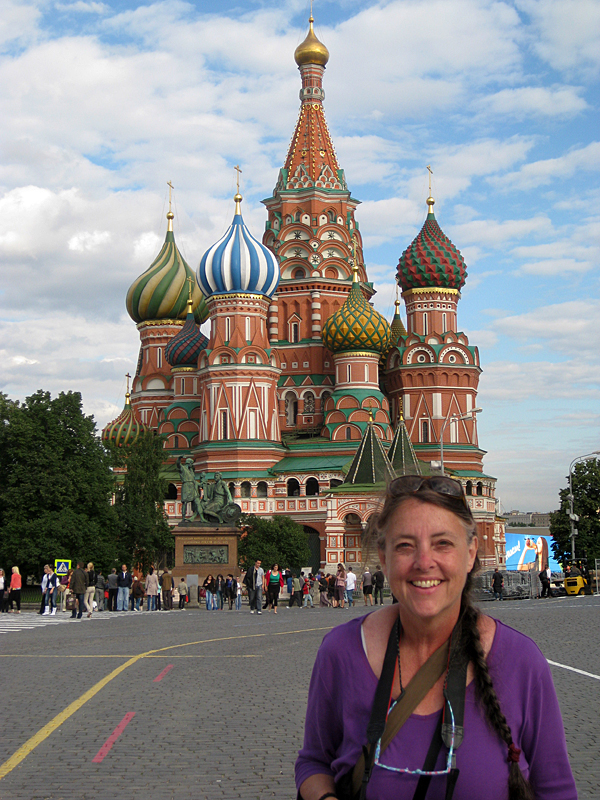
Gail at Red Square, Moscow
In the beginning, my explorations were through the lens of my still camera but when I started shooting motion about ten years ago, my tool of choice became a video camera and with that came self assigned documentaries.
It had been two years since my last passion project “Freedom Riders” and I was itching to start another. My daughter had just graduated from college, I was an emptynester and pretty much free to do as I pleased. I had accumulated over 300,000 airline miles, thousands of hotel award points and another 300,000 plus American Express points. I didn’t know what I was saving them for but it seemed like a good time to use them. So, I made a decision to take a trip around the world. I felt like I still had the energy and stamina to take on such a journey but something was missing – I needed a purpose.
The Idea
I have always been interested in the “common man” as opposed to the celebrity and the simple story that resonates in a viral way. I’m intrigued by people who go up against all odds, to right a wrong or fight for a cause and never give up. I usually side with the underdogs and am inspired by the Cinderella stories. And so after that day at the Met, an idea was born and that was to shine a spotlight on 6 people on 6 different continents who were making a positive difference in the world because it was their calling to do so.
Of course coming up with an idea is the easy part and many times those great ideas seem to drift away with time as one gets caught up in daily work and life. But this idea wasn’t going away – I knew it was the right time for me to bring these stories to life. My goal was to create individual videos about each of these people that would combine together as a feature documentary. My hope was that the film would not only create awareness of my subjects’ efforts, but also motivate others to create change.
The Pre-Production and Facilitation
Next came the hard part – making it a reality and the first step was figuring out how I would fund it. After working on 2 other self-assigned passion projects, I knew one thing and that is that it’s really hard to sell an idea. When I was in the planning stages of The Delta Bluesmen, I spent a lot of time applying for grant money and seeking funds from a variety of sources to no avail. I finally got frustrated and decided to self fund the project even though it meant taking it a bit slower and doing more of the work myself. My critics thought I was crazy to tackle a short film by myself and self fund it but I stuck to it and created a piece I’m proud of and which has brought many rewards to my life. So with that experience behind me, I took another leap of faith on my latest project and started the planning process. But perhaps most importantly, I focused on the fact that the positive aspects of working on a self-funded project is that it would be the way I wanted it to be – not compromised for the wrong reasons.
My first order of business was to send out a query to everyone I knew as well as use social media to find my subjects. My first subject was a given – a local young woman my daughter went to high school with, Maggie Doyne,
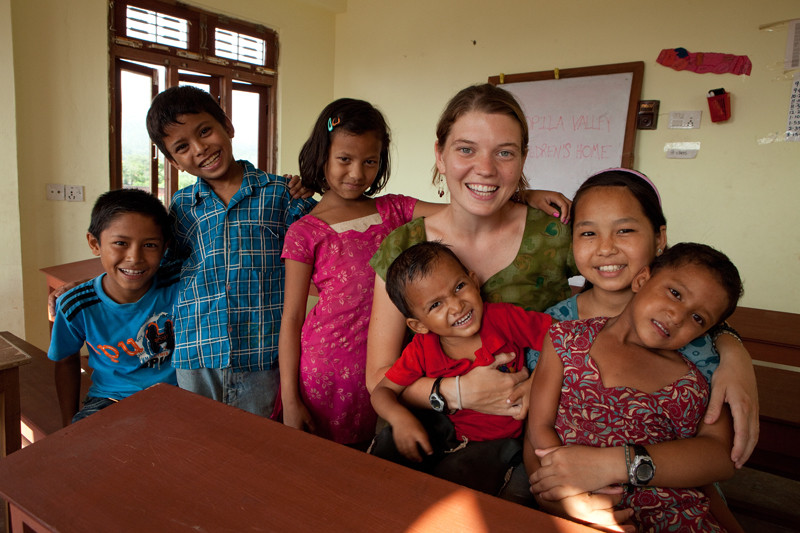
Maggie and some of her children
who opted not to trek off to college after high school. Instead she wound up in Nepal and built a home for orphaned children. She’s 23 years old now, has 30 children in her home and is in the process of building a school. Then my daughter Erin, expressed interest in working on this project with me. She knew she’s need to leave quit her job, sublet her apartment and say goodbye to her boyfriend for 3 months – but she wanted to be part of it. And so we became a duo and with that the project really took off with her support and help.
Since the project was self-funded, I had to be extremely creative with the budget – or lack thereof. So after nailing down our subjects across the globe, we started to plan the logistics –airline tickets, hotel rooms, visas, vaccinations and of course equipment needs. From January to May, I spent countless hours booking reward tickets with 14 airlines for 29 flights – a round the world itinerary with extra local hops thrown in. I’ve arranged for 99 nights of accommodations, staying with friends, friend of friends, using reward points, paying for budget hotels and bartering for other rooms. I had to bite the bullet and pay large sums for our vaccinations and visas and budget for our meals. Most importantly, I needed to purchase new gear because my intent was to shoot this project with the HDSLR cameras. I knew I wanted to shoot stills and video and also knew that I had to travel lean and mean so this seemed like the best solution. You can read more about the gear here.
The Execution
We are about one third through the shoot and have worked on 3 continents. The scheduling has turned out to be brilliant – we work hard and exhaust ourselves for chunks of time – anywhere from a week to ten days and then have a few days to recoup, catch up on sleep, write in our blogs, or just sightsee and take some still snapshots along the way. We’ve had a couple mother/daughter disagreements but for the most part we are having the time of our life and seeing the world. At this point we sometimes forget which currency we are using or what the exchange rate is or what our room number is but in the process of creating a film, we have built a lifetime of memories.
We have also created an audience who tune into our project blog religiously and follow our journeyas we go along. But something remarkable is happening and that is evident in the comments we are getting. We are opening people’s eyes though our travels and our writings. We have connected our audience with our subjects and their endeavors and are building a global community. It has been truly inspirational meeting and working with our subjects and there are days that my heart is full to bursting and confirms my belief in this project.
Post-Production
When we return in September, my first priority will be to edit the videos that I promised in barter arrangements. And hopefully at the end of the month, I will begin the edit. It will most likely take me a month just to log and transcode the footage and sync the audio in the situations where it was captured independently. I’m confident in my editing abilities but I would love to work with a pro. So if there is a pro out there reading this who would love to get involved in a fabulous documentary – I’d love to hear from you.
Distribution
Not really thinking about this part right now other than to use social media and perhaps itunes and Amazon to distribute it. But I have faith in this project and something tells me that this will take on a life of its own. It’s a feel good story and we’ve already gotten a lot of support and interest.
At any rate it’s the trip of a lifetime and I’m taking it with my daughter so I’ve already been blessed.
I have been working intensively with the Canon 5D Mark II and the Canon 7D, filming a documentary Opening Our Eyes. I have discovered the good and the bad with the video functions of these cameras.
The visual is stunning and there is no argument there but there is a lot more to video than the image and therein lies the difference between the HDSLR’s and a traditional video camera.
First and foremost the audio is a bit clunky. I’m shooting both interviews and b-roll. For my interviews, I opted to capture my audio separately and I will sync it later in postproduction. I am using the Samson H4N digital recorder. It is a phenomenal tool but I did discover one big issue that I should make everyone aware of – especially those of you that don’t like to read manuals. You can use this device with “AA” batteries or with an AC adaptor. Because of some of the remote locations I’m working in, I am mostly using it in battery mode. It devours batteries. It says the battery life is about 6 hours – but I think perhaps it’s more like 4 hours realistically. It seems like we barely get through an interview session and we need to change batteries.
Here is where I need to issue a WARNING – when changing batteries – always turn the unit off or you can corrupt the audio files. I found that out the hard way and I had numerous files corrupted. The information was there but it could not be accessed. Had I fully read the manual – I would have known this problem, but I didn’t and in my haste so as not to keep my subject waiting, I didn’t turn the unit off because it takes some time to boot up again. Luckily in my case I have the camera audio, which I always use as a reference, and even though the audio is not ideal, I will only be using the audio as a low-level background audio with an interpreter’s voiceover as the primary audio.
Another problem I have with these cameras is the short durations that you can film – less than 12 minutes for the Canons. A couple of times my subjects have been deep in conversation with very emotional moments – and the camera stops. I know this will happen, but what am I to do – stop them in mid sentence as they tell their stories with tears in their eyes? So for me working in documentary style as opposed to storyboarded films – these short durations is a major issue.
Lastly, the fact that you can change lenses has its pluses and minuses. The pluses are obvious but when shooting video I am shooting lots of variations – wide, medium and tight shots from different angles and moving quickly as I do. It slows me down to change lenses and since I’m shooting journalistically, I’m apt to miss some good moments when I do.
Like anything else, these cameras have their pros and cons. But what I’d really like to see is a video camera with a big chip. I’m hoping the manufacturers are listening and that will be the next generation of cameras.
I’ve been reading a lot of the still photography forums over the past few weeks and I’ve seen a lot of questions about capturing sound with the hybrid HDSLR’s. I’ve also seen some misleading information so I’ve decided to take a few minutes to clear up some misconceptions.
First – Audio is everything in video. People can tolerate a mediocre image but if they can’t understand or hear the audio – they won’t watch. See for yourself – turn the sound down on your TV and see how long you stay interested in the program – even if the image is stunning.
Second – You have many options of capturing audio with the HDSLR’s depending on what you are shooting. I think many still photographers assume everyone is going to be shooting “indie films” with crews. One of the things I find appealing about some of the new technology is that you don’t necessarily need a large crew and a Hollywood budget. And sometimes, if discretion is in order, you’re better off with a small crew. With that said – you should know how to capture good audio.
Third – NEVER use the camera to capture audio – it just isn’t good enough. And I would probably say that you shouldn’t plug an external mic into the camera via the mini plug. I don’t think the audio quality is good enough, especially for an interview.
Fourth – Either use a pre-amp with XLR inputs like a Beachtek or JuicedLink and an external microphone. Make sure you get the mic close to the audio you want to capture. And most importantly monitor the audio through a good set of headphones.
Fifth – Capture your audio independently with a good quality digital recorder like the Samson H4n Zoom and sync it later in post. Syncing sound in post is a snap with a great software application called Plural Eyes.
Lastly – Audio is everything! And remember as you add video to your skill set, you’ll be using your ears as much as your eyes.
The first two days of our Round the World Journey, shooting the documentary Opening Our Eyes has been quite full and I’ve faced numerous situations – really putting my tools to the test.
Our first full day was spent at the offices of Wrap Up Africa, which are located in Kampala, Uganda. In addition to shooting b-roll of tailors at work, we shot several interviews. Our main interview was with Wrap Up Africa’s founder, Letha Sandison, followed by interviews of a couple of her staff members. We also did interviews of some of the cancer victims that Letha has helped. Here is where I not only needed to be attentive to my technical details but be sensitive to the situation and the people that I was interviewing. Hearing some of their stories is heartbreaking and hard for many Americans to fathom. Sure, we all watch the travesties taking place throughout the world on the nightly news, but it’s quite another experience to speak with people who have experienced horrendous tragedies in their lives that are simply unimaginable.
One woman, Evelyn who works for Letha had been abducted and held captive by the LRA, which stands for the Lord’s Resistance Army, and is not exactly a charitable group. She managed to escape after most of her family had been killed in front of her. She is now raising three orphans who had been victims as well and works with Letha, helping others.
Our set up was simple and deliberately so. I set up the Canon 5D Mark II and captured my audio separately with the H4N Zoom. I had two mics – one shotgun on a small boom stand and another lav. I will sync them later in post. We chose a room that had ample window light as we are traveling with only a small camera light and nothing else. Our biggest challenge was that the cabinet installer decided to do his work the day we were shooting – so the sounds of hammering and drilling made up our ambient background sound. But the mics were placed close to our subjects and did a pretty good job of boosting their audio above the din of the environment.
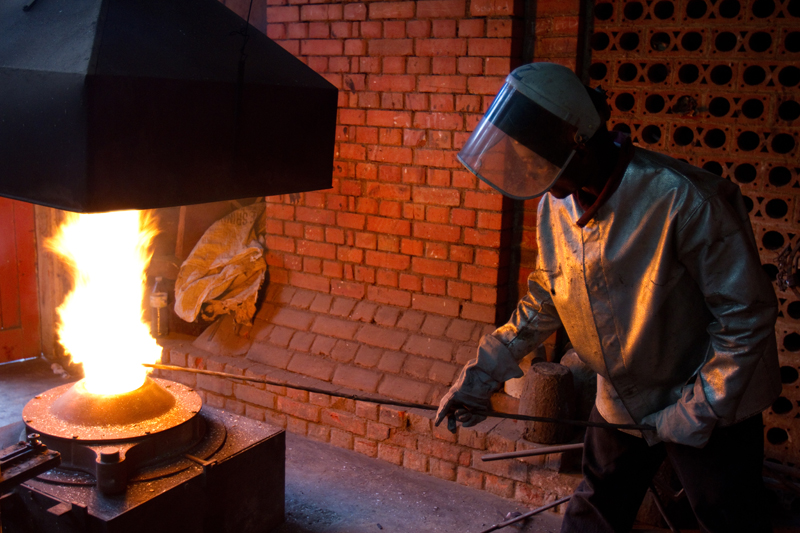
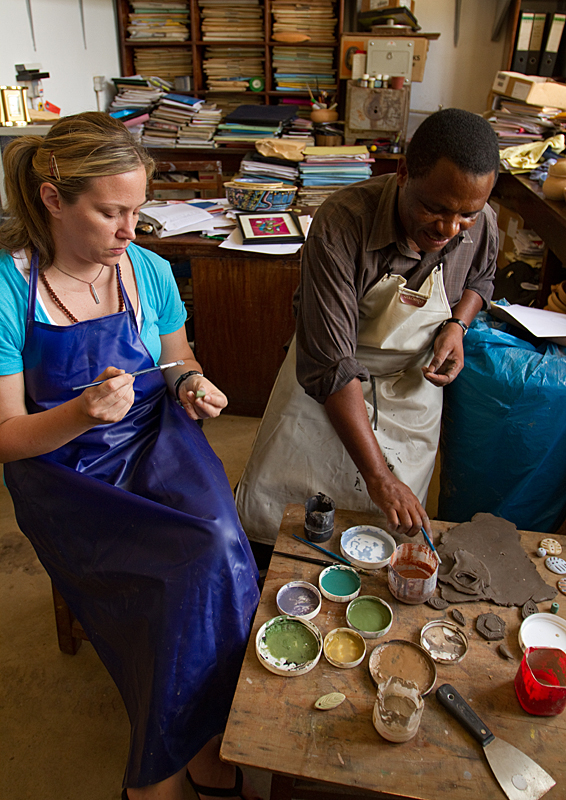
The next situation we faced was shooting b-roll in the dirty environments of a potter’s studio and a foundry. Again we used the Zoom to pick up the ambient sound of the environments. After a morning with the artists, we packed up quickly and headed to Mulago Hospital to visit the children’s cancer ward. We were not allowed to shoot video but we did shoot some still images and was happy to have the hybrid cameras that captured beautiful files – far better than frame grabs from a traditional video camera.
Then we headed to the market, which as usual is always a trying experience. For anyone who has traveled to congested third world environments, you know what I mean by “trying experience”. You must be aware of your personal belongings at all times, while shooting and I wish at times that I had eyes in the back of my head. On top of that I’m sensitive to those that don’t want to be photographed. It’s exhausting but at the same time exhilarating because of the exotic nature of the environment. My daughter wore the GoPro Hero helmet cam that is a tiny camera made for adventure sports but she had a lot of fun walking through the market recording the event with running video as we walked through the market.
I was shooting video with the Canon 5D Mark II and used a shotgun mic on top of the camera and run through a JuicedLink audio mixer. I’m embarrassed to say that somehow, even after lots of testing – I came back with no audio! Luckily the helmet cam Hero picked up very good ambient audio so I’m able to use that and layer it in post. In the chaos and confusion of the market, I probably didn’t set it up right and today I will do additional testing so as not to make that mistake in the future. But the video was captured beautifully and I will interweave those clips into the documentary with sound from the interviews and ambient sound from the Hero.
I am realizing one thing though and that there is nothing easy or streamlined when shooting video with these hybrid cameras. The results are stunning, but the shoot and workflow are much more tedious than when shooting with a video camera. Perhaps at the end of this three-month journey, I’ll be singing a different tune – I certainly hope so.
I’ll keep you posted as I get access to the Internet, which is iffy, and we’ve been off line for the last two days. But there’s something humbling about being off the grid and I’m learning to take it in stride and appreciate what I have. Today is Sunday and we are resting and storing up a bit of energy for the coming week. Please read more about our journey at Opening Our Eyes.
It’s very early in the morning, my favorite time of day – no distractions and a whole new day ahead of me. But today’s a bit different, it’s the day before I leave on a 3-month journey around the world to take on probably the biggest personal project of my life and I have a million details running through my heads.
Just the other day I wrote about the “what if mentality” and how we sometimes fall victim of sabotaging ourselves by talking ourselves out of doing things. And today I have a whole host of “what if’s” running through my head. What if we can’t get into Bangkok or get out? There’s a State Department warning advising Americans not to travel to Thailand and we’ll be traveling with a doctor going into the northern hills – not an easy place to get in and out of in peaceful times. What if one of us gets sick? What if something gets stolen? What if one of our 27 flights get canceled or delayed? What if I don’t get the material I’m after for the documentary?
Certainly, lots of trepidations but I’m a pretty savvy traveler and I’m about as prepared as anyone can be. I try to remind myself of that and focus on the incredible journey ahead of us. I’ll be sharing this experience with my 23-year-old daughter and that in itself will be something we’ll never forget and create a special bond between us for the rest of our lives. We’ll not only be circling the globe together, we’ll be working together to create a documentary on people who are making a positive change in the world. Those connections will be life changing, and in fact one of our hopes is that our film will inspire others to do the same.
So one more day of details and then we’re off – first stop Entebbe, Uganda by way of Johannesburg, South Africa. Our last stop is Buenos Aires, Argentina via the jungles of Peru. Lots in between – lots of laughs, tears, lands and miles. I will be writing as often as I can and uploading when “connected”. And if I disappear at times – you’ll know why. You can follow our journey at Opening Our Eyes.
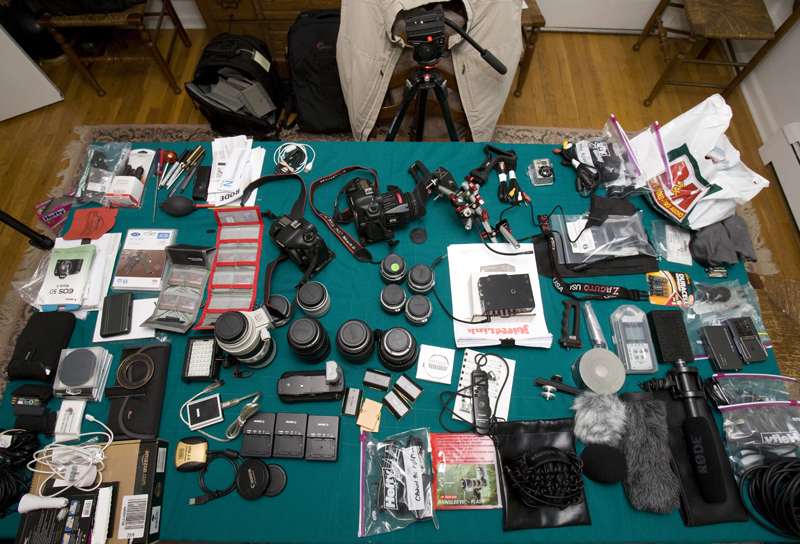
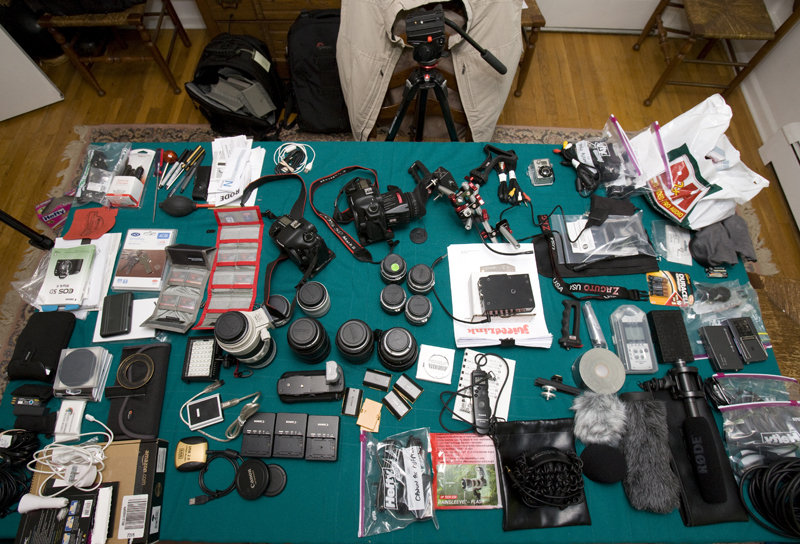
For those who have been following this blog you know that I’m getting ready to depart for a 3-month trip around the world creating a documentary with my daughter – Opening Our Eyes. Here is what I’ve managed to fit into two backpacks – it just fits. Thank goodness there’s two of us.
Please follow our journey http://www.openingoureyes.wordpress.com

 As we ate our pizza and had a lovely, inexpensive bottle of wine – we took notice that here we were in Sydney, Australia, overlooking the Sydney Opera House and it all seemed so surreal. But it was real, it a moment in time that we made happen, that we didn’t postpone until the “perfect” time in the future and a time that we will always have and always remember. We were living in the “now” moment.



 Journeys of a Hybrid