
On the Road (Again)

I’ve been doing a lot of traveling these days, quick one or two-day stays in cities all around the US. But that’s not the kind of traveling I do when I’m on a destination shoot where get totally absorbed in a city because I’m there to tell that city’s story through my images.

These days a lot of my travels are quick trips in and out of cities all around the country, giving seminars for AMSP to still photographers who are thinking about getting into video. So I rarely have time to see the “sights” of the cities and really get my bearings on where I am.

One thing I do try to do while I’m on the road is walk because that is what I do when I’m home and it helps me get clarity on the day. This morning I went out for a walk in the area just outside my hotel. As I walked by various chain restaurants and stores, I almost forgot where I was, because it could have been just about anywhere in America. And that kind of made me sad – that in the US, our towns and cities have lost their unique attributes.

When I got back to my hotel, I saw a posting from a friend on Facebook on how photography introduces you to people whose lives and stories humble you. His words really hit home because I became a photographer for this very reason – to allow me the privilege of meeting people and hearing their stories. For me, photography and my camera have always been a “means to an end”.

Then I realized, that a place isn’t really defined or not defined by its stores and restaurants but by its people. And that even though I may only be in a place for a quick overnight – I always try to connect with the people. Whether that may be a chat with a taxi driver or a waitress or with some of the wonderful people I meet when I do a seminar.

Such is my life, enjoying and being humbled by all the people and their stories as I continue my travels. How lucky I am – to be able to combine my career in photography with my passions.

Add to FacebookAdd to DiggAdd to Del.icio.usAdd to StumbleuponAdd to RedditAdd to BlinklistAdd to TwitterAdd to TechnoratiAdd to Yahoo BuzzAdd to Newsvine

Talking Techy – New Video Gadgets

As far back as I can remember, ever since being the only woman in my graduating class at Brooks Institute, I’ve been in a male dominated business. Along with that comes a lot of tech talk and I’d like to think that I can hold my own “talking techy”.

Lots of new gadgets and tools have been announced in the last couple of weeks. The much-anticipated Scarlet camera has been formally announced for spring – early summer 2010. Check out the 3K Scarlet prototype along with some other new gadgets from the RED folks, and you too will be amazed. And the proposed price – less than $3000 for a 3K video camera that shoots RAW.

Another interesting camera to debut is the Panasonic full HD 3D camcorder camera. Pretty cool, but I wondered how one will look at their 3D footage? Panasonic thought of that as well, and introduced 5 new 3D HD TV sets.

Check out MacVideo’s blog on CES 2010 predictions for digital cameras – smaller, video, interchangeable lenses and wifi enabled are all new features to watch for this year.

And Skype enabled HD televisions are coming so Skype users will now be able to make HD video (phone) calls as long as they have an HD web cam and plenty of bandwidth.

I played around with the popular hybrid cameras, the Canon 7D and Canon 5DMarkII over the holidays. I absolutely love the visuals that these cameras create but they felt clumsy to me, being the street shooter that I am, because I couldn’t look through the viewfinder to focus while shooting. I had to use the LCD monitor on the back of the camera to focus, which was tough outdoors and it also made the camera hard to stabilize because it wasn’t braced up against my eye. I do realize that there are 3rd party viewfinders available that attach to the back of the camera which help with focusing in bright sunlight but also helps with camera stabilization.

Lastly, I wanted to check out a company I heard about called Animoto.com. They provide a subscription based service where one can upload still images, video clips and text and a video is automatically created from your assets (or theirs)  in a matter of minutes. They also have an interesting selection of licensed music to choose from, which you can use in your videos. I literally spent less than an hour of my time to register, upload my video clips, choose a piece of music and create a short 30-second video.

2010 has just begun and I’m already overwhelmed by all the new toys and gadgets.

Add to FacebookAdd to DiggAdd to Del.icio.usAdd to StumbleuponAdd to RedditAdd to BlinklistAdd to TwitterAdd to TechnoratiAdd to Yahoo BuzzAdd to Newsvine

The Power of Social Media

My last blog entry, I wrote about the DO’s and DON’T’s of Social Media. The next day I put some of some of those tips to work.

I am embarking on a personal project, Opening Our Eyes. The idea behind the project is to make a documentary that features people who are making a difference around the world – people who have followed their dreams, passions and ambitions and started their own personal projects that help make the world a better place. Ordinary people who are doing extraordinary things.

In looking for these people or subjects of the documentary, I wanted to utilize the power of social media and my connections and friends, to not only find “leads” but also to make the entire project an interactive experience from the start. So, two days ago I launched a simple website and blog and gave the idea a name, “Opening Our Eyes – Global Stories About the Power of One”.

My daughter Erin is teaming up with me on this project. She lives in Chicago – I live in NJ – but with social media we can bridge that divide as well as get the involvement of all our separate “friends”. Using a company called SquareSpace and their amazing publishing software, I was able to set up a simple blog and website and get it online in less than a day. It site will grow as we both continue to add content and relevant links and information, but by getting the idea “out there” and providing a way for feedback and dialog to take place – we are building our own community at the same time.

After the site was created, I created a fan page on Facebook with information about the project and links to the website. I also registered the blog with Network Blogs and inserted a “follow this blog” button on the fan page. And then I tweeted about project on Twitter, which automatically shows up, on my own personal FB . I also sent out about 50 emails to people I know.

The response has been overwhelming. Within a day I have received over 50 ideas about people and their projects. We’ve had well over 300 hits on the site and almost 40 fans on Facebook. Now that might not seem like a lot to some people – but to us it was an amazing response in such a short time.

As the project takes shape fueled by the interest and eagerness of our participants we are building a community and opening others’ eyes to the “power of one”.

Add to FacebookAdd to DiggAdd to Del.icio.usAdd to StumbleuponAdd to RedditAdd to BlinklistAdd to TwitterAdd to TechnoratiAdd to Yahoo BuzzAdd to Newsvine

Mistakes People Make When Starting a Video Production Business

  • They focus too much on the “tools” and not the “technique”. These days video equipment is relatively cheap. Therefore the entry-level bar has been lowered for video production. Learn your skill set and be unique – have your own vision or point of view that separates you from the rest.
  • They skimp on the audio, tripod and lighting. The camera is just one piece of equipment you need. You also need independent external microphones to be able to capture good audio as well as a good tripod with a fluid head. If you’re going to be shooting indoors or doing interviews – you’ll  need some lighting equipment. You can either go the route of hot lights or LED panels which are portable and cool but costly.
  • They forget about the editing and output. Shooting  is one thing – editing it and getting it “out” is another. Learning to edit will make you a better shooter. You quickly realize in the editing room what you SHOULD have shot in the field.
  • They don’t diversify. This is important when first starting out. It will pay the bills and will help you get better at what you do. And it may also help you in find your niche.
  • They forget about marketing. Lots of people have equipment and even more people have great ideas but if they don’t promote their business, they’ll spend their days waiting for the phone to ring.
  • They don’t realize that business is about people – not just the tech. Work on your people skills and your business will flourish.
  • They don’t network. Networking of course is critical for  getting new business.  It’s also beneficial to network with other people in the video production business. Video production is all about collaboration, so it’s essential that you get to know shooters, sound mixers and editors. Join listserv groups and go to meet-ups in your area.
  • They under-estimate what a job will cost in both time and resources. There are many facets to video production – the shoot, audio, editing, music, graphics, motion graphics, scripts, voiceovers and delivery. If you won’t be facilitating all those facets – then you need to determine how much it will cost and present that in your estimate.
  • They don’t draw up a production schedule. This is essential to keeping a job on target. Make sure that each step of the project has a delivery date specified and signed off on.
  • They don’t realize that they are under insured. Many people coming from a still photography background don’t realize that their current insurance policy does not necessarily cover video production.
  • Add to FacebookAdd to DiggAdd to Del.icio.usAdd to StumbleuponAdd to RedditAdd to BlinklistAdd to TwitterAdd to TechnoratiAdd to Yahoo BuzzAdd to Newsvine

The Family Story

This time of year we all try to spend more time with our families and loved ones. It’s also a time when we reflect on the people who are no longer with us. For the most part we rely on our memories and some scattered photographs or home movies.

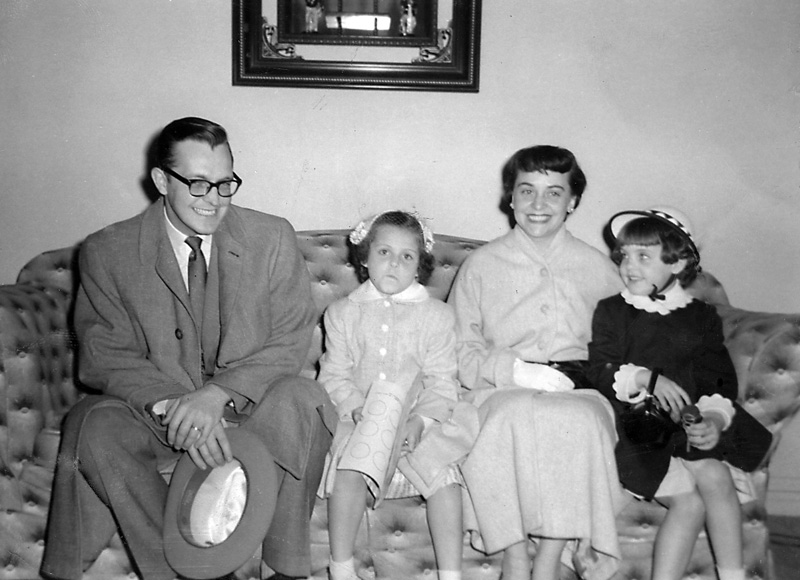
Mooney family dressed up for Easter. I'm the child smiling.

Some of the fondest memories I have of my mother, father and grandparents are of us sitting around the dinner table, long after the meal was over and listening to the family stories. Of course each person would tell the same story in an entirely different way – the way they remembered it.

Every family has stories – mine certainly does and I have started to collect information, photographs and even recordings of family members while they are still around to tell them. It’s such an easy thing to do with all the tools that technology has provided in the way of cameras and audio recorders.

I often think that as photographers and filmmakers we are not only the keepers of our own family stories but we are documenting the stories for other families through our images, recordings and videos. Here’s a recording of my Uncle Dorlen talking about fishing in Northern Michigan in the winter.

Family gathering at my Uncle "Frenchy's" memorial.

Essentially, we are creating an archive of our loved ones and the memories. And that is the most precious gift that I can give someone through the talents of my craft.

I was recently looking at someone’s vacation snapshots and it occurred to me just how precious those images are, certainly for the people in them and the people they know. I have always taken the family snapshots and have recently started video recording my relatives telling their stories through their own voices, preserving them for future generations.

So think about that – even if you just take out your iPhone or Flip this holiday season, start capturing life’s moments. You’ll be glad you did.

Add to FacebookAdd to DiggAdd to Del.icio.usAdd to StumbleuponAdd to RedditAdd to BlinklistAdd to TwitterAdd to TechnoratiAdd to Yahoo BuzzAdd to Newsvine

Mistakes Still Photographers Make When Shooting Video With a DSLR

  • They don’t understand the importance of audio and don’t use external microphones. Audio is everything in video.
  • They think in “moments in time” and start shooting video too late or stop shooting too soon. You need to let the camera linger longer.
  • They don’t shoot sequences with a beginning, middle and end.
  • They don’t think in “storyboard mode” – You should ask yourself  “How will I get into and out of a shot and what’s next in the story?”
  • They don’t shoot enough B-roll with variations in angles and focal lengths – very important in the editing process.
  • They move the camera instead of letting the motion take place in front of the camera.
  • They turn the camera vertically. There aren’t too many vertical TV sets and monitors.
  • They don’t use a tripod forgetting that video is “time in motion”.  It’s one thing to hold a camera steady for 1/60th of a second and quite another to hold the shot steady for 10 seconds.
  • They don’t consider the frame rate and how that will affect workflow and editing.
  • Aren’t careful keeping their sensors clean from dust.  Retouching video is a lot more involved than spotting still images.
  • They “throw” some video clips in with the still photography job, not putting an added value on them and thus setting a bad precedent with clients.
  • They don’t consider the output and the type of file to be delivered.  There are dozens of formats and codecs in video.  Choose according to your target audience and viewing platform or device.

Add to FacebookAdd to DiggAdd to Del.icio.usAdd to StumbleuponAdd to RedditAdd to BlinklistAdd to TwitterAdd to TechnoratiAdd to Yahoo BuzzAdd to Newsvine

Video News

I came across some interesting things this week, so I am passing them along.

One was the much anticipated announcement of the debut of the Scarlet – a new camera from the same company that makes The Red. There have been a lot of rumors about this camera over the past year and it will be rolled out in 2010.  Check out Philip Bloom’s blog about it. And here’s another post on FreshDV with information about the Scarlet.

If you’re a Sony EX-1 shooter, here’s an interesting tip along with a how-to-video on using the Zacuto Z-finder with that camera. This viewfinder was made for the Canon 5d, but Martijn Schroevers found a clever way to attach it to the LCD of the Sony EX-1.

Next up is yet another new video camera format from Sony – NXCAM. The NXCAM can record 1920 x 1080 images at 24Mbps (50i or 25p), as well as supporting 720/50p and Standard Definition recording.
Very interesting but I wish these camera manufacturers would standardize formats and codecs.

I also came across a very interesting company called Wistia. They allow you to share and host your videos but in addition they offer heatmap tracking which gives you a visual spectrum of how your visitors watch your videos and what attracts them or confuses them.

And to give you an idea of how much web video viewing has exploded, here’s an online channel Expotv where consumers send in video product reviews. No fancy production values but an interesting concept of sharing information that has really caught on.

With all those news items I figured it was about time I changed my header – gone is that template blue – replaced by something more relevant to the blogger.

Add to FacebookAdd to DiggAdd to Del.icio.usAdd to StumbleuponAdd to RedditAdd to BlinklistAdd to TwitterAdd to TechnoratiAdd to Yahoo BuzzAdd to Newsvine

Watching TV Without The Sound – A Lesson In Editing

Every morning I spend an hour on the treadmill while plugged into my iPod listening to music. Sometimes the TV is turned on but with the sound turned off. I have found that just “watching” TV and in particular the commercials, is a great way to learn editing technique. I’m not distracted by the audio so I can better see how the elements get cut together.

Commercials need to get their message out in 15 seconds so the cuts are generally quick and the story needs to be told in an efficient manner. Action-reaction shots, cutaways, close-ups, sequencing – all stand out to my eye because I’m not distracted by the sound. It makes for a great lesson in editing. I notice the visual storyline – what shots are bumped up together, how long they stay on the screen and how they all make up the whole in presenting the message.

Conversely, if I have the TV on in another room (with the audio) and I’m just listening, I can usually get the message without seeing any visuals. That’s why great audio is essential – it drives the story. If people can’t hear something or understand it because the audio is poor quality, the piece fails to engage.

So try it sometime. Watch TV without the sound and notice how the story is told through the visuals and how they are cut together. It will help make you a better editor. And then try watching a video that you create with and without the sound. It’s a great way to see if you are telling the story that you meant to tell.

Add to FacebookAdd to DiggAdd to Del.icio.usAdd to StumbleuponAdd to RedditAdd to BlinklistAdd to TwitterAdd to TechnoratiAdd to Yahoo BuzzAdd to Newsvine

Print vs Electronic – What Is The Future?

Just yesterday I was talking about the good and bad of social media and the potential pitfalls with time management. My routine each morning is to check for any news items on Twitter or Facebook or bookmarked blogs after catching up on my email. This morning there was one post on Facebook that caught my eye and was definitely worth the click through.

Via Mashable.com was Time Inc. Show Us Their Idea of The Future of Magazines [Video]. It was about how publishers are preparing digital versions of their magazines for the Apple Tablet. Apple hasn’t even officially confirmed they are working on this device. Embedded in the post was a pretty sophisticated demo of Sports Illustrated.

Amazing as the demo was – it had its critics. Check out Gizmodo’s post Time’s Manhattan Project Will Explode Like the Atomic Bomb It Is. The article questions how it’s any different from a web page and at ten times the cost. They state it’s pretty packaging but still stale and dead.

The future of publishing is an interesting debate. I suppose it really all comes down to how we the consumers want our information. What do you think?

Add to FacebookAdd to DiggAdd to Del.icio.usAdd to StumbleuponAdd to RedditAdd to BlinklistAdd to TwitterAdd to TechnoratiAdd to Yahoo BuzzAdd to Newsvine

A Time of Opportunity

You can look in the rear view mirror and lament the past or you can get excited about the future. With all the gloom and doom in the photography business in this poor economic climate, I remain optimistic and see it as a time of opportunity.  It’s tough to be an optimist in times like this but if you look back through history you’ll see that many businesses got their starts in bad economic times.

There’s nothing new about video but with increased bandwidth and the proliferation of mobile devices video is “hot” right now.  In some markets like the corporate and institutional sectors, I’m seeing more of a demand for video.  I’m hearing from traditional print graphic designers who are asking me if I shoot video because their clients are requesting it. Their clients want to add a video presence to their online communications that can be distributed internally and externally. And can also be spread virally through social media networking.

Editorial markets have expanded into video.  Just about every magazine has an online presence and nowadays it’s not just a regurgitation of their print edition but a lot more.  Take a look at NY Magazine or Zagats.com.

The travel market is ripe for video. When I’m researching a destination I like to get as much information as possible so if I can watch a 2 minute video – it usually hooks me further into that website to explore more and link to other sites where I can  facilitate my travel plans.  Many times videos made for online travel sites are repurposed and used at trade shows. Check out what Intercontinental offers as destination pieces about places where they have properties.

Of course there are hundreds of instructional videos and pod casts, and on the retail end there’s weddings and family biographies.

Even if you don’t shoot video or want to offer video to your clients, you may want to consider using it to promote your own business.  A short web video about your business or your creative approach with some behind the scenes footage of you working provides added insight and information to potential clients.

These are just some of the areas I see opportunities in.  I love to hear from other optimists where they think the opportunities are.

Add to FacebookAdd to DiggAdd to Del.icio.usAdd to StumbleuponAdd to RedditAdd to BlinklistAdd to TwitterAdd to TechnoratiAdd to Yahoo BuzzAdd to Newsvine