Mistakes Still Photographers Make When Shooting Video

Short but to the point – common mistakes still photographers make when starting to shoot video:

1.  They break timecode (only applies when shooting to tape)

2.  Bad audio – audio is everything in video.

3.  They don’t turn the camera on soon enough.

4.  They turn the camera off too soon (thinking in the “decisive moment)

5.  Use auto – focus.

6. They don’t shoot sequences – beginning, middle and end

7. They don’t shoot in “storyboard mode” – “How will I get into and out of a shot and what’s next?”

8. They pan and tilt and zoom in and out – too much – the motion should come from the subject matter – not necessarily the camera.

9.  They don’t shoot enough B-roll with variations.

10.  I’m open to suggestions as to what #10 should be – feel free to chime in.

“Virtual” Companies

I recently got a phone call from a photographer friend complaining that he just lost out on a job.  One of his clients came to him asking if he shot video and he answered no.  He went into a long fear based monologue about how this is happening to him more and more and that he was afraid that he would lose his clients to video shooters and worse yet, video shooters who would also start providing “his” clients with still images pulled from frame grabs from high end video cameras like the RED.

After he calmed down, I asked him “Why did you answer no when your client asked if you shot video?”  He explained that he was an honest guy and that he would be doing a disservice to his client by pretending to be something that he wasn’t or that he couldn’t deliver.  I told him quite simply that perhaps he could have provided that service to his client but that by sending his client away, he was not only doing himself a disservice but his client as well because “he” couldn’t fill their need.  Then I explained the notion of forming partnerships.

Video is made for collaboration and partnerships because there are so many facets to it – shooting – sound – post production etc.  So why can’t a still photographer create partnerships or virtual production companies and work with a team of colleagues to serve a client’s many needs?  It’s a win win – you keep your client in house and your client can work within a comfort zone that you’ve already established with them. You become the producer which for the most part, many still photographers are already.

Look around – virtual companies are being set up in all types of businesses – partnerships that are not confined to the traditional bricks and mortar setting – but rather created on a need basis.  I’ve recently worked with virtual PR firms and ad agencies where the art director may reside in Colorado, the client in NYC and the account exec in California.  Or they all might be in the same geographic location – but just not in the same confined “space”.

So before you say no – think about likely and unlikely partnerships you can form.  Anything is possible which in turn can become profitable.

Being Proactive vs Reactive

I have always approached new technology in a backwards sort of way. I’m not one to buy the latest camera or software version if I don’t have a need driving me in that direction. I got into video because I felt the need to incorporate motion and sound to the stories that I wanted to tell.

Lately all you hear about is video. Clients are coming to me because they feel the need to add video to their website. And more and more still photographers feel the need to embrace video in their work. Whenever someone questions me about getting into video, I always ask them “what do you want to do with it?” A typical answer is “because everyone is getting into” or “I feel the need to keep up and not be left behind”. While these are honest answers, and certainly there’s some merit to them, I always try to get people to focus on what it is they want to use the medium of video for. Will video convey their message better than a still image or text?

Personally I’ve never been a fan of “getting on the bandwagon” just because everyone else is. Whenever I’ve acquired a new “toy” for that purpose – it generally sits in the box because I haven’t thought about how I will use it to “tell the story” that I have to tell. I was reminded today when watching a piece about Don Hewitt, the creator of the TV program 60 Minutes. He was all about “telling the story” and felt that the story is what we humans are interested in and will hold an audience’s attention. His vision was to create a magazine in a TV format. That was almost 40 years ago and 60 Minutes is still on the air. But Hewitt was a persuasive and dynamic man with a strong belief in his convictions. He was also a pioneer in TV broadcasting and at the right place, at the right time – because back then everyone was learning and they were writing the rules as they went.

Right now I think we’re at the same place with video on the web. We’re all struggling with not only new technology but how we can apply it in a business sense. The 100 million dollar question (or more) is How to monetize the Web? I for one don’t have a crystal ball but I do know one thing that history has taught me and that is – nothing new ever comes from keeping the status quo. That’s not to say that every pioneer has a success story and in fact behind every successful person is usually a trail of failed ideas. But if they hadn’t taken that chance……….you gotta wonder.

The other big dynamic is that being proactive is taking control of the situation rather than reacting to something out of fear. For the most part fear stifles creativity. Either way – there’s always going to be a bit of fear but I find when I take control and become more proactive, I focus on the creative aspects and remove the mental roadblocks that are telling me to stop. I don’t always succeed – but I always give myself a shot at success – when I free my mind and am open to possibilities.

“Breaking The Spirit”

I was reminded recently of an experience that I had while shooting a story for Smithsonian Magazine on Arthur County, Nebraska. Truth be told, it was an assignment that I almost didn’t accept. I thought that a story about the least populated county in the United States was not a story for me – I shot city stories for the most part. But then I thought, why not? It ended up being one of the most gratifying magazine assignments that I ever did – on many levels.

Personally, it pushed me out of my cultural norm. “What am I going to do in a desolate part of the country where cows far out number the people?” Photographically speaking as a people shooter, it really pushed me to see and shoot differently. Because there were so few people, I lingered longer and got a closer glimpse into their lives than I normally would have on a 7 day city shoot with lots to cover.

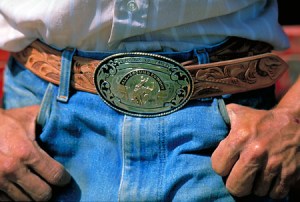
One day stood out for me. I was photographing a cowboy “breaking” horses. cowboy_belt_buckle I watched as he worked with an incredibly spirited horse, trying at first to calm the animal. I remember asking a question about “breaking” the horse to which the handler replied that he never wanted to “break” an animal’s spirit, but rather to gain the animal’s trust. I thought to myself that this cowboy must be a wonderful father and husband and a part of me fell in love with that notion – his understanding of the difference between “managing” this stunning creature and “breaking” its spirit.
I realized that maybe that moment in time was in essence the story itself and the reason that I needed to take that assignment. I remind myself of that every time I’m hesitant to stray from my comfort zone. That almost always there’s a reward. I was fortunate that the assignment editor on that piece saw something in me that I didn’t.  So many times, for a variety of reasons “clients” feel the need to over dictate the visual message and the end piece reflects that, becoming an entity that is neither “here nor there”.  The “spirit” of the piece becomes broken.

These days because of tight budgets and fear of losing one’s job – things tend to become more predictible and safe – choosing shooters who’ve done that type of story before or re-doing the same stories that have proven to be “successful” in the past. But every once in awhile – someone (like the cowboy) comes along and recognizes something in my spirit and gives me the necessary “rope” to bring my vision to the project while still managing the “whole” – and marvelous things happen.

Staying Outside The “box”

A friend of mine recently reminded me that I have said that I like to stay outside the “box”.  That I have spent much of my career trying not to be categorized or pigeon holed into one specialty of photography.  Perhaps not the greatest business decision, but nevertheless a series of mini decisions to continually depart from whatever my norm is or has been.

Even as a child I discovered early on that I wanted to explore – in the broadest sense of the word.  I surely did that in my days right out of high school and college when I embarked on a year long backpacking odyssey across half the globe.

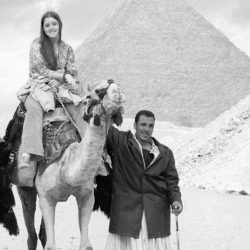
Mooney, Peace Hotel, Shanghai, China 1983

But it was after that sojourn that I pursued a career in photography to facilitate a somewhat vagabond life.  And that I did combining a photographic career with my quest for discovering people and cultures. I ‘ve been  fortunate over the years to have garnered assignments from high profile magazines like National Geographic Traveler, Smithsonian and Travel & Leisure.  And I loved the path that I had chosen.

It was about ten years ago that my restlessness pushed me into the medium of video.  Technology was making it possible and affordable for me to shoot my “stories” in this medium with sound and motion.  But I was more focused on adding those new dimensions to “the story” rather than on the “tools” itself. Getting into video proved to be a great move, certainly a good business move as society has gravitated more toward the web.

So in my desire to live a life “outside the box”, I’ve come full circle and realize that “decision” has not only been “good” for  business – it’s led to a very interesting and rewarding way to live life.

Pre-Production Blues

Pre-production on any video shoot is essential. That is if you want to save time and money, not to mention avoid having a major melt down in the editing room because you didn’t get the necessary goods.  Although I recognize the need for good solid pre-production and am usually more than “just” prepared for a video shoot – there’s a big part of me that despises this part of the process.

With tight budgets comes tight shoot schedules because time is money and you want to be sure that once you get to a location, everything is set to go.  People that need to be notified – have been notified.  Gear that needs to be rented has been and some kind of storyboard or shoot list has been signed off on.  Lots of details have to be taken care of and that’s what I’m good at – leaving no detail to chance.

But once I get to a shoot with the confidence that everything has been previously arranged – I like to allocate some time for serendipity to happen.  And that’s the part of the process I love – when little things happen that I didn’t expect.  But I need to go into a shoot allowing the time for this to happen – leaving  time for the unexpected as well as being mentally “open” to it.  In other words being prepared yet flexible at the same time.

I had a client once say to me “the more I see you worry about the details – the more I know that I don’t have to think about them”.  A compliment for sure but at the same time I realize that it’s all a balancing act.  Always a balancing act between being the prepared professional and the passionate storyteller who is willing to “depart” from the plan if necessary.  When I get that balance just right I feel it.  Words can’t describe it but I literally feel it.  And when a video really comes together in the end, that feeling resurfaces every time I view it.  And that’s the part I love the most.

What Camera Should I Buy?

If I had a dollar for everytime someone asked me what camera they should buy – I could retire.  These days I get a lot of “what video camera should I buy?”  That question is almost impossible to answer without more information.  So I usually reply with my own onslaught of questions “What are you going to be shooting?”, “What editing software will you be using?” , “Are you concerned about getting “natural sound” or will you be using the “video” and not the “audio” from the camera?”.  And of course the big question “What’s your budget?”.

One thing that complicates making a choice in video cameras is that unlike still cameras – video cameras shoot different types of files – mpeg2, native quicktime, HDV, AVCHD.  In addition some shoot to tape, some shoot to cards and some shoot to discs.  Then of course there’s the basic consideration of SD or HD.  And not all HD files are alike.  Sounds confusing and overwhelming doesn’t it?  And it can be so my advice is always to work backwards.

Start by identifying the type of shoots you’ll be doing – corporate interviews or beautiful imagery intended to be shown to a music track.  Where will it be shown?  Broadcast? Web? DVD’s?  And how will you edit it? What platform? What editing software? To help guide you with selecting the right camera for the editing software you have or intend to purchase I have come across some great links to compatablity charts. Adobe Premiere and Final Cut This is a great place to start to see if that reasonably priced prosumer camera that outputs AVCHD files will work with the prosumer version of the editing program you have or will you have to purchase the full pro program.  I have seen lots of posts on listservs with people who need help editing files from the camera they just bought and loosing a lot of time in the process, not to mention the frustration they put themselves through.

There’s all kinds of cool cameras coming on the market everyday and lots of people jumping on the bandwagon as seen in the success of the RED and the hybrid Canon 5D II. http://tiny.cc/KmAOK There’s a lot of great things about both these cameras but before you plunk down the money – ask yourself if it’s the right tool for you.  Unless money is no object, you’ll want to make sure that your investment in a camera will serve your purpose.  There’s a tool for everything.  Here’s another interesting camera that recently debuted.  If you’re an action adventure shooter – it could be the camera for you.  http://tiny.cc/3owdX

My advice is to make a pros and cons list before you even look at cameras.  That way you won’t be overwhelmed by the tools – but will choose the tool that is the right tool and the “means to your end”.

Editing and the Story

I’ve grown to love the editing part of the video production process.  It’s where I “craft” the story and take it where I want it to go.

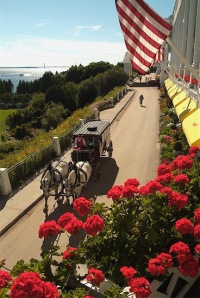
Last Spring I attended a conference at the Grand Hotel in Mackinac Island, Michigan.  The Grand Hotel, Mackinac Island, MichiganWhile staying at this historic gem, my goal was to create a short web video on the hotel and the island.  I shot the property in a dozen different ways getting b-roll footage of carriages, guests on the porch, tea in the parlor, the orchestra and other areas of the hotel as well as scenes in town. I also interviewed third generation owner and President, Dan Musser III and carriage driver Tom McCarthy.  Those interviews as well as some soundbites from a talk given by concierge Bob Tagatz – gave me my narrative track.

When I returned I gathered all my assets – interviews, b-roll and music and started to layout the story. Generally, I lay down my best soundbites first.  This drives the story.  I’ll then go through all my b-roll and live action shots and select the best clips that best illustrate the narrative track.  I was fortunate on this piece because I was able to capture footage of the harpist at the Grand Hotel and this not only provided me with some nice visuals, but it gave me a music track to work with that made sense in the context of the story.

After piecing together the story in Final Cut Pro, I then went  back and “cut” it.  Given time, I may even live with it a bit, going back and cutting more each time giving it more punch.  I’ve uploaded my first two cuts on vimeo.  Here’s a link to my latest rough cut. http://www.vimeo.com/5889700 I’ll probably live with it a bit and then go back and cut out another 20%.  It’s always hard to cut but it makes the piece stronger and these days – people don’t take the time to look at long web videos.