Letting Go of What We Know

There’s so much angst these days in the “photography” community and not just the photo community but everywhere.  People are almost paralyzed from fear – fear of the future.

I don’t think we ever get anywhere if we let “fear” take over our lives.  Certainly not if we live and work in a creative field.  The fear seems to creep up when what we are “used to” is no longer there.  Anyone who works for newspapers can relate to that statement.  But we can’t change “what is”. I don’t look “back” often but when I do – I do it to get perspective.  And when “fear” of the future manifests itself so strongly – to quote Jackson Browne “it seems it’s easier sometimes to change the past”.

We all know we can’t change the past – so why do we dwell on it?  Because it’s really scary to face a future where all the rules have changed.  Technology has forever changed the game.  We can moan that our clients don’t respect us and that they just want work that is “good enough” and worse yet – coming to terms with the fact that maybe, just maybe “good enough” is good enough for their needs. As we communicate visually over electronic platforms like the “web”, do we need an image file that is 8000 pixels in its longest dimension with 300 res – like we did for those glossy brochures?

On the other side of the table is that nagging notion that we all must learn to shoot “motion” and “video” and we’re intimidated by it because it’s not what we know.  I guess I’m an oddball because I’ve never really been too intimidated by what I don’t know – I’m actually drawn to it and excited by it.  Sometimes I rush to the unknown almost carelessly without even considering the consequences. And there’s always consequences – many times negative ones – or ones that may seem negative at the time.  But every now and then – if you just “let go” of holding on to what may not be working anymore in your life – you’ll find that you’ve opened yourself up to wonderful possibilities.  I keep my eye on those possibilities and it’s so much better than holding onto the past.

Are You a DP or a Hybrid? – What’s the Difference?

I’m searching for “the word” the “title” of what I am these days.  I’m a photographer.  I also shoot video but I hate the word “videographer” because it sounds a bit cheap to me or at least dated. I generally think to myself that I’m a “visionographer” but I tend to “title” myself as a “media producer”. With all the talk recently about getting into video, I feel the need to make a distinction between being a shooter or a DP as opposed to a producer.

There is nothing new about still photographers moving forward in their careers and segwaying into commercial motion work.  Traditionally they take on the role of the DP (Director of Photography).  Many times they don’t man the camera but direct the shooter instead.  Generally speaking they work in large crews and with agencies.  The biggest distinction is that most times it’s a “work for hire” situation because the production company owns the finished product.

With the explosion of video and in particular web video, come new buyers for this medium.  Buyers from the corporate world as well as institutions and even ad agencies that may have been historically just “print”.  With the advancement of technology and being able to deliver a high end product because of it – leaner and meaner small production companies have come along.  When you have a shooter using the RED and able to deliver not only the motion part of the job but able to pull stills from the shoot, once again still photographers feel threatened.

When I got started in video, I made a conscious decision to take on the producer’s role.  I could choose to shoot or edit or I could delegate these roles to outside contractors.  I could also form partnerships that were fluid as the needs may be.  But more importantly, I maintained ownership of the final product – which was what I was used to coming from my still photographer background.

Still photographers are essentially producers anyway so it’s not such a mental leap.  So when your client comes to you and asks you if you shoot video (and you don’t) think before you answer that with a NO answer.  It may be better to form some partnerships with people who do and not only keep the money in house – but not send your client off to someone who does.

Do’s and Don’ts for Hybrid Cameras

Many still photographers get started in video with a “hybrid” camera.  Canon just came out with the EOS 7D to add to their already popular EOS 5D Mark II.  Nikon has their – D90 and Panasonic has the Lumix DMC-GH1K.

There is plenty of information online particular to all of these cameras so  rather than repeat what others have written, I’ll list some tips on shooting with these cameras.

1. Don’t shoot verticals when in the video mode – the reason should be obvious but nevertheless because these cameras look and feel like still cameras (and are) turning the camera vertically is a common mistake photographers make.

2. Use an external mic if audio is important and it usually is.

3. Use a tripod – hand holding video is far different than hand holding a still camera where just the “moment” has to be sharp.

4. Don’t try to be sneaky in venues that prohibit video by pretending to shoot just stills.  It’s just not ethical.

5.  Remember when shooting video it’s a motion medium – so seek out subjects with motion.

6. Make sure your sensor and lenses are always spotless – while you can retouch video it’s quite labor intensive or can be.

7.  Editing files from some of these cameras can be slow and clunky in the edit room, especially when trying to blend with other video shot at a different frame rate like 24p.  If you’re shooting with the 5D which shoots in 30p you may want to convert your files to the standard Apple Pro Res at 24p to make everything compatible first.

8. If you’ve been hired to shoot stills for a client and they ask you to “just” shoot some video footage for them from the same camera – don’t just throw that content in for free.  There’s added value there and you’ll short change yourself as well as set a bad precedent for your future video clips.

To be honest, I don’t own a “hybrid” and most of these tips have been collected by hearing complaints and advice from others.  So please add your own tips and cautions.

Living The Dream

There’s that feeling again – a surge of energy and excitement running through my body as I stepped off the plane in Costa Rica.  Feeling the wonderment of being in a “foreign” land and the unknown possibilities that awaited me. I love that feeling – I live for that feeling, even after more than 30 years of traveling the globe –I get that same “surge” that I felt the first time I left the comfort of my “norm”, all those years ago.

My journey to Costa Rica was a short one – too short because of life’s other commitments but nevertheless worth all the hassles that one must endure when flying these days.  I actually don’t mind the hassles and the hours of waiting in airports or train stations, because it’s my time to just let my imagination run wild and I choose instead to focus on the rewards that come with traveling.

The insatiable desire to “explore” is what led me to become a photographer.  My camera has been my “eyes” on the world and all it has to offer whenever I’ve needed to get outside of myself. But oddly enough this time, I didn’t feel compelled to let photography or video drive the experience.  In fact there were several times during the trip that I made a conscious choice not to shoot something but rather to see things through my own eyes and immerse myself in the experience instead of just through the viewfinder.  Those moments weren’t recorded for others to see in print or on the web, but nonetheless were indelibly carved in my memory – listening to an off key singer in a surfer bar performing a Bob Marley tune, watching hot lava rocks tumbling down an active volcano from my hotel room, laughing at the monkeys in the rain forest and feeling the freshness of the rain in an afternoon’s downpour – all etched in the recesses of my mind.

When I was a young girl, I remember walking home from a friend’s house on a cold winter’s evening.  It was that magical time of day when there was still a bit of light left in the sky, yet dark enough that you could start to see inside people’s houses.  The big picture windows were like movie screens to me and I remember wondering to myself about what went on inside those walls.  As much as I felt a certain warmth while peering through those windows, I also felt a bit of loneliness in being “on the outside and looking in”.

Years later while hitching a ride in Romania, I was picked up by a man who was headed up the road to attend a wedding.  When we arrived at his destination, he asked if I would like to go with him to the wedding.  I was in no particular hurry and didn’t really have a place that I needed to get to so I took a chance and said yes.  That “wedding” turned into a three-day event and one of those magical times where I became part of the “inside”.  At the end of the long weekend and when I knew that it was time for me to go, my new “friends” and I exchanged addresses and made promises to see each other again.  We all knew that a reunion would most likely never happen and that the “magic” could never be repeated but I’m certain that I am not alone with the memories  from that weekend etched in my head.

My camera has always been my “tool” that has enabled me to live my dream.  But at the same time, a lot of the magic and wonderment has happened when I’ve taken my eye away from the viewfinder and found my way “inside”.

Mistakes Still Photographers Make When Shooting Video

Short but to the point – common mistakes still photographers make when starting to shoot video:

1.  They break timecode (only applies when shooting to tape)

2.  Bad audio – audio is everything in video.

3.  They don’t turn the camera on soon enough.

4.  They turn the camera off too soon (thinking in the “decisive moment)

5.  Use auto – focus.

6. They don’t shoot sequences – beginning, middle and end

7. They don’t shoot in “storyboard mode” – “How will I get into and out of a shot and what’s next?”

8. They pan and tilt and zoom in and out – too much – the motion should come from the subject matter – not necessarily the camera.

9.  They don’t shoot enough B-roll with variations.

10.  I’m open to suggestions as to what #10 should be – feel free to chime in.

“Breaking The Spirit”

I was reminded recently of an experience that I had while shooting a story for Smithsonian Magazine on Arthur County, Nebraska. Truth be told, it was an assignment that I almost didn’t accept. I thought that a story about the least populated county in the United States was not a story for me – I shot city stories for the most part. But then I thought, why not? It ended up being one of the most gratifying magazine assignments that I ever did – on many levels.

Personally, it pushed me out of my cultural norm. “What am I going to do in a desolate part of the country where cows far out number the people?” Photographically speaking as a people shooter, it really pushed me to see and shoot differently. Because there were so few people, I lingered longer and got a closer glimpse into their lives than I normally would have on a 7 day city shoot with lots to cover.

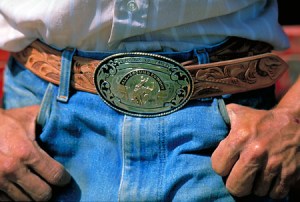
One day stood out for me. I was photographing a cowboy “breaking” horses. cowboy_belt_buckle I watched as he worked with an incredibly spirited horse, trying at first to calm the animal. I remember asking a question about “breaking” the horse to which the handler replied that he never wanted to “break” an animal’s spirit, but rather to gain the animal’s trust. I thought to myself that this cowboy must be a wonderful father and husband and a part of me fell in love with that notion – his understanding of the difference between “managing” this stunning creature and “breaking” its spirit.

I realized that maybe that moment in time was in essence the story itself and the reason that I needed to take that assignment. I remind myself of that every time I’m hesitant to stray from my comfort zone. That almost always there’s a reward. I was fortunate that the assignment editor on that piece saw something in me that I didn’t.  So many times, for a variety of reasons “clients” feel the need to over dictate the visual message and the end piece reflects that, becoming an entity that is neither “here nor there”.  The “spirit” of the piece becomes broken.

These days because of tight budgets and fear of losing one’s job – things tend to become more predictible and safe – choosing shooters who’ve done that type of story before or re-doing the same stories that have proven to be “successful” in the past. But every once in awhile – someone (like the cowboy) comes along and recognizes something in my spirit and gives me the necessary “rope” to bring my vision to the project while still managing the “whole” – and marvelous things happen.

Staying Outside The “box”

A friend of mine recently reminded me that I have said that I like to stay outside the “box”.  That I have spent much of my career trying not to be categorized or pigeon holed into one specialty of photography.  Perhaps not the greatest business decision, but nevertheless a series of mini decisions to continually depart from whatever my norm is or has been.

Even as a child I discovered early on that I wanted to explore – in the broadest sense of the word.  I surely did that in my days right out of high school and college when I embarked on a year long backpacking odyssey across half the globe.

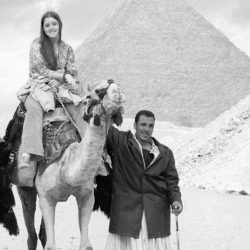
Mooney, Peace Hotel, Shanghai, China 1983

But it was after that sojourn that I pursued a career in photography to facilitate a somewhat vagabond life.  And that I did combining a photographic career with my quest for discovering people and cultures. I ‘ve been  fortunate over the years to have garnered assignments from high profile magazines like National Geographic Traveler, Smithsonian and Travel & Leisure.  And I loved the path that I had chosen.

It was about ten years ago that my restlessness pushed me into the medium of video.  Technology was making it possible and affordable for me to shoot my “stories” in this medium with sound and motion.  But I was more focused on adding those new dimensions to “the story” rather than on the “tools” itself. Getting into video proved to be a great move, certainly a good business move as society has gravitated more toward the web.

So in my desire to live a life “outside the box”, I’ve come full circle and realize that “decision” has not only been “good” for  business – it’s led to a very interesting and rewarding way to live life.

Making a Difference

I’ve always been quite active as a volunteer in my community.  When my daughter was going through the school system, I was very involved with various committees and events throughout the years. What I enjoyed most was being able to share my gift of expertise as a professional photographer and filmmaker.  One year I produced, shot and edited a piece for the school’s International Baccalaurete Program highlighting what some of the students were doing for the CAS portion of the program.  CAS stands for Creative Action and Service and  the students need to spend a certain number of hours in each of these areas.  So I created a short video made up of interviews with current students talking about what types of things they were doing to fulfill those hours.  I also took whatever still photos and video that the kids or their parents provided me and worked it into the piece.  The video was a hit amongst the kids, their parents and the teachers and will be archived to show future students contemplating the IB program.

I’m not so involved with the schools now that my daughter has graduated, and I miss that community connection and what I got from that personally. I do mentor high school kids from time to time who are interested in photography and video and I love to work with the passionate ones.  And last year my husband/partner, Tom and I shot and produced Freedom’s Ride, a short documentary about 20 predominately white students from our high school district and 20 predominately black students from a public school in Harlem, NY who rode the bus to and from Alabama, retracing the Civil Rights Movement of the 1960’s. That was an incredible and rewarding experience for all.

Currently we sit on the board of our local public access TV station Mendham TV.  Independently Tom and I have produced 20 half hour talk shows for the station, called Mendham People.  We recruited local people for hosts who came up with various local people to interview in a Charlie Rose type format.  One of our hosts was our local postal clerk, Pete.  We live in an area where we don’t get mail delivery so everyone goes to the post office on a daily basis and sees Pete. So he’s a well known figure and knows everyone in town.  Recently our station started airing the town’s public meetings.  The station isn’t funded but we managed to get volunteers and trained them to shoot the meetings. I’ve started attending town meetings  and I feel much more in touch with my community.  Volunteering on the board of the local TV station has kept us involved with our community and is a way for us to continue to “give back” to our community.

It’s always nice of course when I get personally thanked or recognized in some small way for my volunteer efforts, but the biggest reward is always  how it makes me feel.  I believe we all can make a difference even in the smallest acts of “giving” and to all those who have shared their time and talents, you know how rewarding it is personally. I’ll end with a quote by Arthur Ashe.

“From what we get, we can make a living; what we give, however, makes a life.”

—Arthur Ashe (1943-1993), professional tennis player, civil rights supporter

Birthdays, Dreams and Optimism

It’s amazing how quickly priorities change. Today’s my birthday and I knew that I had a lot of deadline items I needed to get accomplished early in the day. I was cutting my work day short because I have tickets for a Jackson Browne open air concert this evening in Brooklyn.

I quickly checked my email and caught up on “social media” dialog and then at 7:50AM Eastern Daylight Time – my power went out. I knew I had a “window” of opportunity to get any computer priorities taken care of before my backup battery went out. Then I would need to come up with a plan B. I could still work on my laptop but my airport wasn’t on so I didn’t have an internet connection. I could last as long as the battery in my laptop held out. I could go down to the library – but their power was out too. I could use my blackberry for as long as that battery lasted. Then I actually could recharge both my blackberry and my laptop battery if I used the “universal power inverter” that plugs into the cigarette lighter in our car.

Or I could give into the forces of nature and take the day off from technology. I think I’ll do that. But I’ll use a bit of my battery and write this blog before I succumb to the “powers that be” and “make the best of it”. Who knows there could be a silver lining in all of this. All these metaphors started me thinking about other “mantras” that I’ve led my life by. Seems fitting on my birthday to take the time to reflect on these mantras and share them.

1. Always have a dream. Believe in it and believe in yourself in making it happen.
2. Keep your passions alive. For me, my strong interest in cultural stories will always keep me exploring. I need that and it gives my life perspective.
3. Set goals – even little goals are good and then reward yourself. They will all lead up to you making your dream come true.
4. Make decisions or they will be made for you.
5. Do the “right thing”. You will love yourself more if you do.

It’s still raining and the power is still out at 9:56AM on Tuesday, July 21, 2009. But I’m going with my plan b, taking the day off from technology and heading out to the open air Jackson Browne concert – rain and all. At least it’s his “acoustic” tour.

“The Most Trusted Man in America” – Walter Cronkite 1916 -2009

We lost one of America’s greats yesterday, Walter Cronkite died at the age of 93. I grew up, getting my “news” from Mr. Cronkite along with millions of other Americans. We all believed what he said and we trusted that what he said was the “truth” and not just “opinion”.

Walter Cronkite brought us some of the most amazing news stories of the 20th Century and he did so with the utmost integrity. The coronation of Queen Elizabeth, John F. Kennedy’s assassination, Martin Luther King’s assassination, Bobby Kennedy’s assassination, news about the Vietnam War and of course the first Moon landing. He said once and I’m paraphrasing, that amongst all the turmoil and problems of the 1960’s, the Space Program and in particular that first landing on the Moon showed America’s true spirit and resiliency. He personified that – he gave us hope for the future.

I think anyone who remembers getting their news from Cronkite, longs for those days when the news was the news and not an endless stream of pundits’ opinions. We’ve lost our trust in journalism and journalistic integrity. And with social media and “citizen journalism” I not sure we’ll ever get that trust back.

I had the privilege of meeting and photographing Walter Cronkite in 1986. I was shooting a story for the National Geographic Traveler Magazine about Nantucket and Martha’s Vineyard. I was given contact info for Walter Cronkite and called him up and asked him if I could photograph him for the article. Mr. Cronkite spent his summers in Martha’s Vineyard and was a well known figure there especially among the “sailing set”, so it was thought that a photo of him would make a nice addition to the story . We set up a date and a time for the photograph. Being a professional, I always confirm any appointments the day before. So the day before our shoot was scheduled, I called the telephone number that I had, to confirm. This was well before the days of cell phones and emails and even before computers became such a big part of our lives. Throughout the day, I kept calling the number that I had from whatever pay phone was available but I kept getting a ringing phone – no answer and no message machine. The day came and went and so did the next day – the day I was supposed to photograph him. I missed our appointment because I never connected to get details of where to meet him. I felt betrayed by “the most trusted man in America” that somehow he had forgotten our appointment. And then something hit me that night – perhaps when I rewrote my notes with all my contacts and phone numbers for the shoot – I had not written his phone number down correctly. So I took a shot and called directory information to see if by some slim chance Walter Cronkite was listed. Much to my surprise he was listed! The next day I called him, profusely apologizing, embarrassed and humiliated and told him how I had incorrectly written his phone number down when I was rewriting my notes and that it never occurred to me to check the telephone directory to see if his number was listed. I assumed that someone like him who was so high profile would have an unlisted telephone number.
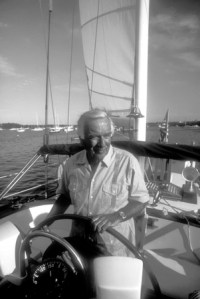
Cronkite

He was incredibly gracious, yet he did warn me about making “assumptions” and I have never forgotten that lesson. And he gave me a second chance and set up another day for the shoot.

The day of the shoot was a glorious day on Martha’s Vineyard and Mr. Cronkite suggested that I photograph him on his sailboat. His mother was also on board and I remember her as being quite a character. I have fond memories from that afternoon. I took my photos but he didn’t head back to shore to drop me off – he loved to sail and it was a perfect day for it so we continued to sail throughout the rest of the afternoon.

I cried last night when I heard the news of his death. I cried because he’s gone and also because we’ve lost our trust in journalists and the news media in general. But like Cronkite, I’m hopeful for the future. Thank you Mr. Cronkite for your integrity, professionalism and your personal words of wisdom for me that wonderful day so many years ago. “And that’s the way it is”.