1. Give it away – One of the best opportunities that still photographers have when expanding their businesses with video is to offer their new services to their existing clients. I hear from so many still photographers who squash this opportunity from the start by throwing in the video clips for free because they are still learning. First of all, I’m not a fan of learning on the job, but more importantly if you give your new skills away because you’re still learning, then the question is “At what point will you be good enough or have learned enough to charge for it?” Who decides that you or your client?
2. Audio is an afterthought – Capturing good audio is more important than making a great image. If a viewer cannot understand the dialog, they will walk away. Don’t make audio an afterthought. Hire a good sound person.
3. Position themselves as “just” a shooter – If you position yourself as just a camera person, then you will not only lose a lot of creative control, but you will leave money on the table by not making a profit on the other aspects of a video production. I position myself as a producer. That’s not to say that I don’t also shoot a job, but I oversee the entire production and charge accordingly for pulling together all the pieces.
4. Don’t collaborate – Get over the one man band, solo creature model and surround yourself with a crew of experts that will make you look good. Build a team of editors, sound mixers, motion graphics artists etc.
5. Forget about the story – Every good product, including commercial videos have a great story. You can have the best production values in the world, but if you don’t tell a good story, it will not resonate with your audience or your client.
…where anything is possible. I’ve haven’t written in awhile because I’ve been traveling. Last week I was in Chicago presenting a seminar at ASMP’s SB3 Seminar. It was the last one in a series and now I’m kind of going through withdrawal. There was so much sharing of information and ideas that no one wanted the conferences to end. But now we all need to initiate some of those ideas and apply some of the things we’ve learned. And that’s the part we can’t forget about – doing the work that will bring our ideas to fruition.
In my last blog I wrote about believing that the impossible is possible. I don’t mean to over simplify that notion and to say that all we have to do is have a positive mindset and things will happen for us. What I really mean to say is that without the belief that we have the power to do anything we put our minds to –we would never try – we would never give something a chance to happen. But along with that comes plenty of times when it just doesn’t happen – the first time, the second and third time and many times after that. And that’s when we need try again – and maybe harder.
The good news is that these days it seems like all our tools are converging to make just about anything possible. We no longer need someone to validate our ideas because we can validate our own. We have affordable cameras that shoot stunning still images and video. We have non-linear editing software to create the stories and we have Facebook and Twitter to get the word out about them. We have crowd funding sites like Kickstarter to raise money so that we can make our ideas a reality. And when our videos are finished we can upload them to YouTube or Vimeo and share them. We can also distribute our creations through image portals, downloaded Apps or through iTunes.
Last week I uploaded a trailer for my documentary Opening Our Eyes. As of today people in 71 countries have played the trailer! I sent the link to less than 30 people and they passed it on, embedded it on Facebook and blogs and it took on a life of its own. That simply amazes me because of the power that we now have to connect and communicate with just about anyone, anywhere in the world. That’s revolutionary. That’s a game changer. That’s powerful.
I’ve just arrived in Las Vegas to attend the NAB show. The National Association of Broadcasters has one of the world’s largest broadcast conferences in the world. All the movers and shakers of the broadcast world are here to network, make announcements about new products and learn. It will be another solid week of input overload with my head bursting with ideas and possibilities. And every one of the ideas has the real possibility of happening because of the age we live in.
Thank goodness February is over. It’s been a long, cold, snowy winter here in New Jersey and February felt particularly brutal. I can cope with cold weather pretty well but “cabin fever” can be deadly for me. And last month it almost killed me. I had been in isolation editing video for 14 hours a day – every day. It was almost inhuman.
This weekend I headed down to Philadelphia to present a seminar at
ASMP’s SB3. It was just what I needed. I needed to connect with people. Conferences like SB3 are meant for stimulation and learning and everyone walks away with their heads exploding with new ideas – attendee and presenter alike. But I walk away with so much more. What I get from interacting with people, learning from them, sharing with them is immeasurable.
Freedom – to see – to be open to opportunities Authenticity – be yourself Intentionality – live intentionally – be proactive Trust – in yourself Hospitality – be open to the world
And I learned about a blog that truly resonates with me The Art of Non-Conformity
As all the conversations still run through my mind, I remember one in particular. I was speaking with someone who had taken his own path – traveling a lot before going to college and pursuing other passions in life before settling down on a career. He wanted to know if I would mentor him but he had so many questions, he was concerned he would infringe too much on my time. I smiled and told him that I was quite accessible and to feel free to call anytime. And that I’d let him know if he was wearing out his welcome He smiled back and said, “you have a hard time saying no don’t you?” My answer to him was “yes” and that I liked that word much more. It opens up so many more possibilities.
If you haven’t attended on of the three SB3 events – there’s still one more in Chicago April 1- 3. Check out what people are saying on Facebook. And then come and join us in Chicago and prepared for lots of “ah ha” moments. It could be life changing. You just never know.
This past weekend at ASMP’s SB3 conference in LA, a young woman came up to me and said that I had given her an “ah ha” moment. I asked her why and she reminded me of what I had said at a panel discussion the evening before. A photographer had just told a story of how he saw himself in very specific terms as to what type of photography he did – he saw himself as wearing one hat. But a client came to him with a job that didn’t fit into his norm and so he turned it down. Then the client came back a few days later in desperation and asked him to please reconsider and he did. The job ultimately turned into a lucrative and regular gig and he learned a powerful lesson and that was to open his head up more to possibilities.
I was in the audience and the moderator asked if anyone had a response to this story. I said that I was really into saying yes more at this point in my life and career and that when I did, the universe was opening up and really great things were happening. I could go on to list a number of examples of some good things that have happened but the point here is that negative energy breeds negativity and positive energy breeds hope and change and positive results.
It’s pretty tough these days to stay positive, with the photographic industry in a state of flux and the lackluster economy but it’s not impossible. Some things I have found that help me stay positive are simple to implement in your life and others take a bit more practice.
For starters, stay away from the groaners and moaners who spend their time complaining. That negativity is contagious – so get as far away from those people as you can.
Find something you do like and cultivate that passion. It will show. You’ll start to talk about it and people will be attracted to you because of it. That attitude is contagious as well but is an attitude that you want to “catch”.
Embrace learning. Growth always has hope and hope will renew your spirit.
Learn to let go of the things that don’t work out. God knows I have had to abandon many expectations but I try to move on and replace them with new ones.
You can’t control what others do to you but you can control how you react. Empower yourself with that thought.
Think good thoughts in those moments right before you drift off to sleep. When you are sleeping your subconscious takes over and if you have positive thoughts running through your head just before you go into that subconscious state – that is what will be reinforced.
When you are feeling low and nothing seems to be working – find something that is working and be grateful for that. And know there are certainly others in the world that are far less fortunate than you.
Always remember that life is the greatest gift of all. Embrace it, cherish it and make every day count.
When you say yes, you at least have a chance at a positive outcome. When you say no – you’ve closed the door. My reward that weekend was knowing that I gave someone an “ah ha” moment. Who knows what may come out of that? What a powerful thought. What a powerful word.
There were all kinds of “ah ha” moments this past weekend in Los Angeles at the SB3 conference. There’s another SB3 conference in Philadelphia coming up – February 25-27. Come and join others who embrace the positive notion of growth, hope and change.
I haven’t done a lot of tech talking lately, but a couple of new items have me thinking that way. Here’s some interesting news about products, firmware upgrades and video delivery.
To start with, for all of you who own a Samson H4N Zoom digital recorder, and have been frustrated that you aren’t able to independently change recording levels on inputs 1 and 2 – you now can. Here is a link to the firmware download and instructions.
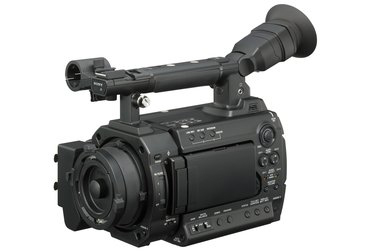
For all you “big chip” aficionados, Sony just announced the PMW-F3
Sony PMW F3
camera with a 35mm CMOS imager. However, with a price tag around $16,000 for the body and an extra $7000 for a set of three Sony prime lenses, it seems more like a competitor in the RED market, rather than in the DSLR niche.
“We recently went through the process of re-designing our website with one of the primary new objectives being adding motion content. So I did extensive research on the websites of directors, cinematographers, and leading production companies to see how they presented videos. I was surprised at how little effort most are making in this area.
I suspect the thinking of the directors and cinematographers is that nobody hires them for a serious commercial gig by discovering their website. It’s very much a matter of relationships and playing the inside game.
But I also think the world is changing fast with the barriers to entry lowering in the motion world, and with talented people increasingly able to compete on creativity rather than on access to expensive cameras and lights. The importance of a strong web presence is rising and becoming fundamental for directors and cinematographers.
So I set out to find the best-in-class practices and leading suppliers of related tools. I found some methods of integrating and presenting video to be more engaging than others.”
PhotoCinenews has also announced that the DVD set of their 2010 PhotoCine Expo is hot off the presses. It’s an 8 disc set of presentations from 14 filmmakers. I am honored to be one of them and as one who attended many of the other presentations, I can tell you it’s worth every penny. Check it out.
“Women’s Wear Daily offers a report that this iPad-o-newsthingy, which has been in covert development for several months, will be called “The Daily.” It will, apparently, have as its pulsating spirit “a tabloid sensibility with a broadsheet intelligence.”
Oh, and there is a price for this melange of the tabloid heart with a broadsheet mind. A ticklingly enticing 99 cents a week.
The Daily will, apparently not enjoy such dated concepts as a print edition or even a Web edition. Instead it will be beamed straight to the iPad (or Galaxy, if you can afford one) from News Corp.’s high pod somewhere in Manhanttan.”
“YouTube attributes the growth to several factors. First, the company’s decision to increase time limits from 10 minutes to 15 minutes per video has helped. It also pointed to the site’s file size limit of 2GB. With the help of mobile phones, YouTube said that consumers are finding it relatively simple to quickly add videos to the site. It also doesn’t hurt that “more companies [are] integrating our APIs to support upload from outside of YouTube.com.”
Lastly, a thank you to everyone who has contributed to my film Opening Our Eyes, on Kickstarter. We have gone past our half way point, meaning we are more than halfway toward our goal. And to anyone who may be thinking of making a contribution – it’s a win/win because you get a DVD of the film if you make a $25 contribution. The money will all go toward the hire of a professional editor who will give the film the polish it needs to have a chance at wider distribution – and with that, the possibility of inspiring more change makers in the world. Here’s the link – please pass it along to people you know who may like to be a backer.
There you have it – a mixed bag of some interesting “new stuff”.
The last two weeks have been enlightening and humbling for me, and I’ll try to share some of the thoughts that have been racing through my mind.
I was honored to be asked to speak about video, at ASMP’s Ohio Valley Chapter’s Photo Tech conference last week. It’s a great event and an enthusiastic and engaged group of people. I also had the pleasure of seeing Walt Jones presentation: “CGI – Friend or Foe”. Walt is a talented photographer and CGI artist. He is in my opinion a new breed of visual communicators. He started out by showing examples of “images” and asking the audience if they were photos or CGI. I was 100% wrong with every one of my guesses. The point is – I couldn’t tell the difference. I was in awe of the power of these relatively new tools that we as “image creators” have at our fingertips.
It really got me thinking that “seeing is NOT believing” anymore and the ramifications of that. I started thinking of the ethical consequences and how in the wrong hands this power can be misused. But as I tossed those thoughts around in my head, I realized that this is really nothing new as far as the power we, as visual creators have, to manipulate an image or skew the story or the message. Even before Photoshop and similar applications hit the scene, we as image creators could sway opinion or belief, just by what we chose to show, or not show. If you look back in history, photographs, film and TV, have swayed public opinion long before the tools of Photoshop and CGI.
Yesterday, I got an email from a photographer, Aaron Huey, with a link to his Ted talk. He told the story of the Lakota Sioux Indians through his words and his images. He presented a timeline of this tribe’s history through his words, as he showed his images of modern day Lakota on their reservation or as he refers to it – their prisoner of war camp. It was one of the most powerful Ted talks, I have ever seen. It also reinforced the notion of the “power” that we all have as visual creators.
I’ve been thinking about that power a lot, and the responsibility that comes with it and that I believe that we all have the obligation, to use it wisely. A few years ago, I created a documentary entitled Freedom’s Ride, a story about two diverse groups of high school students who rode the bus together to Alabama, tracing back the Civil Rights Movement of the 1960’s. The words of one teacher that I interviewed have stayed with me. He said, “we can pass all the laws we want – but we can’t legislate morality”. I’ve been thinking about that statement a lot this week. It’s never been more important than it is now, because of the tools of technology, that we make sure our moral compasses are in check and headed in the right direction.
For the past two years I’ve been traveling around the country presenting a seminar called “Should I Be Thinking of Video” for ASMP (American Society of Media Photographers. This seminar had become quite popular with still photographers as interest in video escalated, partly due to the hybrid cameras and partly due to the increased demand for video content for the web and mobile devices. The iPad in particular is a game changer and everyone seems to be keen on either creating video content or buying it.
With this rush to find or produce video, I’ve seen quite of few people attend these seminars because they feel they have to get onboard. A few weeks ago, someone in the audience, who appeared quite annoyed, raised their hand and said, “but you didn’t answer the question – should I be thinking of video”. He went on to say that there was nothing new about video and weren’t there plenty of videographers already out there. I replied that he needed to answer that question himself. I could only provide him with background information about video production but that decision as far as if he should embrace video was for him to make. I also said that yes there were plenty of videographers out there working in traditional markets that have been around for decades. What is new is the increased demand for video because we as a society are moving more toward an electronic means of communication and away from print.
I think the most important point here is that no matter what creative path you may wish to pursue, you need to have a reason for doing it. For me, I started shooting video more than a decade ago because as a storyteller, I felt the need for motion and sound to adequately tell the stories that I wanted to tell. I certainly wasn’t chasing a trend – not that video is a trend. Just like in still photography, it’s not about the tool or the camera, it’s about your vision and if you don’t know why or if you should be shooting video then how can you possibly have a clear vision.
I can probably better answer the question “should you be thinking of video?” this way. If it’s because you have a camera that is also capable of shooting in video mode then then the answer is no – you shouldn’t be thinking of video, because you will be a technician or a button pusher and will compete with every other person who has that same tool. But if you are thinking, seeing and feeling projects and stories that are all about motion and sound, then you’ve answered that question for yourself.
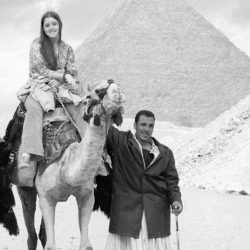
I’ve always been an independent creature, starting with a year long backpacking odyssey as a 19 year old traveling solo, following the “hippie trail” around the world. That sojourn led me to pursue a career as a still photographer, using my camera as a tool to gain access to people, their cultures and their stories.
I’ve had a great ride these past 30 years shooting assignments for high profile magazines that have taken me to all parts of the globe. For the most part, I was a solo act, spending hours, days and weeks observing people, then becoming more intimate as I proceeded to get to know and tell their stories and share them with others.
When I started shooting motion and in particular digital video, eleven years ago I embraced the notion of collaboration. Video production has a lot more facets to it than just the shoot and I knew that even though I knew how to capture reasonably good sound and edit a respectable rough cut with Final Cut Pro, I also knew that working with professional sound people and editors would raise the bar on the quality of my projects.
This past weekend, the value of collaboration, networking and using social media to get my ideas out to the universe, really hit home. I had been asked to speak at the Photocine News Expo in Hollywood, CA about my latest documentary that I was working on, Opening Our Eyes. I had gotten to know two of the organizers of the event, Michael Britt and Lou Lesko, through social media. They had taken notice of my blog and my project, which I had decided to shoot with the HDSLR cameras and had written about it in their blog, PhotoCineNews.com.
I was honored and humbled to be speaking at the same event as some pretty heavy players like Vincent LaForet and Shane Hurlbut. I was a bit intimidated at first, but I knew that I was there to share what I knew and that is how to get a passion project from just an idea – to a reality. So, after returning from my 99-day journey, with just a couple of weeks to prepare a sample from some of the 145 hours of footage that were shot, I flew out to LA.
I suppose I can legitimately say that I have had a theatrical showing of my documentary in Hollywood. True enough – but the real value for me this weekend was in sharing with my peers and making connections with people who I will work with in the future that will help me grow as a filmmaker and storyteller and more importantly who will bring their expertise to my film.
It’s an incredible time that we live in with a realm of possibility. Literally anything is possible. When you share and put things out to the universe – you just never know what you’ll get back. I’ve learned that I share because it makes me feel good – not because I have expectations for an immediate or monetary return. But each and every time I do share – I get back so much more in return.
I’ve just spent the last 2 weeks intensely editing my footage shot on my 99-day journey around the world, shooting my passion project, Opening Our Eyes. I wanted to get a trailer ready for the PhotoCine Expo that I’ll be speaking at this weekend in Los Angeles. I knew that I couldn’t possibly go through all 2900 gigabytes of content (145 hours), let alone cull it down to a finished sample in two weeks time. So, I took a friend’s advice and decided to focus on only two of my ten subjects that I interviewed and shot b-roll on.
Even with going through only 20 percent of my footage has been a grueling and exhausting two weeks. But it’s also given me a much better sense of working with and analyzing the files that come out of the Canon 5D Mark II and 7D.
Some of my loves:
I love the picture quality
I absolutely love the picture quality
You can’t beat the picture quality
It’s true, the picture quality is stunning and worth putting up with SOME of the workarounds, depending on what type of job I’m working on. If I’m shooting a corporate event and I need to record longer than 12-minute intervals, which is the case when someone is giving a talk, then I would opt not to use a DSLR because of the limitations on the duration of a clip. And, regardless of the type of job I shoot, editing the files from these cameras is tedious because I need to transcode them into a file that will play well in Final Cut Pro.
Some of my hates:
12 minute clip duration – this really needs to change in the next generation of these hybrids in order to make it a more workable camera
Audio – Canon really needs to come up with a more professional solution for capturing good audio with the video on one card. I have used a JuidedLink pre-amp with a gain disabler on it but it’s still not as good as the audio I get when I capture it to a separate digital recorder – in my case the Samson H4N Zoom.
Having to transcode all the files into a codec like Apple Pro Res so that I can edit in FCP without stutters, stops and drop frames.
Stabilization is an issue but a solvable one thanks to rigs from Zacuto. And of course you can always use a tripod – and really should if the situation warrants.
I’m sure I’ll come to other conclusions as I dig deeper into my content and I’ll share my thoughts as I continue to immerse myself in the post production part of this film.
In a little more than a week, my 99-day journey trekking around the world with my daughter shooting a documentary, Opening Our Eyes will be over. Or will it? My work is really just beginning as I contemplate all we’ve done, people we’ve met and interviewed and how I will put this all together in an edited, finished film.
There are hundreds of ways I can edit this documentary and quite honestly, beginning the process and deciding the direction is always the most difficult. But there will be a moment when the light bulb goes off and the vision will be clear as to how to make sense of it all. Then it becomes easy as the story unfolds – as it should from my heart. It’s the story that can only be told by me and this case, me and my daughter.
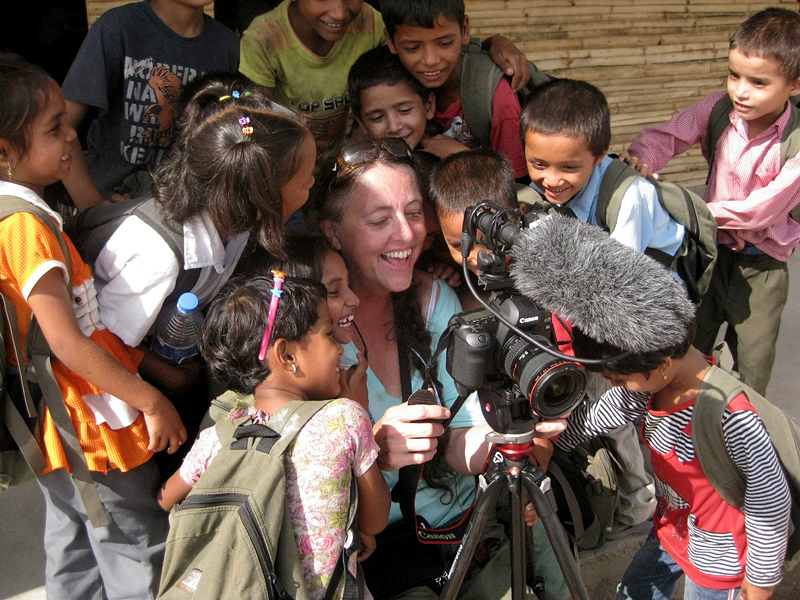
My daughter and others have urged me to do a behind-the-scenes DVD
Gail at the Kopila Valley Primary School, Surkhet, Nepal
– she tells me “that’s what people want”, to know more about the making of the film – more about the people behind the film. As much as I agree with her and understand this interest on the part of the viewer, there is also a resistance to make myself part of the documentary. With that said, a separate “behind-the-scenes” chapter could be the solution – to provide more information, without inserting the two of us into the film itself.
One thought does keep popping into my head that motivates me to provide a commentary on the why’s and how’s of this journey and the making of this film. Too many times when I’ve visited museums, I’ve been taken aback by some of the things that I over hear docents talking about in relation to the paintings. They analyze and interpret what the artist meant by his choice of color, brush stroke and placement of objects within the art and how that related to what was going on in his life at that point in time. I often wonder how they know that or even how can they be so sure? Is it documented or is it really just someone’s interpretation that has become fact over the years?
My daughter and I do plan to sit down this week and attempt to do on-camera interviews – while we are still in the moment and before we get back to our normal lives. Here’s where we need your help – tell us what you want to know. Maybe you’re curious about how we survived the dynamic of a mother/daughter team for three plus months. Maybe you want to know why we did this – or how we funded it. Or maybe the questions are even more basic – what did we like? – what was difficult?– any surprises? etc. etc. Perhaps you want to know more about the craft of shooting the doc– and how I went about that. And maybe you don’t really want to know anything at all and just want to know about the subjects of our film.
But please tell me what you’re curious about – as far as the behind-the-scenes making of this film. All questions are welcome – from the seemingly obvious to the more provocative.







 Journeys of a Hybrid