
- They talk themselves out of things. – Telling themselves that it wouldn’t matter if they learned new skills or shot new images or whatever they didn’t want to make the effort to do.
- They try to “educate” their clients (sometimes a bit too much) instead of collaborating and possibly learning from them. A lot of “older” photographers are like this when they are working with younger art buyers or directors. I think the energy needs to work both ways.

- They give themselves an A for effort for starting something but too many times their starts lead to nowhere if they don’t have an end goal in mind.
- They don’t open themselves up to networking with others by attending industry meetings or events.
- They treat their clients like their enemies where one needs to win instead working toward a positive outcome for both.
- They make the mistake of creating for an audience, instead of creating for them selves. (Thanks to Seth Godin for that thought)
- They take workshops or pay for a service and then don’t utilize them. I’ve been guilty of this too many times.
- They don’t shoot for the pleasure of it.
- They rely too much on commissioned work instead of taking advantage of new opportunities and ways in which to market and sell their own projects.
- They don’t stay true to themselves.
Looking Back
Today, I’ve been looking back  through two year’s worth of blog posts that I have written. Wow – I’ve written a lot! I really surprised myself at just how much when I started gathering the content that I had written in regards to the making of my documentary, Opening Our Eyes. I’m putting together my 2nd ePub that will be a companion to my first ePub, recently published on Amazon and Barnes and Noble.
My focus is centered on the “craft” and the making of the film, and I talk about everything from “the gear” I put together for our 99-day journey around the world to the distribution process for the final film. A bulk of the content has already been written with photographs ready to upload and links. It’s just a matter of consolidating the information and presenting it in a more concise way.
Earlier in the year, I paid my dues in the learning department when I put together the first ePub. After my experience working with a professional formatter, I quickly realized what not to do. One big thing I learned was not to get too heavy with the images because the first generations of Kindles have only b&w displays. I also learned not to create intricate designs in Pages because later I had to undo all the work I had done for a PDF version of the printed book.
I am amazed at how much I have written over the last few years. It was interesting to look back through some of my blog entries, and see how I was “processing things” at the time I was writing those posts. I’ve never really kept a journal before, accept for a one year period in my life, between the ages of 19 and 20, when I was making my first journey around the world.
I’m really happy that I have archived these stories and records of my life, but that’s not what motivated me to first start writing. I used to wake up super early in the morning – my mind spinning with ideas and random thoughts, not allowing me to get back to sleep. So, I would get up and I started writing down my random thoughts and I found it therapeutic. It was like having a conversation with someone and sorting things out.
There are chunks of time in my life that I simply don’t feel like writing or that I have nothing to really say. My mind seems to go into a dormant phase where I convalesce with other distractions – usually mindless ones. But then there are days when I just have the need to get my thoughts down on paper. I’m grateful for those days – on days like this when I take the time to look back from where I’ve been.


Monetization of Photography in Spite of a Lousy Economy
I talk to a lot of photographers. I don’t define the word “photographer” by the type of camera he or she shoots with. Whether someone is shooting with a still camera, a traditional video camera, a motion picture film camera or a hybrid camera that shoots both stills and motion – a “photographer” these days is apt to embrace more than one of these tools.
Regardless of the tools you may use,  I’ve come up with a few tips on how photographers can stay afloat and make money in this continued stagnant economy.
- Think outside the box – don’t think of yourself as one who just shoots still images. Even your “still” clients will have a need for motion imagery these days. It may not warrant the need for them to hire a big video production crew to make a broadcast spot. But it could be one of your corporate clients needs a “talking head” for their website. Even if you don’t shoot motion or don’t want to – collaborate with someone who has these skills to fill your client’s needs instead of sending your clients elsewhere.
- You don’t need someone else to commission your services in order for you to make a living. When photographers take on personal projects, not only are they creating a buzz and getting noticed by potential clients, they are also creating their own “content” to monetize. It is possible now to get our content to market without the need of a middleman. Portals are open and plentiful to all.
- Take advantage of what is “free”, rather than be put out of business by it. There are so many ways to build your brand and get noticed without spending a fortune. The costs of building and maintaining a website have dropped significantly because of advances in technology. And utilizing social media to create a buzz and get the word out about your company is virtually free with Facebook, Twitter,LinkedIn and YouTube. But be prepared to do the work and discipline yourself because this territory is ripe with distractions.
- Re-purpose your content. If you’ve been blogging or have something useful to share – consider packaging your “knowledge” into ePubs, podcasts or “how to” webinars. One thing I’ve learned about making an ePub is that you can either do it yourself or hire a formatter so that it gets to market quickly – via Amazon, Barnes and Noble or the iTunes platform. Price it right – and offer more than one ePub at a time. (I’m working on my 2nd ePub now) In this market, if someone has just spent $3 or $4 to buy your ePub and they see you have another one for sale – it’s not a big stretch for them to buy that other book you offer at the same time.
- Collaborate with others. Partner with others to put on webinars, podcasts, call in phone seminars etc. Use this opportunity to build your own brand. Don’t always feel that you have to be the only “act” offered. In fact many times, if you join forces with other creatives, it will get you further than if you are the only speaker in a half filled room. Get out there and get noticed and learn from your colleagues at the same time.
- Be authentic. I cringe when I write that word because it has become a bit trite. I guess in a way I have always been authentic. In fact I just can’t help myself. If you are true to yourself, you will be ready, eager and able to work hard on your dreams. And hard work is exactly what is necessary to make it in this profession. You’ve got to want it bad enough in order to do the work. If you are a clone of other photographers, you’re career will be short lived. I guarantee the photographers that you are emulating will be “moving on” because their passion is driving them to new things. So, what happens to the cloned versions then?
- Don’t focus solely on the money. Easy to say and really hard to embrace when you can’t pay your mortgage. But look at any successful person – I don’t care which business you choose to look toward in terms of finding successful people – but you’ll see that most people who have “made it big” were not driven by the money. I’m not saying that money is not important, but if you are solely focused on the money and not on the act of creating – it will show. Being too focused on the money part of the equation, can sometimes push it away. People sense it. It’s human nature to want to be around a “winner” – not someone who is begging for a job to keep them afloat financially.
- Be patient. Everything turns around. While the old days and ways of doing things won’t come back, better opportunities will replace them. Don’t be paralyzed by your own fears. Do what you can that won’t cost you a lot of money and there is plenty you can do. Work social media, learn new skills – audio, editing, writing etc., network with people, create new content for ePubs, webinars, and podcasts. Use your imagination, pursue what you are passionate about and when the economy turns around – you’ll be ready.


Five Top Tips for Emerging Photographers
I talk to a lot of young aspiring photographers these days and invariably I am asked, “What advice would you give someone who is just starting their career in photography? – Is there a future? – Can I make a living?”
I don’t have a crystal ball  but I do have 35 years of experience behind me but yet the enthusiasm and outlook of a 25 year old. I remind myself of what I learned from my mentors when I was just starting out. One mentor, who shaped my career, was art director Adrian Taylor of Travel & Leisure Magazine. Adrian taught me a lot – about magazines, about the story, about style and taste and most importantly he gave me the confidence to believe in myself. Adrian gave two young, naïve photographers, my partner and myself a chance and in return – we always gave it our all every time we set out to shoot a story.


With that said, I would not be where I am today if it had not been for mentors like Adrian Taylor and my greatest joy at this point in my life is to pay that forward to photographers just starting their careers.
- Learn video – Video is no longer a “specialty niche” or in fact a separate genre at all. In the very near future – which is already upon us – a photographer will need to know how to shoot both stills and motion – or partner with someone who does.
- Stay true to what your inner voice is telling you. For example, if your passion is to be a photojournalist, don’t listen to people who are telling you that photojournalism is dead and that newspapers are a thing of the past. While “printed” newspapers may be dying out – journalism and photojournalism is not. Don’t let others’ dogma determine what your path should be.
- Collaborate with your peers. When I was first starting out, photographers kept their clients, their techniques and their ideas to themselves. But I have found that whenever I have collaborated with others – we all push the bar to the next level – each bringing their own strong suits to the project. As a subject of my film Opening Our Eyes told me “We’ve got to shine each other up.”
- You don’t need the validation of others to proceed with your idea and make it into a tangible plan and product. As far as publishing and/or distribution is concerned – the gates to the kingdom are open and the kingdom is the entire world. We are living in a time of empowerment for the individual and for a content creator that is profound. If you are willing to do the work – the rewards are bountiful.
- Act on the ideas that don’t go away. It’s easy to let resistance sabotage you. Resistance comes from many places – your loved ones, friends, your peers – but mostly yourself. Stop talking yourself out of ideas and start acting on the ones that just won’t quit you.
I have made my work my pleasure in my life. I have always found it difficult to separate the two. When you feel that – you’ll know you are on the right path.
New Opportunities for Photography
For this post, I’m going to use a very broad definition for “photography”. I will define photography as any image still or motion shot by any camera  – still camera, video camera, hybrid or even and iPhone.
The business of photography has changed with technology. To start with it demands more than just “still captures” in terms of content. These days, our clients are asking us to create stills and motion content and sometimes even 3D. On top of that technology has made it possible for almost anyone to take a reasonably good picture or video.
So where does that leave us as far as new opportunities in the business of photography? While some look in their rear view mirror and lament the passing of the good old days, I for one have my eye on the possibilities that are open to anyone willing to do the work.
My top 5 pick of opportunities out there:
- Once Magazine – An online photo magazine made for the iPad. Photographs and video look great on the iPad and Once, magazine shares subscription revenue 50/50 with each issue’s contributors. You no longer need an assignment to shoot those long run stories you love and monetize them.
- Crowdfunding – With Kickstarter, RocketHub
- Distribution – Film DIY, Distribber
- Funding and marketing – Sokap
- PR and Marketing Tools – Topspin Media
- Portal for e-commerce (also integrated websites) – Photoshelter
That’s a start. It’s never before been more possible than it is now to create, promote, market and monetize your “photography.” Be smart. Be authentic. Be courteous. Have a plan and be prepared to do the work. Anything is possible. Validation for your project is no longer necessary.
If you appreciate what I have shared – here’s one last link, a shameless plug to our funding campaign on IndieGoGo for our film, Opening Our Eyes. If you can, please contribute. If not, please pass along the link.
Marian Kramer, one of our subjects in the film says:
“We all just have to shine each other up.”


The Movie “One Sheet”
If I thought that by finishing my film, I was done – I was sorely mistaken. My work has just begun. What would have been the point of putting my heart and soul into a film for the past year and a half, if no one sees it? That means there’s a lot more work on my part, getting it out there – distributing it, marketing it and promoting it. All that takes time, money and expertise.
I’ve been reading Jon Resiss’ book “Think Outside the Box Office” – “The Ultimate Guide to Film Distribution and Marketing for the Digital Era”. It’s become my bible. For starters, it lays out what a filmmaker needs to do to get their film out there, create an audience and make money.
In terms of publicity, every film needs a good press kit, which should include:
• One Sheet – with tag line
• Synopses – long and short
• Cast and Crew Bios
• Director’s statement or interview
• Production stills and video interviews for the electronic press kit.
• Production stories – something interesting about the making of the film.
• Technical specs
When I first heard the term “one sheet”,  I wasn’t quite sure what that was. It’s pretty much what it says it is – a one-sheet piece of paper describing your film, but it it’s concise with provocative visuals and a catchy “tag line”, designed to peak interest, whether it is with the press or the movie going public.
A “one sheet” can also be what most of us call movie posters. They are essentially the same thing – a one sheet with imagery and text to capture someone’s attention. Some movie one sheets are works of art in their own right and become collectibles. Think of some of the best ones that you have seen over the years.
Sounds like it should be fun – coming up with a “one sheet” for the movie, but even though I have a lot of great content for a “one sheet”, I don’t have the skills needed to create a composite for a movie poster. There are people who just design movie posters – that’s their niche.
I’ve learned a lot in the process of making a film. The most important thing, I’ve learned is to make relationships and collaborate with others who can bring their expertise to the project. It’s not only a rewarding process, but it raises the bar on the final outcome.
The D.I.Y. Age
The world is full of possibilities these days. In fact, for the individual and their “reach” globally – it’s staggering how many possibilities exist that didn’t just a couple of years ago.
We can not only create in a more affordable way with inexpensive equipment and leaner crews – we can also get our creations out to the world without the need for a publisher or a stock agency or a film distributor.
We can do all those things due to the exponential growth of technology. But we also need to recognize that all those possibilities come with a cost, in terms of dollars as well as man-hours. Each one of those possibilities takes time and money in order to become a reality.
Even the path to getting money or financing these days has changed because of crowd funding. But like anything else you need to stand out amongst the noise, so who knows how long this trend can sustain itself.
If you’re planning a personal project, keep in mind that you will need to not only create it but find a way to get it out there after completion. Expect to put time and money into:
• Self – Publishing – this includes hiring a designer and researching self-publishing partners like www.lulu.com in the print publishing world. They also offer downloads. In the motion world, you have options like Amazon, iTunes and Netflix.
• Marketing, PR and advertising – This is definitely an area where you will need money and expertise. Jon Reiss in his book “Think Outside the Box Office” suggests that it will take an investment for at least as much as you spent creating your film.
• Crowd funding – The crowd funding sites provide you a portal if your project is accepted but you need to do the work as far as getting people to know about your project and fund it.
• Bookings – Whether it is an exhibit or a movie or a lecture – you need someone to book venues for you. This could also mean finding sponsors.
The bottom line is really kind of an old fashioned notion in a high tech age and that is – the prize is out there is you’re willing to do the work.


Ten Things I Learned While Making a Movie With a DSLR
1. It will take twice as long as you think. This is especially true if you have a limited budget. With a limited budget comes a smaller crew and therefore you need to do a lot more of the work yourself – if you can.
2. It will take more money than you think. Everything adds up. There are a lot of costs in post-production – licensing music is a big one and a feature film needs lots of music – and having the sound professionally mixed, makes all the difference and is well worth the money – so anticipate that cost.
3. If you need to transcode files for your editing application – then make that the first thing you do. In fact, I used the Log and Transfer plug-in on Final Cut Pro to do a pre-edit on all my clips as well as add metadata to the files.
4. Hire a professional editor. Smartest thing I did. I raised funds on Kickstarter so that I could hire a pro. I know how to edit – or at least I thought I did – till I worked with a professional editor. My editor crafted the story and cut it like a musical composition with beautiful timing and rhythm.
5. You will need twice the memory or drives than you thought you would. Even, when working with a professional editor – in fact because I was collaborating with an editor, we had duplicate projects and media on 3 – 2 terabyte drives each!
6. Stay focused on the story. Don’t even go into the editing room without a clear idea of what story you want to tell.
7. Define your target audience. Iit’s important, especially in terms of how you want to craft the story and the rhythm of the piece.
8. Plan ahead as far as screenings or putting content online. Many film festivals have strict guidelines about previous screenings, premiers etc. I wanted to show my film on a big screen, but I couldn’t have it open to the public or charge money, so I opted to have an “invitation only” event and called it a “sneak preview”. Test screenings are done all the time with studios. It gives you a chance to get feedback.
9. Utilize social media. Have a website for the film and a fan page on Facebook.
10. Don’t try to be what you’re not. And don’t try to be all things to all people in your film. Stay true to your vision. Push yourself to try new things. Go with your gut.


s
Change
Change Who likes change? Other than needing a change of scenery every now and then, change is usually tough to take. I grew up with change. My family moved 10 times before I got out of high school.

I was always the “new kid”. (Hint: I’m in the second to last row. I was also the “tall kid” even in Kindergarten)
No, my dad wasn’t in the military and we weren’t on the lam – he was just climbing the corporate ladder. He’d get promoted or there would be a new sibling and we’d move to a bigger house or he’d get promoted and transferred and we’d move to a totally different place leaving our friends and familiarities behind.
I’m not complaining, nor saying that I feel slighted by having that constant change in my life. It was the life I knew and I suppose I always looked at it with open eyes and curiosity about what was next to come. Of course, if I thought about the friends and sometimes family that I was leaving behind, it made it much harder.
Perhaps growing up in a constant state of change made me more flexible in dealing with all the changes affecting my business these days. Both still photography and video production have been profoundly changed by a bad economy and technology. Kind of like a double whammy. At least with technology the sword cuts both ways and also provides opportunities. It’s usually during the tough times when the economy is bad when innovation happens. Sometimes people just have to be forced to make changes in their lives, even if what they have been doing hasn’t been working. I was asked to speak at Cal Poly on the theme The Role of Mass Communication and Media Technology in Today’s Global Economy: A Multidiscipline Approach.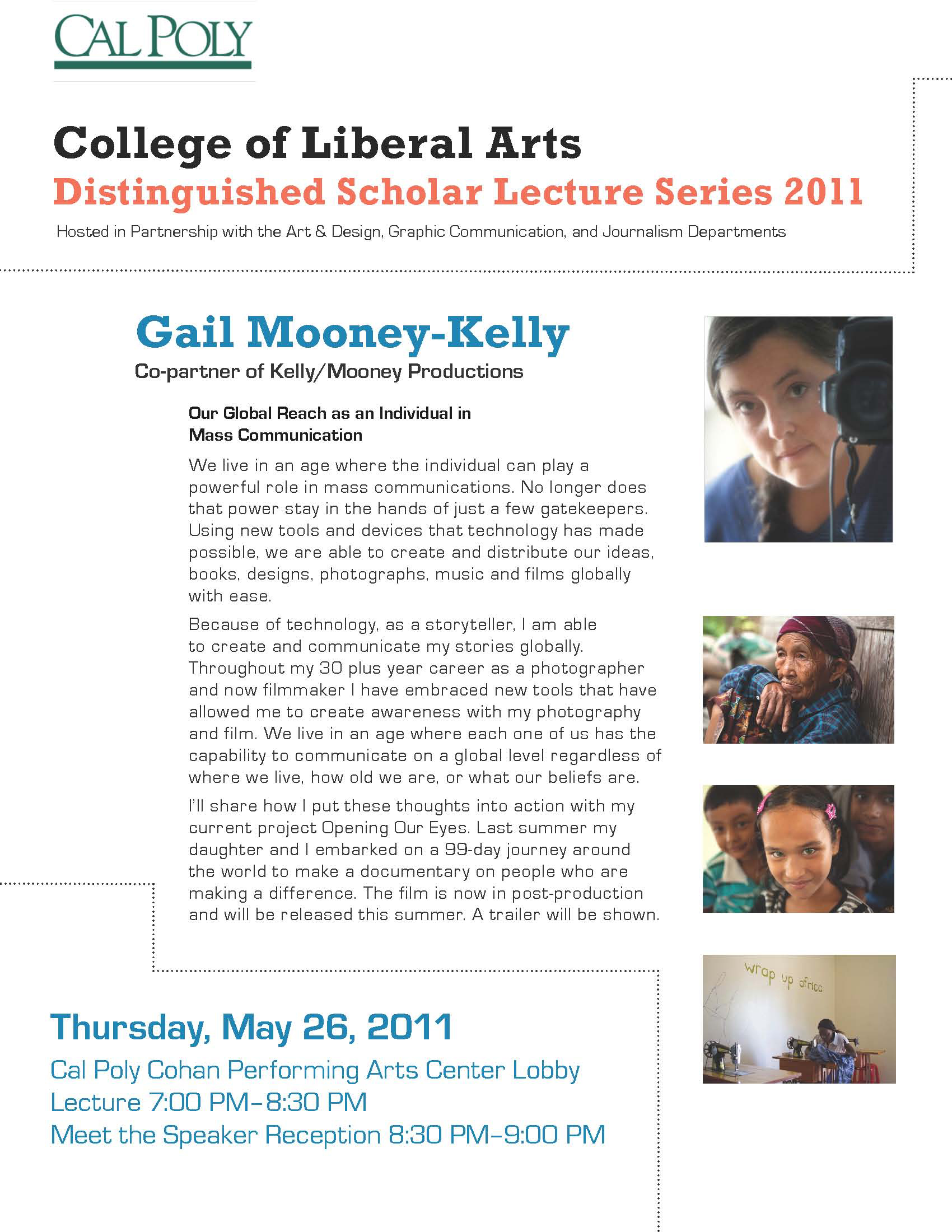 Specifically, they wanted me to talk about how I was using technology to communicate in a global market. I started thinking about how this past year I had vigorously embraced new tools and a new business model, integrated with the Internet and social media to create a mixed media project that will ultimately result in a feature film, a book, an e-book and maybe even an exhibition. I didn’t have a big team behind me, nor did I have a lot of money. We had a two-person crew- myself and my daughter, an editor and my husband working the PR, the social media and the back support. We raised some money on Kickstarter with the help of our backers and we’ve had musicians offer us their music and talents to our film. We are extremely grateful for all of the support worldwide and it could never have happened without advances in technology.
The fact is that we live in such an amazing time where something like this is even possible. It is a time of empowerment for the individual. Technology is democratizing and is leveling the playing field especially in terms of distribution. The locks are gone and the gates to distribution are open and affordable. Within a month of uploading the trailer to my film on Vimeo, it has been played in 95 countries – that’s almost ½ the countries in the world. What a staggering thought in terms of mass communication!
Going forward my ultimate plan at this point in time is to distribute the film through iTunes or Netflix and DVD’s through Amazon. More importantly, I would like to set up 100’s of screenings in communities all over America – maybe even all over the world – and use the film to move people to action. Kind of like a grass roots effort to motivate people to make a difference in their communities. Imagine what kind of an effect that would have if it spread virally through the world. Just Imagine.
Monday Morning Quarterbacking
Ok, I’m just going to come right out and say it. I was one of the few people in America who did NOT watch the Super Bowl yesterday. Before you try to enlighten me as to the merits of the game and sentence me to watch NFL highlights, let me just say I don’t like football. Just never got into the touchy feeliness of the sport. And besides, I’m still chained to my editing station – finally starting to see light at the end of the tunnel.
But this morning I couldn’t escape the pundits grading and scoring the Super Bowl commercials as I clicked through the morning programs looking for the “news”. It was interesting to hear their “take” on what commercials were successful. Most of the pundits made their assessments through the eyes of their “ad men” (and women) persona, debating which commercials caught the attention of the viewers.
One “expert” frequently commented, “now this one had people telling their friends – be quiet – I want to hear the commercial. I’m not quite sure what Super Bowl party this person went to, but no doubt it was a party made up of other advertising folks. Now, I’ve had very limited experience attending Super Bowl parties, but as for the ones I have been to – nobody has ever said “be quiet – so I can hear the commercial”. With that said, as I watched many of the spots this morning via YouTube, some of the most effective commercials required no listening at all. Check out this one for Bridgestone.
I guess the creatives who made this spot go to the same kind of parties as I do – parties where people don’t ask someone to turn the volume up for the commercials. Actually, I’ve learned a lot about editing by watching TV commercials with the sound off. The “story” either becomes apparent – or not.
The New York Times did a pretty good critique of the ads this morning. But what I found most interesting was the running commentary from the “average Joes” via Twitter and Facebook. No doubt some of these advertising experts were paying as much attention to the social media chatter this morning as Mumbarak’s men were. Hands down, the Chrysler “Detroit” spot won the most hearts – mine included. It drew me in from the start and kept me the entire two minutes. Imagine that – a two minute commercial! When was the last time you saw that? A beautiful mini-film told in credible brevity. Quite frankly, to me it would have been just as effective without Eminem or any celebrity for that matter. It evoked emotion – that’s what kept me watching.
At the end of the day, the commercials that resonated most with just about everyone – pundit and laymen alike were the ones that told a simple story that rang true with the human spirit. Works every time. To tell those stories, one needs to get out of the meeting rooms and late nights at the office and spend more time living life. Otherwise, what you end up with is a bunch of people creating commercials about what they think life is like.
 Journeys of a Hybrid