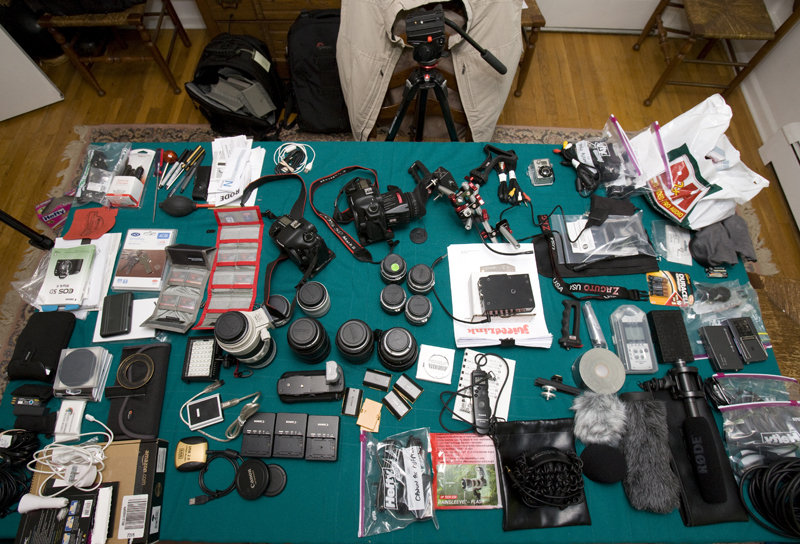
For those who have been following this blog you know that I’m getting ready to depart for a 3-month trip around the world creating a documentary with my daughter – Opening Our Eyes. Here is what I’ve managed to fit into two backpacks – it just fits. Thank goodness there’s two of us.
Please follow our journey http://www.openingoureyes.wordpress.com
I was going through some old personal photographs over the weekend. There were lots of pictures of people smiling for the camera but amongst the school portraits and posed group shots were a couple of candid snapshots that caught my eye.
Brian and Dad. Rochester, NY (early 1960's)
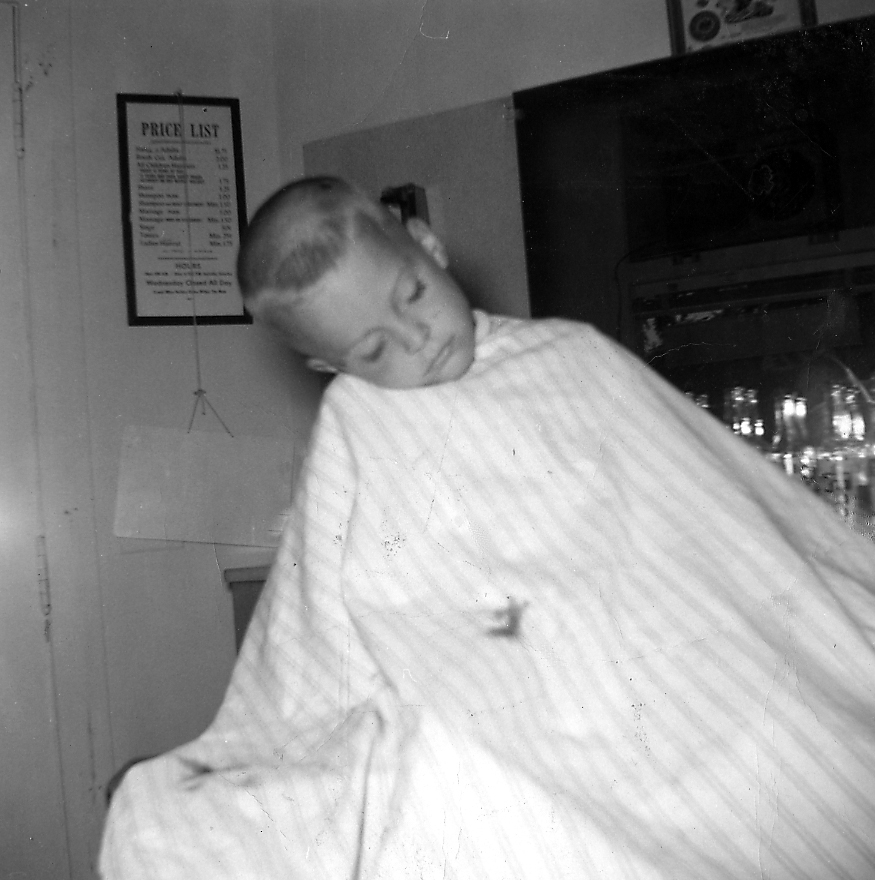
There was a photograph of my dad with my youngest brother – a candid moment, either right before or right after the “posed” moment that captured their spirits. There was a cockeyed shot of my other brother asleep in a barber chair.
Jay at the barber. Rochester, NY (early 1960's)
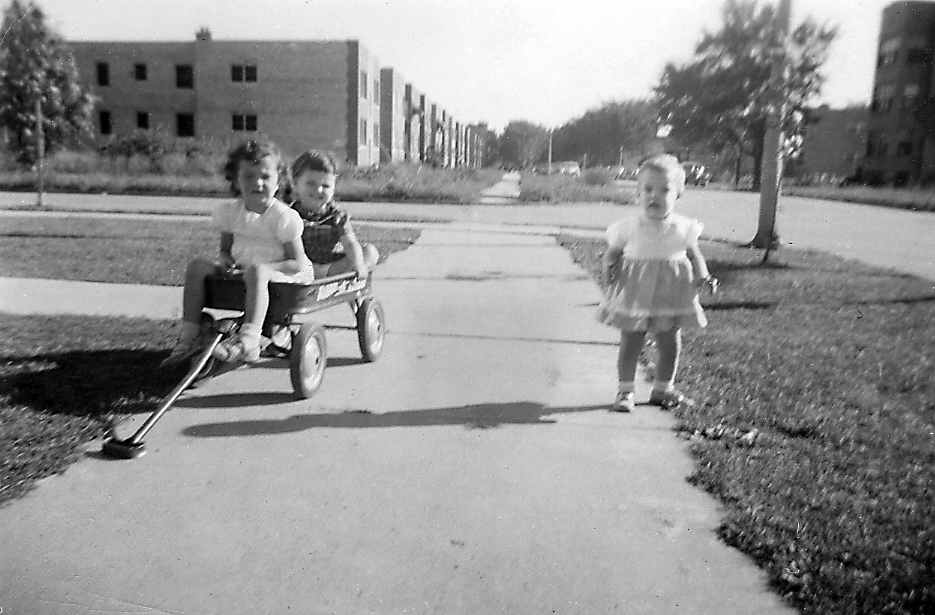
And then there was a shot of me with my sister and cousin that left you wondering. It was a picture of my sister and cousin, sitting in a wagon that had been abandoned on a sidewalk in a newly built “neighborhood”, taken in the early 1950’s. And there I was, younger and smaller than my sibling, but standing defiantly on my own, refusing to pull the wagon any further.
Janice and Jeanine in wagon. Me standing defiantly. Chicago, IL (early 1950's)
When I was growing up taking pictures wasn’t like it is these days in the digital era. The cameras then were totally manual and you were quite lucky if your pictures “came out”. You didn’t really know what your results would be until weeks, months or even years later, after you finished the roll of film that was in your camera and had dropped it off at the drug store to be sent off to Kodak to get developed. Depending on how frugal you had been with snapping pictures on that roll of film, looking through your prints after they came back from Kodak was sometimes like seeing the whole year in images with each holiday neatly documented. So with the odds against you for capturing good pictures, you tended to be very cautious and shoot only the sure-fire posed situations. Those shots were hard enough to get, let alone trying to get candid moments. One of my favorite songwriter/musicians, Jackson Browne writes about the candid moments caught in an image:
Looking through some photographs I found inside a drawer
I was taken by a photograph of you
There were one or two I know that you would have liked a little more
But they didn’t show your spirit quite as true
These days of course taking photos is almost seemless because of automatic features on digital cameras giving us instant gratification in seeing our results immediately. Everyone is taking pictures and in a much more spontaneous way – taking more chances because what’s the harm if something doesn’t come out right – you just erase it and try again. It’s quite interesting because we are all documenting our times and our culture for future generations to see beyond the smiling face.
I love to shoot the candid moments and I’ve spent a career documenting our times and our world through the lens of my camera. I’m an observer and a visual communicator but I’m also a historian, knowing that my images will be a legacy of my time in history. It’s a powerful thought to know that someday someone may look at a photograph that I shot and wonder. Or at least I hope my images will make one wonder, beyond the smile of the faces captured.
Some people would look at the life I’ve lived and say, “She never grew up”. And they would probably mean that I‘ve led my life doing the things that I’ve wanted to do, but not necessarily what I was expected to do according to our culture’s norm. They would be right in that I have pursued my passions and pretty much have done what I’ve wanted to do. Not irresponsibly or selfishly at the detriment to others but actually to the benefit of others.
For example I didn’t go straight through four years of college after graduating high school. I left after my sophomore year and took off on my travels. I eventually went back to college and graduated – when I wanted to – when I was ready to get the most out of it. And when I graduated from Brooks Institute in the mid 70’s and headed to New York to pursue a career in photojournalism at a time when the publishing business was in bad economic shape – everyone told me I was crazy. I guess I was crazy if my goal was to make a lot of money,
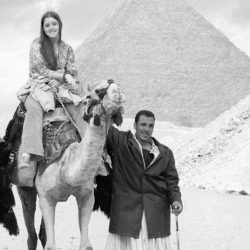
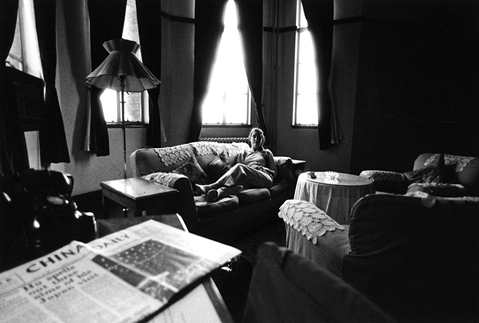
Gail-Peace Hotel, Shanghai,China - 1983
but as much as I didn’t want to be poor, my main motivation wasn’t money. I had a desire to document the world through my camera.
These days I go to parties where people my age are talking about their kids who for the most part have just graduated from college. I over hear people talking about getting their kids connected with the “right people” to get the “right jobs” and it’s perfectly understandable – everyone wants their kids to live a comfortable and fulfilling life. But sometimes those two things compete with one another.
I never really understood the concept of the “right people” or the “right jobs” – I just followed the path that I was drawn to – always have. But I’ve also been open to the possibilities in life and was naïve enough to pursue my dreams to the fullest extent. Some things have worked out – some haven’t And ironically, the projects that I’ve pursued with a passion that certainly didn’t look like moneymakers on paper, have turned out to yield the most financial rewards and recognition.
I’ve never had a real job with a boss except for the one-year I assisted a studio photographer when I first got out of school. I doubt that at my age that will ever happen, but you never know. I’m open to the possibilities of life. In fact I’m ready to take off again for a 99 day journey around the world working on a documentary – a passion project. Please follow my journey at Opening Our Eyes.
Most people have no idea of how much really goes into planning for even the simplest films. My biggest job was to come up with the right mix of gear that would enable me to shoot both still images and video in a high-end way, yet remaining to be portable and lean as far as what we would be bringing with us. That can be an overwhelming task – but the more I break it down and prepare for it with a Plan A, B and C – the more confident and relaxed I feel as our departure date nears.
Please watch the video that I created (nothing fancy) showing the gear that I’ll be bringing around the world on a 99 day shoot for my passion project Opening Our Eyes.
I’m embracing the HDSLR system since I want to shoot both stills and video but by no means is it streamlining my equipment needs. Quite the contrary, I’m bringing an assortment of lenses that I wouldn’t be taking if I were shooting with a traditional camera, as well as a lot of third party gear to augment audio capture and rigging for stabilization. What you don’t see in the video are the two (redundant) MacBooks that are essential when shooting any tapeless workflow.
Of course there are a million other details to cover for a 3 month trip around the world.
I’m still trying to determine my mobile phone and service needs. I’ve set up Skype on both laptops – yes 2 laptops because when you’re shooting tape less you are totally dependent on a computer and a back up if one fails. I’ll most likely upgrade my Blackberry because it’s been two years and that’s light-years in the tech world of communications. And I need to activate travel/medical emergency insurance as well as register my equipment with US Customs and add new gear to my business insurance policy.
There are also accommodations for 99 nights and a slew of internal airline tickets that needed to be taken care of. Read about it more at: Opening Our Eyes
Ethan G. Salwen posed the question on his After Capture blog “Where do you see the photography industry going in the next 5 years?” He asked that the answer be stated in 50 words or less. I’ll give it a try – and this paragraph doesn’t count.
Still photography will be delivered via electronic platforms – the web and mobile devices. Print magazines will still exist but only in genres that don’t deal with timely subject matter. Still cameras will continue to morph as hybrids capable of shooting video and sent wirelessly to the Internet.
That was 48 words but maybe just enough. Who really knows what the industry will look like but I do know it will continue to change with the exponential growth of information technology. And along with the technological changes will come new business models. That part is predictable.
Two years ago I attended the Photo Plus Expo in New York City. I saw a talk listed in the schedule called “The Future of Photography” so I headed to the theater to listen. When I got there a sign was in the doorway and it read “The Future of Photography – Canceled”. I hoped that wasn’t an omen and then I thought “I’m glad I learned video”.
As still photographers move and expand into video because of the convergence of their tools, they often ask me about copyright, licensing and usage and how to apply that to video. Essentially they are trying to apply a licensing business model from their still photography and sometimes that doesn’t work in video production.
The biggest distinction between shooting video and shooting still images is that for the most part a video camera operator is just one of the many creative people involved in a video production. So unless the camera operator is also the producer and in charge of the entire production, including the hiring of the crew, they will be working in a “work for hire” situation. One video project can’t have every collaborator on a project maintaining ownership of their part of the whole.
Depending on the job and the market you work in will ultimately determine who will maintain ownership, copyright and control. Generally speaking the end client or video production company holds the copyright to the finished production. This is why I made a conscious decision when I got into video many years ago, to position myself as a producer and not “just” a content provider. I wanted to maintain creative control and ownership of my projects.
But even in still photography these days, I see more and more “work for hire” contracts, and in market sectors like editorial where that wasn’t the case just five years ago. Sometimes I feel that in our efforts to protect copyright laws, we end up fighting for that right for big corporate entities that in turn grab those rights from the creators through lopsided contracts.
Something to think about – maybe with new eyes. Perhaps we need to start thinking of ourselves as “publishers” rather than just content providers. It’s never been more possible to be a publisher, because distribution has been democratized by the web, giving all of us a pipeline to a global audience.
It’s time to look at our creative businesses with new eyes and not just on the creative part of the process – but the business part as well. I’d love to hear others’ thoughts and ideas on this topic.
A week or so ago, I overlooked a minor milestone. One year ago, I started Journeys of a Hybrid. I have written 131 one posts to date. That’s almost 3 a week. I told myself when I started this blog that I would embrace the idea of writing and sharing and would make it a regular habit.
Quite honestly it’s been very therapeutic for me – a way of organizing my thoughts if you will. While I’m also surprised as to which posts are widely received and which seem to barely get noticed, I’ve always written about what happens to be on my mind, rather than second guessing what I think people want to read.
I thought today – I would list my particular favorites:
Video is the hot topic these days. You’d think it was a new thing. But there’s nothing new about video – it’s been around almost as long as TV. What is new is that broadband has made online video viewing integral to the Internet experience.
In the last year alone we’ve seen an explosion of video viewing and sharing on social networking sites. Advertisers are shifting their marketing dollars to the Web and online ads are booming. Why? Because marketers know that the consumer is going online to see and hear more about the products they are thinking of buying. It’s one thing for a potential customer to see a static image accompanied by text and quite another to see a product in use and demonstrated, or to hear the story behind a company. Online Web videos can be linked and shared and are searchable, providing more possibilities for potential customers or clients to find you and what your company offers.
Using Video to Promote Photography
If you run a video production company, it’s a no-brainer that you’ll want to use video samples to promote your business. But video is also effective for promoting all types of businesses, including still photography.
You can import your still images into some type of non-linear editing system like Final Cut Pro, add a narrative track and/or music and create a video promo of your work for online viewing. This promo can also be uploaded to a mobile device giving you the ability to show your work to potential clients in a quick and interesting fashion, anywhere, anytime. Better than your typical “elevator speech” when someone asks “What do you do?”
Another very effective way to market and promote your photography business is to create a behind-the-scenes video. Everyone loves a story and this is a great way to tell people about your company as well as provide more information about yourself and how you work.
I’m headed into New York City today to speak to college students who are studying photography. A friend of mine who is an educator and also a photographer himself asked me to talk to his students. My first thought was to talk to them about video, because that is what I have been doing lately – speaking to groups of photographers about video. But then I thought about it more and thought it would be unfair to show a power point presentation about another skill set. More importantly, I thought it would be another talk about another tool.
So this morning I switched gears and I started writing down some thoughts that I feel have helped me survive the life that I have carved out as a visual communicator. I remind myself of these ideas whenever I have drifted from my life’s purpose and it gets me back on track.
Seek opportunities – or better yet take notice of them when they come along – they are everywhere if you open your mind to them. I have found that some of the jobs that I almost turned down because I thought that it wasn’t for me have been the most rewarding jobs I’ve ever worked on. Here’s a blog that I wrote about one of these opportunities that I almost didn’t embrace. “Breaking the Spirit”
Find your passion – don’t define yourself by your tool – whether it’s a still camera or a video camera or something that hasn’t been invented yet. Stay true to who you are and how you “see” the world. I need to be reminded of that every once in a while. Recently, a friend of mine got me thinking about whom I am, and I realized that I’m really that same 19-year-old girl who took off around the world with an insatiable curiosity for people and cultures. I became a photographer because I wanted to share this passion with others and I use my camera as a tool toward that end.
Don’t just “be” a photographer – By that I don’t mean that you should also shoot video – although it wouldn’t be a bad idea. What I really mean is that in order to be a visual communicator, you need to have something to say. When I attended Brooks Institute many, many years ago, the constant tech talk used to bore me to tears. I had just come back from hitchhiking around the world and I knew there were more interesting topics to talk about than f/stops and shutter speeds. The funny thing is I don’t remember the technically perfect photos that were critiqued in class if they didn’t have something else going for them – something that evoked a feeling. It’s kind of like an actor who studies acting technique but doesn’t understand or portray the character they are playing.
Keep learning and growing – I’ve never stopped learning. My college days and days at Brooks Institute are long over, but I’m constantly learning and trying new things. I’m an explorer by heart and there will always be something out there to discover.
Take risks – The most important things that have ever happened to me have been also been the things that scared me the most. Nine out of ten times things didn’t work out as planned or what I had hoped for. But it’s that one time when things did work out that brought great value and rewards to my life. So when I try to talk myself out of doing something, based on my fears, I think about the times when the risk did pay off. If I don’t take the chance – I know I won’t have a hope for anything happening at all.
Don’t listen to the naysayers – I try not to let others talk me out of my dreams. I dodge the roadblocks that people try to put in my way. Surround yourself with other dreamers – not the half empty crowd.
Be a publisher – Don’t wait for someone else to validate who you are by assigning you a job and handing you a lopsided contract that is not in your best interest. Distribution is king in regards to content and it’s never been easier in these days of the internet and social media.
Lastly be true to yourself and love life – all facets of life, the bitter and the sweet. We are all just tiny blips on the timeline of life – make the most out of it in your own way.
Today is the final day of NAB and as usual my head is exploding with ideas and information. But before everything totally leaves my head – I’ll share some cool things with everyone.
I come to NAB to learn, however this year I also needed to research and buy some things for my upcoming project Opening Our Eyes. In particular I was looking for a stabilization rig for my Canon 5D and 7D. My timing was perfect because at this year’s show just about every booth had gear for the DSLR cameras – the show was all about either the HDSLR or 3D. I settled on the Zacuto Striker because I wanted something lightweight and quick to put on a tripod. Zacuto had redesigned the plate making the weight distribution better and it felt just right for me. And that’s important – get the right rig for you – if at all possible visit a vendor where you can try these stabilization rigs out so that you buy the one that literally “fits” you and your needs.
One of the biggest buzz items was the HD Hero, a tiny wearable video camera for sports, made by GoPro and at the $200 show special – they sold out the first day. But check them out – even at the retail price of $300, they are amazing little cameras that can be used in all types of situations where you need something small.
RedRock Micro debuted their new HDSLR remote which uses sonar for auto follow focus. The booth was mobbed with attendees dying to get their hands on this accessory that is priced around $1000. Check out the review from the show floor at PhotoCineNews.
Canon unveiled their latest tapeless camera the XF305 that will give the Sony EX-3 a run for their money. Even as stunning as this camera is, Canon didn’t integrate that nice big chip/sensor that we see in their hybrid HDSLRs. But Panasonic did and they had their new prototype camera in a plexiglass box perched on a museum type pedestal. The Panasonic AG-AF100, is the first professional micro 4/3-inch video camcorder optimized for high-def recording. that did make use of that large sensor that everyone seems to be waiting for – stay tuned. Canon-are you watching and listening?
I’m maxed out right now with technology and information yet inspired and energized at the same time by the notion of possibilities. If you’re a still photographer singing the blues because of the lousy economy and the changing paradigm of print giving way to electronic delivery – I can only say one thing – convergence. Embrace that notion, get energized by the idea and open your mind to the possibilities and opportunities that are exploding in this new world of information technology.







 Journeys of a Hybrid