Should I Be Thinking of Video – Or Not?

I give a seminar to still photographers for ASMP entitled “Should I Be Thinking of Video?” It’s a broad overview of the different facets of video production along with how I have positioned myself in this medium and where I think some of the opportunities are. I’m quick to point out what it’s not – it’s not going to tell you everything you need to know to make video part of your business and it’s not about how to use your DSLR. And if anyone promises that they can teach you that in two hours – they’re lying. But most importantly, I can’t possibly answer the question “should I be shooting video” for each individual in the room. And that’s because there is no ONE answer to that question – that’s up to the individuals to decide for themselves.

I think perhaps I should point out some reasons why one shouldn’t be thinking of video:

Fear – Because you are consumed with fear of your future. It’s understandable to be afraid when the world as you know it,  is changing. But if you are so focused on the thought that you have to do something because technology has changed your business to the extent that it just isn’t there anymore, instead of focusing on how you can use technology to grow your business – then you’ll paralyze your mind to new possibilities.
The Camera – If you are getting into video because your still camera is capable of shooting video and you’re not concentrating on thinking and seeing in motion, then you’ll end up with isolated video clips that have no relation to one another and you’ll have a rude awakening in the editing room when you realize you have no clue on how you’re going to put together a cohesive story.
Because everyone else is – With all this talk of video of late, everyone feels they need to jump on board. The truth is video may not be the answer for some photographers. And it may not be the best medium for the markets you work in.

You should be thinking of video if:
• You think that motion and sound is the best way to visually communicate your clients’ story or message.
• You recognize the power of collaboration in this medium
• You understand that there’s a learning curve and there’s no magic bullet.

I cannot tell you if video is the answer for you – that’s up to you to make that decision for yourself. I can only tell you what’s involved and guide you through the process.

When my daughter was growing up, I was always careful not to make all her decisions for her. It was a hard thing to do because many times she wanted me to and I wanted to but I didn’t. I knew if I made all her decisions for her that I wouldn’t be doing her any favors in the long run – because sooner or later she’d be out on her own without me there telling her what she should or shouldn’t do. I think it was one of the hardest things I had to do as a parent.

It’s been challenge this year scheduling time for my production business, along with traveling around giving these seminars. As much as I enjoy sharing information with others through these seminars, I know that I need to be doing what I love most and that is being a visual communicator. So, I’m taking to the road on May 25th – around the world actually, working on a personal project Opening Our Eyes. I need to get back to some real quality time of creating. And the best part – my daughter decided that she wants to join me and be part of this – and she made this decision all on her own.

Add to FacebookAdd to DiggAdd to Del.icio.usAdd to StumbleuponAdd to RedditAdd to BlinklistAdd to TwitterAdd to TechnoratiAdd to Yahoo BuzzAdd to Newsvine

The Race To The Bottom and/or Video

I’m waking up to a beautiful day in San Diego and thinking about my old California days when I lived in Santa Barbara and attended Brooks Institute.  That was a long time ago but whenever I’m in southern California, my head goes back to my beginnings – my beginnings with my husband and partner and my beginnings of my career as a photographer.

Sounds funny now when I mention career and photographer in the same sentence.  But that’s the way it was back then (mid ‘70’s) when you had to be technically savvy to make a good photograph – a technically good photograph that is.  These days just about anybody can create a technically good photograph because of how technology has changed the tools of our trade.  And that’s why it’s gotten harder and harder to make a career out of photography.

It seems like there’s a race to the bottom in photography these days. By that I mean that a lot of photographers will do just about anything to get the job – from giving away rights to almost doing the job for nothing.  I almost can’t blame them when they are facing mounting bills and the phone rings less and less and they consistently get undercut by their peers.  On the other hand I have to wonder, is technology totally to blame for the race to the bottom or did we do it to ourselves?

I talk to lots of photographers these days because I give short seminars about video. A lot of photographers have clients who are asking for video and they want to respond to that.  A lot of photographers see their business dwindling as print needs dry up and as we move to electronic publishing. With that of course comes even more of a demand for video content. And a lot of photographers are there because still cameras are now capable of shooting video.

I cringe when I hear that someone’s motivation for getting into video is because of a tool.  I cringe because I know that it’s not about the tool and that one should really focus on what makes them unique – and how they “see” things.  Right now, you have to still be technically savvy to be able to produce decent videos – with good sound and edited well. Is it only a matter of time before technology makes these tools so good that just about anybody can shoot good video? Perhaps.

I strongly suggest that photographers get out of their solo independent ways of thinking and embrace collaboration when they move into video.  Get away from the tool centric way of thinking.  Surround yourself with people who you can work with – sound people, editors, and musicians.  Place more importance on thinking in motion and storytelling in motion.  And most importantly, produce your own videos, even if that means taking a chance.  Work directly with clients instead of being just one rung on the ladder.  Otherwise you’ll be on the content rung, which is way down at the bottom of ladders these days.

So, while I’m sitting here on a beautiful morning in San Diego and California dreaming – I’m remembering a lot of my peers from my old Brooks Institute days.  I think about what they are doing now – are they still working in photography?  I think the ones who are the ones who shot images that had some soul and went way beyond being technically perfect.

Add to FacebookAdd to DiggAdd to Del.icio.usAdd to StumbleuponAdd to RedditAdd to BlinklistAdd to TwitterAdd to TechnoratiAdd to Yahoo BuzzAdd to Newsvine

Serendipity

I have been completely buried with details, the last few weeks – everything from applying for visas, to booking flights within particular destinations to securing lodging for 98 nights – and doing it all on a shoestring budget. It’s been challenging, frustrating and necessary in order to get Opening Our Eyes off the ground.

I recently stumbled upon some interesting connections and communities while doing research for our travel needs. My daughter Erin had sent me a couple of links to insightful articles on Matador Network. I started exploring this network and website and was really impressed not only with the information that I found here but also by the “community” that had been built. Yesterday I had a great phone conversation with Matador’s CEO, Ross Borden and we discussed some very interesting ideas about how we could collaborate and share – so stay tuned and if you love travel and life – become a member of the Matador Network.

When I started my backpacking adventures over 35 years ago, I didn’t have an online community like the Matador Network – didn’t even have the Internet as we know it, or cell phones, Fedex or any other quick way to facilitate communication – I was pretty much cut off and out there – alone. Yet, I did have a “community” – meeting and talking with other travelers along the way – sharing tips and info, along with cautionary advice. There was definitely a community and it was in real time, face to face but unpredictable.

I started thinking about then and now when it comes to traveling and there is one thing that resonates with me as much today as it did then and that is making sure that I allow serendipity to happen when I travel. Serendipity – the things that happen that aren’t planned – the things that can only happen when you open yourself up to the unknown – when you are willing to take a chance – see what’s out there – follow your instincts and see where they take you.

So my daughter and I have built in “time” for our trip – time to linger and really absorb where we are – to get outside of ourselves and our own little “unit” and become part of where we are. My experience and wisdom from traveling all these years have taught me to plan ahead – but my instincts tell me to leave a little up to chance – and more importantly to be open to possibilities and opportunities. It’s the things that you never would have thought to plan – that are sometimes the most rewarding of all. But you have to open your eyes, take notice and cross into the unknown. That’s hard to do when you are traveling with other people because it’s easy to stay within the comfort of your own “tribe”. That’s one reason why I’ve traveled solo most of my life. But this time around my daughter and I will venture into the unknown, with a lot of trust, gut instincts, thrills and trepidations and see where it takes us – but also knowing that we have each other’s back. And that’s the best of both worlds.

Add to FacebookAdd to DiggAdd to Del.icio.usAdd to StumbleuponAdd to RedditAdd to BlinklistAdd to TwitterAdd to TechnoratiAdd to Yahoo BuzzAdd to Newsvine

What Video Storytelling is Not

It was bound to happen – still photographers shooting video like still images – as DSLR’s became hybrids, capable of shooting both stills and video.  I’m starting to see video clips strung together in a timeline – like a pagination of images in a magazine – but without a cohesive storyline told through edited sequences or an audio/narrative track telling the story.   It’s neither here nor there – not achieving the lingering power of a still photograph, nor utilizing the power of motion and sound to give a story more dimension.
The problem as I see it when I come across these “samples” is that these still photographers are not thinking in motion.

I think totally differently when I shoot video than when I shoot stills.  Stills are moments in time – video is time in motion.  That means that when I shoot video I’m always thinking about the big picture – how will I get into and out of a shot.  What is coming before this shot and what is coming after?  I know to think this way because I’ve edited my own material.  Editing video is a great way to learn how to be a better shooter.  It becomes very clear in the editing room – what you should have shot to be able to cut together a cohesive story.

I learned video storytelling at one of the Platypus Workshops from Dirck Halstead and PF Bentley.  PF continues to inspire me with his storytelling skills in the video medium as he explores shooting with an HD-DSLR.  Check out a couple of his videos – beautiful storytelling and creatively executed.

So once again – it’s not about the tool – the camera.  Don’t think that because you buy a DSLR capable of shooting video that’s all there is to it.  If you really want to use the power of these new cameras – it starts with your vision and how to relay that in motion.

Add to FacebookAdd to DiggAdd to Del.icio.usAdd to StumbleuponAdd to RedditAdd to BlinklistAdd to TwitterAdd to TechnoratiAdd to Yahoo BuzzAdd to Newsvine

Sustaining the Human Spirit

It’s been a tough year for a lot of people. It hasn’t been all that great for me but I’m thankful that I’m still able to make a living doing what I love – telling stories through still imagery and video. But it hasn’t been easy and this month in particular has truly taxed my spirit.

So how does one keep going when faced with the frustration of not getting “the job” and all the rest of the feelings that come with that – feelings of insecurity or hopelessness or worse? What does one do to rise above the negative feelings that will only lead to more negativity, anger and despair?

Yesterday was one of those days for me. Got a couple of emails that didn’t destroy me but left me pretty well bruised. For me many times my hurt manifests itself as anger – at least at first – which only makes things worse. So I try to put things in perspective and also try to understand. I try to understand why I didn’t get “the job” and use this knowledge to raise my own bar, so the next time I will land the job.
And if I’m feeling rejected on a personal level – I try to get outside myself and understand how my actions or words have affected someone else.

Sounds easy – but it’s easier said than done. Sometimes I don’t want to “understand” but rather I want to be understood. And when that doesn’t happen, I put up walls – barriers meant to protect me from being hurt again. That ends up doing more harm than good because it also prevents any positive things from entering my life. And many times those barriers that I erect give me a temporary safe haven – but end up being an empty place to be.

I am a passionate person and many times people are drawn to me because of that. I open myself up to people giving too much – too soon. People are drawn to my spirit and my strength and my ability to face my fears. They also know I’m the type of person who is there for them – they just know. A friend recently told me that during a difficult time – he knew I was there. Even though there was nothing I could do to make things right – he knew I was there and that was a comfort.

I think that pretty much sums up a basic need in all of us – to have someone we know who is there for us during the rough patches of life. I think we all need that and we all need a little understanding. If we know that or even sense that – we can get through difficult times.

Photographers are more vulnerable to bad times than most I think, because they are such independent creatures. They are usually out there doing a solo act. If they don’t have a support system in place with friends and family – they generally have a real hard time dealing with slumps.

One thing I love about working in video production is that it is a collaborative effort. You work with others and draw from their strengths. When working with the “right” group of people – it’s a wonderful thing. Even if you’re in charge and the buck stops with you – you know you have people who you can count on. That’s so important and basic to human happiness.

So when I have a bad day and I feel like my support system is non-existent – what do I do? I try to dig deep and find that inner strength in myself that others seem to find appealing and even take comfort in. And I hope I find it.

Add to FacebookAdd to DiggAdd to Del.icio.usAdd to StumbleuponAdd to RedditAdd to BlinklistAdd to TwitterAdd to TechnoratiAdd to Yahoo BuzzAdd to Newsvine

Driveby Culture

Seth Godin’s blog post today “Driveby culture and the endless search for wow” really hit home with me. Godin writes:

“Should I write blog posts that increase my traffic or that help change the way (a few) people think?”

I think about this a lot – should I write about something that I know will get a lot of eyeballs or should I write about something that I’ve been thinking about that may make others think? Ironically, when I don’t think about what will attract an audience and just write from an open and honest point of view – I end up with a lot of eyeballs. And those are the eyeballs that I want to attract – the ones who I click with.

Godin goes on to say:

“More and more often, we’re seeing products and services coming to market designed to appeal to the momentary attention of the clickers.”

“Mass marketing used to be able to have it both ways. Money bought you audience. Now, all that buys you a mass market is wow and speed. Wow keeps getting harder and dives for the lowest common denominator at the same time.”

We live in a culture of “shock and awe” and sound bites. We don’t read anything lengthy – we want bullet points. Magazines don’t run stories anymore – they do survey pieces – the ten best………….. We want packaging and fizz – wowy zowy. We want exotic imagery and special effects. If it doesn’t grab our attention – we’re bored and off to the next thing. We’ve become so busy clicking around and multi-tasking we hardly take notice that we’re not getting satisfied. We’re left kind of empty feeling even though we’ve just been to a smorgasbord.

Every once in a while something comes along – a simple movie with a powerful message – an image that lingers in our minds – a story that took us to another place. Timeless thoughts, ideas and imagery that continue to resonate with the human spirit and every now and then we take pause and notice. Something makes us all stop and think – beyond the glitter, the eye-candy and the headlines.

Godin questions:

“What works to change mindsets, to spread important ideas and to create an audience for work that matters? What’s worth your effort and investment as a marketer or creator?”

For me the answer is just being myself – open and honest. There’s only one Gail Mooney and that’s what I have to share.

Add to FacebookAdd to DiggAdd to Del.icio.usAdd to StumbleuponAdd to RedditAdd to BlinklistAdd to TwitterAdd to TechnoratiAdd to Yahoo BuzzAdd to Newsvine

Tips for Getting Good Video Interviews

More and more still photographers are getting into video because of the appeal of the hybrid still cameras that also shoot video. Photographers love the visual coming out of these big chip cameras – what’s not to love? But they quickly find out that if they aren’t just going to be laying visuals down to a music track, they will need to start thinking about their audio – specifically a narrative track or one driven by sound bites from interviews. I work in the corporate sector, as well as create documentaries, so I do a lot of interviews. The interviews, along with a scripted voiceover comprise my audio track and drive the story.

I love doing interviews. That’s because I’ve always been a curious person and like to ask questions. I enjoy the “conversation”. I don’t want to become part of the video, even though I am usually the one asking the subject questions. My voice and my questions will not be heard in the final video, so I need to coach my subjects to paraphrase the question when they relay their answers. But before I get to the interview, I research my subject and come up with a good solid list of questions to ask in advance.

Here are some tips for getting good interviews:
1. Ask leading questions – not yes or no questions. Example: Instead of asking where do you work? Ask: Tell me about where you work.
2. Ask subject to paraphrase the question if you don’t want the interviewer to be part of the video.
3. Don’t step on your subject’s lines. Instruct your subject to pause before answering the question. In addition, make sure that you pause after your subject answers the question. Many times someone will add more insightful information to fill in that pause.
4. Ask the question more than once.
5. If your subject rambles – ask them to summarize their thoughts.
6. Use gestures to encourage and guide subjects – remember you don’t want to hear your comments.
7. Be a good listener – many times my best questions are follow up questions to something that the interviewee just said.
8. Pay attention to your subject’s answers because you’ll need to illustrate what the subject is talking about with B-roll.
9. Pick a suitable location for sound. Find a quiet environment and turn off all fans, motors, radios etc.
10. Record room tone – you’ll need it when you edit the sound bites

Add to FacebookAdd to DiggAdd to Del.icio.usAdd to StumbleuponAdd to RedditAdd to BlinklistAdd to TwitterAdd to TechnoratiAdd to Yahoo BuzzAdd to Newsvine

Frozen Waves and Instincts

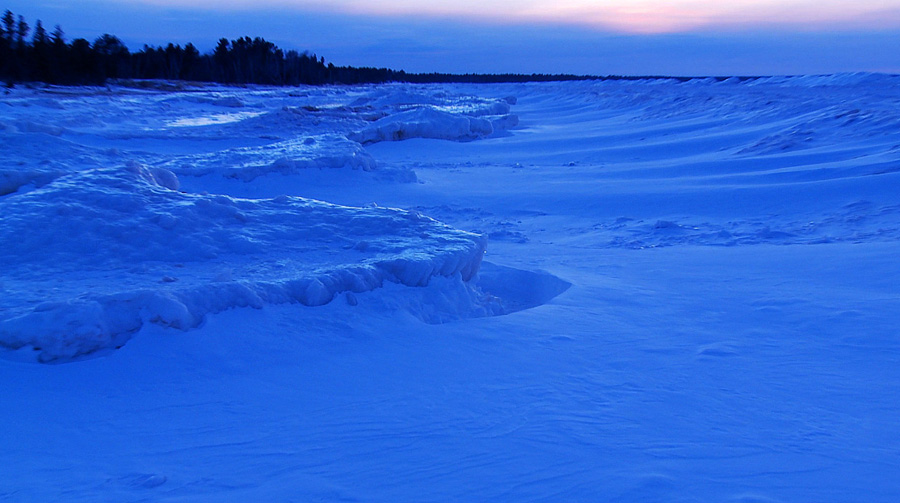
A couple of weeks ago I stood on top of a 10 foot frozen wave on Lake Superior. I was in an amazing place, both physically and spiritually.  The next day, we had an 8-hour drive from the Upper Peninsula to Detroit.  I pulled out my computer and I wrote a blog about my experience on the ice, the day before.  I really didn’t think much of it at the time – I just jotted down my thoughts.

When I got to Detroit, I uploaded the blog to my wordpress site and didn’t check my email or look at any social media sites until very late the next evening.  When I did, I saw that the hits on my blog had gone through the roof – over 2000!  When I checked my email, I noticed there was one from a wordpress editor telling me that my blog had landed on their home page.  No wonder.  Judging by the dozens of comments people had written – I realized the blog has resonated with people.  Not just the icy image, but my thoughts and feelings that I had shared.  I had written from my instincts.

I’ve lived my life taking chances and trusting my instincts.  You kind of have to trust your instincts when you take chances – that comes with the territory.  If you don’t – most likely you won’t be putting yourself out there.  I honed my instincts in my early years, when I was a 19 year old woman hitchhiking around the world.  I had to make snap judgments about people when they pulled over and offered me a ride.  Should I or shouldn’t I get in that car?  I developed a sixth sense if you will – and to this day I go where my gut is telling me to go.

The funny thing is my instincts aren’t always right – not 100% anyway.  Maybe only 70% or 80% of the time.  So that means that 20-30% of the time – my instincts are wrong.  When that happens – I fail.  And when I fail – it’s really hard to trust my instincts again.  But if I question myself (and I do) and I talk myself out of doing something – I know – I’ve guaranteed – that “something” has absolutely no chance of happening.

Sooner or later, I usually get another idea to pursue or an opportunity presents itself and I have to make a decision on which path to follow.  And once again I need to trust my instincts.  It’s scary – it’s always been scary.  That’s why it’s called risk.

I’m pushing myself in a lot of new directions at this point in my life.  I’m not going to pretend that I don’t get afraid – because I do.  So I need to dig down deep inside myself and trust my most basic instincts and hope they serve me right.

Add to FacebookAdd to DiggAdd to Del.icio.usAdd to StumbleuponAdd to RedditAdd to BlinklistAdd to TwitterAdd to TechnoratiAdd to Yahoo BuzzAdd to Newsvine

Funding A Personal Project

I have learned from past experience with other personal projects that getting funding for an idea is no easy task.  But I have also found that with a lot of careful planning, saving and budgeting I have been able to self fund my projects and have been compensated on many levels later on – after the projects are underway or near completion. As I continue to blog and to talk to people about Opening Our Eyes, the documentary my daughter and I are creating which involves us traveling around the world, I get asked a lot of questions.  One question that is asked quite frequently is “who is funding your project?”  The short answer is – we are self-funding our trip and our documentary.

I had managed to save up about 330,000 miles with Continental Airlines and another 329,000 points with American Express over the years.  I was saving them for something, just didn’t know what until a few months ago when I decided to cash all my points and miles in to subsidize our journey around the world.

So far, I have exhausted all but 4,000 Continental miles in ticketing my Round The World plane ticket as well as getting my daughter and I to, from and around South America.  My husband Tom donated his Continental miles to my daughter Erin for her Round The World fare.  I will still need to pay for airplane tickets to Iquitos, Peru from Lima as well as for flights to Nepal from Delhi, India. That still leaves picking up the costs of air or train tickets from Istanbul to Warsaw and Moscow. I will use about a third of my Amex points to pay for the flights from Lima to Iquitos, Peru because those tickets are costly.

I’ll use the rest of my American Express points to fund some of our accommodations, along with any hotel points that I have.  We’ll be staying at guesthouses, people’s homes and budget hotels whenever possible.  We’ll use public transportation for getting us around once we get to our destinations because renting a car isn’t in our budget.

Of course there’s food and miscellaneous expenses on the road like Internet and admission fees.  The vaccinations for the two of us have cost more than $1500 and the visa costs may reach $1000.  And we’ll both need backpacks and other personal needs for the trip.

My biggest expense will be for photo/video gear but that is the purpose of the trip.  I have pretty much figured out the gear that I’ll need: read my blog entry Putting Together a DSLR Video Kit.  When all is said and done, including buying an additional laptop as a backup, I’ll have spent about $12,000 on equipment needs.

So, how will I pay for it?  When my mother died about six years ago she left me a little money.  I never really wanted to spend it and was fortunate that I never had to – so I will use it for this project and this trip.  Somehow, I think she would love the idea of what her daughter and granddaughter were doing.  And if she were still here she might very well have wanted to join us.

I’ll be reaching out to Canon, Apple and others as potential sponsors.  I’m also reaching out to my friends and connections that I have made over the years for donations in kind. If you have any hotel points that you may not be using and would like to donate those points to our trip it would be greatly appreciated.  Or any other type of “in kind” donations you may provide.

Please email: gail@kellymooney.com or call 973-543-6868

Add to FacebookAdd to DiggAdd to Del.icio.usAdd to StumbleuponAdd to RedditAdd to BlinklistAdd to TwitterAdd to TechnoratiAdd to Yahoo BuzzAdd to Newsvine

Standing on a 10 Foot Frozen Wave

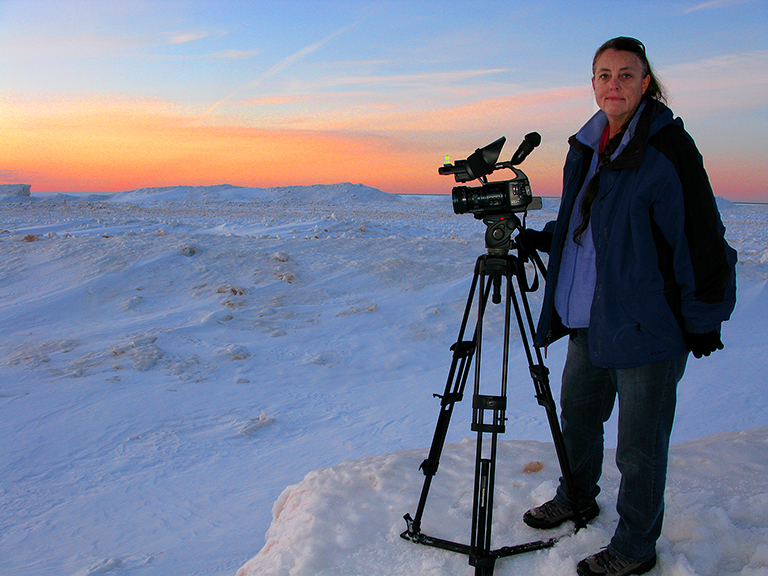
Yesterday I stood on top of a 10 foot frozen wave looking out over the vast icy seascape of Lake Superior. I was shooting footage of this endless field of frozen waves as the setting sun turned them every shade of blue, purple and orange. It was quiet – incredibly quiet – no car or airplane noise, no voices, and no sound of splashing water, not even the sound of a bird. The audiometers on my camera barely registered a blip and yet there was audio. Even dead silence has a sound.

I’ve been on the Upper Peninsula in the far northern reaches of Michigan, shooting footage for a family biography that I’m working on. I had recorded interviews with my mother’s siblings this past summer while attending a family reunion and I had been planning on returning to capture some winter footage to illustrate the stories they told during the interviews. My mother, her siblings and her parents grew up in northern Michigan during the Depression, farming, lumbering, and fishing – pretty much doing whatever they could to survive. Times were hard and living in such a remote, harsh climate didn’t make it any easier. Everyone did what he or she had to do.

While I’ve been in the UP, I’ve met a lot of people who are doing all types of things to survive during this lousy economy. Most I’ve met have several part time jobs. A couple of times I stopped to eat at a restaurant, there would be one woman tending the bar, waiting on tables and cooking the food. Because of it’s geographic location and its sparse population, the Upper Peninsula is kind of like a frontier and the people who live here, have the spirit to go with it.

As I stood on the top of this frozen wave in absolute silence I contemplated resiliency of the human spirit in the context of my own world. Certainly my business has changed – due to technology and the lousy economy. Because of technology, I am able to do more things than I could ten years ago. Because of the poor economy, I’ve had to do more things. Most other photographers I have talked to this past year have diversified their businesses – some shooting weddings, some shooting video and some working in other retail markets. I suppose we’re all just doing what we can to get through these changing times.

So I looked out over the endless view of frozen waves and into the orange glow of the setting sun. For an instant I became fearful of where I was when I looked behind me and saw a deep crevice that I could easily fall into if I lost my footing. But then I looked ahead to the orange glow on the horizon and I felt hope and with that a sense of security because I knew where I came from and I have the heart and spirit to survive.

Add to FacebookAdd to DiggAdd to Del.icio.usAdd to StumbleuponAdd to RedditAdd to BlinklistAdd to TwitterAdd to TechnoratiAdd to Yahoo BuzzAdd to Newsvine