Capturing Good Audio When Shooting With DSLR’s

I see a lot of confusion and misconceptions amongst still photographers as they embrace video using the DSLR camera. For many audio is an after thought which is a big mistake because audio is much more important than the visual. Unless you’re just laying down still images or video clips to music then you have to be able to capture good sound. Some things to consider and remember.

1. You’ll never get good sound with the camera microphone – only use the camera mic for reference audio.

2. Don’t buy a camera that won’t let you use external microphones – unless you will be capturing your audio separately and syncing it later in post.

3. If “running and gunning” – you can probably get away with using a mic mounted on the camera as long as you are close to your audio source. You can either use a mic with a mini plug and connect it to the camera OR you can run the mic via an xlr cord to a mixer like a JuicedLink or a Beachtek, which is much better, rendering a cleaner audio capture.

4. For interviews, most likely you won’t want your camera to be extremely close to your subject. So you won’t want to use a mic mounted on the camera – it’s too far away. I rig a shotgun mic on a boom stand and I also use a lav on the subject and run both into my camera if I’m using a traditional video camera or into my JuicedLink mixer if I want to capture the sound on the same card as the audio.

5. When using a DSLR camera, capturing your audio separately with a digital recorder is ideal. I use a Samson H4N Zoom that not only has a built in dual stereo mic but two XLR inputs. I run my shotgun mic and lav mic into the Zoom and then sync the sound later in post with software called Plural Eyes. Make sure you keep the audio on in the camera as well to use as a reference for syncing later on.

6. When using a device like the zoom that has a built in mic – remember that even though this is a quality mic – you MUST get the mic in close to your sound – no more than a foot away. I prefer not to use this mic but rather a shotgun because a shotgun is more focused and won’t pick up a lot of the ambient noise.

7. Use headphones. Don’t just look at your meters – wear headphones and make sure that you are getting quality sound. You could be picking up interference or static.

8. Always consider your audio even for your b-roll – you need some audio – even if you only intend it as ambient background sound.

9. I only use a wireless system when I need to. In cities like New York you can get a lot of interference on the frequencies. Always go wired if you can. And if you find yourself needing a wireless system, spend the money to get a system that has a good range.

10. Be quiet and tell your crew to be quiet as well. You never know when you’ll want to use the audio – even if you think you won’t need it.

Add to FacebookAdd to DiggAdd to Del.icio.usAdd to StumbleuponAdd to RedditAdd to BlinklistAdd to TwitterAdd to TechnoratiAdd to Yahoo BuzzAdd to Newsvine

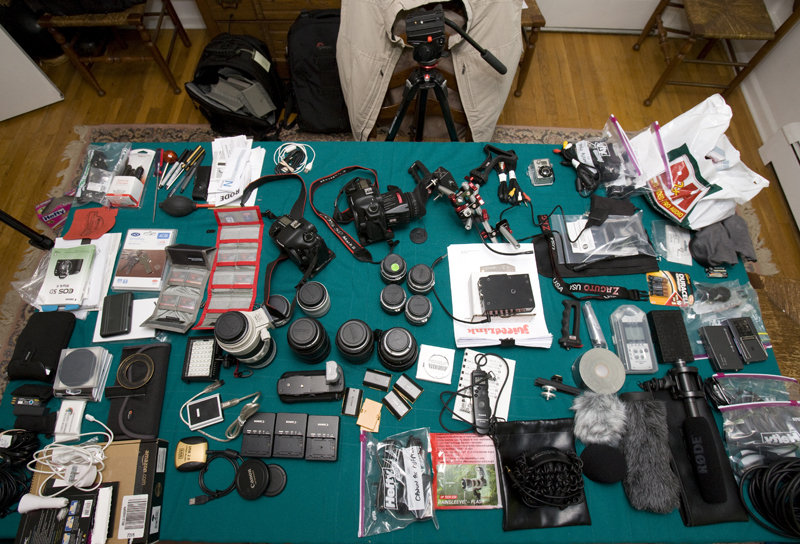
My DSLR Kit for a Three-Month Road Trip

For those who have been following this blog you know that I’m getting ready to depart for a 3-month trip around the world creating a documentary with my daughter – Opening Our Eyes.  Here is what I’ve managed to fit into two backpacks – it just fits.  Thank goodness there’s two of us.
Please follow our journey http://www.openingoureyes.wordpress.com

Canon 5D Mark II
Canon 7D
Canon 16-35mm 2.8
Canon 24-70mm 2.8
Canon 70-200mm 2.8
Canon 70-300mm 4.5
Canon 1.4X tele extender
Canon 2X tele extender
Nikon/Canon lens adaptor
Nikkor 14mm rectilinear lens f2.8
Nikkor 50mm 1.4
Nikkor 85mm f2
6 Batteries for Canon
1 Battery grip for 5D
3 Battery chargers
Remote control for Canon
AC adaptor for Canon
Rycote Hot shoe extension
4 – 16 GB flash cards – all cards – Sandisk UGMA
4 – 8 GB flash cards
2 – 8 GB SDHC cards
2  – 4 GB SDHD cards
Neutral density filter kit
Polarizer
Epson P6000 digital wallet
Zoom H4n digital audio recorder
JuicedLink DT454  audio preamp
Rode shotgun mic
Tram lav mic
Sennheiser Transmitter/Wireless kit
“Dead Cats” (windscreens)
XLR cords
Headphones
HD Hero helmet camera with attachments
Flip HD
ManfrottoTripod and fluid head
Small Matthews boom stand for mic
Reflector
Zacuto Z-Finder

Zacuto Striker Rig
Flex DSLR remote
Lacie Rugged Hard drives – 4000 GB memory!
Firewire and USB cords
3 – card readers
2 MacBookPro Laptops
1 extra laptop battery
1 extra AC adaptor for laptop
Kindle
iPod
Blackberry Tour
2 Scotte Vests – with 22 pockets in each

Add to FacebookAdd to DiggAdd to Del.icio.usAdd to StumbleuponAdd to RedditAdd to BlinklistAdd to TwitterAdd to TechnoratiAdd to Yahoo BuzzAdd to Newsvine

Being Candid

I was going through some old personal photographs over the weekend. There were lots of pictures of people smiling for the camera but amongst the school portraits and posed group shots were a couple of candid snapshots that caught my eye.

Brian and Dad. Rochester, NY (early 1960's)

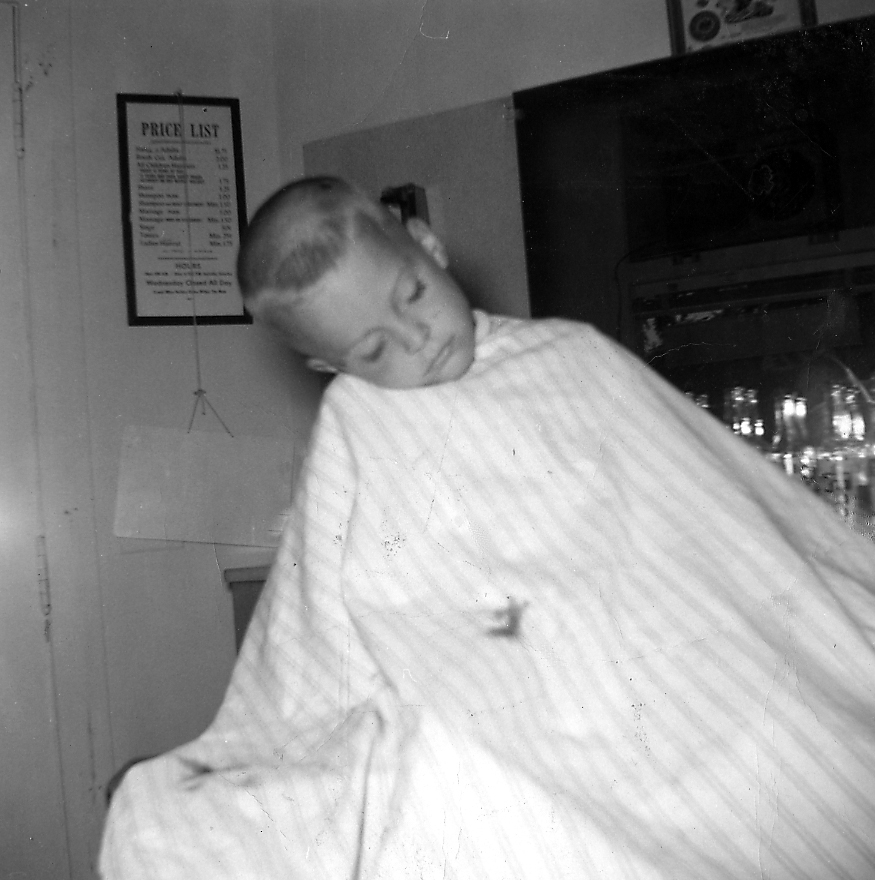
There was a photograph of my dad with my youngest brother – a candid moment, either right before or right after the “posed” moment that captured their spirits. There was a cockeyed shot of my other brother asleep in a barber chair.

Jay at the barber. Rochester, NY (early 1960's)

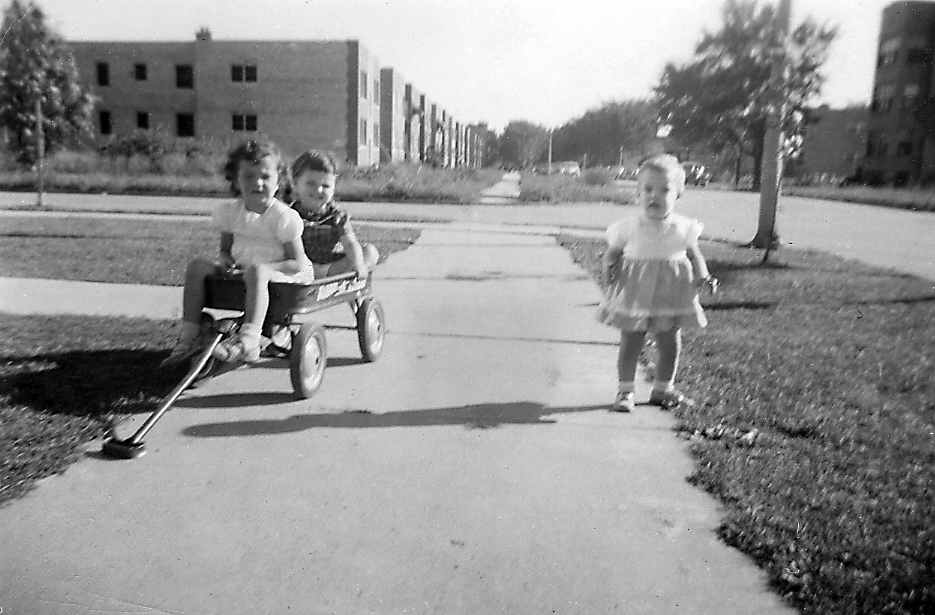
And then there was a shot of me with my sister and cousin that left you wondering. It was a picture of my sister and cousin, sitting in a wagon that had been abandoned on a sidewalk in a newly built “neighborhood”, taken in the early 1950’s. And there I was, younger and smaller than my sibling, but standing defiantly on my own, refusing to pull the wagon any further.

Janice and Jeanine in wagon. Me standing defiantly. Chicago, IL (early 1950's)

When I was growing up taking pictures wasn’t like it is these days in the digital era. The cameras then were totally manual and you were quite lucky if your pictures “came out”. You didn’t really know what your results would be until weeks, months or even years later, after you finished the roll of film that was in your camera and had dropped it off at the drug store to be sent off to Kodak to get developed. Depending on how frugal you had been with snapping pictures on that roll of film, looking through your prints after they came back from Kodak was sometimes like seeing the whole year in images with each holiday neatly documented. So with the odds against you for capturing good pictures, you tended to be very cautious and shoot only the sure-fire posed situations. Those shots were hard enough to get, let alone trying to get candid moments. One of my favorite songwriter/musicians, Jackson Browne writes about the candid moments caught in an image:

Looking through some photographs I found inside a drawer

I was taken by a photograph of you

There were one or two I know that you would have liked a little more

But they didn’t show your spirit quite as true

These days of course taking photos is almost seemless because of automatic features on digital cameras giving us instant gratification in seeing our results immediately. Everyone is taking pictures and in a much more spontaneous way – taking more chances because what’s the harm if something doesn’t come out right – you just erase it and try again. It’s quite interesting because we are all documenting our times and our culture for future generations to see beyond the smiling face.

I love to shoot the candid moments and I’ve spent a career documenting our times and our world through the lens of my camera. I’m an observer and a visual communicator but I’m also a historian, knowing that my images will be a legacy of my time in history. It’s a powerful thought to know that someday someone may look at a photograph that I shot and wonder. Or at least I hope my images will make one wonder, beyond the smile of the faces captured.

Add to FacebookAdd to DiggAdd to Del.icio.usAdd to StumbleuponAdd to RedditAdd to BlinklistAdd to TwitterAdd to TechnoratiAdd to Yahoo BuzzAdd to Newsvine

Photographers/Filmmakers as Publishers/Producers

It’s been a busy year, trying to manage jobs and lots of road trips giving seminars for ASMP to photographers who may be contemplating video.  I’ve enjoyed meeting my peers and sharing information through my presentations as well as on my blog, but I need to take some time to get back in the field and capture my own “moments” and “motion”. I need to spend some time “doing” right now and ultimately that will make what I have to share that more valuable and meaningful. So I will be embarking in a couple of weeks on a “passion project” that will take me around the world for 99 days.

It’s an exciting time to be working on a personal project because of various distribution possibilities and portals that are in everybody’s hands.  Ten years ago when I got started in video, technology made it possible for me to create documentaries and films without the need of large crews and big budgets.  And now with the web, fast download speeds, video host sites, mobile devices and itunes – I can – we all can be publishers and producers and get our content out globally. The pipelines have been democratized and it’s a very empowering position.

I’ve spent a career on the road and on assignment for various publications and corporations.  I’ve been fortunate to have worked for magazines like National Geographic Traveler, Smithsonian and Travel & Leisure shooting stories on destinations and people all over the world. I suppose you could say that I lived the life I dreamed of. I was shooting these assignments at a time when magazines were giving me ample time in the field to come back with a story – back when travel magazines ran stories as opposed to survey pieces or celebrity profiles. More importantly, I maintained the copyright of my images and was free to market them as I wished after a standard embargo period was over – usually around 90 days.

These days many publishers issue “work for hire” contracts, so essentially photographers are giving up their copyright. Photographers have always been strong advocates for copyright and I include myself in that position.  But in our advocacy to keep strong copyright laws in place, we end up fighting for that right for large corporations and publishing empires who ultimately take away our copyright in lopsided contracts.  And for the most part these contracts are not negotiable.  You either agree and take the job or you don’t.

These days because of technology we can be our own publishers and deliver our stories and other content in a number of different ways.  Sure it means taking the risk up front but that in itself brings its own rewards. It’s very liberating to be shooting and answering only to myself – not second-guessing someone else.  I take more chances creatively because I’m not afraid to fail.  And every time I’ve ever done that, I’ve grown and the rewards have been many – both creatively and financially.

I don’t know exactly how and where my Opening Our Eyes project will be distributed when I complete my journey.  But these days – it could be a book, a multimedia exhibition, a feature film distributed through itunes or on a DVD through Amazon, various magazine articles or broadcast.  I could package the journey and the back-story and give talks to universities.  An endless sea of possibilities.  What an amazing time we live in where we can all make our dreams come true.

Add to FacebookAdd to DiggAdd to Del.icio.usAdd to StumbleuponAdd to RedditAdd to BlinklistAdd to TwitterAdd to TechnoratiAdd to Yahoo BuzzAdd to Newsvine

Gearing Up For A HDSLR Documentary

Most people have no idea of how much really goes into planning for even the simplest films. My biggest job was to come up with the right mix of gear that would enable me to shoot both still images and video in a high-end way, yet remaining to be portable and lean as far as what we would be bringing with us. That can be an overwhelming task – but the more I break it down and prepare for it with a Plan A, B and C – the more confident and relaxed I feel as our departure date nears.

Please watch the  video that I created (nothing fancy) showing the gear that I’ll be bringing around the world on a 99 day shoot for my passion project Opening Our Eyes.

I’m embracing the HDSLR system since I want to shoot both stills and video but by no means is it streamlining my equipment needs. Quite the contrary, I’m bringing an assortment of lenses that I wouldn’t be taking if I were shooting with a traditional camera, as well as a lot of third party gear to augment audio capture and rigging for stabilization. What you don’t see in the video are the two (redundant) MacBooks that are essential when shooting any tapeless workflow.

Of course there are a million other details to cover for a 3 month trip around the world.
I’m still trying to determine my mobile phone and service needs. I’ve set up Skype on both laptops – yes 2 laptops because when you’re shooting tape less you are totally dependent on a computer and a back up if one fails. I’ll most likely upgrade my Blackberry because it’s been two years and that’s light-years in the tech world of communications. And I need to activate travel/medical emergency insurance as well as register my equipment with US Customs and add new gear to my business insurance policy.

There are also accommodations for 99 nights and a slew of internal airline tickets that needed to be taken care of. Read about it more at: Opening Our Eyes

Add to FacebookAdd to DiggAdd to Del.icio.usAdd to StumbleuponAdd to RedditAdd to BlinklistAdd to TwitterAdd to TechnoratiAdd to Yahoo BuzzAdd to Newsvine

The Future of Photography

Ethan G. Salwen posed the question on his After Capture blog “Where do you see the photography industry going in the next 5 years?” He asked that the answer be stated in 50 words or less. I’ll give it a try – and this paragraph doesn’t count.

Still photography will be delivered via electronic platforms – the web and mobile devices. Print magazines will still exist but only in genres that don’t deal with timely subject matter. Still cameras will continue to morph as hybrids capable of shooting video and sent wirelessly to the Internet.

That was 48 words but maybe just enough. Who really knows what the industry will look like but I do know it will continue to change with the exponential growth of information technology. And along with the technological changes will come new business models. That part is predictable.

Two years ago I attended the Photo Plus Expo in New York City. I saw a talk listed in the schedule called “The Future of Photography” so I headed to the theater to listen. When I got there a sign was in the doorway and it read “The Future of Photography – Canceled”. I hoped that wasn’t an omen and then I thought “I’m glad I learned video”.

Add to FacebookAdd to DiggAdd to Del.icio.usAdd to StumbleuponAdd to RedditAdd to BlinklistAdd to TwitterAdd to TechnoratiAdd to Yahoo BuzzAdd to Newsvine

One Year and 130 Posts Later

A week or so ago, I overlooked a minor milestone. One year ago, I started Journeys of a Hybrid. I have written 131 one posts to date. That’s almost 3 a week. I told myself when I started this blog that I would embrace the idea of writing and sharing and would make it a regular habit.

Quite honestly it’s been very therapeutic for me – a way of organizing my thoughts if you will. While I’m also surprised as to which posts are widely received and which seem to barely get noticed, I’ve always written about what happens to be on my mind, rather than second guessing what I think people want to read.

I thought today – I would list my particular favorites:


Finding Your Passion

Breaking the Spirit

Convergence-Defining Yourself by Your Vision – Not Your Tool

You’re Only 25 and You’re Already Making Compromises

Standing on a 10 Foot Frozen Wave

Thanks to all of you who continue to read my random thoughts and collections of information.

Add to FacebookAdd to DiggAdd to Del.icio.usAdd to StumbleuponAdd to RedditAdd to BlinklistAdd to TwitterAdd to TechnoratiAdd to Yahoo BuzzAdd to Newsvine

Using Video to Market Your Business

Video is the hot topic these days. You’d think it was a new thing. But there’s nothing new about video – it’s been around almost as long as TV. What is new is that broadband has made online video viewing integral to the Internet experience.

In the last year alone we’ve seen an explosion of video viewing and sharing on social networking sites. Advertisers are shifting their marketing dollars to the Web and online ads are booming. Why? Because marketers know that the consumer is going online to see and hear more about the products they are thinking of buying. It’s one thing for a potential customer to see a static image accompanied by text and quite another to see a product in use and demonstrated, or to hear the story behind a company. Online Web videos can be linked and shared and are searchable, providing more possibilities for potential customers or clients to find you and what your company offers.

Using Video to Promote Photography

If you run a video production company, it’s a no-brainer that you’ll want to use video samples to promote your business. But video is also effective for promoting all types of businesses, including still photography.

You can import your still images into some type of non-linear editing system like Final Cut Pro, add a narrative track and/or music and create a video promo of your work for online viewing. This promo can also be uploaded to a mobile device giving you the ability to show your work to potential clients in a quick and interesting fashion, anywhere, anytime. Better than your typical “elevator speech” when someone asks “What do you do?”

Another very effective way to market and promote your photography business is to create a behind-the-scenes video. Everyone loves a story and this is a great way to tell people about your company as well as provide more information about yourself and how you work.

Read more about video and marketing in my article in Adbase Insight that came out yesterday “Use Video to Market Your Business.”

Add to FacebookAdd to DiggAdd to Del.icio.usAdd to StumbleuponAdd to RedditAdd to BlinklistAdd to TwitterAdd to TechnoratiAdd to Yahoo BuzzAdd to Newsvine

How To Survive as a Photographer or Life in General

I’m headed into New York City today to speak to college students who are studying photography.  A friend of mine who is an educator and also a photographer himself asked me to talk to his students.  My first thought was to talk to them about video, because that is what I have been doing lately – speaking to groups of photographers about video.  But then I thought about it more and thought it would be unfair to show a power point presentation about another skill set.  More importantly, I thought it would be another talk about another tool.

So this morning I switched gears and I started writing down some thoughts that I feel have helped me survive the life that I have carved out as a visual communicator. I remind myself of these ideas whenever I have drifted from my life’s purpose and it gets me back on track.

  • Seek opportunities – or better yet take notice of them when they come along – they are everywhere if you open your mind to them. I have found that some of the jobs that I almost turned down because I thought that it wasn’t for me have been the most rewarding jobs I’ve ever worked on.  Here’s a blog that I wrote about one of these opportunities that I almost didn’t embrace. “Breaking the Spirit”
  • Find your passion – don’t define yourself by your tool – whether it’s a still camera or a video camera or something that hasn’t been invented yet.  Stay true to who you are and how you “see” the world.  I need to be reminded of that every once in a while. Recently, a friend of mine got me thinking about whom I am, and I realized that I’m really that same 19-year-old girl who took off around the world with an insatiable curiosity for people and cultures.  I became a photographer because I wanted to share this passion with others and I use my camera as a tool toward that end.
  • Don’t just “be” a photographer – By that I don’t mean that you should also shoot video – although it wouldn’t be a bad idea.  What I really mean is that in order to be a visual communicator, you need to have something to say.  When I attended Brooks Institute many, many years ago, the constant tech talk used to bore me to tears.  I had just come back from hitchhiking around the world and I knew there were more interesting topics to talk about than f/stops and shutter speeds. The funny thing is I don’t remember the technically perfect photos that were critiqued in class if they didn’t have something else going for them – something that evoked a feeling. It’s kind of like an actor who studies acting technique but doesn’t understand or portray the character they are playing.
  • Keep learning and growing – I’ve never stopped learning.  My college days and days at Brooks Institute are long over, but I’m constantly learning and trying new things.  I’m an explorer by heart and there will always be something out there to discover.
  • Take risks – The most important things that have ever happened to me have been also been the things that scared me the most. Nine out of ten times things didn’t work out as planned or what I had hoped for.  But it’s that one time when things did work out that brought great value and rewards to my life.  So when I try to talk myself out of doing something, based on my fears, I think about the times when the risk did pay off.  If I don’t take the chance – I know I won’t have a hope for anything happening at all.
  • Don’t listen to the naysayers – I try not to let others talk me out of my dreams.  I dodge the roadblocks that people try to put in my way.  Surround yourself with other dreamers – not the half empty crowd.
  • Be a publisher – Don’t wait for someone else to validate who you are by assigning you a job and handing you a lopsided contract that is not in your best interest.  Distribution is king in regards to content and it’s never been easier in these days of the internet and social media.

Lastly be true to yourself and love life – all facets of life, the bitter and the sweet.  We are all just tiny blips on the timeline of life – make the most out of it in your own way.

Add to FacebookAdd to DiggAdd to Del.icio.usAdd to StumbleuponAdd to RedditAdd to BlinklistAdd to TwitterAdd to TechnoratiAdd to Yahoo BuzzAdd to Newsvine

NAB – A Week of Gadgets, Geeks, and Great Inspiration

Today is the final day of NAB and as usual my head is exploding with ideas and information. But before everything totally leaves my head – I’ll share some cool things with everyone.

I come to NAB to learn, however this year I also needed to research and buy some things for my upcoming project Opening Our Eyes. In particular I was looking for a stabilization rig for my Canon 5D and 7D. My timing was perfect because at this year’s show just about every booth had gear for the DSLR cameras – the show was all about either the HDSLR or 3D. I settled on the Zacuto Striker because I wanted something lightweight and quick to put on a tripod. Zacuto had redesigned the plate making the weight distribution better and it felt just right for me. And that’s important – get the right rig for you – if at all possible visit a vendor where you can try these stabilization rigs out so that you buy the one that literally “fits” you and your needs.

One of the biggest buzz items was the HD Hero, a tiny wearable video camera for sports, made by GoPro and at the $200 show special – they sold out the first day. But check them out – even at the retail price of $300, they are amazing little cameras that can be used in all types of situations where you need something small.

RedRock Micro debuted their new HDSLR remote which uses sonar for auto follow focus. The booth was mobbed with attendees dying to get their hands on this accessory that is priced around $1000. Check out the review from the show floor at PhotoCineNews.

Canon unveiled their latest tapeless camera the XF305 that will give the Sony EX-3 a run for their money. Even as stunning as this camera is, Canon didn’t integrate that nice big chip/sensor that we see in their hybrid HDSLRs. But Panasonic did and they had their new prototype camera in a plexiglass box perched on a museum type pedestal. The Panasonic AG-AF100, is the first professional micro 4/3-inch video camcorder optimized for high-def recording. that did make use of that large sensor that everyone seems to be waiting for – stay tuned. Canon-are you watching and listening?

I’m maxed out right now with technology and information yet inspired and energized at the same time by the notion of possibilities. If you’re a still photographer singing the blues because of the lousy economy and the changing paradigm of print giving way to electronic delivery – I can only say one thing – convergence. Embrace that notion, get energized by the idea and open your mind to the possibilities and opportunities that are exploding in this new world of information technology.

Add to FacebookAdd to DiggAdd to Del.icio.usAdd to StumbleuponAdd to RedditAdd to BlinklistAdd to TwitterAdd to TechnoratiAdd to Yahoo BuzzAdd to Newsvine