The “Real” Cost of Shooting Video With the DSLR

There was an interesting thread on  ASMP’s video listservlast week. It started when a still photographer asked if a particular

My DSLR Gear

DSLR camera would help him get into the game  – of video.

Jan Allklier, a Seattle based photographer, shooting both stills and motion summed it up:

“If you simply want to ‘explore the medium’ a hybrid DSLR may well be the right ROI, although it really will only give you a flavor for moving images, not the workflow of professional moving image production, which encompasses a wide range all the way from feature film, to corporate work, to webisodes for small business; and many tools and skills well beyond the image capture device at hand.”

Kevin Kamin, Minneapolis based shooter, reminds us that it’s not just about the camera (or tool), but about the story:

“I understand why some photographers are looking to expand into video, it’s definitely doable, but I believe there is a tremendous underestimation of what  is required to do so. I feel like video is being perceived as simply moving photographs-95% of the videos I’ve seen on commercial photographer’s website are not at a professional level (most feel like overly long, clunky, rough cuts that lack sophistication and a clarity of message). They say that ‘people who are good with a hammer tend to think everything is a nail’ So along that idea, many 
of the videos feel like videos made by photographers, who haven’t fully grasped the spirit of the medium. People can enjoy a still photograph for a minute or 
two, if it is compelling and engaging, but if you have three seconds of video footage that doesn’t move the story or lingers 15 frames too long, you just lost your viewer no matter how pretty it looks. Photography functions differently 
within time based media. 
 Storytelling is the core of video. “

And Chuck Fadely, of the Miami Herald, connects the dots for us, first by passing along a link to Shane Hurlbut Visuals blog that lists the “standard” movie making rental gear for DSLR video. More importantly, Chuck  reminds us that shooting motion is a skill set.  It’s a different way of seeing and shooting.

“The hardest thing about video for a still photographer is learning to shoot in a totally different way. You’ve got to learn to shoot in sequences, with transitions. It takes years to overcome the habits you’ve built up as a still photog — like reframing, adjusting exposure, following action — which are death in video. 

I was a news and feature photog with several decades of experience, with extensive lighting skills, good technical ability, and a knack for learning new stuff. I switched over to video full time and it was shocking how little transferred over. Video is a different beast.”

This was one of the easiest blog posts that I’ve ever written and maybe the most beneficial for readers.  It brings up another important point and that is how much we can learn from each other.  When I started shooting motion back in the mid ‘90’s – there really weren’t any listservs or social media forums where my peers were so forthcoming with information.

When people ask me why I’m so giving and sharing with my knowledge, I always tell them that I get back so much more than I give. What a great time to be alive.

Add to FacebookAdd to DiggAdd to Del.icio.usAdd to StumbleuponAdd to RedditAdd to BlinklistAdd to TwitterAdd to TechnoratiAdd to Yahoo BuzzAdd to Newsvine

Fear and Manipulation

Parents do it to their children.  Spouses do it to one another with ultimatums. Rulers rule by scaring their constituents.  But guess what?  It doesn’t work.

Children rebel.  Spouses start to despise one another for killing each other’s dreams. And rulers get overthrown.

Two years ago my daughter graduated from college.  I saw her wince every time an “adult” asked her the usual questions:  What are you going to do now?  Did you get a job?  Are you going to grad school?  Pity the kids graduating in today’s economy if they were brought up based on fear.  Pre-conditioning young minds to follow the same unhappy path that we may have taken – for the sake of making a lot of money.

Thankfully, people are starting to question the notion of what constitutes success.  College grads have tens of thousands of dollars in loans that they can’t pay back and on top of that their parents are 50 plus and out of jobs because they are too costly to employ.

What a pity – not utilizing the potential workforce.  What a pity squashing innovation from the start.  What a pity not to recognize opportunities – just because they are “different”.  What a pity to live a life based on fear.

Maybe it’s time we all should start thinking about things differently.

Maybe it’s time to change what we value.

Add to FacebookAdd to DiggAdd to Del.icio.usAdd to StumbleuponAdd to RedditAdd to BlinklistAdd to TwitterAdd to TechnoratiAdd to Yahoo BuzzAdd to Newsvine

Avoiding the Pitfalls When Working from Home

A lot of my photographer friends have closed their studios this year, due to a lousy economy and changes with the type of work they do. They’ve set up offices in their home and some have faired better than others. It seems like this transition is a lot harder for some of my male friends than my female friends.

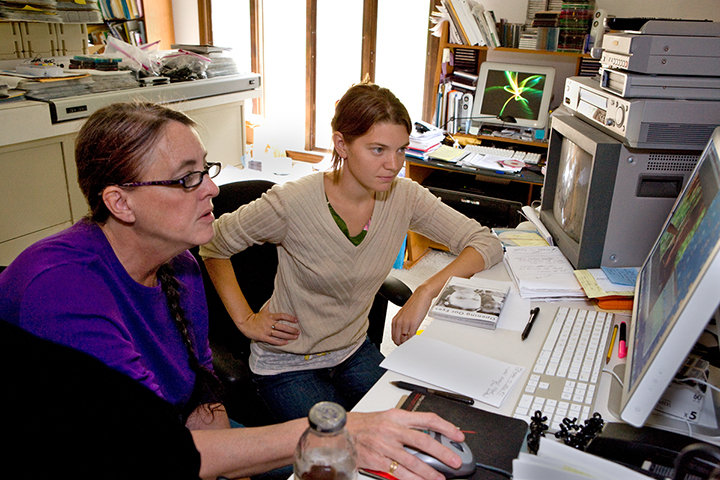
Gail in her "home office" - cluttered but productive.

I think it’s kind of a “hunter/gatherer” type thing where some men feel the need to head off to a “place of work” and if they don’t have that – they feel less “legitimate”.

This past winter one of my friends was having a particularly tough time making this transition and he was ready to pack it all in and get a “real” job. He called me because he knew that I’ve always worked from home, and he wanted to know how I dealt with it and stayed productive. We had a long and very honest conversation and he thanked me.

I saw him at a party this weekend and he came up to me, thanked me again and told me things were looking up for him. Quite honestly, I had forgotten the conversation but he reminded me of some things I said to him and suggested that I blog about it. So here goes.

Some tips and some things to avoid:

  • Start off by calling it your “home office” – not “working from home”. Somehow it’s different psychologically.
  • Be prepared for well meaning family and friends to encourage you to get a “real job”. This happens a lot with people who have creative careers. It’s hard, but you need to explain to your loved ones that what you do IS a real job. Just because you’ve had to lower your overhead and work from a home office, doesn’t mean that you’ve failed. It does mean that you’ve had to make adjustments just like a lot of others have had to do these days to make ends meet.
  • Avoid falling into the trap of taking care of personal tasks during your business hours. My friend found himself spending a lot of time on errands that his spouse asked him to do – “since he was home”. That’s fine once in awhile, but if you find yourself spending half your day doing personal stuff – you are sabotaging yourself and your business. And personal stuff includes putting together Aunt Ann’s birthday bash photos in a fun presentation for all to see. Sure do that – but not during business hours because this is not your hobby – it’s your business.
  • Don’t get overly complacent as soon as you get rid of the expense of your studio. I’ve seen this happen a lot. The pressure to make that overhead is gone so you let your guard down and along with that your clients start to disappear. But it’s because you’ve disappeared – you’re not marketing yourself anymore – and you’re off your clients’ radar.
    • • Have a routine just like you would if you walked out the door to go to work.
    • • Get up at a set time and get dressed – sounds simple but it’s important
    • • Have set work hours
    • • Have a plan – just because you’re in your home doesn’t mean you shouldn’t have a business plan with action items.
    • • Avoid distractions – tough one. If you find yourself doing something that a “boss” wouldn’t approve of – then stop yourself. You’re the boss so stop cheating yourself.
  • Network and connect with your peers and colleagues. This is important, especially in a creative business. You need to have people you can bounce things off of. I have a couple of friends in my life that I’m really grateful for because I know I can share my vulnerabilities and ideas with them without being judged. Friends can do that for you because they don’t have anything personally at stake and can look at things with unbiased eyes. These connections are critical when working from home. These days it’s easy to connect with others. If you can’t do a face-to-face – you’ve got hundreds of other options with social media, listservs or just pick up the phone.
  •  Remember on your darkest days when it seems like it’s hopeless and you’re ready to pack it in and get one of those “real jobs” – don’t totally abandon your dream just yet – leave the door cracked open at least. Maybe get a part time job to start. It will take some of the pressure off and if photography or music or writing or whatever – is your passion – then you’ll quickly find out that a “real job” may not be what makes you happy. The cynics may say that you shouldn’t expect happiness with a job and that the expectation of a job should be to just pay your bills. Maybe so, but do you want to spend most of your life being miserable or counting down the hours to your next vacation? Many times that part time job gives you the push you need to re-invigorate your business because you’ve had a taste of the alternative.
  • Don’t burn your bridges. If you’ve had even the slightest bit of success in the past, following your passions but are in a slump – don’t be so quick to announce to the world that you’re moving on to another career – unless you are thoroughly convinced that you will never have any regrets making that decision. You get the best light from a burning bridge – but it’s usually too late by then. If there’s one thing I’ve learned the hard way – it’s not to burn bridges – because life has a way of making you regret it.

Add to FacebookAdd to DiggAdd to Del.icio.usAdd to StumbleuponAdd to RedditAdd to BlinklistAdd to TwitterAdd to TechnoratiAdd to Yahoo BuzzAdd to Newsvine

Why Not?

I went to a great party this week in New York City.  But there was one conversation that needs to be purged from my head, so I’ll relay it here – and move on.

It was one of those bits of party small talk, when someone said to me “why are you such an optimist – you’re like a little kid?”  I answered him with the first thing that popped into my mind with “because I believe in myself”.  He laughed and said “well sooner or later, you’ll end up like the rest of us cynics”.

I replied with a question to him “Is it easier for you to wake up feeling defeated or hopeful?”  And then I moved on to talk to someone else.

This attitude seems to be more prevalent in big, pretentious cities where somehow it’s perceived “cool” to be a cynic.  Not sure why that is.  I’m not even sure why people seem to take some kind of pleasure in discouraging others by invalidating their dreams – as if they are somehow doing you a favor in showing you the folly of your ways.

This is not gender specific but sorry ladies – we’ve all tried to “change” our men – with good intentions of course. But that sort of thing never ends well because people need to be true to themselves and not live their lives to please others. You have to believe in yourself before you can expect others to believe in you.

It’s hard to be a dreamer.  Dreamers fail more times than they succeed.  But imagine a world without them – replaced by all the cynics that seem to take more pleasure in discouraging others rather than “shining them up”.

Hang out with the “why not?” crowd – not the folks who question “why?”

“In a world that keeps turning you down
Only the heart knows where the strength can be found”
Jackson Browne

Add to FacebookAdd to DiggAdd to Del.icio.usAdd to StumbleuponAdd to RedditAdd to BlinklistAdd to TwitterAdd to TechnoratiAdd to Yahoo BuzzAdd to Newsvine

Top Five Tips For Photographers Moving into Motion

The last post I wrote was titled The Top 5 Mistakes Photographers Making Moving From Stills to Motion.
Why is it anytime I use the word mistake in the title of a post, it goes viral?  Is it because we take comfort in knowing that other people make mistakes?  Or is it that we know we can learn from others’ mistakes?

I think it’s a bit of both.  But I also think that if one takes comfort in knowing potential pitfalls, then they may be more likely to take chances creatively and push their own limits.

In this post, I decided that I’d spin it in another direction – toward the positive – and dish out some tips for photographers moving into motion.

•    Understand where the new opportunities are. Don’t try to compete in traditional markets like broadcast spots right away.  Many new opportunities are with your still photography clients who you already have a relationship with.  They might be new to motion also and need to produce a video.  Ask.
•    Don’t do everything yourself.  You’ll need a good team.  Video has a lot of facets and you can’t do everything yourself, especially when you’re still learning. Find good audio people and editors you can work with.
•    Think differently – Shoot in sequences.  Think how you will get into and out of a shot when you’re shooting, putting the story together in your head.
•    Shoot and move  – Shoot a lot of b-roll.  Cover at least 3 angles on everything with a variety of focal lengths. Get wide, medium, tight and close-up shots.  You’ll be glad you did in the editing room.
•    Make a production schedule – And make sure you get your client to sign off after certain parts of the process – after the shoot – and throughout the edit.

Add to FacebookAdd to DiggAdd to Del.icio.usAdd to StumbleuponAdd to RedditAdd to BlinklistAdd to TwitterAdd to TechnoratiAdd to Yahoo BuzzAdd to Newsvine

Top 5 Mistakes Photographers Make Moving From Stills to Motion

1.    Give it away – One of the best opportunities that still photographers have when expanding their businesses with video is to offer their new services to their existing clients.  I hear from so many still photographers who squash this opportunity from the start by throwing in the video clips for free  because they are still learning.  First of all, I’m not a fan of learning on the job, but more importantly if you give your new skills away because you’re still learning, then the question is “At what point will you be good enough or have learned enough to charge for it?” Who decides that you or your client?
2.    Audio is an afterthought – Capturing good audio is more important than making a great  image.  If a viewer cannot understand the dialog, they will walk away.  Don’t make audio an afterthought.  Hire a good sound person.
3.    Position themselves as “just” a shooter – If you position yourself as just a camera person, then you will not only lose a lot of creative control, but you will leave money on the table by not making a profit on the other aspects of a video production.  I position myself as a producer.  That’s not to say that I don’t also shoot a job, but I oversee the entire production and charge accordingly for pulling together all the pieces.
4.    Don’t collaborate  – Get over the one man band, solo creature model and surround yourself with a crew of experts that will make you look good.  Build a team of editors, sound mixers, motion graphics artists etc.
5.    Forget about the story – Every good product, including commercial videos have a great story.  You can have the best production values in the world, but if you don’t tell a good story, it will not resonate with your audience or your client.

Add to FacebookAdd to DiggAdd to Del.icio.usAdd to StumbleuponAdd to RedditAdd to BlinklistAdd to TwitterAdd to TechnoratiAdd to Yahoo BuzzAdd to Newsvine

Change

Change Who likes change? Other than needing a change of scenery every now and then, change is usually tough to take. I grew up with change. My family moved 10 times before I got out of high school.

Kindergarten, Chicago, IL

I was always the “new kid”. (Hint: I’m in the second to last row. I was also the “tall kid” even in Kindergarten)

No, my dad wasn’t in the military and we weren’t on the lam – he was just climbing the corporate ladder. He’d get promoted or there would be a new sibling and we’d move to a bigger house or he’d get promoted and transferred and we’d move to a totally different place leaving our friends and familiarities behind.

I’m not complaining, nor saying that I feel slighted by having that constant change in my life. It was the life I knew and I suppose I always looked at it with open eyes and curiosity about what was next to come. Of course, if I thought about the friends and sometimes family that I was leaving behind, it made it much harder.

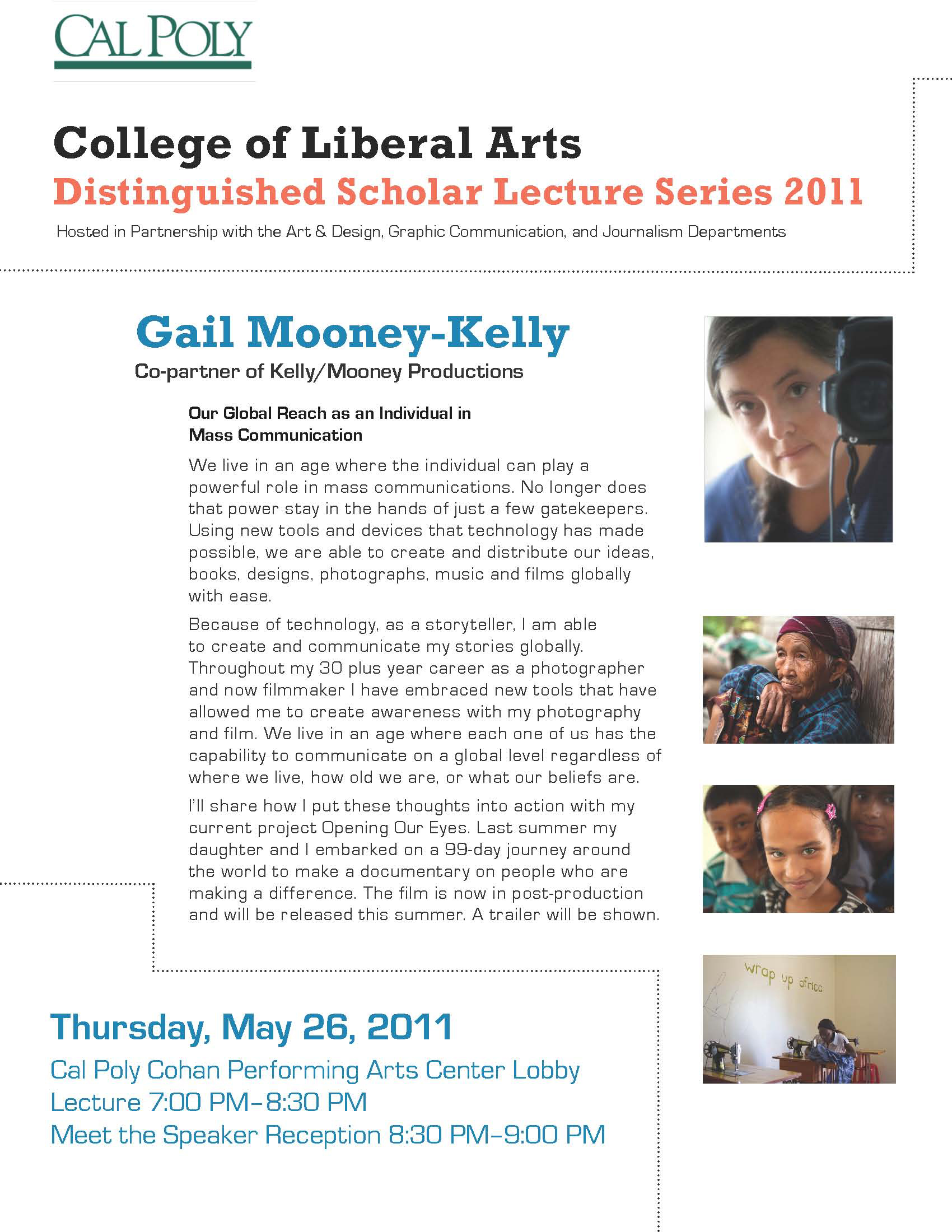
Perhaps growing up in a constant state of change made me more flexible in dealing with all the changes affecting my business these days. Both still photography and video production have been profoundly changed by a bad economy and technology. Kind of like a double whammy. At least with technology the sword cuts both ways and also provides opportunities. It’s usually during the tough times when the economy is bad when innovation happens. Sometimes people just have to be forced to make changes in their lives, even if what they have been doing hasn’t been working. I was asked to speak at Cal Poly on the theme The Role of Mass Communication and Media Technology in Today’s Global Economy: A Multidiscipline Approach. Specifically, they wanted me to talk about how I was using technology to communicate in a global market. I started thinking about how this past year I had vigorously embraced new tools and a new business model, integrated with the Internet and social media to create a mixed media project that will ultimately result in a feature film, a book, an e-book and maybe even an exhibition. I didn’t have a big team behind me, nor did I have a lot of money. We had a two-person crew- myself and my daughter, an editor and my husband working the PR, the social media and the back support. We raised some money on Kickstarter with the help of our backers and we’ve had musicians offer us their music and talents to our film. We are extremely grateful for all of the support worldwide and it could never have happened without advances in technology.

The fact is that we live in such an amazing time where something like this is even possible. It is a time of empowerment for the individual. Technology is democratizing and is leveling the playing field especially in terms of distribution. The locks are gone and the gates to distribution are open and affordable. Within a month of uploading the trailer to my film on Vimeo, it has been played in 95 countries – that’s almost ½ the countries in the world. What a staggering thought in terms of mass communication!

Going forward my ultimate plan at this point in time is to distribute the film through iTunes or Netflix and DVD’s through Amazon. More importantly, I would like to set up 100’s of screenings in communities all over America – maybe even all over the world – and use the film to move people to action. Kind of like a grass roots effort to motivate people to make a difference in their communities. Imagine what kind of an effect that would have if it spread virally through the world. Just Imagine.

Add to FacebookAdd to DiggAdd to Del.icio.usAdd to StumbleuponAdd to RedditAdd to BlinklistAdd to TwitterAdd to TechnoratiAdd to Yahoo BuzzAdd to Newsvine

Validation No Longer Necessary

There seems to be a prevailing attitude of doom and gloom. We have an economy that can’t seem to turn itself around and we’re bombarded by change that technology continues to thrust upon us.  We’re scared to death of the unknown and nobody seems to know what to do next and how to make any money doing it.

Yet, I’ve never been more hopeful in my life. Why?  Because I no longer need someone else to validate my ideas – and that is a powerful notion.  Those of us in the communication business seem to be particularly fearful. Some believe that the “news” business is dying because print publications – newspapers and magazines are folding every week.  But the “news” business is not dying – it’s just being delivered  in another way – electronically and globally.  There are no longer just a few gatekeepers with a lock on the playing field.

Human beings are social animals and we will always have the need to communicate with each other.  These days we can communicate with one another globally.  An idea or creation can be shared around the world in a matter of minutes.  Think of the power in that and think of how we can use that power and the opportunities it presents.  I could digress into a discussion on the ethics of this thought but I’d like to focus more on the reach and influence that each one of us has in creating awareness.

Many of us get enamored with the latest devices that enable us to deliver and receive information with speed and ease. As technology’s exponential growth continues to change our lives in every way imaginable, we will constantly be incorporating and upgrading new gadgets and devices as part of our lives.  We need to be mindful that these “toys” are merely enablers and that each one of us can use these tools to create and distribute our words, images, designs and ideas across the planet.

I think that we as creative’s or journalists underestimate ourselves sometimes.  Perhaps because we chose professions that aren’t lucrative – at least in terms of money.  However, what one is paid doesn’t necessarily correlate with one’s worth. We live in a time now where we can use our creative skills to really make a difference and to tell the stories that we feel need to be told. Mass communication has been democratized. We no longer need the traditional gatekeepers to validate our ideas.

I never would have dreamed that I would be able to circumvent the globe, create a documentary with only one other person in my crew  – my daughter and then distribute it internationally. I never imagined that I would have the power to create awareness on a global level like I did when I uploaded my trailer to Vimeo.  In a little more than a week’s time people in over 72 countries had played that video. Now in less than a month’s time, that trailer has been played in almost half the countries on the planet.  Staggering thought.

This was not a commissioned project by a network or a motion picture studio. If I had waited for that – it never would have happened. I assigned myself.  I was able to fund it by using my airline points, hotel rewards and doing trades with manufacturers for equipment.  I also successfully raised money via Kickstarter a crowd funding site  that made it possible for me to hire a professional editor. My daughter and I have been building an audience for our film since we started blogging about our journey. Our readers got more and more engaged as they followed us on our 99-day adventure around the world. They spread the word through Facebook and Twitter and via their own blogs and pretty soon word of our project spread virally. That was precisely our goal.  To use our tools and skills to create a film about the change makers of our world so that others would be inspired and motivated as to what they can do.

I often think about how things in my life and in history would have been different if we had the Internet when I was growing up.  For starters it would have had a huge effect on the Civil Rights Movement of the 60’s and the Vietnam War.  But everything happens in its own time and when it is meant to happen.  Change can be scary or it can be embraced and sometimes both at the same time.

Never stop dreaming. Never stop learning. Always listen to that inner voice.  Then use the means and the tools of the day to do the dance you are meant to do.

Add to FacebookAdd to DiggAdd to Del.icio.usAdd to StumbleuponAdd to RedditAdd to BlinklistAdd to TwitterAdd to TechnoratiAdd to Yahoo BuzzAdd to Newsvine

The Story and Hereafter

I recently watched the movie Hereafter, another film where Clint Eastwood shows his amazing creativity and ability to tell a story. It’s a film that lingers in your mind and keeps you thinking on many levels.

The official synopsis:

“A drama centered on three people who are haunted by mortality in different ways. George (Damon) is a blue-collar American who has a special connection to the afterlife. On the other side of the world, Marie (de France), a French journalist, has a near-death experience that shakes her reality. And when Marcus (Frankie/George McLaren), a London schoolboy, loses the person closest to him, he desperately needs answers. Each on a path in search of the truth, their lives will intersect, forever changed by what they believe might-or must-exist in the hereafter.”

It’s actually three stories that come together at the very end of the film. Eastwood and writer Peter Morgan (The Last King of Scotland. Frost/Nixon) were brilliant in the way they introduced us to the characters in one of the stories within the movie. We see two adolescent twin boys in a photo studio having their portrait taken.  The photographer is chatting them up, trying to get expressions out of them. We know within the first minute of dialog how vastly different the two boys are, even though they appear to be identical. A simple yet powerful way to set up the story for that particular part of the film.

The cinematography was extraordinary and a reason in itself to see the movie. In the beginning of the movie is some of the most vivid underwater cinematography I have ever seen as the camera captures the ravages of a tsunami.  The footage was vivid and real, yet poetic and surreal at the same time. It was also incredibly intimate. In fact throughout the entire movie I felt like I was inside the film or a part of it because of the intimacy of the cinematography.  I’d like to watch the film again and just try to look at it with my eye on the craft of cinematography.

As far as the story structure, it’s not easy to make a film that is made up of separate stories, yet connected in an organic way. Connected in a way that makes sense to the viewer and doesn’t feel forced. One great example of a film that does this well is Love Actually. Eastwood also pulls it off in Hereafter. He  is a master storyteller and he seamlessly brings us back and forth between the three stories leaving us wondering how at times how they are connected to one another yet not being distracted by it.

I’ve been reading a lot about storytelling and story structure lately and I can appreciate when I see it done well in a film or a book or even at a party.  I think sometimes we take the art of storytelling for granted because when it’s done well it goes unnoticed.  Go see Hereafter.  Clint Eastwood continues to amaze.

Add to FacebookAdd to DiggAdd to Del.icio.usAdd to StumbleuponAdd to RedditAdd to BlinklistAdd to TwitterAdd to TechnoratiAdd to Yahoo BuzzAdd to Newsvine

Commitment

I was stunned yet not surprised yesterday when I heard the tragic news that Tim Hetherington had been killed in Libya.  I’m grateful that I had seen Hetherington speak and present his work at Photo Plus in 2009. I remember being awed by the intimacy of his photographs and motion.  The viewer felt that they were right there in the action because Hetherington had been – and relayed that story to us.

We know about Hetherington and his work mostly because his documentary Restrepo had been nominated for an Oscar last year.  But how many other men and women who document the wars and the natural disasters, putting themselves in harms way on a daily basis, do we ever even hear about? That’s because it is not about them, it’s about what they are photographing or filming or writing about.  It’s about making others aware.

I once thought that I wanted to be a hard news photojournalist because there is a big part of me that loves to be where the action is.  But I also know that living that kind of life takes its toll especially on ones personal life.  I didn’t know if I could achieve the kind of balance in my life that I felt was important, pursuing that type of photography.  So I went the way of shooting more editorial feature pieces with a focus on people. I also thought that I might be the type of person who would become overly emotionally invested when on site and perhaps not able to fulfill my journalistic responsibilities.

I will always have the utmost respect and admiration for all the working journalists, photojournalists and video journalists out there who give us these incredibly intimate stories, risking their own safety over and over again. They do it for precious little financial reward.  They do it because good journalism is necessary for a healthy society. I’m forever grateful.