Pinetop Perkins – Still Singing the Blues at 96

Yesterday, July 7th as the world mourned Michael Jackson’s passing, another music legend, Pinetop Perkins turned 96 years old. Pinetop Perkins, King Biscuit Blues Festival, Helena, AR
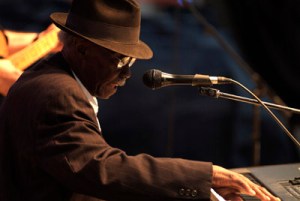
Pinetop Perkins is a legend in the world of “blues” music. He taught Ike Turner how to play piano during the 1940’s while working on Hopson’s Plantation in Clarksdale, MS. Pinetop still tours the world playing his boogie woogie style blues. Even at 96 years old – he’s still living his passion for the blues.

I met Pinetop in Mississippi in 2002 while there for his homecoming. I had recently embarked on one of my earliest video projects – a project about the Delta blues musicians and the part of the world that gave birth to that music.  http://tiny.cc/ntwso My approach was to shoot still environmental portraits of these musicians, but more importantly capture video interviews of them talking about their youth and the Delta.

Pinetop Perkins, Clarksdale, MS I spent the morning with Pinetop sitting on the front porch of an old shack on Hopson’s Plantation. The crowds from the party the day before had come and gone and it was just the two of us, having a conversation on a glorious October morning. It was memorable and I captured his stories which I hope will be heard by generations to come.

That day led to many other wonderful encounters over the years with Pinetop and even a trip to the Grammy’s when Pinetop was honored as a lifetime achievement recipient.
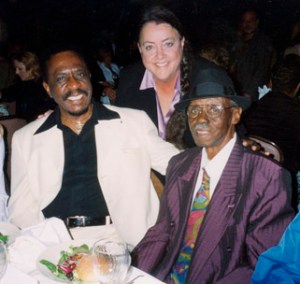
Pineop_Ike_Gail

Seven years ago when I asked him what the blues was, he replied “ Something worrying you so bad that you mights need to cry about it – you got the blues if you can’t sing em”. I try to remember those words when I’m down – and sing the blues to carry my troubles away.

Happy Birthday Pinetop.

Marketing Yourself with Video

Video can be a great way to market yourself and your business online. It has become easier and easier to upload or embed video to your website http://tiny.cc/Ymuj8 and your blog. In additon, video host sites like You Tube or Vimeo allow you to upload and share your videos and let you create your own TV channel. http://www.vimeo.com/kellymooney/videos You get the value of people sharing your video virally and referring others to it. You can also create a link back to your website or blog.

With that said, you want your video to call attention to your business and be consistent with your brand. It needs to be entertaining or informative and relevant to your target audience for it to be noticed and shared. The quality has to be decent enough to get your point across and if your business is a creative one like photography or video production, good quality is a must.

Your video can be about yourself, how you work and can show you in action. Photographer Chase Jarvis has a nice promotional video on his site. http://tiny.cc/NacGq And depending on your target audience – it can be instructional. The video should be short – less than 5 minutes and engaging. You want to make people remember you and come back to your website or blog.

With all the new tools like the latest iphone and the Flip, creating videos for blogs and emails has never been easier.

Utilizing the Tools – Convergence of Video and Photography

Every once in awhile I see a blog or a video that really strikes a chord. Today I saw a video that caught my attention for all the right reasons. It was a video that was produced by a photographer Alexx Henry demonstrating how he used technology in a new way to create a One Sheet, commonly referred to as a movie poster.

He had an idea to make the typically static movie poster, come to life with motion. His ultimate goal was to shoot the movie poster and have it appear like a still photograph in his customary style – but with the surprise of coming alive with motion. He chose as his tool the amazing HD video camera, THE RED. But first he needed to do some testing and to sell the idea to his client. For that he used the hybrid camera, the Canon 5D Mark II. He also needed to use hot lights. Because he was shooting motion, he couldn’t use flash. He chose to use HMI lights to get the same look and feel of the lighting style he brings to his still photographs.

Watch the video – it will give you more insight into his project. I loved his last statement. “A great photographer once told me that if you deliver exactly what a client expects, you aren’t doing your job”. He not only delivered the “surprise” he was looking for, but then some.

http://bit.ly/IFsje

Embracing Technology and Why

There’s a lot of talk these days about technology. Should I get a video camera or a hybrid camera? Should I twitter? Should I connect on Linkedin and Facebook? Should I upload videos to YouTube? Perhaps the question most people overlook is asking themselves why? And if they do ask themselves why – what kind of answers do they give themselves?

There is no one answer for everyone. But the worst way to try to answer those questions is to say because everyone else is. However, here are some possible answers to the question why?

Should I buy a video camera or the best video camera like the RED? Ask yourself if you want to target clients who are using more and more video. How are they using video – online? Broadcast? If the answer is online then perhaps the RED camera is a more expensive option than needed for something that will be output for online purposes. If your answer is broadcast then understand that those needs are high end and may require a high end camera. But don’t stop there. Ask yourself if you want to just be a shooter or do you want to play a bigger role in the production. Ask yourself if you are willing to devote the time necessary to learn these new skills of how to shoot motion. Ask yourself what are the markets that you want to work in. If you are leaning towards videojournalism, then perhaps the RED is not the camera for you. You may be better off with something more discreet.

Should I get a Facebook profile? Should I twitter? Should I use Linkedin? I’m a firm believer in utilizing all these platforms but only after you have come to an understanding of how and why. Each one of these platforms has the potential to either create awareness and strengthen your brand or do harm to your brand if you haven’t come to terms with who are you trying to target and why? Furthermore, you need to know that Facebook and Twitter are ways to give insight into your personality as opposed to Linkedin which is more of a professional networking platform. You should also realize that social media is all about sharing. So if your motives are to sell and promote in a direct way – it will be self defeating. Sharing builds trust. Sometimes that takes time. You need to be consistent and you need to be sincere. You need to be authentic. When you share and are sincere and are coming from a “right place”, good things will ultimately come from that.

Lastly, embrace technology because it enables you to go after opportunities. It levels the playing field. No longer do you need Hollywood budgets and big crews to tell a story in motion. No longer do you need the “gate keepers” to write the rules of who gets published and who doesn’t. Anything is possible because technology empowers all of us to fulfill our dreams. But you need to define your dream first. Only you can do that for yourself.

Story Telling

Now that I am producing both still imagery and video, I am trying to find the right word or title that I can call myself. I’m not just a photographer anymore, yet I really hate the word videographer. I’ve come up with a couple of words like “hybrid” and “visionographer” but still can’t quite find that right word.

And then I realized who I am. I’m a storyteller. I tell the story through visuals and sound and motion. Storyteller – a simple name for a person who has played that role since human beings began telling their story by painting on cave walls.

I love the story – beyond anything else – beyond the toys and the tools. It’s in my blood – it’s what has always motivated me and inspired. It’s why I became a photographer. It’s why I needed to learn video. Both were essential in telling my stories.

I must say that almost every magazine story I ever shot, what I loved most was connecting with people and listening to their stories. Perhaps I should have been a writer but I was more comfortable with my visual ideas and always felt a loss for the right words to express them.

When I think of all the movies that I’ve seen, the ones that really stay with me, have one thing in common – they tell a good story. A film can have all the special effects in the world but if it doesn’t have a good tale – it’s nothing beyond the packaging and fizz.

So the next time someone asks me what I do – I know what I will say – I’m a storyteller.

A Means To An End

I read this weekend about a memorial service for the late lindy hopper Frankie Manning. Frankie died last month – he was 94 years old. Frankie might have looked like his years but when he danced – he was 18 again.

I met and photographed Frankie Manning about 10 years ago when I was shooting a story about swing dancing for Smithsonian Magazine. I had pitched the story to Smithsonian at a time when “swing” had become the “thing” – once again. As much as I had a great time shooting the story, I kicked myself from time to time for pitching a story all about movement and sound to a print publication. But it got me thinking about video.

About the same time, technology was making a profound impact on video and specifically DV (digital video). I was hearing about how filmmakers and journalists were experimenting with video as an affordable means to approach their craft – without the need for huge crews and big Hollywood budgets. Then I read about the first DV symposium that was going to take place at the AFI (American Film Institute) in Los Angeles. I flew out to LA a month later to attend and it was a week that changed my world – my creative world that is. I listened to panel discussions, took workshops and learned about cameras and editing systems etc. It was a springboard for my mind and I started thinking of all the stories that I wanted to tell – that I could only tell – with a “motion” medium.

Ultimately, I got into video because it was the right medium to communicate certain messages. At that time video wasn’t the trend.  I didn’t feel  like I needed to learn it because everyone was doing it. For me it was the right tool for certain stories. It was a means to an end.

The “just” Word

I’m beginning to hate the “just” word. “Why does it take so long-it’s “just” a picture?” “We “just” need a 3 minute video for You Tube – my kid does them all the time”.

Technology has changed our lives and certainly my profession in many many ways – both good and not so good. It has enabled me to produce and shoot documentaries and get them seen globally, when 5 years ago that wasn’t possible.

Technology has also made the greater public think that creating content is “just” so easy – a kid can do it. Of course that is true because kids do it all the time – look at You Tube and dozens of other video hosts. While every now and then quality and skill doesn’t matter if the message or story is so strong that inferior quality hasn’t compromised them, most times the message doesn’t come out because of the poor quality.

But when a client doesn’t even think about the skill set a professional brings to a project because it is “just” so easy, even a kid can do it – it not only demeans the process – it can actually do a great disservice to their brand. Most times, they realize this but it’s too late.

I have started giving workshops to still photographers who are interested in adding video to their skill set. The ones who will benefit are the ones who realize that it’s not “just” buying another tool. But like anything else – they must cultivate and learn their craft because everything isn’t always “just” that easy.

I wish it was “just” that easy. I wish that I could take back the angst that “video issues” have presented to me over the last 10 years. I wish there was a switch that I could flip that could make me something I want to be without putting in the effort – but there isn’t. But when I hear that “just” word – I take a deep breath and tell myself – they “just” don’t get it.

The End of the Decisive Moment?

With the advent of the hybrid cameras from both Nikon and Canon, the future of photography will no doubt be rewritten.

Sports photography will change dramatically. Will these cameras be banned from future Olympic venues for fear that still photographers will be shooting video? Networks like NBC pay big money for ALL broadcast (video) rights. So what happens when a still photographer is shooting video under the guise or disguise of a camera that looks like a still camera?

My guess is that in the future, the TV guys shooting with high end digital video cameras will ultimately produce still images as a by-product. Why depend on photographers capturing the “decisive moment” when a buyer can scroll through the video files and pick that perfect frame?

Trigger Finger

One tip I give to still photographers who segway into video is “don’t shoot like a still photographer”. By that I mean don’t fall into the trap of turning off the camera too soon – let it run. Still photgraphers shoot moments in time – video shooters shoot time in motion.

I had a still photographic assignment a few years back to shoot a story on the LL Bean’s workshops. LL Bean gives skeet shooting lessons and fly fishing lessons etc. I set out to cover a group who would be learning the basic techniques of how to shoot skeet targets with a shotgun. I got to the location early and had some time to kill – no pun intended. The instructor asked me if I wanted to give it a try. Now I’m a person who had never even seen a gun up close, let alone shot one – so I declined. But after about 10 minutes of gentle coaxing, I said yes.

The instructor gave me safety tips on handling a firearm and then I was ready to try my hand at shooting the clay targets. He pulled – I aimed – and shot the target dead on. We both laughed and he said – beginners luck. He told me to give it another try. He pulled – I aimed and I shot it dead on again. After the third try with the same results – he looked at me and said that he thought I had been kidding him when I told him that I had never picked up a gun before. Then it occurred to me that I’ve been aiming and shooting “targets” my entire career as a still photographer. It had become a natural instinct.

So when I teach still photographers how NOT to shoot video like a still photographer, my biggest challenge is to help them overcome this learned instinct of shooting “moments”. It’s a tough instinct to break but stop yourself and let the camera roll on.

Creating Memories

I’ve just returned from a shoot in Mackinac Island, Michigan. For those of you not familiar with the island – it’s like a step back in time with no cars and very limited cell phone service.

The purpose of my trip was two fold – to attend a conference of a trade association I belong to, The Society of American Travel Writers and to shoot video of the island and the magnificent Grand Hotel.

The Grand Hotel is a historic landmark living up to its name. It’s family owned and operated and I had the pleasure of interviewing one of the owners, Danny Musser. He said something in the interview that really resonated with me. He said that they weren’t in the business of selling lodging and meals but of creating memories. And that they do – every little detail is a cinematic experience.

I thought about that philosophy – creating memories – and realized that this is essentially my goal as well when I shoot stills or video. My intent is to capture the essence of one’s experience, whether it be a travel experience or a documentation of a personal event.

So I need to remind myself that behind the technology is the visual message. Behind the beautiful shots and the attention to detail is the “message” or the “memory” captured. I’d like to think that what I capture today will ultimately be archived and “create memories”.