Working With a Professional Editor

I know how to edit. Well, I should say I know Final Cut Pro. Knowing how to use a particular software and knowing how to edit – to tell the story, are two different things. Just like taking a photograph skillfully is more than just knowing how to use a camera.

I have done a relatively decent job editing projects in the past, but nothing has ever been longer than a half hour in length. Nothing has ever been as demanding as what I have been working on over this past year and a half.

After traveling around the world last summer, on a 99-day adventure, shooting a feature length film about people who are making a difference, with just a slim crew (myself and my daughter), and an even slimmer budget, financed with airline miles and hotel rewards, I returned with over 150 hours of footage and 5000 still images.

After a bleak winter of endless days of trying to make sense and order of all my content, I managed to get a very rough storyline down with interview sound bites and do a first cut on the b-roll. But there was a long way to go to get this looking like the film that I imagined in my head. I knew I wanted to work with a professional editor who would not only help me, but also would bring their own vision and craft to the film and most importantly “move the story”.

I’ve been working with Erik Freeland, from Springhouse Films over the past few months and I am simply in awe of what he has brought to the film. I’ve learned so much by collaborating with Erik. Not, little tips and shortcuts in terms of Final Cut but how to tell a story cinematically. I’m beginning to learn about the craft of editing and how the nuances of timing and juxtaposition of clips and interviews can move the story forward – or not.

As a shooter, I’m paying attention to movement in a scene and following the action. An editor looks for just the right part of the action in the clip – and how that clip will juxtapose with another clip. Not only the timing of the action within the clip is important, but also the timing of the duration of the clip itself is critical to the pacing of the film.

Timing is everything in editing – it’s almost like making a musical composition timing and pacing the highs and the lows of the story. In fact a big part of the editing process is integrating the music, adding yet another dimension to weave the viewer in and out of the story. Music is the heart of a film, the emotional backbone. Without music – the film has no heart.

So in a way, a good editor is a mixture between a technician, a storyteller and someone who has rhythm. An interesting combination for sure. It’s been a wonderful experience collaborating with my editor, Erik and I think what has made it work so well is that we have respect for what each other has brought to this project. We have both learned and grown along the way and pushed ourselves creatively. What more can you hope for? That’s the beauty of collaboration.

Add to FacebookAdd to DiggAdd to Del.icio.usAdd to StumbleuponAdd to RedditAdd to BlinklistAdd to TwitterAdd to TechnoratiAdd to Yahoo BuzzAdd to Newsvine

A Year Ago Today – The Beginning of Our Documentary and the DSLR

It was exactly a year ago today that I left with my daughter on a 99-day journey around the world to create a documentary about people on six continents who were making a difference in the world. I was not new to video or documentaries, having shot motion for over twelve years and completing three short films.  But this was big – not in the sense of “big production” or “big crew” or certainly not “big budget” – it wasn’t any of those things but it was indeed BIG.

I had no idea how big it turned out to be.  The trip in itself was almost the easy part, although don’t get me wrong – it was arduous on every level.  What was overwhelming was taking the project from idea to completion.  Had I known how overwhelming it has been at times, I may have reconsidered – or at the very least had a bigger crew.

The crew was my daughter and myself.  I shot video. She shot stills.  She interviewed the subjects and ran sound.  I operated the camera and shot B-Roll.  She research, scheduled and pre-interviewed the subjects and I worked on all the logistics – travel, travel needs and gear.  I thought about gear long and hard and decided to go with the hybrid cameras, in my case the Canon 5D Mark II and the Canon 7D.  I wanted to capture both stills and video, but I didn’t want to bring two separate camera systems, so I chose the hybrids. I have written a lot about the gear but the all time most popular post I wrote was about my gear for this 99-day journey.

We returned in September with over 150 hours of footage and over 5000 still images.  Wow!  Talk about overwhelming. I spent 2 solid months of my winter getting the footage into a manageable rough timeline – or at least the sound bites. I handed it off to my editor Erik Freeland of Springhouse Films and he hopes to get me his rough cut this weekend.  I’ve had many conversations with Erik over the past month or so about the story(s) and the arc of the film and he truly understands how to tell a story.  I am extremely grateful that I was able to hire a professional editor and it never would have been possible, without my successful run with Kickstarter.

I have been working a lot in the back scenes with distribution options and I am thrilled with what I am finding.  This is the time for “the documentary”.  It’s possible with small budgets and crews to make a powerful film that can be seen in hundreds of various venues well past the big screen movie houses and film festivals.  It’s an amazing time for “the individual” and what can be accomplished because of technology. That’s another blog for another time though.

I’m headed to California this afternoon to speak at Cal Poly tomorrow evening. Join me if you’re in the area.  For old time’s sake, I took my Eagle Creek bag  – which I had circumvented the globe with.  It seemed like the right thing to do.

Add to FacebookAdd to DiggAdd to Del.icio.usAdd to StumbleuponAdd to RedditAdd to BlinklistAdd to TwitterAdd to TechnoratiAdd to Yahoo BuzzAdd to Newsvine

The “Real” Cost of Shooting Video With the DSLR

There was an interesting thread on  ASMP’s video listservlast week. It started when a still photographer asked if a particular

My DSLR Gear

DSLR camera would help him get into the game  – of video.

Jan Allklier, a Seattle based photographer, shooting both stills and motion summed it up:

“If you simply want to ‘explore the medium’ a hybrid DSLR may well be the right ROI, although it really will only give you a flavor for moving images, not the workflow of professional moving image production, which encompasses a wide range all the way from feature film, to corporate work, to webisodes for small business; and many tools and skills well beyond the image capture device at hand.”

Kevin Kamin, Minneapolis based shooter, reminds us that it’s not just about the camera (or tool), but about the story:

“I understand why some photographers are looking to expand into video, it’s definitely doable, but I believe there is a tremendous underestimation of what  is required to do so. I feel like video is being perceived as simply moving photographs-95% of the videos I’ve seen on commercial photographer’s website are not at a professional level (most feel like overly long, clunky, rough cuts that lack sophistication and a clarity of message). They say that ‘people who are good with a hammer tend to think everything is a nail’ So along that idea, many 
of the videos feel like videos made by photographers, who haven’t fully grasped the spirit of the medium. People can enjoy a still photograph for a minute or 
two, if it is compelling and engaging, but if you have three seconds of video footage that doesn’t move the story or lingers 15 frames too long, you just lost your viewer no matter how pretty it looks. Photography functions differently 
within time based media. 
 Storytelling is the core of video. “

And Chuck Fadely, of the Miami Herald, connects the dots for us, first by passing along a link to Shane Hurlbut Visuals blog that lists the “standard” movie making rental gear for DSLR video. More importantly, Chuck  reminds us that shooting motion is a skill set.  It’s a different way of seeing and shooting.

“The hardest thing about video for a still photographer is learning to shoot in a totally different way. You’ve got to learn to shoot in sequences, with transitions. It takes years to overcome the habits you’ve built up as a still photog — like reframing, adjusting exposure, following action — which are death in video. 

I was a news and feature photog with several decades of experience, with extensive lighting skills, good technical ability, and a knack for learning new stuff. I switched over to video full time and it was shocking how little transferred over. Video is a different beast.”

This was one of the easiest blog posts that I’ve ever written and maybe the most beneficial for readers.  It brings up another important point and that is how much we can learn from each other.  When I started shooting motion back in the mid ‘90’s – there really weren’t any listservs or social media forums where my peers were so forthcoming with information.

When people ask me why I’m so giving and sharing with my knowledge, I always tell them that I get back so much more than I give. What a great time to be alive.

Add to FacebookAdd to DiggAdd to Del.icio.usAdd to StumbleuponAdd to RedditAdd to BlinklistAdd to TwitterAdd to TechnoratiAdd to Yahoo BuzzAdd to Newsvine

Avoiding the Pitfalls When Working from Home

A lot of my photographer friends have closed their studios this year, due to a lousy economy and changes with the type of work they do. They’ve set up offices in their home and some have faired better than others. It seems like this transition is a lot harder for some of my male friends than my female friends.

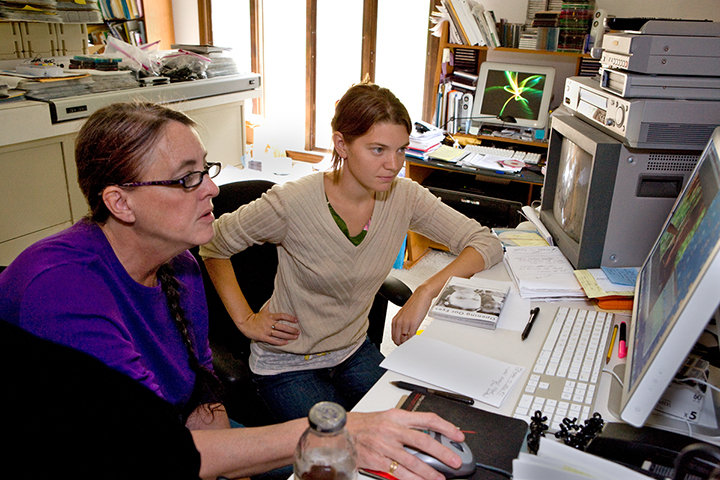
Gail in her "home office" - cluttered but productive.

I think it’s kind of a “hunter/gatherer” type thing where some men feel the need to head off to a “place of work” and if they don’t have that – they feel less “legitimate”.

This past winter one of my friends was having a particularly tough time making this transition and he was ready to pack it all in and get a “real” job. He called me because he knew that I’ve always worked from home, and he wanted to know how I dealt with it and stayed productive. We had a long and very honest conversation and he thanked me.

I saw him at a party this weekend and he came up to me, thanked me again and told me things were looking up for him. Quite honestly, I had forgotten the conversation but he reminded me of some things I said to him and suggested that I blog about it. So here goes.

Some tips and some things to avoid:

  • Start off by calling it your “home office” – not “working from home”. Somehow it’s different psychologically.
  • Be prepared for well meaning family and friends to encourage you to get a “real job”. This happens a lot with people who have creative careers. It’s hard, but you need to explain to your loved ones that what you do IS a real job. Just because you’ve had to lower your overhead and work from a home office, doesn’t mean that you’ve failed. It does mean that you’ve had to make adjustments just like a lot of others have had to do these days to make ends meet.
  • Avoid falling into the trap of taking care of personal tasks during your business hours. My friend found himself spending a lot of time on errands that his spouse asked him to do – “since he was home”. That’s fine once in awhile, but if you find yourself spending half your day doing personal stuff – you are sabotaging yourself and your business. And personal stuff includes putting together Aunt Ann’s birthday bash photos in a fun presentation for all to see. Sure do that – but not during business hours because this is not your hobby – it’s your business.
  • Don’t get overly complacent as soon as you get rid of the expense of your studio. I’ve seen this happen a lot. The pressure to make that overhead is gone so you let your guard down and along with that your clients start to disappear. But it’s because you’ve disappeared – you’re not marketing yourself anymore – and you’re off your clients’ radar.
    • • Have a routine just like you would if you walked out the door to go to work.
    • • Get up at a set time and get dressed – sounds simple but it’s important
    • • Have set work hours
    • • Have a plan – just because you’re in your home doesn’t mean you shouldn’t have a business plan with action items.
    • • Avoid distractions – tough one. If you find yourself doing something that a “boss” wouldn’t approve of – then stop yourself. You’re the boss so stop cheating yourself.
  • Network and connect with your peers and colleagues. This is important, especially in a creative business. You need to have people you can bounce things off of. I have a couple of friends in my life that I’m really grateful for because I know I can share my vulnerabilities and ideas with them without being judged. Friends can do that for you because they don’t have anything personally at stake and can look at things with unbiased eyes. These connections are critical when working from home. These days it’s easy to connect with others. If you can’t do a face-to-face – you’ve got hundreds of other options with social media, listservs or just pick up the phone.
  •  Remember on your darkest days when it seems like it’s hopeless and you’re ready to pack it in and get one of those “real jobs” – don’t totally abandon your dream just yet – leave the door cracked open at least. Maybe get a part time job to start. It will take some of the pressure off and if photography or music or writing or whatever – is your passion – then you’ll quickly find out that a “real job” may not be what makes you happy. The cynics may say that you shouldn’t expect happiness with a job and that the expectation of a job should be to just pay your bills. Maybe so, but do you want to spend most of your life being miserable or counting down the hours to your next vacation? Many times that part time job gives you the push you need to re-invigorate your business because you’ve had a taste of the alternative.
  • Don’t burn your bridges. If you’ve had even the slightest bit of success in the past, following your passions but are in a slump – don’t be so quick to announce to the world that you’re moving on to another career – unless you are thoroughly convinced that you will never have any regrets making that decision. You get the best light from a burning bridge – but it’s usually too late by then. If there’s one thing I’ve learned the hard way – it’s not to burn bridges – because life has a way of making you regret it.

Add to FacebookAdd to DiggAdd to Del.icio.usAdd to StumbleuponAdd to RedditAdd to BlinklistAdd to TwitterAdd to TechnoratiAdd to Yahoo BuzzAdd to Newsvine

Top Five Tips For Photographers Moving into Motion

The last post I wrote was titled The Top 5 Mistakes Photographers Making Moving From Stills to Motion.
Why is it anytime I use the word mistake in the title of a post, it goes viral?  Is it because we take comfort in knowing that other people make mistakes?  Or is it that we know we can learn from others’ mistakes?

I think it’s a bit of both.  But I also think that if one takes comfort in knowing potential pitfalls, then they may be more likely to take chances creatively and push their own limits.

In this post, I decided that I’d spin it in another direction – toward the positive – and dish out some tips for photographers moving into motion.

•    Understand where the new opportunities are. Don’t try to compete in traditional markets like broadcast spots right away.  Many new opportunities are with your still photography clients who you already have a relationship with.  They might be new to motion also and need to produce a video.  Ask.
•    Don’t do everything yourself.  You’ll need a good team.  Video has a lot of facets and you can’t do everything yourself, especially when you’re still learning. Find good audio people and editors you can work with.
•    Think differently – Shoot in sequences.  Think how you will get into and out of a shot when you’re shooting, putting the story together in your head.
•    Shoot and move  – Shoot a lot of b-roll.  Cover at least 3 angles on everything with a variety of focal lengths. Get wide, medium, tight and close-up shots.  You’ll be glad you did in the editing room.
•    Make a production schedule – And make sure you get your client to sign off after certain parts of the process – after the shoot – and throughout the edit.

Add to FacebookAdd to DiggAdd to Del.icio.usAdd to StumbleuponAdd to RedditAdd to BlinklistAdd to TwitterAdd to TechnoratiAdd to Yahoo BuzzAdd to Newsvine

Top 5 Mistakes Photographers Make Moving From Stills to Motion

1.    Give it away – One of the best opportunities that still photographers have when expanding their businesses with video is to offer their new services to their existing clients.  I hear from so many still photographers who squash this opportunity from the start by throwing in the video clips for free  because they are still learning.  First of all, I’m not a fan of learning on the job, but more importantly if you give your new skills away because you’re still learning, then the question is “At what point will you be good enough or have learned enough to charge for it?” Who decides that you or your client?
2.    Audio is an afterthought – Capturing good audio is more important than making a great  image.  If a viewer cannot understand the dialog, they will walk away.  Don’t make audio an afterthought.  Hire a good sound person.
3.    Position themselves as “just” a shooter – If you position yourself as just a camera person, then you will not only lose a lot of creative control, but you will leave money on the table by not making a profit on the other aspects of a video production.  I position myself as a producer.  That’s not to say that I don’t also shoot a job, but I oversee the entire production and charge accordingly for pulling together all the pieces.
4.    Don’t collaborate  – Get over the one man band, solo creature model and surround yourself with a crew of experts that will make you look good.  Build a team of editors, sound mixers, motion graphics artists etc.
5.    Forget about the story – Every good product, including commercial videos have a great story.  You can have the best production values in the world, but if you don’t tell a good story, it will not resonate with your audience or your client.

Add to FacebookAdd to DiggAdd to Del.icio.usAdd to StumbleuponAdd to RedditAdd to BlinklistAdd to TwitterAdd to TechnoratiAdd to Yahoo BuzzAdd to Newsvine

Snapshots With Words

Many of you have probably heard me say “still images are moments in time” and “video is time in motion”.  I think and I shoot differently in each of these mediums.

It is kind of like the difference between poetry (or the lyrics of a song) and prose.  In a poem, just as with the lyrics of a song, each word must “say” a whole lot just like a still photograph must convey everything in that one moment in time.  When writing prose you have all those other words to connect your thoughts. To be honest, I never took any writing courses in college and I did not find myself reading books of poetry in my off time.  But I did listen to a lot of music back then – still do – and there’s not a lot of difference between the lyrics of a well-crafted song and those in a poem.

When I was traveling last summer, I found myself mentally capturing images in my head as we went from destination to destination.  I started to type out these random thoughts on my blackberry and because of the nature of that device and the tiny keys, I typed out my thoughts in abbreviated fashion. My intent was never to share these thoughts with anyone, let alone pretend that I could write poetry, but I did share some of them, reluctantly and with trepidation, “testing the waters” so to speak.  I felt like I was standing on the edge of a dock and dipping my toe into the water while a friend egged me on and encouraged me to jump in.

I’ve continued writing my snapshots with words but I’ve become a bit more self-conscious these days with sharing these thoughts.  Perhaps I’ve become more guarded or maybe just too self-conscious to share.  I suppose that’s ok because what is most important is that I don’t let my own inhibitors and doubts stop me from writing.  When I first started writing down these words or poems or whatever label you want to put on them, perhaps I needed to share them with someone else. I needed to test the waters and when I did I got the necessary encouragement to jump in.

These days I try not to define myself too rigidly as to who or what I am by definitions and labels like photographer, filmmaker, writer or poet.  Ultimately, I use whatever tool works best to express the thoughts and stories that run through my mind. I continue to stick my toe into unfamiliar water and every now and then I get brave enough to jump in thanks to a little encouragement from my friends. I think we all need that in our lives – someone who we know we can bounce ideas off of without the fear of ridicule. As one of the subjects in my documentary beautifully stated “we’ve got to shine each other up”.

FaceTweet it!

Some Useful Information for Workflow

I made a few new discoveries this past week.  Forgive me if these items aren’t new but they’re new to me.

One item I discovered was Drop Box and the timing was perfect.  Drop Box is a sharing and storage site.  I can upload files and documents to their server and share those files with anyone who has Drop Box installed on their computer. For instance, I am able to share project files and updates with the editor that I am working with on Opening Our Eyes.  This past week, I was working on a new trailer for my film and I was able to share that updated project file with him, along with the RF music that I licensed for it.

The other thing that I love about Drop Box is that I can share files and info with the various computers that I work on.  No more emailing docs or copying media to a DVD so that I can transfer files over to my laptop.  With Drop Box installed, I can share files, media and calendars with any and all of my computers.  As a bonus, Drop Box acts as an off site storage solution as well.

My other discovery was a royalty free music site called Neosounds. I’ve been searching through hundreds of royalty free music libraries over the years and Neosounds is definitely the best source for high quality music that I’ve found.  It stands out amongst the rest because their music doesn’t sound like royalty free music.  Recently, I needed  music for a new trailer that I was making for OOE and I was googling around for some cinematic sounds. I found the perfect background music for my film’s trailer.  I’m still tweaking the trailer a bit, but you can listen to a clip of music from Neosounds that I used in a short video I made that appeared on a recent blog post.

One last item that I’ll mention is a great source for travel guides – the unconventional type. They are called Unconventional Guides and are brought to you by Chris Guillebeau. Since discovering Chris Guillebeau’s blog The Art of Non-Conformity, I’ve become a huge fan of Chris and his writings.  If you haven’t discovered Chris’s blog , then do so. He has an amazing outlook on life and he articulates his thoughts  so beautifully in his blog.  His global view of the world and how to live life is truly an inspiration to me.  He’s definitely, a kindred spirit.

Back to tweaking.  Stay tuned for my next blog with links to some new samples.

Add to FacebookAdd to DiggAdd to Del.icio.usAdd to StumbleuponAdd to RedditAdd to BlinklistAdd to TwitterAdd to TechnoratiAdd to Yahoo BuzzAdd to Newsvine

Open Yourself to Possibilities

Thank goodness February is over. It’s been a long, cold, snowy winter here in New Jersey and February felt particularly brutal.  I can cope with cold weather pretty well but “cabin fever” can be deadly for me. And last month it almost killed me.  I had been in isolation editing video for 14 hours a day – every day. It was almost inhuman.

This weekend I headed down to Philadelphia to present a seminar at

©Douglas Bovitt

ASMP’s SB3.  It was just what I needed.  I needed to connect with people.  Conferences like SB3 are meant for stimulation and learning and everyone walks away with their heads exploding with new ideas – attendee and presenter alike.  But I walk away with so much more. What I get from interacting with people, learning from them, sharing with them is immeasurable.

Some things that stuck with me:

“Be awesome” Colleen Wainwright

“Hang out with people better than you” Blake Discher

And from Tom Kennedy
F.A.I.T.H

Freedom – to see – to be open to opportunities
Authenticity – be yourself
Intentionality – live intentionally – be proactive
Trust – in yourself
Hospitality – be open to the world

And I learned about a blog that truly resonates with me The Art of Non-Conformity
As all the conversations still run through my mind, I remember one in particular.  I was speaking with someone who had taken his own path – traveling a lot before going to college and pursuing other passions in life before settling down on a career.  He wanted to know if I would mentor him but he had so many questions, he was concerned he would infringe too much on my time. I smiled and told him that I was quite accessible and to feel free to call anytime. And that I’d let him know if he was wearing out his welcome He smiled back and said, “you have a hard time saying no don’t you?” My answer to him was “yes” and that I liked that word much more.  It opens up so many more possibilities.

If you haven’t attended on of the three SB3 events – there’s still one more in Chicago April 1- 3.  Check out what people are saying on Facebook. And then come and join us in Chicago and prepared for lots of “ah ha” moments. It could be life changing.  You just never know.

Add to FacebookAdd to DiggAdd to Del.icio.usAdd to StumbleuponAdd to RedditAdd to BlinklistAdd to TwitterAdd to TechnoratiAdd to Yahoo BuzzAdd to Newsvine

Monday Morning Quarterbacking

Ok, I’m just going to come right out and say it.  I was one of the few people in America who did NOT watch the Super Bowl yesterday.  Before you try to enlighten me as to the merits of the game and sentence me to watch NFL highlights, let me just say I don’t like football.  Just never got into the touchy feeliness of the sport. And besides, I’m still chained to my editing station – finally starting to see light at the end of the tunnel.

But this morning I couldn’t escape the pundits grading and scoring the Super Bowl commercials as I clicked through the morning programs looking for the “news”.  It was interesting to hear their “take” on what commercials were successful.  Most of the pundits made their assessments through the eyes of their “ad men” (and women) persona, debating which commercials caught the attention of the viewers.

One “expert” frequently commented, “now this one had people telling their friends – be quiet – I want to hear the commercial.  I’m not quite sure what Super Bowl party this person went to, but no doubt it was a party made up of other advertising folks. Now, I’ve had very limited experience attending Super Bowl parties, but as for the ones I have been to – nobody has ever said “be quiet – so I can hear the commercial”.  With that said, as I watched many of the spots this morning via YouTube, some of the most effective commercials required no listening at all. Check out this one for Bridgestone.

I guess the creatives who made this spot go to the same kind of parties as I do –  parties where people don’t ask someone to turn the volume up for the commercials.  Actually, I’ve learned a lot about editing by watching TV commercials with the sound off.  The “story” either becomes apparent – or not.

The New York Times did a pretty good critique of the ads this morning. But what I found most interesting was the running commentary from the “average Joes” via Twitter and Facebook.  No doubt some of these advertising experts were paying as much attention to the social media chatter this morning as Mumbarak’s men were. Hands down, the Chrysler “Detroit” spot won the most hearts – mine included. It drew me in from the start and kept me the entire two minutes.  Imagine that – a two minute commercial! When was the last time you saw that?  A beautiful mini-film told in credible brevity. Quite frankly, to me it would have been just as effective without Eminem or any celebrity for that matter. It evoked emotion – that’s what kept me watching.

At the end of the day, the commercials that resonated most with just about everyone – pundit and laymen alike were the ones that told a simple story that rang true with the human spirit.  Works every time.  To tell those stories, one needs to get out of the meeting rooms and late nights at the office and spend more time living life. Otherwise, what you end up with is a bunch of people creating commercials about what they think life is like.

Add to FacebookAdd to DiggAdd to Del.icio.usAdd to StumbleuponAdd to RedditAdd to BlinklistAdd to TwitterAdd to TechnoratiAdd to Yahoo BuzzAdd to Newsvine